Conference Keynote That’s a Terrific Middle Level 101

When walking in the woods, sunshine can illuminate a path that has been taken by others, making a journey a bit easier, and offering the opportunity for you to discover what they had discovered. Let’s shed a little light on those who created the Middle Level paths for us. Now is the time to reawaken, enliven, and celebrate early lessons from Middle Level Education.

Summary:

10-14 Year olds can be mysterious creatures. But those who have gone before us can help see the path to reaching these students.

Watch the video here!

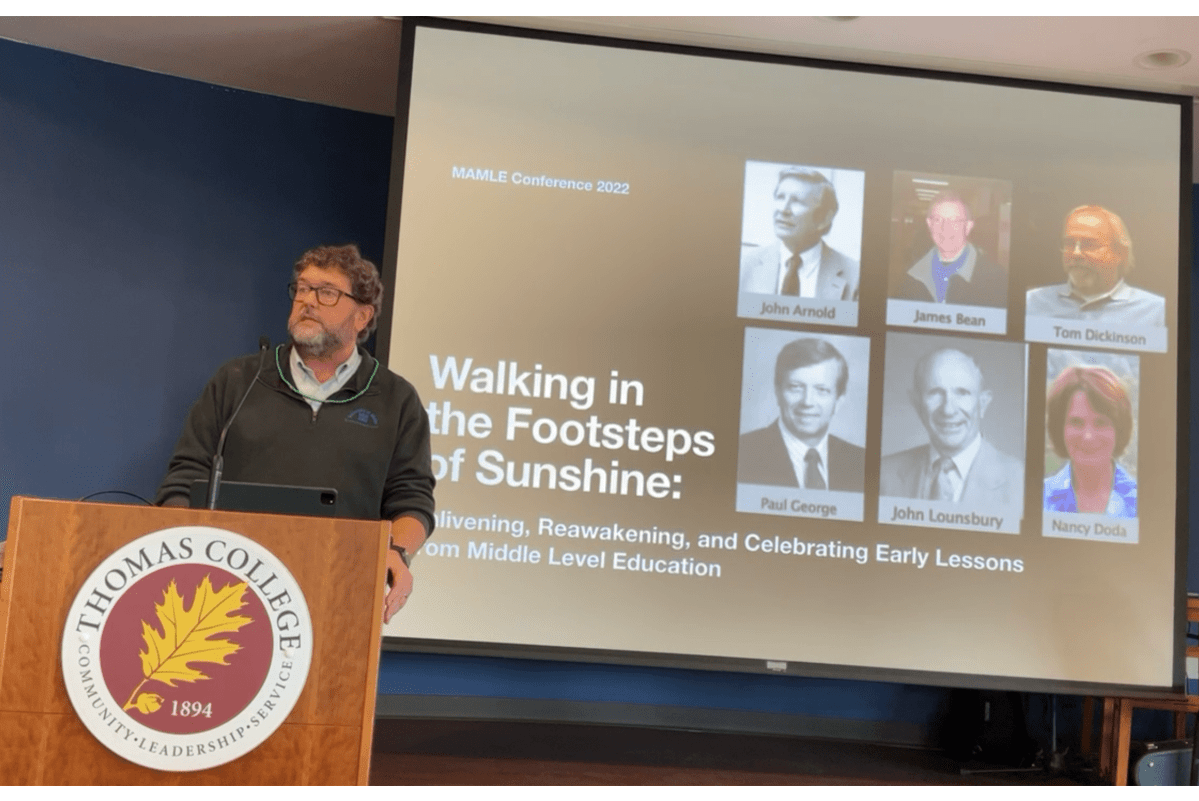
Walking in the Footsteps of Sunshine – A keynote on the Founders and Foundations of Middle Level Education

When walking in the woods, sunshine can illuminate a path that has been taken by others, making a journey a bit easier, and offering the opportunity for you to discover what they had discovered. Let’s shed a little light on those who created the Middle Level paths for us. Now is the time to reawaken, enliven, and celebrate early lessons from Middle Level Education.

Presented at the MAMLE Conference, Oct. 7, 2022, at Thomas College.

Learn About

  • The story of Middle Level Education
  • Some of the founders of middle level education
  • The developmental characteristics of young adolescents
  • Practices that are harmonious with those characteristics
  • The impact of those practices on young adolescents
  • The detractors getting in the way of middle level education
  • What our charge, as middle level educators, is now

Related:

New Year’s Learning Resolution – Great Way to Engage Teachers

How might I find a way to reach more of my teachers? A colleague in another district has come up with a New Year’s Resolution professional learning program with personalized, bite-sized, monthly professional learning around topics like the 4Cs of 21st Century Learning, student reflection, formative assessment, and podcasts as professional learning. And now I’m thinking about how to apply a version to the educators in my district!

One of the things that has weighed on me with the new Tech Director position in Bethel is trying to figure out how to support all our staff (K-12) with coaching, professional learning, and support for learning through technology.

Much of my time this year has been taken with working with Michelle and James, our two technicians, to take over the work of Everything Just Works, especially the pieces the previous tech director did himself. The teachers in the district have not had a tech integrator to date, despite having had 1to1 devices for their students for years. They are thirsty for learning more about how to leverage their technology in the classroom.

And I’m thirsty to start working with them more directly, and am just about at the point where I can start getting into classrooms, and inviting teachers to work with me. But I worry about having a broader reach. Granted, we’re a small district (about 750 students K-12, and about 80 classroom teachers), but I still manage all the tech and tech projects in the district and manage the Tech Team, so I’m guessing I have a little more than half time to work as a tech integrator.

The question on my mind has been, “How can I reach more teachers across the district than simply collaborating with a handful?”

Saco’s New Year’s Resolution Professional Learning OpportunityThen my colleague, Alice Lee, who is doing graduate work in learning through technology, shared with me a professional learning opportunity one of her classmates had created. Wendy Cannon is a PreK-2 Technology Coach in the Saco Schools (ME). She created the New Year’s Resolution PD Website for her teachers, with the message: “As we begin the new year, let’s commit to learning together!” (PLEASE NOTE: There is a RSVP link on the home page, but the New Year’s Resolution is only open to teachers from Saco.)

Wendy has created a bite-sized approach to professional learning for each month, January through May. It included topics such as the 4Cs of 21st Century Learning, student reflection, formative assessment, and podcasts as professional learning.

What I really like about her project is that each month provides some excellent resources, a new strategy to try out, time in a face-to-face session to share what they’ve done and to be introduced to new approaches. Each topic is an powerful strategy for the classroom, but broad enough that any teacher (any grade level or subject area) can apply it to her own context. In other words, it is personalized to each teacher who participates.

I also love that, although the topics are rich, each piece is right-sized for busy teachers with even a modicum of interest to find the time to participate. It’s sized so that it is easy for teachers to say “yes!” to participating.

In short, this appears to be an approach that would help me reach many of my own teachers, maximizing my reach, while using my time efficiently.

So, of course, it’s now time for me to make my own SAD 44 New Year’s Learning Resolution. I’m sure it will look very much like Wendy’s (in terms of topics and plan), but I will tailor it to our district.

And, of course, I’ll be sure to share what I come up with, and how I plan to implement it in our district.

Are We Taking On Too Much Too Fast?

We have lots of tech-focused projects to work on. And we’ve done a good job of identifying all the tasks that need to happen to be successful. And I’d love to have them all done soonest! But it looks like I haven’t accounted for how much time each takes. We might need to adjust our timetable…

I had an epiphany the other afternoon: I think we may be trying to do too much, too quickly.

We (the Tech Team) have plenty going on: updating the Central Office servers and getting them working efficiently (and without fail!); a K-2 iPad refresh; figuring out the easy way of doing inventory and device management; managing a network update/upgrade at our middle school/high school; figuring out the easy way to manage device access to our networks; device and systems prep for state testing; rearranging responsibilities for tech support and managing student information systems; managing eRate (which is new to me); developing a device refresh rationale and plan…

All without letting education or support services suffer hiccups for long, and making sure all the behind-the-curtain tasks get taken care of.

And all while I try to get into classrooms and initiate tech integrator support for all our teachers in all four of our schools (for the first time!).

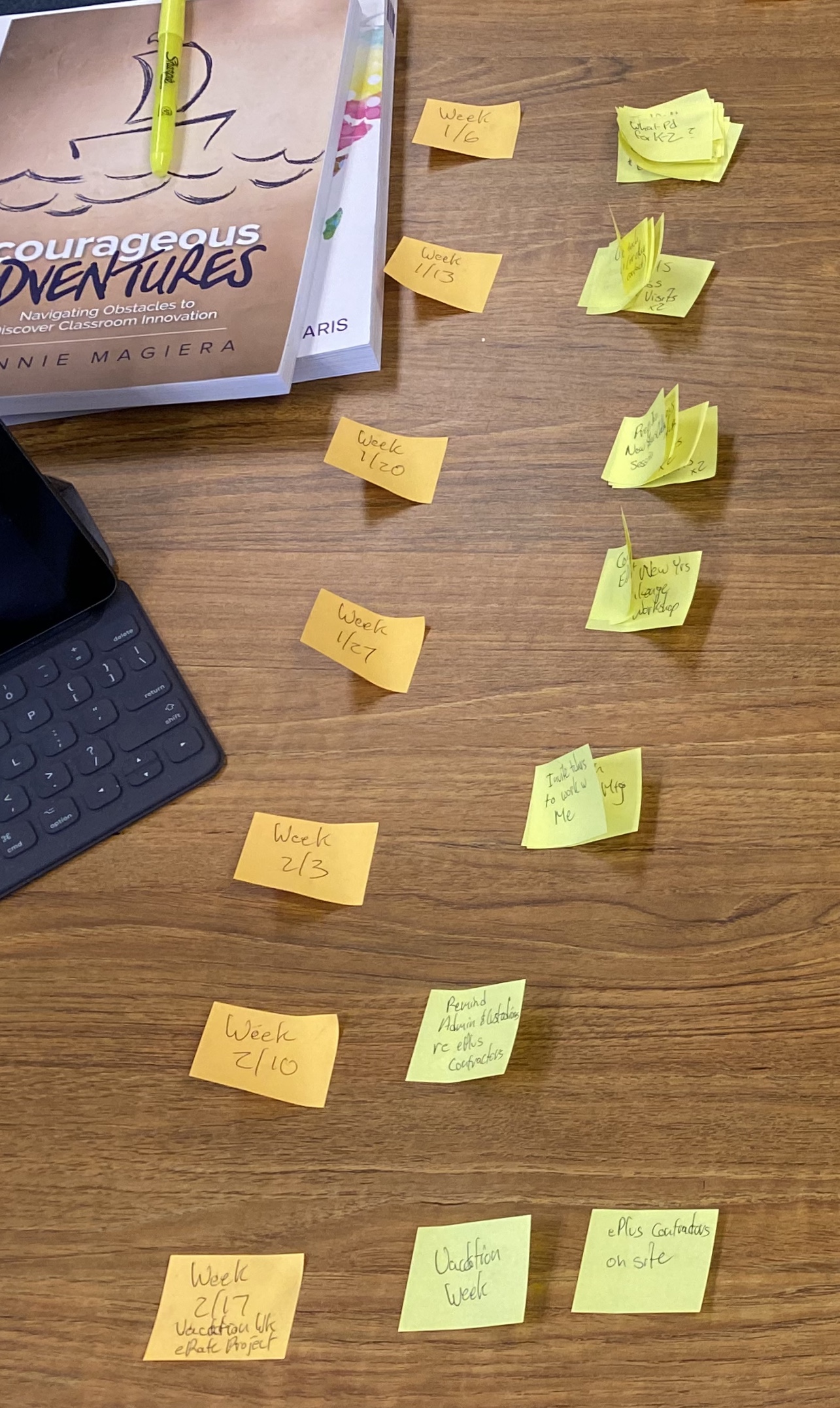
All my upcoming tasks, written on small Post-It Notes, spread out all over my desk in an attempt to organize them by week.I started to lay out all our immediate tasks on small Post-It notes and then set them out by week, over the next 7 weeks.

And what I realized quickly was that, although we had done a great job of identifying our top priorities, we were trying to take them on too quickly, and all at once. I easily had 3 weeks’ worth of work (as evidenced by the stack of Post-It notes aligned to each week) for each of next three weeks.

The message to me was that we needed to give ourselves more time to get the work done, so we could do it well and get it done right. It probably also means that we have to put some of that work back a couple weeks.

This was reinforced when Michelle, one of our technicians, came back having visited with a tech director she used to work for, and shared that she had told him about 3 of our major projects (the K-2 iPad Refresh, the Central Office Server work, and the eRate-funded network upgrade at our middle/high school), and his response was that that was a lot to take on for one year! (And we’re working on so much more!)

Ok. I might be slow, but I’m trainable. So in the next day or two, the Tech Team will meet and we’ll not only provide updates on each of our projects, but we’ll map them out on the calendar and see if we can’t creat a more effective timeline.

An Alternative to Standardized Tests for School Accountability

What if we had a better choice than standardized test, that could tell educators useful information about what actions really needed to happen to help students learn better? I recently sent this email to Maine’s Commission and Deputy Commissioner of Education making just such a suggestion. Let’s focus on assessing what really matters in schools.

What if we had a better choice than standardized test, that could tell educators useful information about what actions really needed to happen to help students learn better? What if we could focus on assessing what really matters in schools? I recently sent this email to Maine’s Commission and Deputy Commissioner of Education making just such a suggestion:

I’m writing to suggest the Hope Study (see resources below) as an alternative to standardized tests for accountability for Maine’s public schools.

Students learn better when they have more of each of the Hope Components.
Public schools are a public trust, so accountability is important. But, when it comes to standardized tests, to paraphrase the great philosophers in Princess Bride, I don’t think they measure what you think they measure! They may hint at where students are succeeding and where they have holes in their education, but the results don’t actually provide actionable data.

We suffer from the same problem with standardized tests that we suffer with poverty. With standardized tests we may say that a student needs more math, and with poverty we may say a person needs more revenue. Both are true. But both also really suggest very little about how we might make that happen.

In fact, with poverty, we rarely address the foundational components that need to be in place for economically disadvantaged persons to be able to pursue earning more revenue: job training; flexible day care; transportation; safe, reliable housing; adequate diet and nutrition; even access to an appropriate work/professional wardrobe.

To simply throw more math (or another subject) at a student is no different than simply demanding that someone living in poverty try to earn more money. In so doing, our interventions are likely focusing on the wrong thing, and we are working at cross purposes to our intended outcomes.

The Hope Study, on the other hand, has identified those foundational components for academic learning:

  • Hope
  • Engagement
  • Academic Press (a press for understanding, rather than for performance)
  • Goal Orientation
  • Belongingness
  • Autonomy (opportunity for self-management and choice)

Collectively, these components are called “Hope.”

When standardized test scores are low, too often the premise is that the problem lies in the performance of teachers and students. There is little, if any, attempt to address other factors that might be interfering with the ability, or motivation, of teachers to engage students and of students to work hard on the right things.

Not only do student perform better academically when they have a high level of Hope, but when educators work to improve students’ level of Hope, the students’ level of academic performance improves. In other words, at the core of the Hope Study are the questions: Is our educational environment developmentally healthier for adolescents, and, if so, how do they respond? And if not, how do we respond?

What if our school accountability efforts could address the issues that actually do make a difference?

(Note: The Hope Study was developed by Mark Van Ryzin, a teaching assistant at the University of Minnesota’s College of Education and Human Development, and has been vetted for reliability and validity. The Hope Survey is based on the Hope Index developed by Dr. Rick Snyder at Kansas University. The Hope Survey is not related to the HOPE Teacher Rating Scale for identifying G/T students.)

Resources

Education Technology Duality: Nouns, Verbs, and “Everything Just Works”

There is a duality in education technology: the hardware and software (the nouns) and what you want to do with it (the verbs). And even when you work to focus on the learning experiences made possible with the technology, that that technology works as needed/when needed is critical.

I write a lot about a learning-focused approach to education technology, including a Learning Technology Framework, an exploration of whether we are talking learning or talking technology, or imploring education technology leaders to focus on learning. This work is embodied by the phrase, “More Verbs, Fewer Nouns,” a request to focus more on what we want to do with technology (verbs) than on the tech itself (nouns).

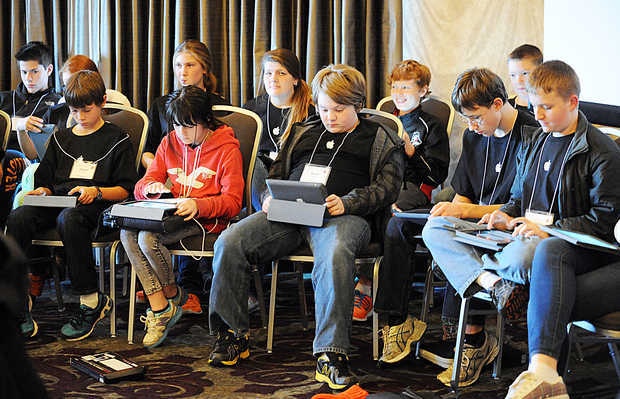
Students learning with technologyAnd yet, now that I’m a tech director in a small rural (yet, technology-rich!) district, responsible for expanding their learning focus on education technology, I’m discovering that there are no verbs without nouns. The technology must work before we can get too far into the learning. It is not one or the other, but rather both.

Because the nouns need to be in place and function as planned in order to implement our verbs, we’re working toward a philosophy of “Everything Just Works.” At the core of “Everything Just Works” is the belief that teachers are more likely to use their technology with students if there are no hiccups and everything works for their activity as planned.

So “Everything Just Works” is the intersection of our nouns and verbs. It is not sufficient to make sure all the tech functions, but rather that it functions as needed for the learning activities planned. In other words, students have the devices, tools, and connectivity they need, as they need it, for their learning. That’s a different lens for how the technology is expected to work. That’s a verb-focused lens for the nouns.

And we know that we have work to do on Everything Just Works.

How do we know? When some students don’t have the apps and it’s not easy getting onto the student devices, or the Apple TV drops your device from projecting, or you can’t connect to the WiFi, or the WiFi works fine, but the filter won’t let you access the education website you were going to use, or when the teacher’s or the students’ devices are stuck in an endless update loop, or you just updated and now the app you were relying on for the less doesn’t work…

But we’re making progress…

So, Apparently, There are No Verbs Without Nouns

This is how I learned that there are no Verbs without Nouns. You can’t work on instruction and learning experiences unless all the tech is working seamlessly. And that’s when I realized that you can only be Verb-focused when everything just works.

As I mentioned in my previous post, I finally have the opportunity to help shape an entire district toward More Verbs, Fewer Nouns. We were, with the Superintendent’s direction and blessing, going from a previous Tech Director who focused on techie things (Nouns) to my becoming Tech Director focused on learning and teaching (Verbs).

MSAD 44But that’s easier said than done! At least at first…

I was hired just before school started and there was, for a variety of reasons, and the passing on about systems, subscription, tools, and accounts from one Tech Director to the other was spotty. Plus the Elementary Technician had also retired when the previous Tech Director did. I’ve always been a technology for learning experiences guy and my own knowledge about how to handle the techie issues is VERY limited.

So, no matter how much I wanted to lead out the gate with conversations about pedagogy, and instruction, and good learning experiences, I was met, of course, with questions of “When can we distribute devices to students?” And “Are you ready for the eRate WiFi project at the middle school?” And “Is everything set for testing?” and “I can’t find my students’ passwords, can you help?” And “We have 3 new students; how quickly can we get them devices and accounts?” And “Don’t forget we need to move a SMART Board from Room A to Room B.” And “When will the new staff have email accounts and accounts in the student information system?”

These were certainly all Noun issues.

And just as certainly I wasn’t going to get to do any Verbs unless all these Nouns were addressed.

So I sent out an email to district administrators letting them know that I would do my best to address any issues they send to me and the Tech Team, but, for September, I would focus on these priorities:

1) Bring an Elementary Technician on board
2) Get student devices up and running and into the hands of all students
3) Do our best have NWEA testing go smoothly
And we were reasonably successful.

For the most part (with a handful of exceptions) teachers and we got student devices up and running for the year, and NWEA testing went relatively well. One of the elementary principals, who had been a teacher who leveraged her class’s technology fairly well, was especially helpful with making sure the MacBooks worked with the testing and assisting me as “elementary technician” until we could hire a new one.

The Elementary Technician position had been posted earlier in the summer, so I had a list of candidates to work with. The hiring process went fairly well, with the longest portion of hiring being waiting for our hire to be released from her position in another district.

Our Elementary Technician has been working with us for several weeks. She comes from tech-rich district and knows a great deal about working with MacBooks, and is quickly learning the iPads. She is picking up on new skills/duties quickly and works really well with both our Middle/High Technician and me. She’s a great addition to the team!!But most importantly, the lesson I learned very quickly is that there are no Verbs without Nouns. You can’t work on instruction and learning experiences unless all the tech is working seamlessly.

And that’s when I realized that you can only be Verb-focused when everything just works.

Moving a District Towards More Verbs

I recently started a new journey to be (Learning Through) Tech Director in a small, rural, but innovative, 1to1 school district. I’m going to start sharing our journey to focus on more verbs (what we want to do with our tech) and fewer nouns (the devices, gadgets, and tools).

New journeys are both exciting and full of detours, breakdowns, and bumps in the road!

Bethel, MaineBethel is wonderful small town nestled in a beautiful section of Western Maine. The White Mountains raise all around us here. There is a beautiful downtown with a well stocked, but relatively small, grocery, and an old fashioned hardware store across the street (Ironically named Brooks Brothers!). And there are plenty of really good restaurants – mostly because the town sits between two popular ski resorts. But it will take 30-40 minutes in any of four directions to find a big box store.

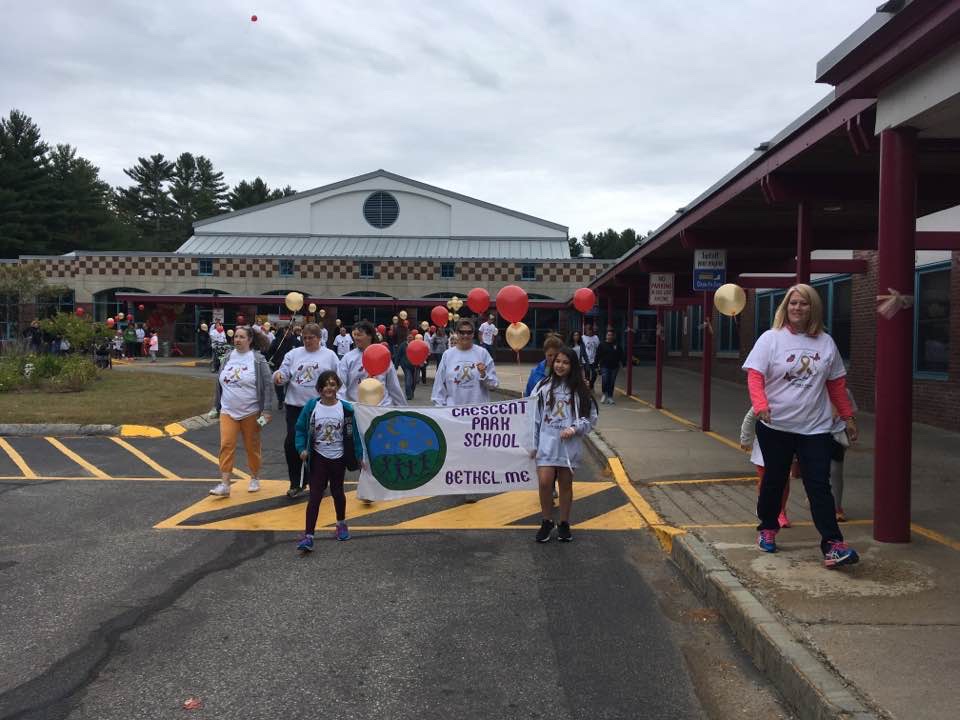
This wonderful little town is at the center of Maine School Administrative District #44.SAD 44 has three schools (well, sort of four): Crescent Park Elementary School (where about 3/4 of the K-5 students attend), Woodstock Elementary School (where the other 1/4th are), and Telstar Middle/High (although it’s one building, they divide it so 6-8 is fairly separate from 9-12). There are only about 775 students district-wide (about 50 students per grade level).

And I have just become their Tech Director.

The district may be small, and they may be rural, but they are fairly innovative. They have a Freshman Academy that all 9th graders participate in. They hold classes most of the day at a 4H Camp and subject learning targets are integrated into hands-on, environment and outdoor themed projects and units. The district also has 1to1 technology for all it’s K-12 students (iPads in K-2 and MacBooks in 3-12).

This is the perfect opportunity to work on living “more verbs” (focus more on what you want to do with the technology) and “fewer nouns” (focus less on the “stuff”, the hardware and the software)!

The district has a small tech team, made up of an elementary technician (who retired just before I came on – an early task was filling the position!), a MS/HS technician, and the Tech Director (me). Historically, the Tech Director was also a technician, working with the others, keeping hardware and software functioning (all “nouns” work).

David Murphy, the Superintendent responsible for much of the innovation in the district, and I have been wanting to work together for years, and the former Tech Director had been wanting to retire for a long time! So the superintendent brought me in with the intention of the Tech Director becoming learning and teaching focused (more verbs!!), letting the two technicians take over all the hardware and software pieces (all the nouns).

That sounds wonderful! And an easy transition to accomplish! (And frankly, these teachers, who have had teacher and student devices for years, are enormously welcoming and excited to have someone to work with them on better leveraging their technology for learning!) 

But transitions like these are full of challenges and bumps and fails and detours, with needing to hire a new elementary technician, and “But the previous Tech Director did this!” and tech challenges that come up requiring skills none of the three of us on the district tech team have much experience with, and folks not knowing who to contact about what, and some critical info (including accounts and passwords) falling between the cracks as one Tech Director retires and the new one comes in, and everyone getting used to this new guy (me) who shifts nearly every conversation to the topic of learning experiences… And… And…

So it feels good to be blogging again and I plan on chronicling pieces of our journey and transition toward making tech systems seamless and invisible because they function well and leveraging technology to create better learning experiences for more students. Toward more verbs and fewer nouns!!

Onwards!

Do One Small Thing!

A couple small things teachers can do for a big impact down the road.

A fellow educator recently asked if i had a suggestion for one small thing a teacher could make that would have a big impact down Impact students by doing the right small things.the road. I had two: 

  1. Treat your students “as if.” As if they are capable. As if they are trying to do the right thing. As if they are nice and kind. As if they are bright. As if they are likable and lovable. As if they are worthy of your every effort to support their success in school. The irony is that the more you treat them “as if” the more they act “as if.
  2. Spend less time thinking about why students should learn your content and more time wondering why would they want to. This is NOT a suggestion that students should only learn what they want to, but rather how might we spark curiosity, wonder, and interest in the content we’re working with them to learn (especially if we think they SHOULD learn our content!).

Honoring Controversy – The Series

One of the truly challenging parts of leading large-scale school change is how upset some people can be about the change. Large-scale school change, especially paradigm shifting change, invariably generates controversy. The question is how to deal with it…

School Administrators working on controversyOne of the truly challenging parts of leading large-scale school change is how upset some people can be about the change (School Change Truth 2 reminds us that people seem to abhor change). Large-scale school change, especially paradigm shifting change, invariably generates controversy.

The question is how to deal with it. Understandably, many of us don’t like confrontation and would rather not deal with it or hope that it will simply go away.

But this is one instance where ignoring the situation will not make it go away and will likely make it worse. What to do?

The Series:

How well your initiative deals with controversy and critics will depend on how calm you remain, how productively you listen to your critics, and how good you get at determining when to simply acknowledge a critique and when to do something about it.

How We Listen Matters

When dealing with controversy, it is important to listen closely to your critics (even when how they say things makes it hard to listen!). They may tell you what you need to say and haven’t yet and which words you’re using are helping your cause and which are hurting your cause.

Adding the “barking dogs who bite” parent, mentioned in the previous post, to the design team taught us something else about dealing with controversy. The way critical community members deliver their message, especially when they are forceful or angry, can keep us from listening productively to their message.

For example, we certainly intended to use iPad apps to reinforce letter formation and spelling. The way angry parents were telling us we shouldn’t use tablets to teach young learners had us dismissing them (and their message) as extremist.

But then a small statement in an otherwise enflamed tirade made me realize that they thought we were going to teach students to handwrite only using the devices!

It had never occurred to us that we should be directly stating that the correct way (the only way) to properly teach handwriting was with pencil and paper. Once we made that statement, they cooled quite a bit. We were debating the benefits of using apps to reinforce letter formation when what no one had said (and needed to be said) was that handwriting needed to be taught with pencil and paper. It was so obvious to us, we never thought to say it.

But listening productively to the critics (even when it’s hard) told us the message we should be sharing.

Similarly, when working with a middle school to implement interdisciplinary, project-based learning, our group talked a lot about problem-solving, connecting learning to the students’ world, and active learning. Critics were angry because they saw us throwing out the curriculum and dismissing Math, English, Science, and Social Studies. It was a lesson in how listening productively to your critics can also tell you when you’re using the wrong words or wording.

Of course we were teaching Math, English, Science, and Social Studies!

But in our excitement about the learning power of connecting subjects and using projects and active learning, we had said nothing about the content students would be learning. Our critics quieted and were less frequent when we started talking about how we could make Math more meaningful by using it to address issues in Science and Social Studies, and how applying reading and writing to solving real world problems makes learning the reading and writing skills more meaningful to students, and how active, hands on learning strategies, help students better learn Math, English, Science, and Social Studies.

Our critics helped us know what we were not saying that would be helpful and what terms we were using that were generating less buy-in, than other terms that helped promote buy-in.

Barking Dogs and Barking Dogs Who Bite

When folks from the school community are expressing their concerns around your initiative, you need to decide quickly if they simply need to be listened to, or if additional action is needed. You must decide if they are “barking dogs” or “barking dogs who bite”!

Thinking of school change from the framework of being intentional and rational about moves and counter moves, as mentioned in the previous post, can be helpful. Remember, a confrontational and forceful community member perceives their job as saying whatever it takes to have you NOT make the school change you are in the process of making.

Part of thinking through moves and counter-moves is knowing when you can and should ignore the issue, or take no action, and when you must do something, perhaps quickly. You have to be able to distinguish between “barking dogs” and “barking dogs that bite.” Many of the critics of the primary grade iPad initiative in Auburn said their piece, then went away. But we had one parent who kept returning to the school committee and to other community groups to blast the initiative. Her arguments were starting to gain traction, even though to those of us implementing the initiative none of them had any credence or basis in fact. She had become a barking dog that bites.

My superintendent was surprised by my solution. I put the parent on our design team. My superintendent wasn’t so sure about the move but trusted that I knew what I was doing. I’m not so sure that I knew what I was doing at the time (and frankly, part of it was the old “keep your friends close and your enemies closer”), but my instinct proved correct. The parent saw how decisions were made and saw that “what was good for children” was at the heart of what we were doing.

She also had a voice in our decisions (as did every design team member) and was now in the position of not being able to pontificate at a board meeting about what she thought we should or shouldn’t do, but now had to work with the team to convince us to do what she thought was right. When her ideas were what one might call extreme or crazy, she was only one voice and her ideas didn’t go far. When her ideas were on point, we collaborated on finding the right way to address the idea. She made quality contributions to the design and implementation of the initiative and even became a cautious supporter, advocating for continued funding for the project at budget time!

Dealing with Controversy Requires the Right Mindset and Temperment

Ignoring the situation will not make controversy go away and will likely make it worse. What to do? How should we react?

As discussed in the previous post, large-scale school change, especially paradigm shifting change, invariably generates controversy. The question is how to deal with it. Understandably, many of us don’t like confrontation and would rather not deal with it or hope that it will simply go away. 

But this is one instance where ignoring the situation will not make it go away and will likely make it worse. What to do?

The first step is, to the greatest extent you can, to not take it personally. If you care deeply about your initiative, which is often the case when you play a strong role in designing or implementing an initiative, it’s hard not to take the criticisms and concerns personally, especially the ones that seem unrealistic and crazy or when the community member is so angry or forceful in their convictions. It’s almost impossible to avoid taking it personally when they make it personal about you (I once had a parent at a school committee meeting attack me by name and try to shame me for supporting our work).

It’s critical to remain calm. This is not simply an issue between you and the angry community member. There are others watching. Some will agree with the community member. Some will think that the community member is being unreasonable and will sympathize with you (perhaps feeling bad that you have to sit through this onslaught!). In many cases, you can simply thank them for sharing their perspective and let their comments (and how they were delivered) stand on their own.

If you respond too strongly, sharply, or angrily, no matter how justified you may be to feel these things, you are the one whose argument loses every time. It doesn’t matter that the community member thinks they are correct and is being angry or forceful, when you lose it, you lose your supporters. It is for them and for you that you remain calm, no matter what.

If possible, provide a counter example. When Maine decided to be the first 1-to-1 laptop initiative in the country (The Maine Learning Technology Initiative, MLTI) by providing all 7th and 8th grade teachers and students laptops, WiFi, and training (probably the largest middle school initiative in the country!), teachers, principals, and tech directors were highly anxious. At the time (2001), no other state was doing this. Few schools across the country were doing this. Then-Governor King got calls saying that if he wanted to improve Maine’s economy, he should give every middle school student a chainsaw, not a laptop. He even got death threats!

Even caring educators’ imaginations were rife with worries about all the bad things that might happen: students going to inappropriate sites, students being distracted from focusing on learning activities, equipment not working properly when needed, laptops going missing. As a new initiative, it’s hard to counteract supposition because there may be no counter-examples to point to. Fighting supposition with supposition is difficult (”My belief it won’t happen should be stronger than your belief it will happen!”).

But he had the advantage of having one middle school, Piscataquis Community Middle School in Guilford, Maine, who had initiated 1-to-1 laptops with their eighth grade earlier that year.

When a critic shared their worst fears about what would happen when every seventh and eighth grade teacher and student had an internet-connected laptop, Governor King could publicly turn to the Guilford teachers and say, “I see this person’s concern. Has this been an issue with your program?” The teachers could then state that it has not been, or if it had, what the scope of the problem had been and what their solution was. It also helped that the response came from someone other than the governor. It wasn’t just the program advocate’s response, but a response from someone who is already doing the work. Bottom line, those teachers, in this instance, had more credibility with the critics than the governor did.

Keep in mind, too, that your critics aren’t trying to ruin your day. Initiatives are “initiatives” because they are new. They haven’t been done much (if at all) before. They aren’t “tried and true.” And they are unlikely to be what your stakeholders and learning community have experienced in school. As I pointed out previously, all they have to work from is supposition and their imagination, both of which are charged by emotion. And without real counter-examples, you are fighting an uphill battle. Trying to debate an emotional worry without real counter-examples is simply a debate of opinions and in the end will simply give credence to the critic’s concern. I’m reminded of a Facebook meme: “That is a very well laid out rational point, but I will still hold to my emotional opinion based on no facts or evidence.” 

In such a situation, remaining outwardly calm and simply thanking them for sharing and letting their comments stand on their own is the only practical path forward for you.

That can be quite discouraging, feeling like you have no way to parry what you perceive to be an irrational assault on your initiative. Maybe this will help. I was working with a small group creating a career academy for challenging and at-risk students in a mid-sized city. It became quite a political hot potato, and, as the superintendent’s project, a pawn in battles between the superintendent and other groups (having little to do with the school itself). My colleague had friends–who were not connected to the school project–over socially one evening and was telling them about our challenges in that district. One of the friends was a veteran combat pilot now working as a commercial airline pilot. He told my colleague, “You know, they only shoot at you when you’re over the target.” It became a metaphor that has energized me through this and other initiatives since!

I also find it helpful to think of implementing an initiative in the midst of controversy a bit like chess, as a complex game of moves and counter-moves to win the game. I don’t so much want you to start thinking of implementing your initiative as a game or to turn this into another situation where someone wins and someone loses. But the framework of being intentional and rational about moves and counter moves is a helpful one. Remember, a confrontational and forceful community member perceives their job as saying whatever it takes to have you NOT make the school change you are in the process of making.

In the next post, we’ll explore sizing up the individuals expressing concern about your initiative.

School Change Generates Controversy

School Change can generate quite a bit of angst and controversy among the school community.

One of the truly challenging parts of leading large-scale school change is how upset some people can be about the change (School Change Truth 2 reminds us that people seem to abhor change). Some parents worry their children won’t do as well as they do now. Some teachers worry about the work and adjustments they’ll have to make with the change, or fear they’ll fail at the initiative or that it’s another initiative they’re expected to implement well without adequate training or support. Some just think that the initiative doesn’t look “like school,” so you’re clearly doing it wrong!

Parents will resist and fight back against the change. Teachers will resist and fight back against the change. Community members will resist and fight back against the change. Some directly: telling you –or your superintendent or the school committee–exactly what they don’t like about the initiative or what their worries and concerns are. Others are less direct, telling you what they think will make you stop or change your mind, rather than telling what they really fear, or that they don’t want to put the effort into the change. And if your initiative is the kind that few others have implemented to date, and you have no examples to point to, then your stakeholder group has only their imagination, good and bad. And some of those stakeholders will rail against the worst their imaginations can come up with! Without counter-examples, you have no proof they are wrong.

When Auburn Schools ventured to be the first district to have a district-wide 1-to-1 kindergarten iPad initiative, there were no other kindergarten iPad initiatives to point to. We had educators and partners who were excited about the opportunity. Our imaginations told us about all the good that was possible from such an effort. But we also had some angry community members who came to testify at school committee meetings about all the worst things their imaginations could conjure:

  • We would reduce the number of teachers and just teach students through online learning
  • Students would spend all their time on the tablets and would no longer play outside, draw with crayons, sculpt with clay, sing songs, or sift through sand
  • Predators would get to the children through the cameras on the devices
  • The kindergarteners would spend all their time playing games they downloaded or going through Facebook instead of doing the learning activities
  • Students eyes would go bad using the tablet screens, and they would all need glasses
  • The children would never learn to write with pencil and paper

Many years later, none of these predictions came to fruition. But that didn’t stop them from being hot topics in the beginning. (In fact, back then I blogged, “Rumor of our Locking Students in Closets with iPads Are Greatly Exaggerated!“)

Large-scale school change, especially paradigm shifting change, invariably generates controversy. The question is how to deal with it. Understandably, many of us don’t like confrontation and would rather not deal with it or hope that it will simply go away.

This series will help address how to deal with the controversy your initiative generates.

MLTI is not a Tech Buy or Commodity. It’s a Learning Initiative.

A recent “Concept Draft” bill came to Maine’s Legislative Education Committee to make the Maine Learning Technology Initiative “more cost effective.” It greatly misunderstands MLTI. Read my testimony to the Ed Committee in opposition to this bill.

The Maine Learning Technology Initiative (MLTI) has been around since 2001, providing 7th & 8th Grade students and teachers with devices and more.

Recently a new piece of “Concept Draft” legislation popped up: LD 137: An Act To Make the Maine Learning Technology Initiative More Cost-effective. In so many ways it represents what people don’t understand about MLTI.

It states: “This bill proposes to enact measures designed to make the Department of Education’s Maine Learning Technology Initiative, or ‘MLTI,’ more cost-effective for schools and for the State, thus allowing participation by increased numbers of students. The cost- saving measures may include, but are not limited to, eliminating the ability of school administrative units to choose higher-cost technology options.” 

In fact, that’s the only thing the Concept Draft bill says.

Here is the testimony I have submitted:

MLTI - Learning Through TechnologyI’m writing in opposition to LD 137.

I have been involved in learning through technology initiatives for more than 20 years. I was an early technology integrator, leveraging technology for learning academic content rather than primarily learning technology skills, served on the original design team for MLTI with Bette Manchester, was part of the team that created the first district-wide primary grades iPad initiative in the country (in Auburn, ME), and served for 2 years as the Learning Through Technology Director and MLTI Director at the Maine Department of Education.

It’s easy to walk into a big box store or search eBay and look at some of the inexpensive tablets and laptops that are available, then look at the per-pupil cost of a MLTI and think that it could be made less expensive.

But to focus on simply trying to make MLTI less expensive would be to fundamentally misunderstand MLTI in several critical ways.

The first misunderstanding is that MLTI simply buys a laptop or tablet for each student. MLTI provides much more than devices to students. The per-pupil cost represents an entire solution including a device, software and apps, classroom WiFi, device management, ongoing technical support, and professional development. Any effort to improve the cost of MLTI must examine the cost of similar packages that include all of these elements and not simply the cost of a device.

The second misunderstanding is that the cost for MLTI is high. When one looks at cost, one should look at the value for the entire package and the relative cost of the entire package. MLTI‘s RFP process already ensures that MLTI is cost-effective. The RFP process reviews vendor’s proposals for the adequacy of each component in the solution, as well as the overall cost for the entire package. Districts have tried to replicate the MLTI solution on their own, thinking they can save money, but find that they have to either leave components off of their homegrown solution to maintain MLTI’s price point, or end up paying more than the MLTI price.

The third misunderstanding is that all devices are created equal, and therefore a more expensive device can be readily replaced by a less expensive device. Maine’s MLTI RFP process outlines minimum specifications for the device, based on initiative goals and anticipated desired use of the tools. Numerous device options have already been ruled out because they do not meet the minimum specifications for the initiative. Cost-effectiveness should always be examined from the perspective of goodness of fit to a purpose and not simply compare one device to other devices without consideration for how the device will be used.

The fourth misunderstanding is that MLTI is a tech buy or a commodity purchase. MLTI has always been about learning. Even in its name, the word “learning” comes before the word “technology.” It is true, MLTI has helped close the digital divide. There are schools, especially our rural schools north and east of Bangor, that the only significant access to technology students have is to MLTI provided devices. But there are two digital divides. This first one is the Digital Access Divide.

MLTI was designed to address the second digital divide. While research shows that technology can be effective in the classroom, it’s not being used effectively in every classroom. This the second-level digital divide, the Digital Use Divide, and it disproportionately impacts low-income students. MLTI was intended to help address the Digital Use Divide through its networking and professional learning to encourage impactful use of technology in the classroom. A simple focus on word processing, presenting, online learning, and high stakes test taking is an insufficient rationale for the state funding technology solutions for students. It must include supports, models, and professional learning that drives improved learning, such as student skill development, creativity, critical thinking, collaboration, and agency. 

MLTI should not be reduced to a simple “tech buy” or commodity arrangement. Any revisions or update to MLTI should remain focused on supporting quality improvements to teacher practice and in learning experiences for Maine’s children. This will not be achieved by a simple cost reducing effort.


Maine Learning Technology Framework

The Maine Learning Technology Framework describes the key elements and components needed to achieve the greatest learning benefit from a district’s technology investment. The Framework is intended to support teachers, tech leads, librarians and other school leaders in their efforts to leverage technology to improve student learning experiences related to learning targets and outcomes.

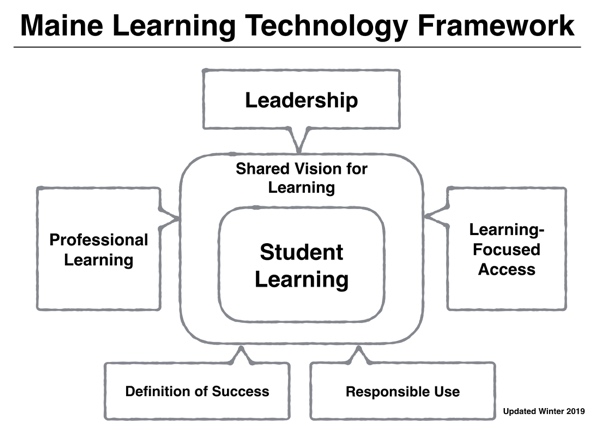
Maine Learning Technology FrameworkThe Maine Learning Technology Framework describes the key elements and components needed to achieve the greatest learning benefit from a district’s technology investment. The Framework is intended to support teachers, tech leads, librarians and other school leaders in their efforts to leverage technology to improve student learning experiences related to learning targets and outcomes.

At the center of the Framework is a focus on creating good learning experiences for students, recognizing that the quality of the pedagogy and learning experiences drive student learning and achievement. The core of the Framework are student learning experiences and a district’s Shared Vision for Learning.

Student Learning – Many 1to1 technology initaitves leverage a common model to guide teacher practice and the integration of technology into instruction and learning: Technological, Pedagogical, Content Knowledge (TPCK) by Drs. Punya Mishra and Matthew Koehler. TPCK suggests that technology serves education best at the intersection of content knowledge and pedagogy and instruction.

Using TPCK terminology, this portion of the Framework focuses on the following instructional practices (from the Plain English Instrucitonal Model), and thinking about how technology can support these practices:

  • Instruction for Foundational Knowledge: Helping students learn the basics in subject area content.
  • Instruction for Practice and Deepening Understanding: Helping students develop some fluency and automaticity with those basics, or develop conceptual understanding beyond simple memorization.
  • Instruction for Using Knowledge: Students demonstrating their proficiency with content and skills by applying them in a real world context and at a higher level of complex reasoning.
  • Assessment, Feedback & Continuous Improvement: Providing timely feedback to drive continuous improvement, or capturing evidence of what they know and can do.
  • Student Motivation & Engagement: Ensuring that students are mentally and physically present and engaged. Educators creating the conditions for student self-motivation.

Shared Vision for Learning – An school’s Shared Vision for Learning is a powerful tool to help describe what kinds of learning experiences the school’s educators, parents, students, and community value and want to see in their schools. Note: this is not intended to be a vision for technology, nor a general vision for school. Where the Vision should focus on desired learning experiences or conditions for learning, technology should be considered one collection of tools applied to help advance classroom practice toward that Vision.

Student learning, the core of the Framework, is supported and undergirded by five pillars:

  1. Leadership – Achieving the Vision for Learning takes a diverse team of school leaders who can both help build buy-in for the Vision and for the role of technology within the Vision, but also to help manage the implementation of the development, adjustments, and alignment required of the Vision.
  2. Professional Learning – The strategies used by the district to provide timely professional learning opportunities, and other supports designed to effectively encourage and assist teachers’ successfully bolstering and broadening classroom practices.
  3. Learning-Focused Access – Each learner (adult and child) has access to the device, connectivity, apps, programs and services they need, as they need them for their learning, with a minimum of barriers to engaging in purposefully designed learning experiences.
  4. Definition of Success – How the district defines success for applying technology to learning, how they ensure that definition is broadly known and understood, and how they measure progress against clear goals.
  5. Responsible Use – How the district ensures they are meeting CIPA requirements. How they are applying their technology to improving accessibility for students. The approaches and strategies they are using to help students learn to use technology responsibly and safely.

The Maine Learning Technology Framework was originally created for the Maine Department of Education to support MLTI (the Maine Learning Technology Initiative) and other learning through technology efforts across the state.

Are We Talking Technology or Are We Talking Learning

We will never be successful having our technology help improve student learning if we continue to primarily discuss the technology. Our technology conversations must focus on the kinds of learning we want for students.

More and more, educators are recognizing that the true value of technology isn’t learning how to use the tools and devices, but rather using the tools and devices to learn (see here, here, and here).

Even a recent meta analysis of the research on 1to1 learning environments shows that when the studies focused simply on the presence of technology, there was no real improvement in learning. Yet, when a study focused on how the devices were used, certain types of use (those focused on effective instructional practices) showed a real improvement in learning.

We will never be successful having our technology help improve student learning if we continue to primarily discuss the technology.  Our technology conversations must focus on the kinds of learning we want for students. After all, if the goal of our technology initiative is simply to make sure that students have technology, when we are successful, all we have are students with devices (and perhaps distracted students at that!).

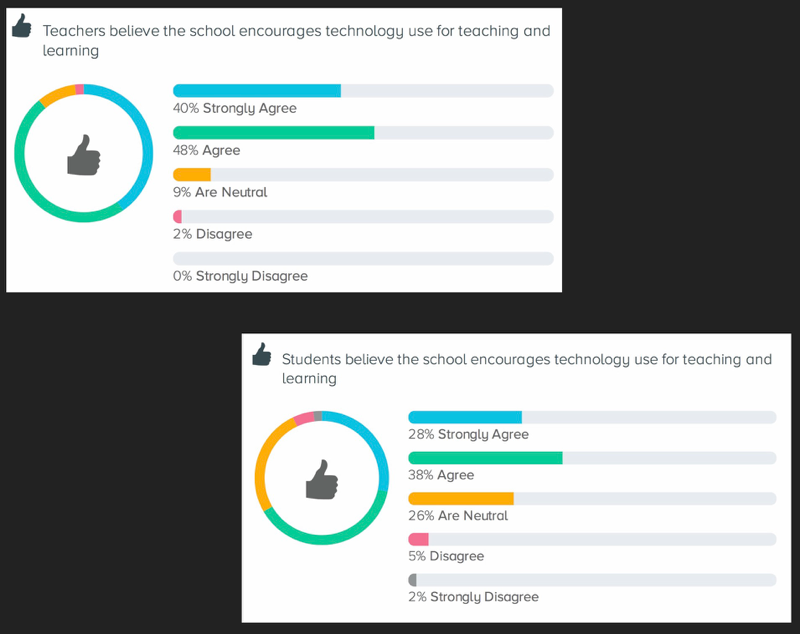
The good news is that Maine’s 2016 statewide BrightBytes data on technology and learning show that students and teachers feel they are encouraged to use their technology for learning:

Teachers and students encouraged to use tech for learning

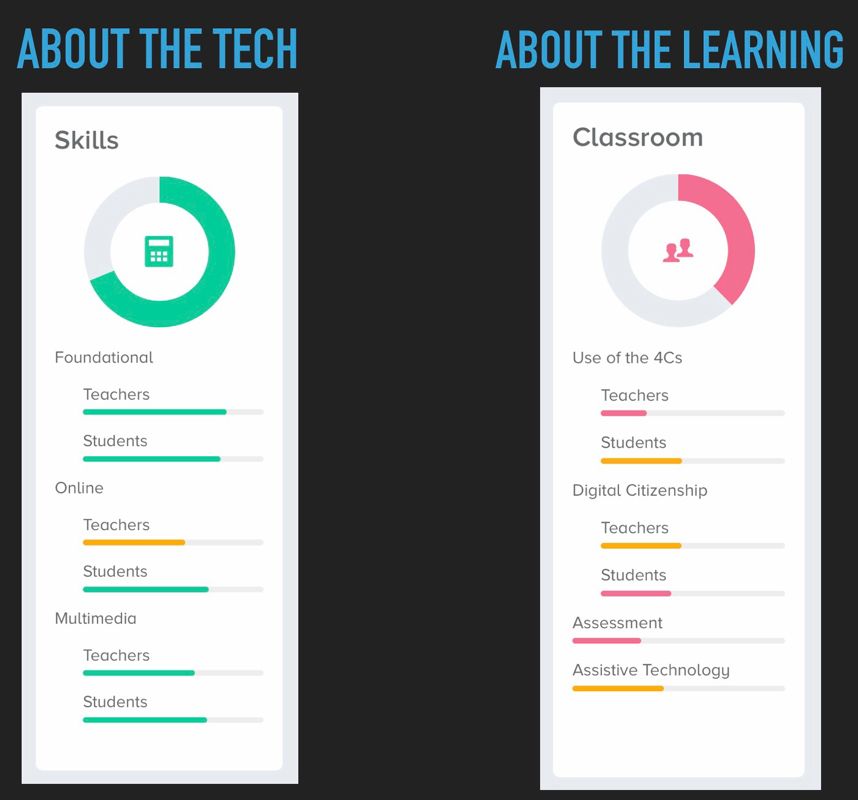
But those data also show that, although we’ve done a pretty good job of teaching teachers and students how to use the devices and tools, we have a ways to go for implementing those tools and devices for learning:

Knowing skills and using for learning

So, these data reinforce the need for our push for “More Verbs, Fewer Nouns” – our need to talk less about the devices and tools and more about the way we want to use them.

How can you tell if you are talking about Tech or talking about Learning?

You are talking about tech when you talk about the following:

  • Cost of devices
  • How easy it is (or isn’t) to manage
  • Wanting same device/platform K-12
  • Teaching skills or about the tools (out of context)
  • Tips and Tricks PD
  • Latest Gimmick/Gadget PD

And you are talking about learning when you talk about the following:

  • Specific academic content focus
  • Used meaningfully for learning task
  • Beyond facts to deeper understanding, to creativity and complex reasoning
  • Student engagement
  • Teaching tech skills as foundation to completing learning activity
  • PD on good instruction (with tech)

There is no doubt that we need “noun people” as part of ensuring technology is used purposefully for learning. We still need a technology infrastructure to support the learning activities for which we want to use technology. I refer to that as Learning-Focused Access.

In Taking Classroom Tech Use to the Next Level: Specific Traits to Look For, the author points out that Alan November recommends six questions to determine if technology adds any value to the learning:

  1. Did the assignment create capacity for critical thinking on the Web?
  2. Did the assignment reach new areas of teaching students to develop new lines of inquiry?
  3. Are there opportunities to broaden the perspective of the conversation with authentic audiences from around the world?
  4. Is there an opportunity for students to publish (across various media) with an opportunity for continuous feedback?
  5. Is there an option for students to create a contribution (purposeful work)?
  6. Were students introduced to the best example in the world of the content or skill?

As the author points out, “Three of the most important traits they look at when evaluating a lesson are whether it is discipline specific, promotes critical thinking and whether technology is used in transformative ways.”


Let’s Focus on the Learning

As I have moved through the state and talked with educators about learning through technology, including while working with MLTI (the Maine Learning Technology Initiative), too often the conversations focused on laptops and tablets and folks wondering if we could find devices that were less expensive.

Is it possible that in their thinking, all laptops and devices were created equal, in such a way that the only variable is cost?

Possibly it is the wrong conversation completely. The conversation shouldn’t be about price; it should be about value.

We may have missed the boat on the value conversation when we started spending too much time talking about the technology and the tools, or about providing technology and procurement.

We need to spend most of our time talking about what kinds of learning we would like to make happen with the technology. You can only get to the value conversation when you can discuss what you want to do with the devices and compare different devices and tools around how well suited they are to those purposes.

A really wonderful professor of elementary educational technology, Ralph Granger, used to say, “When you go to the hardware store to buy a new drill bit, you don’t really want a drill bit. You want a hole.” When it comes to educational technology, we need to talk less about our “drill bits” and more about the “holes” we want.

Or, as Marc Prensky is given credit for saying, we need more verbs and fewer nouns.

And, as TPACK reminds us, when we align our educational arrows, we are talking about content, pedagogy, and technology (What instructional strategies might we use to teach this learning target, and how might we leveraging our devices?).

How are you prepared to help make our educational technology conversations focus more on learning?

Focus on 6 High-Impact Motivation Strategies

Teachers struggle to reach seemingly unmotivated students. It is true that the degree to which students are “self motivated” is a key factor of student academic success, and it is probably true that we cannot actually motivate students. Teachers too often try low-impact or no-impact motivation strategies thinking they will help. The good news is that there are things that teachers can do to create the conditions for students to be self motivated, and there are at least 6 high-impact strategies for creating the conditions for students to be self motivated.

Teachers struggle to reach seemingly unmotivated students. It is true that the degree to which students are “self motivated” is a key factor of student academic success, and it is probably true that we cannot actually motivate students. This is the old idea that we can lead a horse to water, but we cannot make him drink.

The idea falls flat, however, when it is accompanied with the assumption that there is nothing teachers can do to help students be more self-motivated. This is compounded by the fact that teachers too often try low-impact or no-impact motivation strategies thinking they will help (probably because they are used so often and seem to have legitimacy, even if they don’t work well). These low-impact/no-impact motivators include grades, detentions for not doing homework, bribery rewards, showing enthusiasm, being nice to students, or statements like “you’re going to need this in high school (or college, or work, etc),” or “it’s going to be on the state test.”

The good news is that there are, in fact, at least 6 high-impact strategies for creating the conditions for student to be self motivated. This is the idea that we may not be able to make a horse drink, but we can certainly salt his oats.
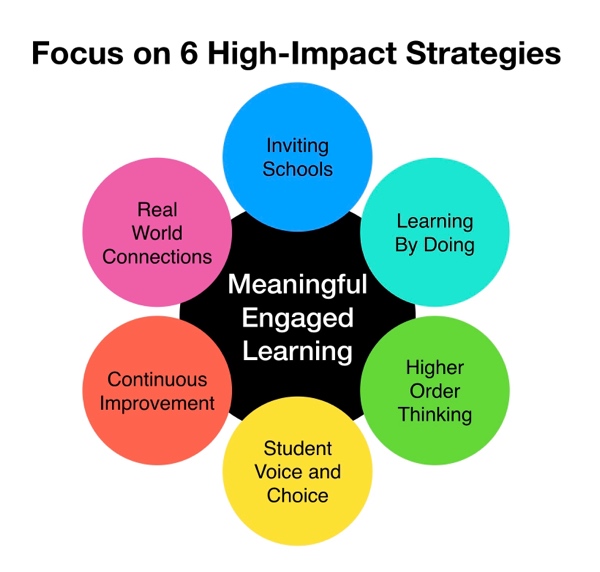
6 High-Impact Motivation StrategiesOne approach to creating the conditions for student self motivation are the 6 Meaningful Engaged Learning Focus Strategies which grew out of me dissertation so long ago. Schools working to improve student motivation, engagement, and achievement concentrate on balancing six focus areas:

  • Inviting Schools
  • Learning by Doing
  • Higher Order Thinking
  • Student Voice & Choice
  • Real World Connections
  • Continuous Improvement

Here’s a brief overview of each strategy.

Inviting Schools: Sometimes, it may seem like this one has little to do with academics or engaging students in learning, but positive relationships and a warm, inviting school climate are perhaps the single most important element to implement if you are working to reach hard to teach students. I have heard over and over again from the students I have worked with that they won’t learn from a teacher who doesn’t like them (and it doesn’t take much for a student to think the teacher doesn’t like her!). It’s important for everyone in the school to think about how to connect with students and how to create a positive climate and an emotionally and physically safe environment. Adult enthusiasm and humor go a long way, and teachers are well served to remember that one “ah-shucks!” often wipes out a thousand “at-a-boys!”

Learning by Doing: When you realize that people learn naturally from the life they experience every day, it won’t surprise you that the brain is set up to learn better through real experiences, in other words, active, hands-on endeavors. Many students request less bookwork and more hands-on activities. The students I studied were more willing to do bookwork if there was a project or activity as part of the lesson. Building models and displays, field trips and fieldwork, hands-on experiments, and craft activities are all strategies that help students learn.

Higher Order Thinking: It may seem counterintuitive, but focusing on memorizing facts actually makes it hard for students to recall the information later. That’s because the brain isn’t accustomed to learning facts out of context. Higher order thinking (e.g. applying, analyzing, evaluating, and creating, within the New Bloom’s Taxonomy) requires that learners make connections between new concepts, skills, and knowledge and previous concepts, skills, and knowledge. These connections are critical for building deep understanding and for facilitating recall and transfer, especially to new contexts. Remembering things is important and a significant goal of education, but remembering is the product of higher order thinking, not the other way around. Involving students in comparing and contrasting, drama, and using metaphors and examples are strategies to move quickly into higher order thinking.

Student Voice & Choice: Few people like being told what to do, but in reality, we all have things we have to do that may not be interesting to us or that we would not choose to do on our own. Nowhere is this truer than for children in school. So, how can we entice people to do these things? We often resort to rewards or punishments when we don’t know what else to do, but other blog posts discuss just how counterproductive and highly ineffective they are. Instead, provide students voice and choice. Let them decide how they will do those things. This doesn’t mean allowing students to do whatever they want, but it means giving them choices Let students design learning activities, select resources, plan approaches to units, provide feedback about how the course is going, and make decisions about their learning.

Continuous Improvement: Continuous Improvement takes skilled guidance, direction, and coaching from thoughtful teachers, who will place emphasis on assessing frequently, providing timely formative feedback, coaching, motivating and nudging, and monitoring of progress. Learners need to know what they are aiming at (clear picture of the learning target), and to see fairly immediately how they did with meeting the target. They can gather the feedback themselves, or a guide or coach can provide the feedback (or both). But that feedback needs to be as immediate as possible, and needs to be detailed enough to lead to improved performance. Learners need the opportunity to make corrections on their next turn (and, therefore, need opportunities for next turns!), and the next turn needs to be soon after the current turn. This isn’t about letting students just try and try and try until they get it. To focus on “re-do’s” is to focus on the wrong part. It is about strategically leveraging the clear target and the detailed feedback to improve performance.

Real World Connections: This focus area is often a missing motivator for students. Schools have long had the bad habit of teaching content out of context. Unfortunately, this approach produces isolated islands of learning, and often makes it easy to recall information learned only when they are in that particular classroom, at that time of day; they are not as able to apply the information in day-to-day life. When learning is done in context, people can much more easily recall and apply knowledge in new situations (transfer). Making real world connections isn’t telling students how the content they are studying is used in the “outside world.” It’s about students using the knowledge in the authentic ways people use the knowledge outside of school. Effective strategies include finding community connections, giving students real work to do, and finding authentic audiences for work (think project-based, problem-based, and challenge-based learning).

These six focus areas aren’t new material; they are a synthesis of what we’ve known about good learning for a long time. The model is comprehensive, developed from education research, learning theories, teaching craft, and the voices of underachieving students.

But it is important to keep in mind that students need some critical mass of these strategies to be motivated. Teachers sometimes get discouraged when they introduce a single strategy and it doesn’t seem to impact their students’ motivation. The trick then isn’t to give up, but rather to introduce more of the strategies.

Working With A Diverse Staff: The Complete Series

This series is for school leaders working on implementing large-scale, learning-focused school change. Your success depends not just on your technical knowledge about the initiative, but also how well you understand the three kinds of staff in your school (Yahoos, Yes Buts, and NFWs) and how their support needs differ.

This series is for school leaders working on implementing large-scale, learning-focused school change.

Your success depends not just on your technical knowledge about the initiative, but also how well you understand the three kinds of staff in your school (Yahoos, Yes Buts, and NFWs) and how their support needs differ.

The Yahoos are those folks who are always excited about new and interesting practices, programs and resources and were anxious to try them out in their own classroom.

The Yes Buts seem hesitant and skeptical of the initiatives with their questions of “but what about this and what about that?”

The NFWs are the folks who look a little like Yes Buts with their questions of “but what about this and what about that?” but who are really saying to themselves and their fellow NFWs, “No freaking way am I doing this!”

Another Adventure; Same Mission

Learn about my new job with GEAR UP Maine and how we’re helping schools not only create a culture for post-secondary education, but support their work with Proficiency-based Education.

I have a new job. Well, I have a new employer.

I recently joined GEAR UP Maine. GEAR UP (Gaining Early Awareness and Readiness for Undergraduate Programs) is that federal grant program  that increases the number of low-income students who are prepared to enter and succeed in postsecondary education.

The traditional approach to GEAR UP programs provide academic supports so students are both academically ready for college and can graduate on time. It provides opportunities to parents and students, such as tutoring, campus visits, and financial aid workshops, to help them view college and post-secondary education as a real possibility.

Maine is going further by leveraging several Multiple Pathway pilot programs of school-design, shared leadership training, and supports for proficiency-based education.

My position is Proficiency-based Education Specialist. I’m working to support our over-tasked, under-resourced schools with frameworks, tools, and supports right-sized for their context. In addition, we’ve identified a couple promising practices we’re helping some of our schools implementing: experiential math, and student micro-credentials to certify learning outside the classroom.

I have joked for a while now that for the last 20 years I’ve really only had one job: helping schools figure out how to reach disengaged learners, students in poverty, and youth from rural, isolated areas. I just keep changing who pays me!

Well, this change to GEAR UP Maine certainly fits the bill!