MLTI, Kindergarten iPads, & Customized Learning: a Keynote with Gov. King & Commissioner Bowen

Imagine!

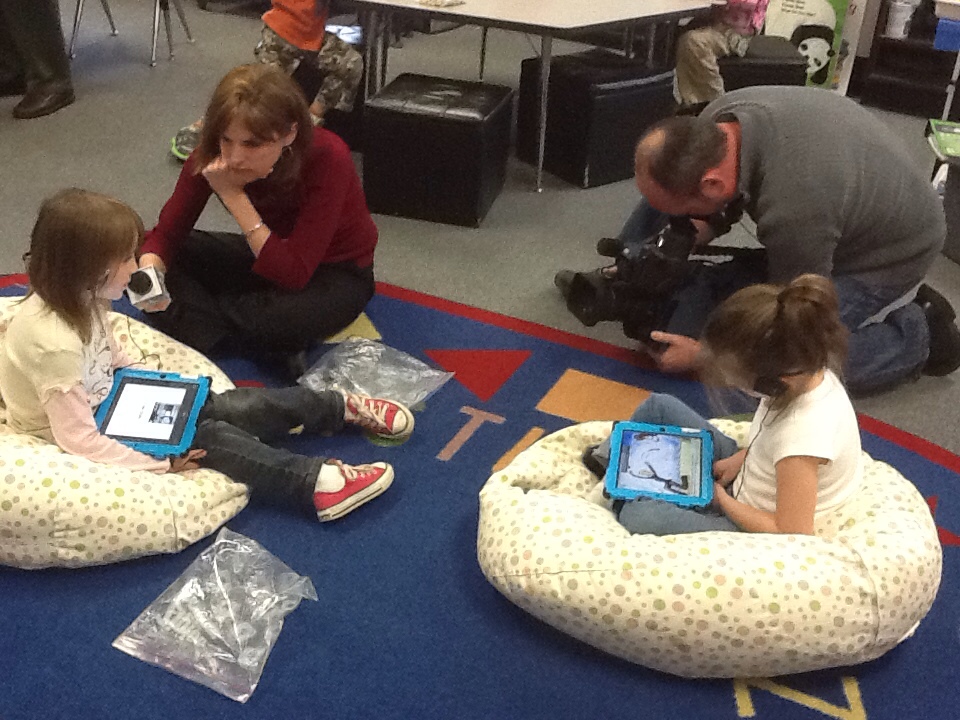
Governor Angus King, who started the country’s first statewide 1to1 learning with laptop initiative, on stage with Commissioner Steve Bowen, whose strategic plan for education moves Maine away from Carnegie Units and toward Customized Learning, answering questions posed by kindergarten students who are participating in the country’s first 1to1 learning with iPads in kindergarten program.

What would they say about meeting the needs of all students?

What would they say about the role technology could play?

What would they say their favorite color was?

That was the opening keynote, “Learning – Past, Present, and Future,” at the 2011 Leveraging Learning – iPads in Primary Grades Institute in Auburn, ME.

If you missed the institute, you can still watch the keynote (link to YouTube).

Hope folks can join us for the 2012 Leveraging Learning Institute next November. Registration opens in mid-August.


Our 8 Messages to the State Board of Education

State Board of Ed visits an Auburn Classroom

On May 9th, the State Board of Education had their meeting in Auburn (press coverage in the SunJournal and at WCSH6). The Board often has their regular meeting at a school, spending the morning in a workshop and the afternoon in their business meeting. They came to Auburn School Department because they wanted to learn more about teaching and learning with technology.

We used the morning workshop to have them visit technology-using classrooms at our middle school, high school, and one of our elementary schools, then return to Auburn Middle School for a debrief and lunch with some of our students.

What did we want the Board to learn about teaching and learning with technology? Here are our 8 messages to the Board:

1) Technology is About Learning
Technology isn’t “cool gadgets” or a content area. Technology is a teaching and learning tool, and decisions need to be based on questions such as, “How does this impact the quality of learning opportunities in the classroom?” and “How can we leverage technology to help students learn in ways that they couldn’t without?”

2) Technology For Learning Takes Deliberate Leadership
Good teaching and learning with technology doesn’t happen on its own. It doesn’t happen just by giving teachers laptops or tablets. It takes deliberate leadership, leadership that is a team focus on positive pressure and support, teacher practice, funding, partnerships, resource management, branding and buzz, and PD for paradigm shift.

3) Technology is No Luxury; It Is The Modern Learning Tool
Some view technology as a luxury schools can’t afford. And yet technology is prevalent in nearly every sector and part of life outside of school. If we want students to think school is relevant to their lives, then we need to use tools for learning that they see in use outside of school.

4) Effective Technology Use in Schools is All About Having Great Teachers
Technology is just a tool. It doesn’t replace teachers. In fact, using technology well takes a good teacher. We won’t ever improve learning by simply handing technology to students. But when a good teacher hands technology to students with a good activity, then learning can soar.

5) Teachers Need Support
Very few of our teachers grew up as students in classrooms where technology was a teaching and learning tool. It is unfair to expect teachers to implement technology well if they have not experienced it’s use as a learning tool themselves. We need to provide lots of support to teachers so they can get good at teaching and learning with technology. That support needs to include identifying models of effective use, classroom visits, trainings that model effective use, access to resources, a safe environment to try new things (and maybe fail), and a little professional hand holding.

6) Teachers Need to Focus on Student Engagement
Whether we have technology available in the classroom or not, teachers need to compete for student attention more than ever before. Students have access to much more information outside of school than when we were students. If teachers are to remain effective and schools are to remain relevant to students, then we need to focus on engaging students, keeping things interesting, and making learning meaningful.

7) Even Young Students Learn With Technology
Young children are adept at using technology, and there are many great technology-based apps and resources available for a quality early learning or primary grades program.

8) It’s About Blalance
Schools known for effective technology rich environments are good at identifying the right learning tool for the learning target. And even though they use technology widely, they would never use technology exclusively. Students still have teachers, read books, create art, play outside, write with pencil and paper, toss a ball, etc.


Should Kindergarteners Use iPads in the Classroom? Absolutely!

This week, Government Technology posted the article, “Should Kindergarteners Use iPads in the Classroom?

It looked like the article had found year-old news of our starting our iPad initiative, thinking it was current, and raised the question if this were appropriate.

I was fine up to the point that readers started posting “black and white”/”all or nothing” comments…

I have submitted this comment:

I’m with Auburn Schools, and it was actually last April that we decided to move ahead with a literacy and math initiative that included 1to1 iPads in Kindergarten. We’re a year into the program and are finding that student engagement is up, teachers find that they are getting to reading groups earlier in the year than in the past, and that it is easier to customize learning for students. We even did a randomized control trial on the pilot which found a statistically significant improvement in the iPad classrooms.

But it is all about the right tool at the right time. We still teach handwriting with pencil and paper, students still play and pretend and read books and work with teachers (all things that some people thought we had plans of stopping once students had iPads – for what reason, I can’t even imagine).

But now that we have actually done it, we entusiastically say yes, iPads do belong in kindergarten.

We’re on track to add 1st Grade iPads for this coming year.

It’s a Matter of Using the Right Prompt: The Words of Gary Stager

This week, both Gary Stager and I were featured speakers at the Association for Independent Maryland and DC Schools’ (AIMS) technology conference.

Gary is an old friend and colleague, who has a long history of working with 1to1 learning with laptop schools (including the very first, in Australia) and with other schools interested in leveraging technology for learning and in constructivist learning. He clearly loves children and everything he advocates for schools is based on creating better experiences (especially learning experiences) for children. He is provocative and takes on a lot of populist education ideas with a very common sense approach. He always leaves his audience thinking.

What follows are some of the ideas and quotes Gary shared in his sessions at the AIMS conference.

  • The secret to engaging students is using the right prompts. A good prompt is worth a 1000 words – a good prompt, challenge, problem, or motivation; appropriate materials; sufficient time; supportive culture (including expertise) – kids can do works that is beyond them. Good prompts require a really different educational environment, one that values the kinds of things that Reggio Amelia values.
  • Gary has several articles on effective PBL on his “virtual handout.” (among other great resources)
  • We have to think less about teaching how to do computers, or about working at someone else’s pace. We need to stop teaching secretarial skills. We need good prompts. We need to teach students to use the computer to create what they want to create.
  • Alan Kay – the computer is simply an instrument whose music is ideas.
  • Gary’s only rule when he is working with students – you have to be doing something.
  • Teacher as “Ringmaster”
  • “Students will do it for themselves, when it matters to them, but not when it is arbitrary or coercive” – Gary Stager
  • Less us, more them
  • Gary likes it when schools/classrooms focus their work with children by asking the question, “What are the 5 big ideas of your grade level or course?”
  • Some of Gary’s recipe for being successful with students: Being sensitive to the passions, talents, and styles of kids. Being receptive to the learning differences of kids. If you are doing active learning activities, then you can get to know kids.
  • The best decisions about education are made closest to the child.
  • What if we simply reduced it all to waking up every morning and asking, “How do we make this the best 7 hours possible for these children?”
  • The biggest problem we have in school is we don’t get to know the kids and everything is taught disconnected from everything else. That’s followed by not trying to make things interesting for students, not finding out what is of interest or a passion to the students, not having resources, not letting students do things.
  • Gary on why teachers need lots of PD that puts them in different learning environments as learners: People can’t choose from what they haven’t experienced

3 Tools to Assess and Guide Your Deliberate Leadership

So, you’re working on your school’s big change. Maybe it’s getting instruction shaped up for the introduction of the Common Core. Or maybe all your students and teachers are getting laptops or tablets. Or maybe you’re making the move to customized learning, or project-based learning, or…

And if you’re reading this blog, then you’ve probably found this model for school change to use when it’s a biggie, such as when it requires a paradigm shift for educators (and perhaps the community) because it’s different than when they were a student and maybe they have never taught this way or been trained to teach this way.

And maybe, like a lot of schools, you had a good start and you paid attention to all the Key and Supporting components of the model, but as the year went on, and the initiative went on, and the day to day running of the school/district loomed big, you have begun to wonder, how do I know we’re still paying attention to all the moving parts of our initiative? How can you get a little check to make sure you’re still on track?

The three tools described below are designed to do exactly that. The three work in concert to help you or your team identify what you’re doing in the initiative, where there may be gaps in providing leadership for the initiative, and what can be done to make the initiative more complete.

This process can be done individually by an initiative leader, or with a leadership team, or with a larger group of stakeholders. I’m partial to using a team effort. Over and over and over again, I’m surprised about the things that are captured and dealt with because team members have perspectives and strengths different than my own. These were always things that would have fallen through the cracks, if it hadn’t been for the diverse perspectives of team members. When working with a group, decide if it is most appropriate to work through each component as a whole group or to divide up into smaller groups, each working on a different component.

A group can work through all three of these tools in 2-3 hours.

The Lead4Change Check-In Tool
The Lead4Change Check-In tool has one sheet for each of the 7 components of the Lead4Change Model. The intent is to reflect on what work is currently underway in each category. It’s a way to gather your list of efforts toward your initiative. The intent is to determine what is going on right now, in preparation of asking the question, are we dealing with all the parts we should be dealing with?

As each effort is listed on the form, the note taker can check which piece(s) of the Component the effort relates to. Some efforts will not only relate to more than one piece of a Component, but to more than one Component. There is no problem with listing an effort on more than one sheet. In fact, you want to make sure that all your efforts toward each Component are recorded.

I’ve done this work with a leadership team through a modified Carousel Activity. I broke the large team into smaller groups. Each small group worked on a different Component for a certain amount of time, then passed the individual Component sheet to the next group. The next group would add to the sheet, passing it to the next group when time was up. Each Component sheet would eventually visit each group. One advantage is that this kind of small group work is more likely to engage every member of the large group than when the same work is done in a “whole group” approach.

The Where Are The Holes? Tool
The Where Are The Holes? tool let’s the same group of reflective practitioners to then look back over the Check-In documents and think about each piece of each Component. They would decide if that piece is “covered” or a “hole.”

Why not skip the Check-In and jump right to here? I think that sometimes, when presented with a checklist, it is too easy just to look at an item and say “Yup! Doing that!” without really stopping to think about “how are you doing that?” Using the the Check-In tool forces you to provide the evidence of if you have covered it or not.

Is it always a problem when there is a hole? No. Large-scale school change initiatives take time and have lots of pieces to pay attention to. There are times when you will look at a hole and say something like, “It is okay that that is a hole right now, because it isn’t time yet to do that. We will be addressing that next semester/year/etc.” But finding the holes insures that any current hole is a hole on purpose, for a good reason, and not just because the team has overlooked it.

The What Could We Do? Tool
So now you know what is going on, and where you have holes and need to pay attention. Now is the time to capture some ideas of what the initiative could do, especially to fill those “overlooked” holes in implementation.

The What Could We Do? Tool helps with this. Groups fill in their ideas of what could be done, recording whose idea it was, who could be a contact person, as well as, what Component and piece it relates to. Special attention should be paid, of course, to those pieces that you identified as holes.

The ideas listed on the sheet are brief and sometimes the sheet sits for a while before the leadership team gets back to it. Capturing whose idea it was allows the leadership team to go back later and find out more about the idea if they have clarifying questions.

Listing a contact person allows the group to get in touch either with who would be responsible for getting the suggested idea going, or with an outside contact person who has implemented similar work.


Having your leadership team work through these three tools, could be a useful approach to revisiting the Lead4Change Model as a piece of your continuous improvement plan.

Correct Answers vs. Building Understanding: What Do Learners Need?

My step-son, Sam, is one of those otherwise bright students who struggles with math. Back when he was in high school, his mom asked me to help him. He had gotten a question wrong on a Geometry quiz and didn’t understand the correct answer. My wife hoped that since I was a former high school math teacher that I could help him out.

The question was, “What is the intersection of two planes?”

He told me that he had answered that the intersection was a point, since only lines intersect. Sam went on, “I went in to ask my teacher about the question, but she just kept giving me the right answer. I really don’t understand it at all.”

“So, you’ve only talked about lines intersecting?”

Sam nodded.

“And you haven’t really talked at all about planes and how they intersect?”

Sam shook his head.

“Then I could see why you thought it was a point,” I told him. “But look at this.” His notebook was on the kitchen counter where we were talking and I said, “Let’s say this is one of the planes,” while tapping his notebook. I grabbed a magazine, saying it was the other plane. I held the spine of the magazine at an angle against the face of Sam’s notebook.

“How do these two planes come together? What kind of geometric shape?” I asked.

Sam got one of those “Oh, my gosh! Is it that simple?!” looks on his face and said it was a line.

Now, there was nothing wrong with the teacher asking the plane intersection question without first modeling it for students. It is a great way to have students apply the concept of intersection of geometric shapes and see if they really understand it. And the teacher was a kind and knowledgeable math teacher.

But students who struggle with a subject need more than just someone who is sensitive and kind and knowledgeable. Sam needed more than the correct answer. I think teachers who are intuitive mathematicians (or social scientists, or literacy specialists, or scientists) know their subjects in an intuitive way that makes it hard for them to explain ideas to students who do not understand their subject intuitively.

When students get an incorrect answer, it is too easy for teachers who understands their content intuitively to assume that the student simply made a mistake (perhaps in calculating), or didn’t study hard enough, or is simply a slow student in their subject.

What they don’t understand is that more often than not, a student’s wrong answer is actually a correct answer within the student’s current (but incorrect) schema for the topic – the student’s internal model that tells him how things work.

If the teacher’s goal is to have the student understand the material correctly, then simply offering the correct answer is less productive than trying to understand the student’s misconception and then think of an example or a way to model the material that will create a bridge between the student’s misunderstanding and the correct understanding.

Sam’s schema said only lines intersect and he knew that lines intersect in a point. We could either stop with proving that Sam was wrong by giving him the correct answer, or we could work to understand his thinking so we could lead him in the right direction.

I don’t blame the teacher. She simply did what I did when I was a math teacher. It wasn’t until long after I stopped teaching math and became of student of learning that I grew to understand this principle.

How much more effective would our teaching be if we approached our students’ incorrect answers as misconceptions rather than missing information?


Keeping the Main Thing the Main Thing in Middle Level

I recently posted “Let’s Put the “Middle” Back in Middle Level” over on the Bright Futures Blog.

In it, I argued that we middle level educators are being pulled away from our core values by a lot of competing priorities and goals. I wrote:

Middle level shouldn’t be about test taking, or getting kids to put aside their cell phones or Facebook pages, or high school readiness, or work readiness. It’s not even about “hormones with feet…” First and foremost, middle level needs to be about young adolescents: what are their characteristics and what practices are harmonious with those characteristics.

And later:

And the more we get away from that being our center (no pun intended), the harder it is to teach middle level students. That includes (and is perhaps especially true for) that list of important (but supporting) goals for middle level education…

I also shared some really great resources! available for free on the AMLE website, that we can use with our teachers, school boards, and parents and communities to remind everyone about the main thing in middle level education.


It’s Your Turn:

How are you keeping the main thing the main thing in middle level education?


Put the Middle Back in Middle Level: Vote Mike for AMLE President Elect #WhyMikeAMLE12

The Association for Middle Level Education (formerly the National Middle School Association – NMSA) is a wonderful organization striving to be the go-to people for all things related to educating young adolescents.

They are currently having their annual elections for the Board of Trustees (elections opened April 5 and continue through early May).

I’m running for President Elect and hope you’ll consider voting for me.

Middle Level has been the driving force in making me the educator I am today. When I was first a teacher in the mid and late 80s, mostly I just knew that school didn’t seem to work for too many kids. Middle Level Education was my first introduction to an approach to education that really started with the learner and a hard look at the developmental characteristics of the age group.

Since then, I’ve considered my work to be being in the service of students. How could I make learning more interesting and engaging to them? How could I make school meaningful? How could I make it work for more students.

Along that journey, I’ve been a middle grades technology integrator, and part of the design team of the country’s largest middle level initiative, MLTI (the Maine Learning Technology Initaitive) which is still the only statewide learning with laptop initiative and started with every 7th and 8th Grade student and teacher in the state. I’ve been a teacher educator at the University of Maine at Farmington, and helped create their middle level education program and established the Maine Center for Meaningful Engaged Learning. My doctoral program emphasized middle level education, and my doctoral research focused on what motivates underachieving middle school students, producing a model that is now a state-approved School Improvement Model in Louisiana. I’ve been an educational developer, creating programs designed to motivate students. And I’ve served my state and national middle level associations, being a Board member and President of the Maine Association for Middle Level Education (MAMLE), and a Research Advisory Board member and an East Region Trustee for NMSA/AMLE. (Learn more about my contributions to middle level)

I’m ready now to leverage my experience to help put the Middle firmly back into NMSA/AMLE.

Please vote Mike for AMLE ’12!

Tell why you’d vote for Mike at Facebook.com/MikeMuirForAMLE12

Or Post it to Twitter with the hash tag #WhyMikeAMLE12


Introduction to Twitter for Educators: 12 Resources & Strategies

The irony is that at the same time my district has banned Facebook and has a team working on a social media policy, our administrators are learning how to use Twitter for both Branding and Buzz and their own professional development.

(Well, maybe it isn’t irony. I think maybe it is exactly the Yin and Yang of social media that has schools confused about what to do with it. On one hand social media seems to lead to distraction and bullying. On the other hand, it is a powerful marketing tool and tool for building a professional learning community.)

Auburn’s administrative team will soon get a brief Introduction to Twitter inservice. These are the resources I will be sharing with them.

What other resources would you share? (please add your suggestions in the comments)


Getting Started with Twitter:


Leveraging Twitter as Your Professional Learning Community:


Leveraging Twitter for Building Branding and Buzz Around Your School:


Leveraging Twitter for Teaching and Learning


Are Parents Leaving Their Good Kids at Home? Easy to Teach and Hard to Teach

I’ve worked with teachers, who refer to their students as “quick learners” and “slow learners,” or “bright students” and “dumb students.” Other teachers approach me sounding as if they believe that kids either have motivation or they don’t, and that teachers can’t do anything about that. And some teachers act as if parents are keeping their good kids at home!

But this isn’t the right way to think about our underachieving students. It certainly isn’t borne out by research. In Insult to Intelligence, Frank Smith (1986, p. 18) explains:

We underrate our brains and our intelligence. Formal education has become such a complicated, self-conscious and over-regulated activity that learning is widely regarded as something difficult that the brain would rather not do…. But reluctance to learn cannot be attributed to the brain. Learning is the brain’s primary function, its constant concern, and we become restless and frustrated if there is no learning to be done. We’re all capable of huge and unsuspected learning accomplishments without effort.

And these students are certainly intelligent (in fact, sometimes you wish they weren’t so darned clever!).

It is important to remember that when we say a student won’t learn, what we really mean is that he won’t learn what we want him to!

All students learn well when they are learning what they are interested in or see as valuable – even if that only seems to happen outside of school. The challenge, of course, is motivating students to learn the content that we see as important and valuable to them – or perhaps it is more accurate to say the challenge is to create the conditions so students will be self motivated to learn what we want them to…

So, I’ve moved away from thinking of students as quick or slow, or bright or dumb, but rather as “easy to teach” and “hard to teach.” Not only do I feel that these terms are more accurate, but they aren’t disrespectful to our underachievers, who bristle at being called slow or dumb. Students I’ve spoken with don’t mind the labels easy to teach and hard to teach. They know how they are in the classroom.

But there is no doubt that some students learn almost regardless of what we do (of course! – by definition, they are easy to teach!), and other students challenge us, no matter what we try. But maybe we’ll get current with helping all students achieve if we have more productive terminology for referring to our students.


References

Smith, F. (1986). Insult to Intelligence: The Bureaucratic Invasion of Our Classrooms. Heinemann.

Harassment & Engagement – Social Media Study Group

Note: This is one in a series of blog posts to be used by Auburn’s Social Media Design Team to conduct a study group before making recommendations for social media policy. If unfamiliar with this series, you might find reading this post helpful.

Core Issues Study Questions (Bullying & Boredom)

  • What are Auburn schools current doing related to bullying and school climate?
  • What are Auburn schools current doing related to fostering student engagement in academics?
  • What is considered best practice around bullying?
  • What is considered best practice around engaging students?

Although intended as a tool for Auburn’s Social Media Design Team, everyone is invited to use these posts as a resource. And if you are not a member of Auburn’s Social Media Design Team, you are welcome to post comments, too. But please limit/be thoughtful of the sharing of opinion and stay focused on the focus questions – we a trying to use these posts for fact-finding, identifying resources, identifying best practice, etc. Thanks!


Supervision – Social Media Study Group

Note: This is one in a series of blog posts to be used by Auburn’s Social Media Design Team to conduct a study group before making recommendations for social media policy. If unfamiliar with this series, you might find reading this post helpful.

Supervision Study Questions

  • What are Auburn schools current doing related to supervision when students are using technology?
  • What are manual and technical approaches to supervision and setting limits?
  • What is considered best practice around supervision of technology use?


Although intended as a tool for Auburn’s Social Media Design Team, everyone is invited to use these posts as a resource. And if you are not a member of Auburn’s Social Media Design Team, you are welcome to post comments, too. But please limit/be thoughtful of the sharing of opinion and stay focused on the focus questions – we a trying to use these posts for fact-finding, identifying resources, identifying best practice, etc. Thanks!


Educating for Appropriate Use – Social Media Study Group

Note: This is one in a series of blog posts to be used by Auburn’s Social Media Design Team to conduct a study group before making recommendations for social media policy. If unfamiliar with this series, you might find reading this post helpful.

Education for Digital Citizenship Study Questions

  • What are Auburn schools current doing related to Digital Citizenship (both for students and adults)?
  • What is considered best practice around teaching digital citizenship?

Although intended as a tool for Auburn’s Social Media Design Team, everyone is invited to use these posts as a resource. And if you are not a member of Auburn’s Social Media Design Team, you are welcome to post comments, too. But please limit/be thoughtful of the sharing of opinion and stay focused on the focus questions – we a trying to use these posts for fact-finding, identifying resources, identifying best practice, etc. Thanks!


Impact of Social Media – Social Media Study Group

Note: This is one in a series of blog posts to be used by Auburn’s Social Media Design Team to conduct a study group before making recommendations for social media policy. If unfamiliar with this series, you might find reading this post helpful.

Impact of Social Media Study Questions

  • How many social media-related discipline issues have been logged?
  • Of the logged social media-related discipline issues, what percent were about being distracted, what percent were about bullying, and what percent were about something else (and what was that)?
  • What are the reasons we would not want access to social media at school?
  • What are the reasons we would want social media at school?

Although intended as a tool for Auburn’s Social Media Design Team, everyone is invited to use these posts as a resource. And if you are not a member of Auburn’s Social Media Design Team, you are welcome to post comments, too. But please limit/be thoughtful of the sharing of opinion and stay focused on the focus questions – we a trying to use these posts for fact-finding, identifying resources, identifying best practice, etc. Thanks!


Banning & Blocking – Social Media Study Group

Note: This is one in a series of blog posts to be used by Auburn’s Social Media Design Team to conduct a study group before making recommendations for social media policy. If unfamiliar with this series, you might find reading this post helpful.

Banning/Filtering Study Questions

  • What is the impact of blocking Facebook?
  • What methods of blocking are available to us and what are the untended consequences of each?
  • How easy is it to circumvent any filtering?
  • What is considered best practice around filtering?


Although intended as a tool for Auburn’s Social Media Design Team, everyone is invited to use these posts as a resource. And if you are not a member of Auburn’s Social Media Design Team, you are welcome to post comments, too. But please limit/be thoughtful of the sharing of opinion and stay focused on the focus questions – we a trying to use these posts for fact-finding, identifying resources, identifying best practice, etc. Thanks!


Auburn’s Social Media Design Team

Auburn has long had a pretty progressive social media policy. We didn’t block Facebook or Twitter, even thought nearly all the districts around us do. As you can imagine, it was pretty controversial, but it was based on the idea that effective communication through social media has become a job skill, that there are appropriate (even academic) uses for social media, and that we needed to teach young people appropriate use.

So, if leaving social media open was half of the approach, we certainly were struggling with the other half: teaching staff how to teach with it, figuring out how to integrate digital citizenship training, etc., etc.

Then, over the last 6 weeks or so, we had a couple high impact instances of bullying. Facebook was involved with both. One big one was student to student, but we also had one student to teacher.

It was time to do something.

So we blocked Facebook.

But the real problem is bullying, not Facebook.

So we put together a K-12 Social Media Design Team that will work as a study group, explore specific questions, do some fact finding, check in with parents, students, and educators for their perspective, and then make recommendations for social media policy.

So Facebook will remain blocked for now. But we’re going to collaborate toward a much more reasoned response.

We’re building our work around the lessons learned by veteran technology-using educators. When technology is viewed as a problem, blocking and banning (by itself) is usually not the answer. The answer usually is a combination four strategies:

The next couple blog posts (linked above) are going to be for the Social Media Design Team. We’re going to use them as a tool for collecting our evidence and resources. They will add these resources, ideas, data, etc., as comments to the posts.

Everyone is invited to use these posts as a resource. And if you are not a member of Auburn’s Social Media Design Team, you are welcome to post comments, too. But please limit/be thoughtful of the sharing of opinion and stay focused on the focus questions – we a trying to use these posts for fact-finding, identifying resources, identifying best practice, etc. Thanks!


18 Reasons We Need More Psychology (And Less Logic) In Our Education Thinking

Few systems are as complex as education.

I’ve been thinking a lot about education lately, I’m in the school change business, especially as it relates to creating schools that work for all children. Over the last years, my work has focused on designing schools that work for all students, programs for hard to teach students, and on technology-rich learning environments, especially 1to1 learning with laptop and ipad initiatives (these all usually overlap considerably when each is done well). And I especially wonder how it is that competent educators (good people) make decisions and policies that seem to not work very well.

From my perspective, a decision or policy works if it supports the working of the system. You can tell if it doesn’t work if the system is still upset or in some level of tourmoil.

I’m not sure I can explain this like I want to, but I guess I should say here that when I say “system,” I don’t mean the “education system” or “school system” (the policies that govern a district, school, classroom or other jurisdiction), but rather the system of learning. By my definition, if kids generally do their work, follow the rules, learn, and are engaged, then the system “works.” If kids are breaking rules, not learning, refusing to do their work, then the system doesn’t work. If a school has a high breakage rate on devices or they go missing, the the system isn’t working. When breakage and missing rates are negligible, then the system works.

So why do seemingly good policies not work?

I’ve come to the conclusion that problem lies with logic.

Good people use logic to make decisions. But education is a complex system based on people, not things. Therefore, we need to use psychology, not logic. By definition, logic makes sense in systems that focus on things or stuff. But it is psychology that makes sense in people systems.

So, from two decades of working with schools, including my own, around customized learning, or student motivation, or technology-rich learning environments, or leadership for school change (or, more often, all of these combined!), I’ve started to discern some of the “Logic vs. Psychology” problems schools have. In each case, the “logical” solution is certainly logical, but seems to have perpetuated (or even exasperated) the kinds of disruption or disequilibrium that the solution was trying to solve (it “didn’t work”), whereas the “psychological” solution seems to have had the desired effect.

So here are 18 reasons we should use more psychology and less logic:

  1. Logic says 1to1 is a technology initiative. Psychology says it is a learning initiative.
  2. Logic says students should learn (it is for their own good). Psychology says we must ask ourselves why students would want to learn.
  3. Logic says do workshops on how to use the various software on the laptops. Psychology says do workshops on how the software can be used to help students learn academic content.
  4. Logic says that a teacher must cover content. Psychology says that a teacher must connect with students personally.
  5. Logic says schools should ban disruptive technology (cell phones, mp3 players, blogs, chat, social networks, etc.). Psychology says if a tool is part of the child’s culture, then we should find academic uses for it.
  6. Logic says filter the Internet heavily. Psychology says filter some, but mostly educate students.
  7. Logic says use technology to do what teachers have always done, but more effectively. Psychology says use technology in new ways to engage students and help them learn.
  8. Logic says supplying the tools is enough. Psychology says apply some positive pressure and support to get teachers to use the technology effectively for academic purposes.
  9. Logic says breakage and theft is about the technology and the kids. Psychology says breakage and theft is about how the technology is being used for academics and the leadership around the technology initiative.
  10. Logic says tech folks need to protect the stuff. Psychology says tech folks need to enable engagement and the learning.
  11. Logic says a school is doing well if the easy to teach students are doing well. Psychology says that a school is doing well if the hard to teach students are doing well.
  12. Logic says give students information. Psychology says help students make meaning of information.
  13. Logic asks, did the teacher cover the material? Psychology asks, did the students learn it?
  14. Logic says that technology is a separate line item. Psychology says that all the expenses related to technology are integrated throughout the budget (infrastructure, instruction, staff, etc.).
  15. Logic asks, how smart are you? Psychology asks, how are you smart?
  16. Logic says teachers should speak to students with authority. Psychology says teachers should speak to students as people.
  17. Logic says a teacher can select which teaching styles they choose to employ. Psychology says that there are high-impact and low-impact pedagogies, and teachers should choose wisely.
  18. Logic says pass out laptops to teachers as soon as the school gets them. Psychology says pass out the laptops at an inservice where school leaders can set the tone on how they will be used in the classroom.

Let’s try to use a little less logic and a little more psychology.


What Students and Teachers Say About Voice and Choice

The students and teachers in my Underachievers Study (2001) all had things to say about student voice and choice.

All students in the Underachievers Study felt they learned better when they had choices about how they learned. The teachers interviewed agreed. Mrs. Libby and Mrs. Edwards both believe that choice is a way to spark student interest or to engage students. Students reported that they sometimes had free choice about what book to read or could select from several books. Occasionally students could choose between two class activities, such as when Mrs. Libby allowed her language arts class to decide to either watch a video or work on creating a paper quilt. The students also said they could sometimes choose who to work with or were involved in setting due dates and scheduling tests, and sometime even in deciding how to assess a unit or project. Mrs. Jacques summed student choice up this way:

Choices? A lot of times I let them choose where they can sit, who they want to work with, what kind of learning environment they want to have in here. You see some of the stuff around the room, the different ways that they can report out. Sometimes they use overheads, sometimes they use charts, sometimes they use different things. I let them choose the kind of projects that they do.

In our interview, Mrs. Edwards and I described these kinds of choices as “the teacher making a skeleton and the students putting the skin on it.”

Mr. Mack believes that getting student input is the key to reaching reluctant learners:

Ask them if we are doing a certain unit, why they don’t like it? What type of things do they like? If it’s notes and discussions and a paper and pencil test at the end, they might not like that unit. Is there another way we can take the same information for them, that might be that they still take the notes but they do a model or a demonstration at the end. If they need to do the hands-on piece. I think that if you make it fun, exciting, they get into it without realizing that they are getting into it. And they’re starting to learn and they’re with you. And then at the end you ask them, “What did we do?” and they say, “We did this, this, and this,” and they were with you all the way along. But the student input helps me make it that way.

Choices and input were important components of project work for Ben, Doris, and Cathy. Doris said she wanted to do class projects and assignments her own way. Cathy wanted input into the kinds of work she does; she doesn’t mind parameters, but doesn’t want to be told exactly what to do. Ben thinks he learns best when he is doing hands-on activities that students have more control over. Cathy notes, however, that most of the time, teachers lay out all the work to be done by students and students aren’t given many choices. Ben and Doris agreed. Doris finds it boring when all the work is laid out to be done. Ben doesn’t see how he is given many choices in school and points out that he would like to have at least one course where he could learn what he wanted to:

Okay. I’d like to have a class where you get to learn what you want to learn. And it would be pretty much divided up [by interest group]… We have something like that only it’s an activity at the end of the day, called [activity period], that we only have on some days. I think there should be a class that is just, you choose what you’re going to learn. You have a little list of choices and you just choose.

Mrs. Jacques was explicit that students don’t get to choose what to learn, “As far as choosing the curriculum, you know, what they want to learn, that’s kind of set. So, they don’t really have much choice in that.” Seventh graders who participated in the Aspirations survey agree. The data show that only about half the students felt that they got the chance to explore topics that they found interesting (51%) or had opportunities to decide what they wanted to learn (44%).

Reference

Muir, M. (2001). What engages underachieving middle school students in learning? Middle School Journal, 33(2), pp. 37-43.

An Extrinsic Motivator So Good It Should Be Your Secret Weapon

You’ve been reading through a series of my posts highlighting, mostly, counterproductive extrinsic motivators.

You must be wondering, though, are all extrinsic motivators bad? The kind of motivators Alfie Kohn describes (bribery rewards) do have a negative impact on learning, but are there other kinds of extrinsic rewards (besides random rewards) that will positively effect learning?

The answer is, Yes!

It is choice that can help make extrinsic rewards almost as powerful as intrinsic motivation, that force that drives us to do what we’re interested in. Choice makes the difference. The fancy term is “autonomous supportive strategies” and comes from self-determination theory (Deci & Ryan, 1985; Deci, Vallerand, Pelletier, & Ryan, 1991). Proponents of self-determination theory maintain that integrated regulation is as effective for achieving optimum learning as intrinsic motivation.

Student Voice and Choice can be achieved through a variety of strategies. Teachers can allow students to share in the decision-making and authority within the classroom. They may negotiate the curriculum with the teacher, or help the teacher decide how they will learn the curriculum. Teachers might involve students in planning the entire unit or simply give students a choice of doing one of three assignments. Project-based learning, for example, allows students numerous choices around what form their finished product will take, while learning valuable content determined by the teacher, district, or state. The key is to make sure students have choices about their learning.

Keep in mind that giving students choices does not mean “let them do what they want.” We don’t ask toddlers, “What do you want for dinner?” But we might say, “Do you want peas or carrots with dinner?”

The same is true of students. We would never think to ask them “what do you want to learn?” But we might say, “We’re starting a unit on the Great Depression today and we’re all going to read a novel about the depression. But let me tell you about these three outstanding books so you can choose which one you want to read…” We might progressively structure more and more choice for students so that they can take on more and more of their own learning. But that would only come with careful scaffolding, just as we might give our own children more and more choices about what they eat, and as they develop the ability to make healthy choices, eventually get to the point where we do ask our teenager what she would like to eat for dinner.

This is why Student Voice and Choice is one of the 6 Focus Strategies of Meaningful Engaged Learning and why it is one of the critical components ofProficiency-Based Learning. It is so powerful that teachers should use it was their secret weapon in working to motivate students and help them be successful.

References:

Deci, E. L., and R. M. Ryan. (1985). Intrinsic motivation and self-determination in human behavior. New York: Plenum.

Deci, E., Vallerand, R., Pelletier, L., & Ryan, R. (1991). Motivation and education: The self-determination perspective. Educational psychologist, 26(3 & 4), 325-346.

Some Students Need More Than Direct Instruction

Direct instruction

An old friend provided me with a wonderful opportunity. She’s the Middle Level Director for a city in the South. I’ve been doing workshops for her schools and teachers for about 14 years. A couple summers ago, I worked with the teachers at two schools that have high populations of at-risk and hard to teach students. I introduced the teachers to several strategies for reaching these students. The following winter, I returned to the district and got to spend a day at each of the schools. I was able to conduct classroom observations and focus groups at the schools.

Surprisingly (at least it was an “aha” for me!), I didn’t see out of control classrooms or bad teaching. What I did see was order and a lot of competent (and in some cases outstanding) direct instruction.

Even so, I often only saw about half of each class “engaged” (showing signs of being on task) and, in conversations and focus groups, teachers indicated that many students don’t care, won’t do the work or study, and there isn’t much support from home.

One teacher called this “lazy disease.”

But maybe it wasn’t just laziness or home support. Maybe, for some kids, how we teach doesn’t work for them. Any parent with more than one child knows that they learn in different ways. Why do we expect our students to all learn the same way?

This helped me realize that some students need more than direct instruction.

The teachers also unknowingly provided me with the answer to the question, “When do you know that you need to do more than direct instruction?” The answer: “When the students don’t care, won’t do the work or study, and there isn’t much support from home. When they have hard to teach students.” Simple, right?

I think that maybe direct instruction isn’t enough for these students because it focuses more on the content than on how students might learn it. We are often quick to get frustrated with hard to teach students exactly because we covered the material and they didn’t learn it.

And yet shipping companies, such as UPS, would never think to say that they “delivered” a package if a customer did not receive it. It might be accurate to say they left the package on the porch, but it isn’t “delivered” until the resident actually gets the package. Dewey puts it a little differently:

Teaching may be compared to selling commodities. No one can sell unless someone buys. We should ridicule a merchant who said that he had sold a great many goods although no one had bought any. But perhaps there are teachers who think they have done a good day’s teaching irrespective of what people have learned. There is the same exact equation between teaching and learning that there is between selling and buying. (Dewey, 1933, p. 35-36)

Underserved populations, including underachieving students from all learning styles, career aspirations, cultures, and socioeconomic levels deserve a quality education.

It is not surprising that improved instruction, which involves students in meaningful, engaged learning, is viewed as a remedy to the growing concern over the high social and economic cost of large numbers of disengaged and at-risk youth. Identifying practices which help these diverse populations learn well is a step toward creating an educational system intent on serving all students. Finding out what motivates our underachieving and hard to teach students will help inform and equip teachers in the struggle to lead all students to academic achievement.


References

Dewey, J. (1933). How we think. Chicago: Henry Regnery.