Modeling of Customized Learning (Paradigm Shifting)

Although teachers can often apply familiar best practices to unfamiliar contexts, the integration of Customized Learning is often a paradigm shift for teachers, involving practices they are not familiar with. Rarely have teachers experienced Customized Learning themselves, and, collectively, Maine Cohort for Customized Learning districts are early enough in their implementation that many teachers have still received very little training.

Educators who effectively help teachers shift paradigms recognize that it requires more than sharing information and formal workshops.

Schema theory sheds the best light on how to structure professional development for large-scale change: provide models and experiences. Or as some school change experts say, “Teachers can’t do what they haven’t experienced.” Teachers are more often stumped with implementing an initiative by that lack of knowing what it looks like, feels like, tastes like – that not having a mental model of what it is like in action – than by any lack of technical information.

We are using a couple approaches to provide modeling to let teachers experience Customized Learning:

Visiting Classrooms: When teachers don’t have a lot of experience with an innovation, one way to get them that experience is by having them visit other teachers who are successfully doing similar work. Cohort districts are working to make sure that other teachers can come to visit classrooms so they can begin to expand their experience (although school leaders are trying to be careful how they schedule and manage such visits as not to distract too much from the learning that is supposed to be their first order of business!).

Vicarious Classroom Visits: Getting out to other classrooms, especially those in other districts, isn't always practical. Alternately, teachers can visit classrooms vicariously through videos or stories. Teachers can set up a Skype (or some other video conference) during their class so other teachers can see what is happening. Various videos are online. And teachers can read articles about Customized Learning classrooms – but not descriptive articles, so much as those that tell the story and paint a picture for the reader (remember, this is not about information, it is about experience).

Connecting with other Educators: A different approach to helping teachers and program leaders build models is to provide them opportunities to communicate with educators who are doing similar work. Networking is a powerful way for teachers to develop their own practice while helping colleagues (often in different states or countries!) to develop theirs. School leaders encourage teachers to consider tweeting or blogging about their experiences, since it can help build a diverse professional learning network for the teachers who do (although few teachers have taken on these options to date – Cohort teachers seem more eager to connect with teachers in more traditional ways: on the phone or via email).

These strategies are not limited to Customized Learning. These are Professional Development for Paradigm Shift strategies that schools can apply to any large-scale school change, any change that most teachers have not yet experienced themselves.

A Vision of Customized Learning

It is the vision of my district (and the others who are members of the Maine Cohort for Customized Learning) to expertly prepare every child for a future yet to be imagined. We look to achieve this by restructuring our schools for Customized Learning.

At the root of Customized Learning are two core principles: that students learn in different timeframes and that students learn in different ways.

We believe that many of our challenges with student achievement are based on the fact that our current school structure does not widely support these two principles. Through our reform work, we will strive to make learning the constant and time the variable, instead of trying to struggle for student academic success in our current school structures where time is the constant, resulting in learning being the variable.

Our vision has students working their way through a well-defined continuum of learning, using their passions to create a path and choose how they will demonstrate their understanding of the learning.

While teachers will still do targeted direct instruction and plan rich, interesting (standards-based) units of study, these are delivered when students need them (and we have the tools, so teachers will know!). Good Customized Learning takes skilled guidance, direction, and coaching from thoughtful teachers, who will place emphasis also on assessing frequently, providing timely formative feedback, coaching, motivating and nudging, monitoring progress, identifying learning resources and multiple pathways to demonstrating mastery, as well as timely direct instruction.

Teachers and students will work together to match student interests, strengths, and learning preferences to opportunities to learn. Ultimately, all students will be successful with our career- and college- ready curriculum, and teachers will be successful in creating learners who are well prepared to go wherever they want with their futures.

As educators, we work in a vocation that, for over a hundred years, has been geared toward the preparation of youth for the Industrial Age. Yet, today, we are acutely aware that we need to prepare students for the Information Age. Where in the Industrial Age, school appropriately developed the talents of a few and the compliance of the many, school today needs to apply a different tact for the Information Age. We need to develop everyone's talent.


Are We Ready to Trust Teachers with School Change?

It won't surprise any of you that once you really start digging into how to systemically implement Customized Learning, it doesn't take long to figure out that you need shared leadership, and that teachers need to be an active part of that shared leadership.

In Auburn, we're even working with teachers and the Association to see how we might re-envision the contract, so that it is both fair and flexible. Fair to teachers in terms of working conditions, compensation, training and support, and benefits. But flexible enough to the the new system to allow us to redefine professional development (and adjusting teacher roles), grouping (and regrouping) students, “courses” and other ways to organize “delivery” or “coverage” of the curriculum. (We've reached some interesting philosophical agreements about what a “from scratch” contract might look like, but, to help everyone bridge between that vision and what we have now, we'll probably focus on simply tweaking sections of the existing contract this round.)

But one of the issues that has come up several times, is an expanded role for teachers as decision makers: in allocating resources and creating budgets; in supervising and evaluating teachers, and working with those who need extra support; etc.

It's an interesting question. School leaders are asking teachers to trust them to change schools to a system that we may philosophically believe will be better for more students (including, perhaps some innovative, but unprecedented, changes to their contract!). But are school leaders ready to trust teachers to help design and lead that work, to help us all successfully implement customized learning?

Recently, I came across Trusting Teachers with School Success, a book that looks at 11 schools that have done exactly that, and relates their successes and challenges. You can learn more at their website: www.trustingteachers.org.


The Curriculum and Customized Learning Series

When you start changing how you organize school for performance-based learning and recognizing that people learn in different ways and in different time frames, you quickly realize that the center of school shifts from courses to the curriculum and where students are within the curriculum.

How you organize the curriculum and then make it transparent to students becomes critically important.

Here is the whole recent series of posts related to curriculum organization and learning progress management within customized learning:


Keeping Track of Student Learning in Customized Learning – Part 2

In the previous post, I discussed how keeping track of student mastery of learning targets is both a critical and a non-trivial component of personalized, standards-based, competency-based education, such as within Customized Learning schools.

Online systems can make the task much easier to implement. Already, there are a growing number of options for schools, including PowerSchool, Jump Rope, Project Foundry, and Educate (I have used the last two).

But not all of the available options do the same thing, nor do it the same way. Some simply make it easier to connect standards to courses, some are standards-based grading systems, and some are true learning progress management systems, a frequently updated individual student data system that tracks student progress and attainment of learning standards (not courses), help students select or propose learning activities as they progress through a learning pathway, and help communicate individual student progress to teachers, students, and parents.

So, what do you look for in a learning progress management system?

At it's most basic, a good learning progress management system would do several things:

  • It would maintain a database of the curriculum (standards-based measurement topics and the progression of learning targets).
  • It would contain assessment information for each level of mastery of each measurement topic and learning target (think rubrics).
  • It would maintain a database of each student's level of mastery for each measurement topic and learning target.
  • The learning progress management system would be used to set goals, and create and monitor each student's Individualized Learning Plan, or Pathways (a personalized sequence of instructional content and skill development designed to enable the student to achieve his or her individual learning goals), and Individualized Graduation Plan (to ensure he or she can “graduate on time”).
  • It would facilitate the creation of individualized, data-driven transcripts and progress reports.
  • Teachers, students, and parents could access the learning progress management system readily to monitor where the student is in his or her learning progression 24/7.

A well-designed learning progress management system would also utilize a database of educational resources (including links to digital content and references to common resources, such as texts) and learning activities correlating to each learning target. These resources and activities allow students multiple pathways to demonstrating mastery of the learning target and would facilitate teachers and students selecting activities that appeal to their learning styles and interests, thus motivating students and deepening individual student learning. Further, the system would allow for the uploading of artifacts and evidence of learning correlated to specific learning targets or steps on a learning progression. (These would be the “proof” of mastery for each student.)

A superior learning progress management system would “intelligently” provide students suggestions on what activities he or she might try next, matching both the next learning target in their progression and their learning preferences. Imagine, as a student completes a measurement topic, getting a recommendation from the system of an activity for the next learning target, which is an approach the system thinks the student will like. (Think Amazon book recommendations, but for learning activities.)

Maine Cohort for Customized Learning districts are partnering with Scott Bacon of 3Shapes to create and develop such a learning progress management system: Educate. Through that partnership (including piloting the system in some Cohort districts), Educate already has many of the features described above. Further, Scott Bacon solicits feedback from our schools to keep Educate under continuous development, both to better implement existing features, as well as to add new features we would find helpful. Many of the Maine schools using it report that Educate seems especially well suited for Customized Learning, our version of personalized, performance-based learning.


Keeping Track of Student Learning in Customized Learning – Part 1

One of the reasons you put so much care into how you organize and articulate the student curriculum in Customized Learning, is because instead of tracking which courses a student has taken, schools track which learning targets and measurement topics students have mastered. The challenge, of course, with tracking courses, instead of mastery of content, is that the same curriculum may or may not be addressed in any two courses with the same name. Further, there is no guarantee that any two students in the same course (perhaps even the same section) have learned the same material. At best, tracking courses tracks what teachers “cover,” not what students learn.

But tracking courses taken and passed is much simpler than tracking student learning! Tracking what all your students have learned (and evidence of that mastery!) for all those learning targets is no trivial endeavor! With students working at different paces and awarding students “credit” based on what they demonstrate they know and can do (rather than by seat time or courses they have completed), educators need an efficient way to monitor and record student progress.

Schools that have been focused on personalized, standards-based, competency-based learning for a decade or longer started with paper-based systems of keeping track of student learning.

The Chugach School District in Alaska, won the Baldridge Award for their continuous improvement and Total Quality Management approach to improving learning in their district. They accomplished this by becoming a standards-based, rather than course-based system. At one point, they used (among other paper-based tools) a Student Assessment Binder (SAB), a tool the student and teacher used to monitor progress, store past assessments, and keep sample work. These were maintained on a weekly basis and were never out of the student's sight. I remember seeing pictures of students carrying around a 5″ binder as their evidence of learning!

The Minnesota New Country School is a public charter school where students earn credit by designing and implementing (with teacher support and guidance) standards-based projects. MNCS was recognized by the US Department of Education in 2006 for their work with parents and the community, and success with students who, in other contexts, tend to fall through the cracks. A 2003 profile of the school included links to some of the forms they used at the time (sorry, some of the links are no longer active), and a video of the work at the school included glimpses of those project proposal and learning tracking forms.

But online tools have made tracking student learning much easier. (I cannot imagine doing this work without a computer-based management system!!) The Chugach schools changed to an online system in 2002. The Minnesota New Country School now uses Project Foundry.

Part 2 of this post will focus what kinds of functions and features educators should look for in a learning progress management system.


Life-Long Habits of Mind: Curriculum for Customized Learning

Districts in the Customized Learning Consortium have expanded their curriculum model beyond simply content knowledge. Lesson planning and unit development happens at the intersection of Content Knowledge, Complex Reasoning, and Life-Long Habits of Mind. Life-Long Habits of Mind is the third domain of our curriculum model.

The Life-Long Habits of Mind curriculum is where Customized Learning schools will be addressing the social, emotional, and behavioral needs of students, built around foundational work, such as the Search Institute's 40 Developmental Assets. All students must be guided in developing the “soft skills” that are so often left dormant in our populations (e.g. resilience, self-confidence, mental toughness).

Districts in the Maine Cohort for Customized Learning are working with Bea McGarvey to create a Life-Long Habits of Mind curriculum.

Educators collaborating on this writing effort, will create teacher materials for Life-Long Habits of Mind in a similar format to the Dimensions of Learning: Teacher's Manual, used for the Complex Reasoning curriculum. Also as with the Complex Reasoning curriculum, instruction in the Habits will progress from helping students develop an understanding of the “habit” through examples, to providing students with written guidelines and graphic organizers, and then to lots of modeling. Once the teacher materials are developed, the curriculum may be organized into the Marzano curriculum framework, to facilitate the tracking of students' development of thes skills.

The current draft outline of the Life-Long Habits of Mind curriculum includes the following:


Reflective Learner (Understanding Oneself)

  • Understanding One’s Learning Style
  • Cultivating Creativity & Imagination
  • Maintaining a Growth Mindset
  • Responding Appropriately to Feedback


Self-Directed Learner (Improving Oneself)

  • Meeting Quality Standards
  • Persevering
  • Setting and Monitoring Goals
  • Managing Impulsivity


Collaborative Worker (Working with Others)

  • Working Toward Team Goals
  • Listening With Understanding/Empathy
  • Seeking To Be Understood
  • Seeking to Resolve Conflicts

This approach of looking at the intersection of Content Knowledge, Complex Reasoning, and Life-Long Habits of Mind allows student to not only master critical academic content but to also develop skills and traits important to career and life readiness, such as goal-setting, teamwork, perseverance, critical thinking, communication, creativity, and problem-solving.


Complex Reasoning: Curriculum for Customized Learning

The second domain of curriculum for Customized Learning is complex reasoning.

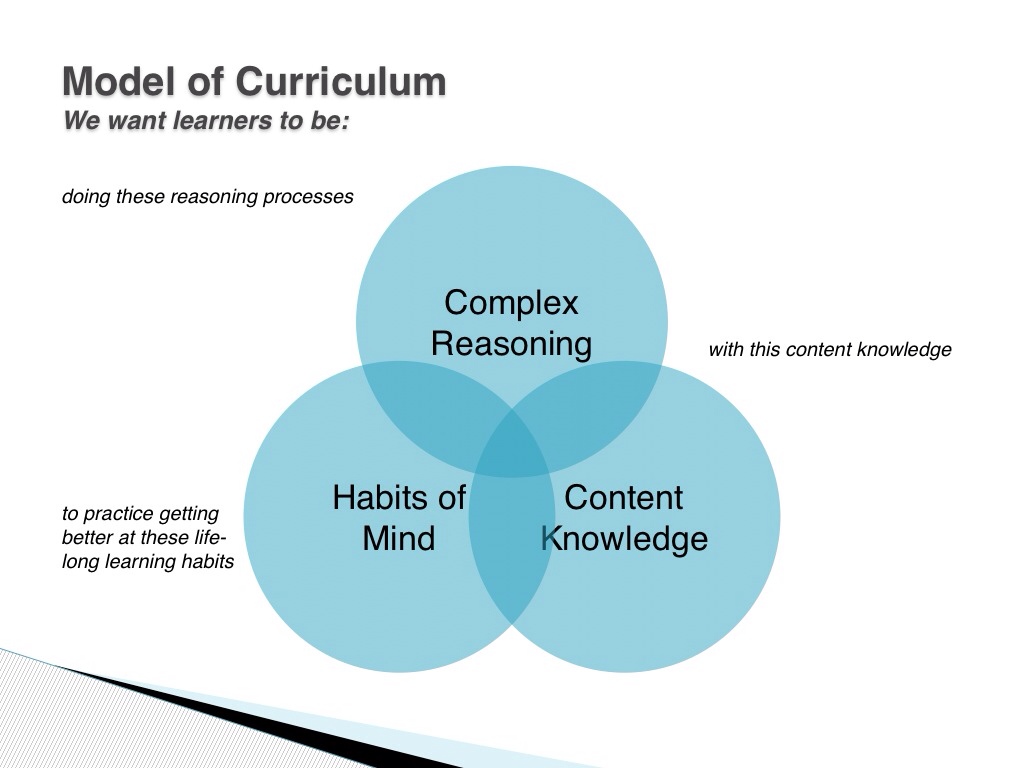
Lesson planning and unit development happens at the intersection of content knowledge, complex reasoning, and life-long habits of mind. We want learners to be – doing these reasoning processes – with this content knowledge – to practice getting better at these life-long learning habits.

Not only is the focus on complex reasoning a key component of Customized Learning, but represents the higher order thinking that is one of the Focus 5 strategies for motivating students.

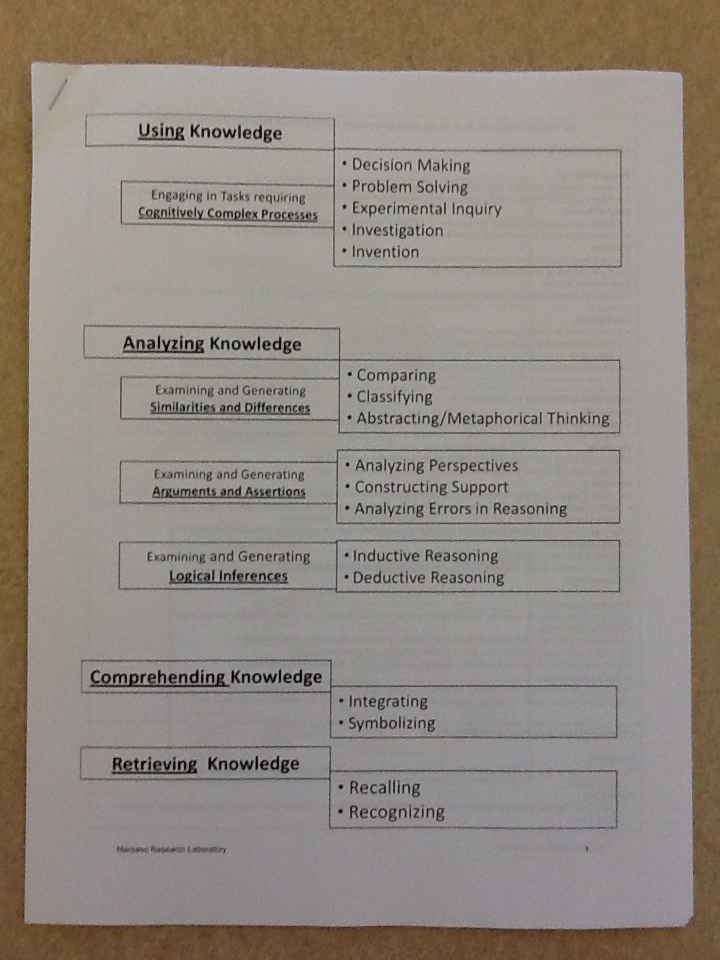
We are using Marzano's framework for higher order thinking. The Complex reasoning curriculum includes the following:

Complex Reasoning Curriculum

Comprehending Knowledge

  • Symbolizing
  • Integrating

Analyzing Knowledge

  • Comparison
  • Classification
  • Error Analysis
  • Deduction & Induction
  • Perspective Analysis
  • Constructing Support

Using Knowledge

  • Decision Making
  • Problem Solving
  • Experimental Inquiry
  • Investigation
  • Invention

The Maine Cohort for Customized Learning has partnered with Debra Pickering and Bea McGarvey of Marzano Associates and are using the curriculum outlined in the Dimensions of Learning: Teacher's Manual as the foundation for our Complex Reasoning curriculum.

The plan is to organize it into the Marzano curriculum framework of measurement topics, learning targets, scopes, and scales, just as the content knowledge curriculum has been. Teachers will be trained to explicitly teach students the strategies. The instruction in each strategy would happen when students might logically apply the strategy (not in an out-of-context separate class), and includes helping students develop an understanding of the process through examples, providing students with written guidelines and graphic organizers, and modeling, modeling, and modeling.


Content Knowledge & Curriculum Organization for Customized Learning

The first of the three domains of our Customized Learning curriculum model isn't very sexy, nor interesting, and is what most folks already think of when you say “curriculum”: Content Knowledge. (But there is some interesting stuff a little further down this post!)

Like most states, Maine's education standards are determined by law (we call ours the Maine Learning Results). These standards, as recently updated, identify the knowledge and skills, as the DOE likes to say,essential for college, career, and citizenship in the 21st century.” As you'd expect, Maine has specific sets of standards for each of eight subject areas:

  • Career and Education Development
  • English Language Arts
  • Health Education and Physical Education
  • Mathematics
  • Science and Technology
  • Social Studies
  • Visual and Performing Arts
  • World Languages

Maine has incorporated the Common Core State Standards for math and English language arts into the Learning Results, and Maine is one of 26 states participating in the development of Next Generation Science Standards.

So, where curriculum gets interesting is in how we organize it to support Customized Learning.

The curriculum from these standards needs to be articulated and organized in a way to facilitate proficiency-based learning. What are the measurement topics within each subject area? What are the learning targets and learning progressions within each measurement topic? What are the scoring guides for each learning target that allow a student to assess their progress and teachers to provide formative feedback?

Educators from districts in the Maine Cohort for Customized Learning have collaborated to organize the curriculum into Marzano's curriculum framework. The framework breaks each content area into a group of Measurement Topics. Each Measurement Topic has a scope, that is a progression of learning targets, and represents the learning required for mastery of that topic. Each level in the scope has a scoring guide, called a scale, that clearly identifies the proficiency target for that level.

In the process of revising how the content knowledge standards are organized and written, some changes have been made. In some cases, what has long been thought of as Content Knowledge, such as scientific reasoning and the experimental process, was moved over to the Complex Reasoning domain because of the nature of the knowledge or skill.

We have also pulled all assessment language from the standards (e.g. ”write a report to demonstrate…”) and left just the pieces that were the actual content knowledge in the standard. Part of Customized Learning is the premise that students should be able to demonstrate mastery in what ever way they choose and deem best (multiple pathways to learning and mastery).

Currently all 8 content areas exist in this framework and are being piloted in classrooms across Maine. Feedback from the pilot classrooms will allow the curriculum teams to revise and update the Content Knowledge curriculum framework. These frameworks will be reviewed and revised annually by the educators who are actually using them.

And all of curriculum frameworks are stored in a learning progress monitoring/management system (Educate) that make it infinitely easier for both students and teachers to know where students are in their learning, what they need to learn next, and to identify a diversity of resources and activities to learn it.


Curriculum and Customized Learning

We are one of the 29 districts who make up the Maine Cohort for Customized Learning. Together, we are on a journey to implement Customized Learning. Further, Maine statute now requires that, by 2017, students in Maine will graduate based on demonstrated mastery of the State's rigorous content knowledge standards, rather than by course credits (seat time).

When you start changing how you organize school for performance-based learning and recognizing that people learn in different ways and in different time frames, you quickly realize that the center of school shifts from courses to the curriculum and where students are within the curriculum.

How you organize the curriculum becomes critically important.

You need an explicit model of curriculum.

Curriculum Model

The model we have adopted views the curriculum as 3 overlapping domains – Complex Reasoning, Content Knowledge, and Life-Long Habits of Mind (“Use these reasoning strategies to learn this content knowledge to develop these habits of mind.”).

So this is the first in a series of posts that hopefully will shed light on how Customized Learning districts are using and organizing the curriculum. Future posts will include not just how we're organizing content knowledge, but the Complex Reasoning curriculum, the Life-Long Habits of Mind curriculum, and learning progress management.


Where Can I Learn More about iPads in Elementary Schools

I get asked regularly, besides my writing about our iPad initiative, who else writes about iPads in elementary education.

Here are some of the folks I read:

  • Sidwell Friends School (the primary grades iPad initiative at the school the Obama girls attend)
  • Fraser Speirs (Scottish tech integrator. Has great posts about iPads in elem sch)
  • Tony Vincent (great info on teaching and learning with mobile tech, especially iPads)
  • Jennie Magiera (amazing tech coach in Chicago, was one of our keynotes at our Leveraging Learning Institute – not exclusively iPads but on the nose about pedagogy with tech)
  • And this blog isn’t about iPads, but we see our iPad initiative as how we implement Customized Learning in the Primary Grades and Mark Davis is a teacher who writes about his experience with customized learning. Very nice, concrete writing about implementation…

Merry Christmas! (And More!)

Merry Christmas, Happy Chanukah, Happy Kwanza, and Happy Holidays!

This is a great season to remind us the importance of how we treat each other, how we care about each other, and how we look out for one another. A good time to remember, regardless of our differences, we are neighbors and colleagues. The season of peace and love and renewal.

Merry Christmas, everyone!

A Response to the Sandy Hook Elementary School Shooting

I have remained quiet, until now, about the recent Sandy Hook Elementary School shooting.

I have seen all the thoughtful posts friends have made to Facebook and Twitter. Not to take away from the heartfelt nature of the posts, but they all started to sound the same, and I wasn't sure a what I could add. And I wasn't sure what I wanted to say that matched what I was feeling.

And I have seen all the sound bites and stories suggesting this happened because there wasn't enough God in schools, or men in schools, or guns and shootists in schools, but I wasn't sure what I could say about those other than to slowly shake my head and say, “You. Have. Got. To. Be. Kidding…”

But a friend at work was really upset about the shooting, even last Friday when we joined with others across the county in a moment of silence, a week after the tragedy, and I realized that there were two things that did comfort me; made me feel better. I shared those two things with my friend and now I share them here.

The first was a Fred Rogers quote which I saw all over social media last week:

“When I was a boy and I would see scary things in the news, my mother would say to me, ‘Look for the helpers. You will always find people who are helping.’ To this day, especially in times of ‘disaster,’ I remember my mother’s words, and I am always comforted by realizing that there are still so many helpers – so many caring people in this world.”

The other was a parent's response to the idea that this happened because there isn't enough God in school. What it really is is a wonderful testimony to the great work teachers do, way beyond making sure children learn the 3 Rs.

These made me feel a little better. Maybe they will you, too.


Social Media for School Leaders

I just returned from the national middle school conference (AMLE12) in Portland, OR.

While there, I attended a wonderful session on Social Media for School Leaders by Howard Johnston and Ron Williamson. Their presentation showed a wonderful balance of the realities of today's viral communication and the school context.

The presentation addressed the role of social media in five areas:

  1. Social Media and Schools
  2. School Safety and Crisis Management
  3. Communication
  4. Productivity
  5. Professional Growth

What they made clear is how important a tool social media is to schools and school leaders, and the enormous opportunity lost when schools shun social media. They raised the following questions suggesting why school leaders might want to pay attention to the potential of social media:

  • Do you communicate with students, families and staff?
  • Do you monitor community views about your school?
  • Do your kids use social media?
  • Do you need to stay on top of cutting-edge educational topics?
  • Do you need to promote good news about your school in the community?

And they recommended a 5-step plan (in part, based on findings from the Pew Internet and American Life Project) related to social media and school safety:

  1. Learn about social media and how it works
  2. Recognize that most teens use it responsibly
  3. Don’t attempt to ban it
  4. Help students, families and staff know about how to manage social media
  5. Focus on responsible student use

Johnston and Williamson provided a great list of resources available to school leaders:


More Indications of Positive Results from Auburn’s iPads

We’ve had iPads in our Kindergarten classrooms for more than a year now. This fall, we also rolled out iPads to our 1st grade students. All in the name of improving students’ mastery of literacy and math.

We know that we have too many students who aren’t demonstrating proficiency, so for several years, we’ve been making sure that teachers are getting quality training in literacy and math instruction, and we’re hopeful that, combined with the access to educational resources made possible through iPads, that we’ll increase that level of proficiency.

And when we examined gains made by last year’s kindergarten students, that’s what we found. Our kindergarten students had made more gains than in years past, leading our Curriculum Director to proclaim that taxpayers’ money is well spent.

Read more about our gains in the Sun Journal article Educators Say iPads Help Scores, and the MPBN radio story Auburn Educators Tout Benefits of iPads for Kindergartners (sorry iPad users; you need flash to listen to the story, but you can still peruse the article).

Learning about Leveraging iPads for Learning

We just wrapped up our second annual Leveraging Learning Institute. We played host to 140 educators from across Maine, the country, and around the world! We had folks from Georgia, West Virginia, Massachusetts, and Pennsylvania. We even had five educators from two schools in Japan. What we all had in common was a passion for the potential of iPads to personalize learning for primary grades students.

Apple even sent a bunch of their people to learn from us about how we’re doing customized learning with iPads.

We had wonderful sessions on everything from the kinds of apps we’re using (presented by our 1st grade students!), to how to use various kinds of data to support your initiative, to communicating with the community, to what to do if your initiative is having troubles, to figuring out the complexities of syncing apps in a school setting. Check out all the sessions here. Resources from sessions and the institute are available here. (Fear not! Over the next couple weeks more and more will be posted. Videos of the keynotes will also eventually be posted.)

In addition to the Auburn team, Education Commissioner Steve Bowen, trauma suregeon Rafael Grossmann, Apple Distinguished Educator Kathy Shirley, Apple Distinguished Educator Jennie Magiera, and customized learning evangelist Bea McGarvey presented and participated. Get connected to all our presenters here.

We had wonderful press coverage! Stories highlighted the conference just prior to its starting, the Commissioner’s involvement in the opening keynote, trauma surgeon Rafael Grossmann, who also shared the opening keynote, and Auburn Kindergarten teacher Amy Heimerl, who did her own research study on the effectiveness of the iPads.

Maybe the best press coverage was our team of Auburn Middle School students who live tweeted every session and even participated in a few! (Search for the #adv2014 hash tag and be sure to set your feed to receive “all posts.”)

We’re already looking forward to next year’s conference. But I’ll warn you! We opened registration in the second half of August and registration filled in just a couple weeks with a long waiting list. After this year’s success, we expect to fill even more quickly!

I’ve Been Busy Writing, But Not On My Blog – Our Race to the Top Grant

I really enjoy writing. Especially about the great projects I'm lucky enougth to be involved in. I use them to populate the Maine Center for Meaningful Engaged Learning website, and to answer other educator's questions. And I like to post at least a couple days a week.

But I haven't been able to do that lately (my last post was more than a month ago!). But not because I haven't been writing. In fact, I've probably been doing more writing lately than I usually do. That's because I'm part of a great writing team preparing a Race to the Top – District grant for a consortium of 5 districts. Here's some info about what we've been working on:

A consortium of schools from across Maine are looking to support their adoption of Customized Learning by applying for a federal grant. The Customized Learning Consortium will apply for a U.S. Department of Education Race to the Top – District Grant to further and support their implementation of Customized Learning. Auburn School Department will act as Lead LEA. Other districts in the Consortium include RSU 3 (Unity, Thorndike), RSU 10 (Dixfield, Rumford, Buckfield), SAD 15 (Gray, New Gloucester), RSU 57 (Waterboro).

All districts are members of the Maine Cohort for Customized Learning, and already collaborating at implementing this approach to personalized learning. All schools in each of the 5 district are participating, so this is a Pre-K/12 initiative, representing over 13,000 students.

The Consortium is eligible to request up to $30M over 4 years. It is still early in the proposal development process, and the exact amount the Consortium will request is yet to be determined. The grant is due October 30, and must include a 10-day comment period by the state and local communities, which is currently underway.

Customized Learning is based on the two core principles: that students learn in different timeframes and in different ways. Research shows that when schools are designed to support these two principles, students learn better. Making a change to Customized Learning requires a lot of capacity building (training, coaching, support, etc) and infrastructure (policies, structures, tools, resources, etc.). The grant will support Consortium district’s implementation of Customized Learning by focusing on these two areas. Grant activities include the following:

Capacity Building

  • Teacher Development
  • Pedagogical Coach Development
  • Leadership Development
  • Community Development
  • Development of Strategies Successful with Students and Families of Poverty

Infrastructure

  • Curriculum Development & Organization (content knowledge; critical reasoning skills; lifelong habits of mind)
  • Learning Progress Management System Development
  • Educational Resources (learning materials, educational devices, apps, etc.)

Please note, that not only is this the work that Consortium districts are currently involved in, but it is the work that all districts in the Maine Cohort for Customized Learning are working on. It is also consistent with the Commissioner of Education’s strategic plan: Education Evolving. Receiving the grant would insure that districts in the Consortium have sufficient resources to successfully complete this work in a timely fashion. Further, lessons learned and products from the Consortium’s involvement in grant activities will be made available to be shared with other Maine schools.

Perhaps the irony is that I'm not sure I could have contributed as much as I did to the narrative sections I drafted if I didn't have my old blog posts to draw from, and the new writing will contribute to new blog posts once the grant is submitted.


Tricks for Teaching Tech Quickly (The Series)

Technology can certainly help a teacher manage her classroom, or keep track of student progress. And there are students who will benefit from becoming computer experts by taking computer classes. But the most powerful use of technology in schools is when it is a learning tool for students, just like their texts, papers, and pens (well, maybe not just like…)

But to leverage the power of technology for learning, the technology needs to be treated as a tool, and most of the time allocated for the activity needs to focus on the curriculum, while making sure that students still learn what they need to in order to use the technology well.

This series of posts will help you do that well in your own classroom:


Kids Teaching Kids: Tricks to Teach Tech Quickly (4 of 4)

This is the fourth in a series of posts on teaching technology quickly so technology-based learning activities can be focused more on the curriculum than on the technology.

Kids Teaching Kids
Another effective strategy is “Kids Teaching Kids.” This strategy is important because many teachers still don’t feel they know as much about technology as their students do (whether they actually do, or not).

The good news is that same feeling of inadequacy translates into the teacher having 15-30 valuable resources right in her own classroom!

In its simplest form, “Kids Teaching Kids” can be as simple as when a student comes to you and says, “I saw that Moesha had some interesting animation in her project; will you show me how to do that?” You respond, “Why don’t you ask Moesha how she did that?”

More deliberate approaches include creating a poster listing typical tech issues, apps, peripherals, devices, and programs for your classroom, and the students who know how to use them, do them, or fix them. When a student needs help with using the iPod Touch as a digital camera, he can look up at the list and see which of his classmates already know how to use it.

Some teachers use the “three before me” rule. If a student has a question about how to do something, she must ask three other students before approaching the teacher.

Another strategy is to teach a new skill or tool to a handful of students, with the expectation that they will then go on and teach the other students.

Notice how each of these approaches both empowers students (often including students who may not have a lot of other opportunities in class to feel empowered!), and frees you to put your energy where it is most needed.


Cheat Sheets: Tricks for Teaching Tech Quickly (3 of 4)

Below, is the third of four posts highlighting techniques that will help insure that teachers are helping students succeed with their work by teaching them the technology skills they need, but doing it quickly, so that most of the time could be spent focusing on content from the curriculum.

Cheat Sheets
The third trick for teaching technology quickly is a strategy that works hand in hand with mini lessons: the use of “Cheat Sheets.”

Cheat Sheets are help guides: step-by-step instructions for using a specific program or doing a specific project. (My students always preferred this name to “help guides” or “instruction sheets,” although I’m not so sure my former Assistant Superintendent liked the name….)

If students were learning how to make Web pages, the teacher might give students a handout with step-by-step directions for making new pages, saving pages, inserting graphics, formatting text, making links to other pages in the project, making links to other Web sites, and creating tables to use for formatting the project.

Unlike mini lessons, there can be many sets of directions on the cheat sheets because students can go directly to the one they need, when they need it.

When teaching mini lessons, it’s valuable to have the teacher model following directions on the cheat sheet. For example, many middle grades students aren’t all that good at following step-by-step directions, and when I was a middle level technology integrator, had students that wanted to start with Step 3, or wanted to do the steps in a different order. In many cases this was simply because they hadn’t been shown how to follow directions (or hadn’t been shown for a long time). Saying, “Where do we start? What's the first step?” or “So, what's the next step? What step number are we on?” can go a long way…

Further, when a student asks how to do something that is on a cheat sheet, I’d often ask her what step she was on. Some students find it easier to ask the teacher how to do something, than to go back to the directions and do it themselves. Redirecting the student to the cheat sheet helped make them more self-reliant and freed me to work with the students who really did need my help (after all, why did we put all the time to writing out directions?).

I often found that after students followed the directions on the cheat sheet three or four times, they had learned the skill and didn’t really need the cheat sheet again. But they always had the cheat sheet to refer to if they came back to do this type of project in the future.

Be sure to share any cheat sheets you create with your colleagues. No reason each teacher needs to create all the cheat sheets themselves. Remember: many hands make light work!