We Must Do More Than Fill Students’ Vessels

I was especially dissatisfied with my own teaching when I started.

Early in my teaching career, I was presented with a paradox that continues to shape my interests in education. When I was teaching high school computer application courses, my students would learn to use a word processor (in the day when stuents were likely to only have access to computers at school). I was very thorough and made sure they learned how to use nearly every feature (although word processors then had many fewer features than they do today!). We spent a lot of time on it, and together we worked hard so that nearly everyone would be successful on the challenging word processing test.

What surprised me, however, was that a few weeks later, students would return to me, announce that they had a paper to write, and ask me to show them how to use “that word processor thing” again!

I couldn't understand why these students didn't remember how to use the program. These were bright students who had had no problems during class, and who had done well on the test. Very little time had gone by since we had last used the word processor. There was no reason that they should not know how to use it.

There was obviously something I didn't understand about learning. It was the first time I started to question how learning took place, and prompted my inquiry into how people learn.

I fear that during my first few years of my teaching, all I had really taught most of my students was that I was knowledgeable within my field. I tried to convey my knowledge to my students but I was simply trying to “fill their vessels.”

The way I organized the curriculum wasn't even oriented toward learning; it was organized for teaching. I was mostly concerned with questions like when were the standardized tests and what would be on them, when would other teachers be teaching related ideas, what would kids need to know for the next course? All my content was organized the way an expert might look at it. It was neatly categorized and sequenced like it might be done by someone who was already familiar with the information.

I never asked myself how people might learn the same information. I never asked how experts had acquired their vast knowledge; was it through a logical sequence or some other order?

Some of my kids seemed to do okay, but not enough of my students to make me feel like I had done a satisfactory job. I knew I was teaching the way all my teachers had taught me, so I knew I was teaching correctly. But somehow contradictions, like with the word processor, kept happening, and I started to doubt if it really were the right way to teach…

Those contradictions and doubts led me to question my assumptions about teaching and learning. Eventually, I found tidbits that helped shape my work, such as the quote from the classical Greek philosopher, Plutarch, “A mind is a fire to kindled, not a vessel to be filled.

My job wasn't to give students information but to inspire and nurture them. And like Ian Jukes says, “Teachers don't need to be fire kindlers, they need to become arsonists!”


The Importance of Helping Students Save Face

Are your hard to teach and underachieving students friendly and kind? Easy to get along with?

Or are they often the students that drive your blood pressure up and tax your patience?

If your experience is like mine, I'm guessing many are in this second group. Getting frustrated with their behavior and performance is an understandable and logical reaction. And speaking to them sharply is often a very human and logical response to their behavior.

But I had an enlightening experience with Josh, one of my challenging students, that helped me rethink things some…

Josh was the kind of student it seemed I had to talk to every five minutes. One day, when I had finally had enough with Josh, I took him out into the hall to talk to him. When I asked him what was up, he responded, “You don’t like me!”

I was really surprised by his statement and asked him what he meant by that. I said, “I live near you and! when I’m out for my walks, we stop and talk. I tease you, which I only do with students I like. I always ask you how you’re doing and I’m interested in what you do. What do you mean I don’t like you?”

Josh said, “You yelled at me in front of the class.”

Now, Josh's actions had warranted a sharp response, he had been disruptive and out of line. But clearly such a response did not lead to Josh settling down. It had not helped me be more successful with Josh.

And suddenly I realized it wasn't about what Josh deserved for his actions (to be chastised or punished), but rather, about what would get me the results I desired (Josh settling down so I could teach the whole class).

I realized that working with Josh (and probably other hard to teach students) would require more psychology than it would require logic.

I started by reminding Josh, “You know, I need you to behave so I can teach all thirty kids in the class. When I’m talking to you every five minutes, I really can’t teach the other twenty-nine.” He had certainly heard this frequently from his other teachers.

But then I said something that really surprised him, “So, what do you need from me so you can do that?”

It was clear that, although he had had more than his share of dressings down, he wasn't used to being asked about his needs. When his jaw came up from off the ground, he said that all he needs is not to feel that I hate him. So success would depend on my not reacting sharply to Josh, especially in front of his classmates.

Josh had taught me about the effectiveness of allowing students to save face.

I have a friend in Louisiana who likes to remind me that one “aw shucks” wipes out a thousand “atta boys.” It doesn’t matter how many times we handle situations delicately with a student, the one time we are sharp with him in front of everyone else, we negate all of our past (positive) history.

Perhaps more than with any other group of students we work with, having a safe and respectful atmosphere is critical both to helping hard to teach students learn and to helping them behave in class. Whenever we are working to correct student behavior, the importance of relationship and having the right kind of environment become even more important (and we certainly seem to spend a disproportionate amount of time on the behavior of hard to teach students!).

Josh and I made an agreement that when Josh got to be “high energy,” I would come over next to his desk and discretely say, “Josh, do you remember what we talked about?” It was private and personal. No one else knew what we were talking about and, when done in an upbeat tone, didn’t even sound like I was admonishing him.

When we implemented the plan, I would just say it in a positive way, and he would say, “Yeah, yeah, yeah,” (with a smile) and settle down. I had to do that every once in a while, but he was much better at monitoring his own behavior. It even began to feel like we were working together on it, not against each other. Occasionally we would have to go back out into the hall, but it wasn’t all that often, certainly not daily or every five minutes like it used to be. It made a huge difference in my ability to work with the whole class and with Josh feeling safe and comfortable.

All because I found a way to let him save face. All because he taught me the importance of letting students save face.


Kindling Fires of Curiosity

“A mind is a fire to kindled, not a vessel to be filled.” (Plutarch)

I am a Mainer who has lived in several homes heated by wood stoves, and have done living history, and have gone camping, so I am no stranger to trying to build fires.

Therefore, it won’t surprise you that my connection to this metaphor is deep.

Most folks know you can’t start a fire just by simply piling up logs and holding a match to them. What a lot of people don’t know is that that method doesn’t even work all that well when lighter fluid is applied (there is usually a short-lived flame that goes out without creating a sustainable fire – and you never want to use accelerant in an enclosed wood stove!)

Fire starters know that building fires is a two stage process: first you have to get the fire going, then you can feed the fire. Both have their own set of strategies. I think when most folks think of having a fire, they think mostly of the second phase and a lot less of the first. Further, I think most folks can feed a fire; it’s just a matter of not adding too much wood too soon (or things get too hot), not letting the coals burn too low (or there arent enough coals to keep the fire going), and adding wood in a way that allows a little air to circulate (or, again, the fresh logs won’t ignite). Even with these caveats, the strategies are fairly forgiving and it isn’t too hard to keep the fire going.

On the other hand, starting a fire isn’t particularly difficult, but it does take a little more strategy. And if you aren’t experienced with fire, these strategies may not be as obvious as those for keeping the fire going.

A good fire starts with some kindling (a variety of small sticks and pieces of dry wood that catch relatively quickly, but will burn long enough to catch the larger sticks and logs that will be added soon) and some tinder (such as newspaper, shavings, twigs, or dry grass) that will catch easily with a match and burn long enough to ignite the kindling.

Even with these components, you aren’t guaranteed a fire; they need to be used properly. The kindling should be stacked in one of a couple of ways: often with smaller kindling and newspaper organized in the center of larger kindling in a “log cabin” or “teepee” configuration. When you light the newspaper, it catches the small kindling, which in turn helps the larger pieces catch. Then, once those get going, you can (carefully) put on the first logs.

You don’t have to use much more strategy than that if the fire catches quickly and cleanly. But what if it doesn’t? Have you ever been camping and tried to light a campfire with damp wood? Or maybe you got the small kindling going, but the larger sticks weren’t catching well? What do you do? How do you get that fire going?

Do you take another match and hold it under the part of the log that isn’t burning?

Of course not! (And, yet, how often do we try that!?)

Instead, you blow where the wood is already burning. Or you add a little more kindling where it is burning. You can’t get your fire lit by attending to the part that isn’t burning. You get it burning by nurturing the fire that is already started and let it spread to the rest. In fact, paying attention to the part not burning will often let what little fire there is go out, leaving you with no fire at all…

Ok. Ok. I feel some of you getting noodgy, wanting to talk about the “logs.” (and yes, at this point, we’re starting to mix metaphors…) Are the logs seasoned (dry?) or are they still moist with sap or wet from a drenching? Sure, most folks can make a fire with well seasoned logs without really trying, but talking about unseasoned logs sounds a little like an argument about why you shouldn’t have to make a fire because some of the wood isn’t dry. I’ll even concede that there are probably some logs that can’t burn, no matter what. But those are few and far between, and should never be used as an excuse to avoid making a fire with less than perfect logs.

In truth, experienced fire builders can start a fire with the wood they have.

The fire building strategies above work well with both dry and damp logs. Whether you get a good fire raging or not probably has more to do with your kindling and tender, or how you nurture the fire, than it does with the logs themselves.

So perhaps, we just need to understand how fires ignite, catch, and burn :

  • Have we thought about what kindling and tinder we will use?
  • Which technique will we apply to the kindling and tinder?
  • How will we nurture the fire as we add the first logs?
  • How will we attend to damp and unseasoned wood to get it burning well?
  • How will we blow on the flames that are already burning, rather than hold a match under the unlit portion?
  • How will we monitor the fire and know just the right time to add to it so it doesn’t burn too hot or burn down and go out?

If teachers are fire builders, perhaps their primary job isn’t to give students information, but rather to inspire and nurture them as they work on their own learning. Sometimes when we are teaching hard to teach students we forget about their interests (don’t blow on the flames) or about making it interesting (adding a little more kindling to the flames) and instead keep plowing along through the curriculum (holding a match to an unlit log). Perhaps, we need to focus on how to use kindling and care to make them burn brightly.

In fact, Ian Jukes says, “Teachers don’t need to be fire kindlers, they need to become arsonists!”

Personal aside: This saying has spoken to me since early in my teaching career, and has certainly shaped my growth as an educator and my work with schools to reach all children. It probably even played some direct role in focusing my dissertation research on motivating underachieving students and in starting the Maine Center for Meaningful Engaged Learning.

At the very least, it has said something to me about changing my assumptions about what it was to teach. And when I think about schools serving all the children of all the people, and about easy-to-teach students and hard-to-teach students, and about students at various levels of engagement, I think we probably need to challenge our assumptions.

How might the fire building metaphor help you think about reaching your students or having conversations with your colleagues about reaching students?

Making Lessons Interesting 2

It may not be possible to always tie curriculum into the students’ interests, even when teachers know their students well. I do believe, however, that we can make things interesting.

Take, for example, adjectives.

This is typically a topic that many students are less than enthusiastic to study (was that an understatement?). Even so, one of the university practicum students I was supervising (teacher candidates doing their sophomore student teaching) had planned a different kind of lesson designed to make adjectives interesting to students.

When the students came into the room, each pair of students had a little brown paper lunch bag. On the brown paper lunch bag was written one of the five senses. The practicum student began, “There is a mystery object in your brown paper lunch bag and what you are going to do is try and help us figure our what your mystery object is. What you and your partner are going to do is write down as many descriptive words as you can about your mystery object. Don’t take your mystery object out of the bag, because you don’t want anybody to see it, but write down as many descriptive words as you can. Each descriptive word should only relate to the sense written on your bag.”

For example, if the bag was labeled “sight,” the students could only write about what it looked like. If it said “taste” the students could only write about what it tasted like. If it said “hearing,” the students could only write about what it sounded like, etc.

So students generated their words and then the class regrouped and each pair read off their lists. When the other students could figure out what the mystery object was, just from the list of descriptive words, the whole class applauded! When the students could not figure out what the object was, my student teacher would say, “Wow, those were great descriptive words, but we didn’t figure out what it is yet. Why don’t you show us what it is and the rest of you now think of descriptive words for that sense that would have helped you figure it out!” And the students could often think of a couple words that would have helped the class.

When they were all done deducing the objects in the bags, the practicum student asked, “Do you know what we’ve been working with all day today? We’ve been working with adjectives. Adjectives are just descriptive words.” Then she would instruct the students to open their grammar books and do a series of exercises related to identifying and applying adjectives.

And the students did the assignment!

Have you ever seen kids willingly do assignments in the grammar book?!

It was because they were hooked; because she made it interesting to them first.


How do you try to hook students on a topic you are teaching?

Making Lessons Interesting 1

Intrinsic motivation (things that we're interested in) is probably our most powerful motivator. Interest as a motivator is not just building on what students are already interested in. It is also about making things interesting.

  • Can you use novelty?
  • Can you make it a mystery?
  • Can you make it fun?
  • Can you make it interesting?

My doctorate focused on what motivates underachieving middle school students (article; dissertation). In the Underachievers Study, even though students thought that much of their work did not tie in with their interests, they did find some of the work interesting. This varied by the individual. Doris liked teachers sharing stories from their past. Cathy liked lessons related to government and books such as The Outsiders and Huck Finn, which related to the South, where she had lived as a young child. Ben thought his fourth grade teacher, who dressed up as story characters, was interesting.

There is a special category that motivates middle school students: “blood and guts.” Why do you think those “Grossology” books that we all love to hate sell so well? Because middle school kids love belching and farting, body parts and bodily fluids. They love anything disgusting! So anything, we can tie productively into belching and farting will capture their imaginations! Mrs. Edwards, a teacher in the study, reported that Ben also liked blood and guts and anything gory, “Ben loves books that have gory stuff things in them. He loved Edgar Allan Poe.”

When I was a university Practicum Supervisor (supervising sophomore student teachers during their first field experience), I was in a sixth grade science teacher’s classroom and they were introducing students to the microscope. A common introductory activity for working with microscopes is to look at the difference between plant cells and animal cells. Often the activity uses onions because they have large cells. The activity also often calls for using cells from inside their mouths. The students have to take a cotton swab, dab the inside of their cheeks, and put it on a slide.

What do all the sixth grade girls say at this point in the activity? “Ewwwww, gross!” But they almost always follow that immediately with, “Let me do it!”


What do you do to make your lessons interesting?

Student Motivation: What Level of Engagement Are Your Students At?

I’ve worked a lot with schools wanting to motivate students, and we have largely focused on the “how.” In this work, I have named the conditions necessary for students to be motivated. My list includes student voice and choice, higher order thinking, inviting schools, learning by doing, and real world connections.

But wouldn’t it also be helpful to think in some productive way about how motivated students are?

Thinking of kids as simply being motivated or not is not all that helpful. In my work, I’ve often asked that students be thought of as “easy to teach” or “hard to teach,” and although this framework is helpful for certain conversations with educators, this isn’t really the same construct as how motivated or engaged students are.

My friends at the Great Schools Partnership have defined engagement in their iWalkThrough tool as the percent of students that are on task during the classroom observation. Again, although perhaps a useful operationalization of “engagement” for a walk through protocol, I’m not sure this is really the same construct as student motivation and engagement…

But I think I have finally found that useful, practical way of thinking about how motivated students are. I recently learned of Phil Schlechty’s five patterns of engagement, described here:

Authentic Engagement. The student associates the task with a result or product that has meaning and value for the student, such as reading a book on a topic of personal interest or to get information needed to solve a problem the student is actively trying to solve.

Ritual Engagement. The task has little inherent or direct value to the student, but the student associates it with outcomes or results that do have value, as when a student reads a book in order to pass a test.

Passive Compliance. The task is done to avoid negative consequences, although the student sees little meaning or value in the tasks themselves.

Retreatism. The student is disengaged from the tasks and does not attempt to comply with the demands of the task, but does not try to disrupt the work or substitute other activities for it.

Rebellion. The student refuses to do the task, tries to disrupt the work, or attempts to substitute other tasks to which he or she is committed in lieu of those assigned by the teacher.

These certainly aren’t the kinds of classifications that a visitor could observe on a walk through, but I believe any teacher could place each of their own students into these categories.

Here are a couple of things I really like about having this framework:

  • It differentiates students’ levels of motivation well beyond “he’s motivated or he’s not.”
  • It provides a framework for educators discussing how motivated their students are.
  • These might even be interpreted as levels and a thoughtful educator mighty work to move students from one level to the next.
  • It helps teachers differentiate their strategies for motivating students (moving them to a “higher” level) based on what category the student falls in.
  • It helps answer the question of why we (educators) might still have work to do, even when students do well on tests or are getting good grades (they could still be in the Ritual Engagement or Passive Compliant categories).

How might this framework enhance and extend your conversations with educators about student motivation?

What’s to Blame for Kids Not Learning?

If you’ve been following this blog for a while, you know I believe all students can learn. You know I think there are “easy to teach” students and “hard to teach” students, but I think they all can learn. So what is it that gets in the way of students learning?

When I ask teachers that question, they often generate a list like this one:

    • Attitude
    • Lack of home support
    • Learning disability
    • Learning styles
    • Substance abuse
    • Apathy
    • Defiance
    • Low aspirations
    • Lack of sleep
    • Lazy
    • Peer pressure
    • How the teacher teaches
    • Lack of preparation
    • Normal distractions

There is no doubt that home and social factors have an enormous impact on achievement. Many students come to school facing problems that cannot be fixed by anything that teachers might do. We could point to a long list of factors such as psychological problems, emotional problems, poor study habits, low self-esteem, withdrawal, aggression, social isolation, conflicts at home, over-expectations of parents, under-expectations of parents, physical or medical causes, social/class differences and expectations, conflicts with teachers, lack of academic readiness and preparation, learning disabilities, poor home life, unsupportive parents, previous traumatic experience, poverty, and low self-confidence.

When you look at lists like these, it is easy to understand why educators might fall into the trap of blaming others for why some students aren’t learning.

But we need to be careful of blame as this poem (author unknown) points out:

Different Levels of Blaming Each Other for What has Happened…

The college professor who said such wrong in the student is a shame,
Lack of preparation in high school is to blame.
Said the high school teacher good heavens that boy is a fool,
The fault of course is with the middle school.
The middle school teachers said from such stupidity may I be spared,
They sent him up to me so unprepared.
The primary teacher said the kindergarten blockheads all,
They call it preparation, why it’s worse than none at all.
The kindergarten teacher said, such lack of training never did I see,
What kind of mother must that woman be.
The mother said poor helpless child–he’s not to blame,
His father’s folks are all the same.
Said the father at the end of the line,
I doubt the rascal is even mine!

Blaming, however, does not help us address the issue of helping every child learn. I am reminded of the old saying, “Do you want to fix blame, or do you want to fix problems?” Perhaps another familiar saying is appropriate here:

Grant me the serenity to accept the things I cannot change.
The strength to change the things I can, and
The wisdom to know the difference.

While it is easy to identify all those factors that contribute to a child not succeeding in school, it is much more important that we identify the ones we do and do not have significant control over. For example, we can’t control if students are sleepy unless we let them sleep in class, and we can’t control anything that happens away of school unless we adopt them (and supervise them closely!). And there is no way to control what has happened to them in the past.

So what can we control? What factors can we change? Where is the opportunity for us to impact learning, especially with students facing lots of challenges?

And the only answer is: What we do in the classroom. Instruction.

Classroom practice, how we teach and how we interact with students, is one of the few factors impacting achievement over which teachers have direct control. A few premises of this blog are that school practice does play a role in both underachievement and achievement, and that changing instruction to better meet the needs of hard to teach students can both help reverse negative achievement patterns and counter-act the negative conditions over which we have no control.

And maybe that’s the best reason for a teacher to focus on engaging students in meaningful learning: to gain a little more control…


What Makes for Good Learning Experiences?

The more we try to to help build the talents of every student and help every learner succeed in school, the more we have to be deliberate about creating good learning experiences in our classrooms. I have certainly added to the conversation about what I believe gives students good learning experiences.

The roots of those ideas are not just my own experiences as a learner and a teacher, and not just conducting research and reviewing research, but from actually asking people about their own good learning experiences. The Good Learning Experiences Activity is one of the ways I have explored different people’s perspectives on how they think they learn well.

“Think of a good learning experience,” the script for the activity begins. “It can be in school, or out of school. It can be when your grandfather taught you how to cast a fly rod, or when your teacher worked with you to write that really good essay. But think of a time when you had an ‘aha!’ or something finally made sense, or you could finally do something. Think of a good learning experience.”

I give small groups of participants a few minutes to share their stories. Next, I ask them to jot down on scratch paper what it was that made it a good learning experience. What were the characteristics of the experience? After a few more minutes to share their lists with their neighbors, we compile a class list on chart paper, an overhead, or on a projected computer.


Before reading on, just take a second to think about a good learning experience of your own, and what it was that made that a good learning experience.


I have conducted the activity with people of nearly every age group: upper elementary students, middle school students, high school students, college students, teachers, and parents. Only a few learners state that they can’t think of any good learning experience. Many of the learners state that their best learning experiences have taken place outside of school. No one has ever said that their best learning experience came from a terrific lecture, or an interesting textbook, or an engaging worksheet (although I believe each of these can be a useful teaching tool when applied wisely).

Having conducted this activity with so many groups, I am intrigued by the results. I was surprised to find that, regardless of the group involved, there were common elements with other groups’ lists. Since 1992, I informally tracked the results and found that certain characteristics of good learning experiences come up in nearly every list:

  • The work was well connected to other ideas and to the real world
  • The content of the learning experience was personally relevant, interesting, useful, or meaningful to the learner
  • The learner had choices, shared authority, control, and responsibility
  • The learning was hands-on and experiential
  • The learner learned from and taught others
  • The learner had the support of a patient, supportive, and nurturing mentor
  • The learning was individualized and although there were standards for the work, the learner could meet them in his or her own way
  • There was a positive aesthetic component to the experience: it was fun or left the learner feeling good
  • The experience helped the learner understand him or herself
  • The learner had success and accomplishment with challenging work

Now, these are my words synthesizing the lists I have collected over the two decades I’ve been doing this activity. Certainly elementary students aren’t going to use these word exactly. But doesn’t this list reflect what made your own good learning experience good?

Much can be learned by investigating how students believe they learn well. What better source for finding out what motivates students to learn than themselves?

But with knowledge comes responsibility. If you know what makes for good learning experiences, don’t you now have an obligation to insure that you model these in our own teaching? – Or at least start learning how to do these in the classroom?


(Note: I have been with educators who have used the prompt “think of a good experience” or “think of a good school experience”, and it never gets to the right information about when people learn well. If you are considering doing this activity with your own students or teachers or parents, I highly recommend that you stick with the prompt “think of a good learning experience.”)


We Had It All Backwards: The Two Types of Instruction

When I told my Curriculum Director, Shelly, about my thinking about there being two types of instruction (Instruction for Lower Level Thinking and Instruction for Higher Order Thinking), she seemed to think the idea made a lot of sense to her, especially in the context of our work around Customized Learning.

She agreed that given how curriculum is organized within Customized Learning, we couldn’t continue to emphasize lower level thinking.

And we got talking about how, since all our middle and high school students had laptops, probably the low level learning, the recall and simple application, was something that students could largely do on their own (with guidance, and coaching).

And then Shelly said, you know, we’ve had it all backwards…

She told me about when she was a high school science teacher, she did a cell unit with students. She used to spend about two weeks of direct instruction to insure that students knew all the parts of a cell. Then she would turn students loose to do an analogy project, where they would write about how a cell and it’s parts were like something else (maybe a football team, or a corporation) and its parts. Students largely worked on this project on their own.

And we reflected on the irony that we (teachers) would spend so much time on something students could probably do on their own (looking up background information). And we did so little direct teaching on something that students probably needed more modeling and assistance with, the higher order thinking.

And we reflected on how teachers should really do a unit, like the cell unit, the other way around. Turn kids loose to learn about the parts of a cell, then do a bunch of instruction and scaffolding on how to make a good analogy (or what ever kind of complex reasoning we’re asking students to apply).

Other places do it that way. Carpe Diem is a 6-12 public school in Arizona that allocates its teaching resources directed at the higher order thinking more than the lower level thinking. Students use online curriculum, supervised by educational technicians, to learn the basics within a unit. Then students spend a large block of time each day, working directly with certified teachers, doing projects and other activities that require higher order thinking (nontrivial application, complex reasoning, and creating) with the content and skills from the unit. Watch this video about Carpe Diem’s approach.


What impact would it have on your students, if we turned them loose to use technology to learn the basic information in a unit, and then we spent quality time with them, both instructing students in how to do complex reasoning, and in applying complex reasoning to the content?

Thinking of Instruction as Two Types

When our pilot teachers were visiting a school that is a little further along than we are at implementing Customized Learning, a colleague and I got talking about how we (us and our colleagues) had a lot of work to do on instruction if we were going to be successful with our implementation.

Then it hit us that a lot of teachers would say they already do a pretty good job with instruction and would object to being told that we had a lot of work to do on it.

And then I realized that both perspectives were right. We just weren’t talking about the same kind of instruction in each instance.

There are two kinds of instruction.

There is Instruction for Lower Order Thinking and Instruction for Higher Order Thinking.

So, it doesn’t matter if you use Bloom’s Taxonomy, New Bloom’s, Marzano’s Taxonomy, or Webb’s Depth of Knowledge, Instruction for Lower Level Thinking is focused on recall and simple application, and Instruction for Higher Order Thinking is focused on nontrivial application, complex reasoning, and creating.

Our teachers are really pretty good at Instruction for Lower Order Thinking. But we have a lot of work to do on Instruction for Higher Order Thinking.

The distinction, thinking of instruction as two types, doesn’t just help clarify our thinking.

This distinction would actually help us in a couple different ways.

We now could say, “You guys are really good at Instruction for Lower Level Thinking. But now, to do Customized Learning well, we need to help you get better at Instruction for Higher Level Thinking.” The message about getting better at instruction would have always been about support, but could have been taken as criticism of their abilities. Now, we can differentiate between validating their abilities, and identifying a need, and offering support to address that need.

And it helps us think about when should teachers apply each type of instruction.

And it will help teachers think about how the two kinds of instruction are different and which strategies support which type.

And it helps us think about leveraging what kinds of interventions to support teachers.

What would thinking of instruction as two types mean to you and the work you are doing in your school?

School is Boring

School is boring.

We all know it.

Kids know it.

Parents know it, but don’t want to think about it.

We teachers know it, too, but defend it. In some small way, I think we don’t want to think that the subject(s) we love could possibly be boring! But we do go on to say things like: It’s preparation for life after school. We all have to do things in life that we don’t want to do. Or, I wish students would start taking responsibility for their own learning. Or, it is the students’ job to learn.

My problem with putting the onus on students is that we are all quick to forget that kids are not in school by choice. They are in school by law. Ironically, it is we, the educators, who are in school by choice. In fact, we are getting paid to help kids learn. In fact, we are the only ones getting paid – if learning were the children’s job, wouldn’t they get paid, too? To me this all shifts the moral responsibility.

And we are quick to forget that kids are kids. And that being a kid when you are a kid is appropriate. It is what you are supposed to be!

And we are the adults.

And we spend WAY too much time trying every possible crazy thing so solve the problem, EXCEPT trying to engage students. It’s enough to make you tired!

I think teachers defend school being boring because we fear we will be blamed.

But I don’t blame teachers.

(Well, if you lecture through an 80 minute block, perhaps you should be blamed…)

Edwards Demming, the father of Total Quality Management, says that 95% of our problems come from structures, not people. And Roger Schank actually makes the argument that it is school being boring that is to blame for kids not learning more, not teachers! In response to Tom Friedman’s blaming teachers, Schank writes:

So one more time for Tom: the problem is that school is boring and irrelevant and all the kids know it. They know they will never need algebra, or trigonometry. They know they will never need to balance chemical equations and they know they won’t need random historical myths promoted by the school system. When all this stuff was mandated in 1892 it was for a different time and a different kind of student.

I’m not denying that it’s hard, or that teachers get frustrated when we are trying what we think we can and not getting any further than we do. Why wouldn’t we feel like we were treading water as fast as we can?! And maybe that even makes it (a little) understandable when we blame kids for not learning.

But, the the solution to ALL this is teachers doing more to engage students.

Not be because it is our fault.

Because it is what we have control over.

And if we want teachers to engage students, then we sure better support the heck out of teachers!

And even though its true, we can’t simply say to teachers, you just have to focus on these five things: inviting schools, higher order thinking, learning by doing, real world connections, and student voice and choice.

We need to get teachers training. And into classrooms with teachers who do a good job engaging students. And we all better remove the barriers that are keeping us from creating the conditions that students find engaging (even if it means changing our curriculum, or how we schedule students, or how we group and regroup students, or how we connect with the community and the potential classrooms outside the building).

And the good news is that when kids aren’t bored, they don’t only learn more (making teachers/us look good), they behave better (making teachers/us happier!).

We need to get beyond the (irrelevant) question of who is to blame, or the (senseless) debate of whether we should or not, and just do it! Just work to engage students!

Engaging students is a win-win! It’s good for kids and it’s good for teachers. Just do it!


How will you help make school less boring?


Positive Pressure & Support Part 3: Support

Schools need effective, practical approaches to helping more students succeed academically.

A focus on student motivation and meaningful, engaged learning, on project- or problem-based learning, on personalized, customized learning, or on technology rich learning environments are all approaches that can help make that happen, but require a paradigm shift for teachers, since few of them have experienced these approaches themselves.

Successfully implementing initiatives that require a paradigm shift for educators requires strong, deliberate leadership for school change. The key pieces of Positive Pressure and Support (setting expectations, supervising for those expectations, and supporting those efforts) are necessary components of that leadership, and is the primary way to drive your initiative to a higher level of implementation.

Teachers will start using more core strategies of your initiative when they know it is expected of them and is being monitored—but they need (and deserve) support in getting there. What follows are some of the support strategies that I’ve found helpful.

Support: Celebrating Successes
Celebrating successes is the place to start. Implementing signficant school change is a long road, so the people working to implement those changes need encouragement and to know they are on the right track. Your expectations may be high, but teachers, like students, need to progress (to some extent) at their own pace and within their own capabilities. Nudging, prodding, and pushing are much more effective when combined with pats on the back and kind words, even if it is just small things being noticed.

For the teachers most resistant to change or the most challenged by the change, celebrating baby steps is especially important. With our own children, we didn’t wait to get excited until they could run. We got excited when they could crawl, then when they could stand, and again when they could put one foot in front of the other, and on and on. We need to celebrate each developmental growth step the staff passes through.

Often the best “celebrations” aren’t time consuming or expensive. As you’re walking down the hall, walk beside the teacher and say, “Your kids were pretty engaged during that lesson. You must have done a great job with that new strategy!” Or stick your head in the door during the teacher’s break and say, “Do you mind taking 5 minutes at our next meeting to tell the staff about that thing I saw you do this week? I think others will want to know how to do that.” Or as you leave a walk through, hand the teacher a 3×5 note card, where you’ve written, “I know you were frustrated with how things went in general, but I think you need to remember that the part where you did X, Y or Z went pretty well.” (Notice how the whole thing doesn’t even have to go well to celebrate the parts that did!)

Celebrating growth, progress, and success gives the message that this is important, that you noticed what they have done, and that they are on the right track. This is the fuel that keeps a staff working on hard work.

Support: Facilitate the Sharing of Ideas
By definition, this is “new” work: new to the teachers, new to the students, new to the leadership team. Sure, this initiative may be similar to others, or share components with those you’ve worked on in the past. But I’ve been defining large-scale school change as often being A change that teachers don’t have much experience putting into action, even if they have read about it, have heard about it, or are familiar with the key ideas.

And I have a friend who likes to say, “Teachers can’t do what they haven’t experienced.” Teaches are more often stumped with implementing an initiative by that lack of knowing what it looks like, feels like, tastes like, that not knowing for sure how to put it into action, than by any intent or determination to block or sabotage (even if blocking and sabotaging are how fear of failure most often surfaces for teachers!).

As the high school in Auburn is working toward implementing Customized Learning, many of our teachers are starting to use a Parking Lot, a kind of poster used to solicit students’ ideas, questions, feedback, and input. One of our teachers recently told us that he doesn’t believe in the Parking Lot because he put one up and students don’t use it. But, if we want teachers to put into practice something they haven’t done before, we owe it to them to help them find ideas on how to put it into action – how to make it work. We know that Parking Lots have been implemented effectively elsewhere. What strategies did those teachers use, and how could we connect our teacher with those strategies?

I wrote quite a bit in the last post about how talking about the initiative in meetings and modeling lessons can help with sharing ideas. Having teachers share in staff meetings and professional development sessions about their challenges and successes with their work in the classroom provides opportunities to get advice from their colleagues and to learn new strategies. So can having teachers visit schools and classrooms where the initiative is already in action (even within your own building or district!). Alternately, have teachers watch videos or read stories of how others implemented similar work – not informational pieces “about” the initiative, but those that actually illustrate “how” the initiative works, those that provide vicarious experiences.

Regardless of how you make it happen, you need to be thinking about where you can help teachers find their new ideas on how to implement the core strategies of your initiative.

Support: Provide Opportunities for Training and Professional Development
Part of support is looking for ways to provide further training and professional development. In fact, PD may be the first thing you think of when you think “support.” I know if you are thinking of a new initiative, you are already thinking about how to get your staff trained.

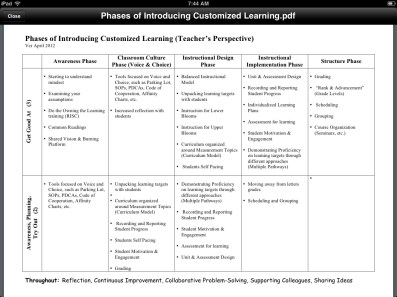
But you can’t think about this only in terms of initial training. If this is a big initiative, such as Customized Learning, then you need to be thinking about implementing it in phases, that means delivering training in phases, too. In Maine, the training for the first couple phases of implementing Customized Learning is generally “Own The Learning” (awareness), “Classroom Design and Delivery” (creating a culture of voice and choice), and “Instructional Design and Delivery” (working with the curriculum and organizing instruction around it). Not all the staff needs to be trained in the phases at the same time. In fact, staggering the training for staff can mean that folks a phase or two ahead can become resources for the rest of the staff.

But even if an initiative doesn’t lend itself to clearly defined phases, make sure that you are thinking of training in ongoing, not “one shot,” terms. In our kindergarten iPad initiative, we had one training at the end of the school year for teachers new to the initiative to get their iPads, learn how to use it for as a personal tool, and how to start identifying apps that might relate to their teaching. That was followed, late in the summer, with a two-day training helping teachers think more about teaching with the iPads. Then, throughout the year, we took advantage of Early Release Wednesdays, meeting nearly every other week.

Where are there other opportunities to get staff trained? Can you cajole your colleagues in another district for a handful of seats in their training? Is there a workshop or conference coming up in your region that directly addresses a need within your initiative? Do you have staff that you could groom to train others on some aspect of the initiative? Do you have someone you could free up to go into colleagues’ classrooms and coach them?

Your walkthrough data, teacher survey data, and conversations about the initiative at staff meetings should help you focus on the training and support your staff needs most at that moment.

Support: Provide Resources
Do your staff have the resources they need for this initiative? Do they have their own school-issued iPad or laptop? Does the wireless network adequately support as many simultaneous users as you are likely to have? Are there apps or programs your teachers need? Can teachers get to the websites they need to get to? Is there a book that will will help them design their lessons? Are there materials teachers need to execute those lessons? Do teachers have access to the expertise (perhaps in the form of books or of people) to put their learning activities into action? Do they have a reasonable number of the texts or equipment they need?

I was once involved with a non-traditional school in a mid-sized city. The school was trying to be a project-based career academy for students who were over-aged, but under-credentialed. We had a pretty effective and engaging online literacy program for students who were struggling because of their literacy ability. But the district Director of Curriculum (who also used to be a literacy specialist) insisted that we only use the district-approved literacy program (you know, the one that hadn’t worked for these students yet…). But we said ok, and she promised to send us the materials.

What showed up were the left over materials from the other schools in the district. Not only were there not enough of any item for there to be a class set (and we had 12 classes), there wasn’t even at least a single copy of each key set of materials in the program!

If you want your teachers to put your initiative into action, then make sure they have all (reasonable) materials they may need to do so.

Support: Remove Barriers and Run Interference
Doing something new is hard enough. But it is almost impossible if you see barriers around you, or you are left exposed to criticism. One of the most important ways you can support your staff is also something that they may never know that you do: removing barriers and running interference. Teachers making a good faith effort to implement your initiative deserve support in getting obstacles out of their way.

Many of the typical barriers you’ll remove simply by following the other suggestions in this post. Does a teacher not know how to implement a component of your initiative? Connect them with training or other teachers who can share their ideas on how to do it. Is not having certain resources or materials interfering with the teacher increasing their level of implementation? Find a way to get them the resources they need.

Time may be the largest perceived barrier for teachers. Find ways to create protected, designated time for planning and collaboration. Even if you have the protected time, sometimes teachers have so much going on that the time is used for other things, or to vent (perhaps not even about the initiative). Working to have those planning and collaboration times, and creating an agenda for each meeting to guide the work can remove that barrier.

Another type of barrier is the unhappy parent or colleague member. Such complaints are often based on a little truth, but often with a lot of missing information. As a leader, you have an opportunity to protect your staff from attacks and distractions. You can deal directly with the unhappy person and take the heat, then bring the legitimate pieces of the concern to the staff member in a much more calm, safe, supportive way.

Another way you help run interference for your teachers is by encouraging everyone (especially yourself) to “seek first to understand” (one of Stephen Covey’s habits of highly successful people). What is the full story of the thing the person is upset about? Students don’t like the way the teacher is teaching? What exactly is the teacher trying? What parts does the teacher think are going well and not so well? What does the teacher see as his next steps? It may be perfectly appropriate to respond to the parent or colleague, “Well, that teacher is working hard to implement the initiative beyond where he has been trained. He’s aware of the challenges he is having and has already asked for help in addressing those challenges.” And frankly, we need teachers who are willing to take those kinds of risks and blaze a trail of the rest of the staff.

My mantra is that if we want teachers to learn how to do things they haven’t experienced before, then we better be ready to support the heck out of them. If you want to drive your school initiative to a high level of implementation, help your teachers help you get there. How you get your teachers the training and ideas they need, work to remove barriers for staff doing this work, run interference as they make good faith attempts to implement new ideas, and how you connect staff to resources will also leave your teachers feeling supported as they work to meet higher expectations.

How do you plan to support your teachers as they strive to implement your large-scale school change?

 

Positive Pressure & Support Part 2: Supervision

So, you’re waist deep in your school’s initiative. Maybe it’s improving learning by taking advantage of 1to1 tablets or laptops, or through Mass Customized Learning, or with a focus on student motivation and engagement.

And you are providing teachers with training and resources. And you are working to leverage Positive Pressure and Support to drive your initiative to a high level of implementation. You’ve taken the first step and set expectations with your staff. In general, your staff are working to put those into action.

And you’re ready to move your implementation to the next level. It’s time to focus on supervision.

Most educators really do work hard at trying to do a good job in all aspects, not just for the initiative, and that means that they are busy and have lots of (sometimes contradictory) priorities they are trying to address. Knowing what school leaders are keeping an eye on can help focus their efforts. Frankly, even the best teachers are more likely to address priorities that they know are being supervised. An expectation that is simply stated is not as likely to be implemented as one that is both stated and monitored. Think of the old assessment adage, “What gets measured gets done.”

Several strategies help leaders supervise for the implementation of their initiative.

Supervise: Check With Teachers
Periodically checking in with teachers can go a long way toward increasing implementation. Check their lesson plans. Are they clearly planning to use desired strategies as often as you’d like? You don’t necessarily have to have everyone turn in their plans weekly. Random spot checks can be powerful and not a time-sink for you. You can always increase the frequency of checks with teachers who need a little extra encouragement.

Alternately, give teachers a weekly survey. In Advantage 2014, our iPads in kindergarten initiative, we used a Google form to survey the teachers each week. They simply had to select drop down choices for each item, such as how many times this week did you use iPads in literacy centers? Or how often this week did you use iPads for individual student interventions? These survey questions came directly from our expectations for the program. We also included “what have been your successes?” and “what have been your challenges?” as open response questions in the survey. This has been an added bonus, because it provides invaluable information on when a teacher might be a resource to others and where teachers need additional (and timely!) support.

Supervise: Talk About Implementation at Staff Meetings
Take a little time at every staff meeting (or grade level meeting, or department meeting, etc.) to talk about the initiative. I like to make sure there is time for teachers to share what specific things they have done and what has gone well or what has been challenging. Sometimes I’ll use information I’ve gotten from the surveys to either offer a tip that might be a quick fix to a challenge, or to ask a teacher who has had a success to take 5-10 minutes to describe what they did, or to model a lesson.

It doesn’t hurt to review the specific expectations and even have a conversation about any of them that teachers want to talk about. Of course, people are people, so such open conversations about expectations, expectations that some might be struggling with, takes good facilitation skills (e.g. have you collaboratively set norms with your staff for discussions in staff meetings?).

(Note: if you want to be a leader for school change, one of the biggest favors you can do for yourself is to learn effective strategies for facilitating difficult conversations. No one really enjoys conflict or when emotions are running high, but, in the end, your colleagues will appreciate you’re working to deal with those situations is a respectful, safe way, rather than avoid them and brush them under the rug – or worse! Deal with them ineffectively to increase conflict and make emotions higher…)

It is clear that taking the time to talk about their strategies for implementing the initiative (and meeting expectations) will reinforce the expectations. And this strategy will tell the staff that this is important and we want to keep moving toward our vision.

But it is also a supervisory move. Who is sharing and who isn’t? What does what each teacher shares tell you about how they are doing with the initiative? Are they just “yes ma’am”-ing you, or are they really trying strategies (even if they aren’t being entirely successful yet)? Do their comments show depth (like they’re really trying and thinking about what they are trying), or are comments kind of superficial (like they want you to think they are trying)?

Supervise: Conduct Walk Throughs
“Walk throughs” can mean different things to different people, or in different contexts. Here, I mean frequent, brief classroom visits. It is helpful to use some short of checklist or form to collect a little data on observable instructional characteristics connected to your initiative and to your explicit expectations. So, in the context of Positive Pressure and Support, walk throughs are when you quietly drop into the room, watch, make a few marks on a form, smile at the teacher, and leave.

And I especially do not mean the classroom observations that are used for evaluation. Walk throughs work best when they are used as formative assessment (information to guide and inform your efforts to increase the level of implementation), rather than as evaluative data. Teachers will behave differently when they believe they are being evaluated, not simply observed or supported. The best walk through data (data that will help you increase the level of implementation of your initiative) comes when teachers feel safe when being observed.

In fact, if you are the one doing teacher appraisals and evaluations, you may not be the right person to do the walk throughs. If you are going to do these walk throughs, you may have to do some groundwork with your staff to help them understand the difference between this data and appraisal data, and reassure staff that this data will be used to help the school get better at the initiative, not for their evaluations. (Of course, it goes without saying that the quickest way to undermine your own initiative is to violate staff trust by using this walk through data for evaluations.)

Alternately, having teachers do walk throughs on each other can be a powerful strategy that produces added benefits. You can free staff to take a period every couple of weeks to do drop-in walk throughs of their peers. Not only do teachers often feel safer being observed by their peers, but teachers are often isolated from each other, and seeing other teachers teach can give the visiting teacher ideas for their own practice.

Observations forms should match your initiative’s goals and your expectatons. A quick google search will help you find samples, or you can create your own. For Advantage 2014, we created this walk through form for principals, connected directly to our expectations. When working with schools on using Meaningful Engaged Learning, I have used this walk through form that looks for low-impact and high-impact motivators. There is a wonderful online walk through service called iWalkThrough. It allows you to use a laptop, tablet, or smart phone to record your observable data using one of their pre-established observation forms.

Supervise: Talk About Walk Through and Level of Implementation Data
Clearly there is little “positive pressure” unless you use the data you have collected. How do you leverage that data, if you aren’t going to use it for evaluation? How can it be used to increase the level of implementation?

Start with tabulating data so that you can get a quick picture of where the staff is as a whole. One advantage of iWalkThrough is that it automatically does this for you (in fact, because everyone using iWalkThrough is using the same observation forms, you can even see how your school is doing against the agregate performance of all iWalkThrough users). Sharing this data at a staff meeting gives you the opportunity to have the staff comment on the school’s progress (including praise, and recognizing effort and progress), and even brainstorm how they might move to the next level. This is especially helpful as data is collected over time and the school can track its progress month to month, or term to term.

Tools like iWalkThrough will even allow you to use the data in interesting ways. In one staff meeting at a school I was working with, we called up the data and created a graph mapping “level of student engagement” onto “level of Blooms.” Wasn’t that telling! You can do similar kinds of investigations if you put your own data into a spreadsheet, but that’s a little more involved.

Tabulating individual teacher data will let you know where each staff member is, and provides the opportunity to have conversations with each teacher about their own progress and about setting individual goals (but I don’t recommend this unless you have been using the school data alone for a while and are starting to see progress). Having teachers examine their own level of implementation against the school’s agregate data can be a reality check. Sometimes, teachers who are struggling think everyone else is, too, and they believe they are doing just fine. But seeing that the school as a whole is ahead of them can lead them to ask what others are doing that they are not (if they feel safe and supported). Conversely, teachers who are way ahead of the school as a whole can shift from being frustrated that others aren’t further, to thinking about how they might support their colleagues.


Supervising is where you create the “positive pressure” to move your initiative to a higher level of implementation. Supervising helps provide your staff the feedback and evidence they need to continue to move toward the school’s vision. But keep in mind that it is “positive” pressure you’re looking for. Negative pressure is likely to take you in the other direction, toward a lower level of implementaiton. You need the pressure to help drive your initiative, but you need to be mindful of whether you are creating positive or negative pressure.

Other than the strategies described here, how else might you create positive pressure?


Auburn’s Messages About Learning with Technology for Commissioner Bowen

Commissioner Bowen Visits Auburn Schools

This morning, Maine Education Commissioner Steve Bowen spent an hour at Auburn’s Fairview Elementary School.

We had been wanting Commissioner Bowen to see how Auburn’s schools are leveraging technology for learning. Although the brevity of his visit precluded having him go to the middle school or the high school, we did get him to one of our elementary schools.

The Commissioner was able to visit Kelly McCarthy’s kindergarten classroom to experience Advantage 2014, our literacy and math program with iPads. Next, he visited Stephanie Marris’s 6th grade to see project-based learning with laptops in action (in this case, working on filming and editing plays students were creating and performing).

The Auburn team had three key messages for Commissioner Bowen about teaching and learning with technology.

Teachers Need to Get Out of the Way
Teachers are used to being the experts and passing their knowledge on to students. This sometimes leads to teachers feeling uncomfortable when they aren’t the expert. In many cases, however, students are more comfortable with technology than their teachers are. Teachers need to get out of the way of their students when it comes to technology. They need to see what the students can teach them, and allow students to pursue ways to use the technology for learning that the teachers themselves might not know how to do. This can be especially true for teachers in grade levels starting an initiative while inheriting students who have already been in it for a year or more (as it was for 8th grade teachers in the second year of MLTI a decade ago, and will be for Auburn’s 1st Grade teachers this coming year).

Teachers Can Teach More
When teachers are intentional in their planning, and are selecting apps and activities that both match the curriculum and engage students, the students can be more self directed, receive more immediate feedback, and spend more time on task. This allows teachers to give more students individualized attention, as well as give each student what they need academically when they need it. More teaching gets done!

It Takes Deliberate Leadership
Successfully leveraging technology for learning doesn’t just happen. Kids don’t learn better just because we passed out laptops or tables. It takes planning, and team work, and communication, and positive pressure and support, and lots and lots of PD and support for teachers. It takes leadership with school change in mind.


Driving Your Initiative: Positive Pressure & Support (Part 1: Expectations)

So you’re working on your school initiative, and you really believe in it, and you really want it to make a difference.

And you are trying to pay attention to leadership for school change, and have certainly provided training to your staff and have made resources available.

Unfortunately, simply participating in training and having the resources available does not mean that students will do better or that your initiative will have it’s desired impact. The degree to which teachers implement your initiative and related strategies matters. Level of implementation matters.

So, how do you get your level of implemention up?

Providing Positive Pressure and Support is how school leaders affect the level of implementation. Positive Pressure and Support is made up of three easy pieces:

  • Expect
  • Supervise
  • Support

This is the first in a series of three posts on Positive Pressure and Support, each on one of the three pieces, and this first focusing on setting expectations.

Expect – Start Simple
When MLTI, the country’s first statewide learning with laptop initiative, first got started in 2001, there were still an awful lot of teachers who had not used technology much themselves, let alone used it in the classroom with students. The goal, of course, was to impact learning, but more than a few teachers were a little intimidated by either having to teach differently (especially with a device they weren’t that familiar with), or by having every middle schooler sitting in front of them having a laptop (that the student was probably a lot more comfortable with it than they were!).

But we started seeing good progress in schools where the principal made a simple expectation: Do one unit, between now and Christmas, that involves students using the laptops.

That seemed to take the pressure off of teachers who may have assumed that since laptops were everywhere, they needed to be used all the time. In fact, many of those teachers then did their single unit (perhaps to get it out of the way) and discovered that it wasn’t so bad and started using the laptops pretty regularly.

But without the expectation, reluctant teachers may have continued to put off using all the technology in their classrooms.

Similarly, setting initial expectations for Meaningful Engaged Learning can be as simple as letting teachers know you expect to see greater implementation of the Focus Five strategies. Setting expectations for an iPad initiative can be as simple as letting staff know you’d like to see the iPads used in centers. Expectations for getting started in another initiative might be the following: participate in the offered training; increase the use of higher order thinking strategies in daily lessons and activities; do at least one engaging task with students each week; and do one project in a unit in one class before the end of the next grading period.

But setting expectations (even starting with simple ones) can help overcome the (often understandable) inertia that some teachers may feel at the start of a new initiative.

Expect – Participate Yourself
Another way to set expectations is to participate yourself. Busy leaders sometimes find it hard to take the time to attend trainings. But doing so sends the vital message that you value the training and think it’s important. Participating in the training also means that you know what you can expect your staff to be able to do in their classrooms and can better supervise and support the implementation of those strategies.

I once worked with a school where the principal would announce the professional development then leave. We had a hard time getting staff to an adequate level of implementation, I’m sure in no small part because many staff felt that if the initiative wasn’t important enough for the prinicpal’s time, why should it be important enough for theirs…

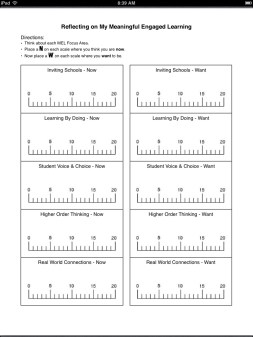
Meaningful Engaged Learning goal setting form

Expect – Have Teachers Set Goals
Teachers seem to do better with expectations when they have a voice in setting them. One way to do that is to have teachers set goals. When I have worked with schools using Meaningful Engaged Learning as their School Improvement Program, I have had teachers think about the five components of Meaningful Engaged Learning, and asked them to rate themselves on where they think they are in implementing each component (I have used this form).

I then ask them to think about where they would like to be on implementing each component at the end of some timeframe (the end of the semester, for example). When that time frame is up, we can reflect again on what progress has been made.

This approach sets the expectation that we will get better at each component, while both validating that the teacher may already be good at some of those components (is already meeting that expectation), and giving the teacher a voice in deciding how much energy to put into each component, and which they will focus on the most.

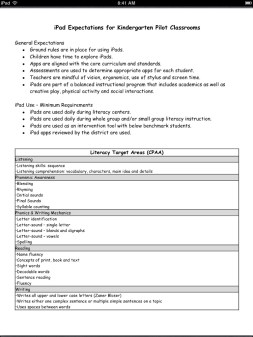
iPad expectations

Expect – Collaboratively Set Expectations
Another way to give teachers voice is to collaborate with them on setting those expectations. That’s what we did in Auburn, as we started Advantage 2014, our math and literacy initiative that includes iPads in Kindergarten. We simply had a conversation. What should our expectations be? In what kinds of activities should we expect to see the iPads used? How often?

The consensus that grew from those discussions became our expectations for the program. This included general guidelines, like apps should correlate to our curriculum, and that iPads are part of of balanced educational program that includes traditional approaches, and included minimum expectations for use, such as using iPads daily in literacy stations, or using iPads for interventions with students.

When collaboratively planning expectations related to implementing new initiatives and strategies, it should be a goal to set specific expectations on those strategies:

  • How many?
  • How often?
  • By when?
  • By whom?


These four strategies for setting expecations should help you get started with Positive Pressure and Support. How will you set expectations with your staff? What will those expectations focus on?


What is Our Purpose for Education?

As I have mentioned, there were recently some interesting conversations on the MiddleTalk listserve around each of the points in the Forbes article, “Nine Dangerous Things You Were Taught In School.”

Number 9 is “The purpose of your education is your future career.”

Rick Wormeli reminded us that we are all more than just our job descriptions.

And Chris Toy thought that developing these would make for a noble educational purpose:

  • Curiosity
  • Wonder
  • Love of Learning
  • Finding Out
  • Imagination
  • Experimenting
  • Exploring

This listserve thread prompted me also to reflect on various expressed goals and purposes of education (both those expressed through words and those expressed through actions and practices)…

I think it’s great if one outcome for a young graduate is that they are work-ready and can find employment. Our Chamber of Commerce would certainly agree.

But I don’t think that’s the only purpose we have for an education. I think there are several other purposes, if we both think back to public cries for education, and if we watch what people’s behavior and actions seem to say about what they believe. Some I believe in and some I clearly don’t.

John Dewey suggested that education was both preparation for life and life itself.

Folks involved in customized learning (in all the many forms it exists and names it goes by) would say that education is for developing the talents and passions of each child.

Every time we get a new wave of immigrants, some suggest that the purpose of education is to acclimate the new arrivals to being Americans, while others suggest that it is to prepare us to understand and appreciate diversity.

Our founding fathers would say that it is to prepare citizens to live in (and contribute to) a democracy.

I think some folks are very concrete (perhaps they would say “practical”) and say the purpose is to learn math, science, social studies, English, and some other content.

Sometimes I think the US Department of Education believes the purpose of education is to teach students how to pass tests.

I heard on NPR recently, during a conversation about homework, a statement that would suggest that some believe education should teach young people the “life lesson” of doing things they don’t want to do (sorry, I just gagged a little…).

Sometimes I think some groups believe the purpose of education is to prove that some people (mostly their own kids) are better than other people (the whole sorting thing…).

I also believe (sadly) that in some small circles, the purpose of education is to preserve the institution of schools as they exist today.

Monte Selby pointed out that when he teaches various educational philosophies to college students wanting to be teachers, even undergraduates represent each of those different philosophies passionately! He wrapped up by saying:

It was very clear for them to see how I taught, and they could accurately “label” my philosophy. And they liked how that impacted them in the classroom. But, even though they thought my philosophy was ideal for them, many still thought that “their” philosophy was what other children needed.

To simplify – nearly all liked receiving a personalized, self-improvement, “differentiated” format to develop their own talents and passions – a good philosophy for them. Even when their own philosophy stated a different ideal approach to educating youth.

(I think, as ironic as it sounds, we sometimes forget that working in schools is about working with people, not widgets, and Monte’s anecdote is a reminder of what I have said here before: we need to use more psychology in our educational decision making, and less logic!)

I do believe that some of the ongoing trouble we face is that we don’t have any agreement on the purpose(s) of public education, beyond some agreement that kids should be in school to a certain age and learn something in agreed upon content areas (even if we can’t agree on specific content within those subject areas).

For me, I wish the purpose we agreed was our goal was developing the talents and passions of each child. I wonder how many other goals that would achieve at the same time. But I also think that would require that we make some substantial changes to our schools and how they operate….


What If Sitting In Class Were As Much Fun As Days Off!

I participate in conversations on the Association for Middle Level Education’s MiddleTalk listserve. Recently, we’ve had a series of interesting conversations around each of the 9 points in the Forbes article, “Nine Dangerous Things You Were Taught In School.”

Number 8 is “Days off are more fun than sitting in class.”

I caught myself thinking this one might be true…

Most of you reading this know, my own professional work has focused, for a long time, on motivating students. I constantly wonder how many of our problems would we solved if we just put more energy into how to engage students and how to make learning meaningful to them: attendance; behavior; being on task; distractions like technology and social media; achievement; and on and on.

Now in all fairness, I don’t blame teachers for this lack of focus on engagement and student motivation. I think few of us grew up in schools focused on motivation and engagement, and few of us went through teacher preparation programs that emphasized (let alone modeled!) a focus on engagement and motivation. And you can’t do what you don’t know.

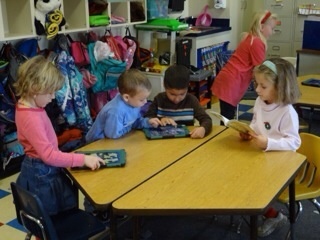
Young children engaged with an iPad

That said, I do think now is the time to start building that focus. It seems clear, when I think about the the challenges schools face, like the day-to-day issues listed above. And it seems clear as competition for students is increasing (public schools, private schools, charter schools, online schools, political pressure for school choice, etc.). And it seems clear as I think about the shift from Industrial Age education, with its focus on developing the talents of the few and the compliance of the many, to Information Age education, with its need to develop the talents in all.

But, if we’re going to ask teachers to do what they have not experienced, then we need to support the heck out of them. And not with information. Information doesn’t change practice, teachers need experiences! Send them to schools and classrooms that are doing a great job of motivating students. And share stories and videos of such classrooms. Structure workshops and courses and committee meetings (any school function focused on the adults needing to learn) so that they model the conditions that motivate learners.

And then, maybe, if we do focus on engagement and motivation, being in class would be more fun than a day off…


Mexican Food Schools

I remember being in high school, and frustrated with school, and thinking, “I can do this better than it’s being done to me!”

I think that thought alone is the main reason I became a teacher.

But it is also the reason I worked on what I called “the Making Algebra Meaningful Project” (Surprisingly not an oxymoron! But it took me a long time to come to that conclusion…). And it was why I started looking at teaching and learning with technology, became a technology integrator, and later a partner in the first statewide learning with laptop initiative. And it was why I did my graduate research on motivating underachievers.

Keep in mind that when I started teaching, I didn’t really know how to teach any way other than “how it was done to me,” but it was my motivation to explore how to reach more learners.

An innovative educational program

For about five years, I had the opportunity to work with a great group that focused on creating schools designed to motivate students (well, still focuses, I just work in Auburn now). Among other projects, we helped the School District of Philadelphia write and support a Magnet School grant, and we created a successful nontraditional school that combines online curriculum with project-based learning and graduated students at a high rate. And they helped me create Projects4ME, the statewide virtual project-based program for at-risk and dropout youth in Maine, that got me connected to Auburn in the first place.

We were/are big believers in multiple pathways to graduation, and that educators will only be successful raising graduation rates and decreasing dropout rates when districts offer students several different approaches to learning, so they can choose the one that works for them.

When we would talk to a superintendent about creating a school for them, we liked to say, “No one really cares if you like Chinese food and I like Mexican food and we go to different restaurants. But we tend to only have Chinese food schools and say there is something wrong with me for being a Mexican food learner.”

We were trying to make those Mexican food schools.

Now I’m in Auburn, where we’re working hard not just to make Mexican food schools for students, but Mexican food programs inside of schools, and lots of other “flavors,” as well.

What are you doing to make sure your students’ diverse tastes in how they learn well are being addressed?


Not All At Once: The Phases of Implementing Customized Learning

Some folks have started hearing grumblings from educators and community members about their school’s work on implementing Customized Learning. And these grumblings make us worry (rightly) if working toward Customized Learning is really the right move.

Here are some of the actual grumblings I’m hearing from within my own district and from other Maine districts working toward customized learning:

  • Parents in District A have made their concerns well known (and well publicized) that they do not like, nor do they want, the changes to grading and report cards that the district has implemented.
  • Principal B wants to know how we can possibly do this work without first changing how we schedule and group students, as well as change our grading system.
  • Teachers in School C wonder what they’ll do with students who finish a course-worth of work by mid-March.
  • Teacher D says he has posted the poster-like tool that is supposed to solicit students’ questions, ideas, and feedback, but students won’t use it.
  • Colleagues and students of Teacher E don’t think the way he is implementing customized learning is working and are saying, “If the way he is doing customized learning is what customized learning is all about, we don’t want to do it.”

Hearing these kinds of concerns, it’s not hard to understand why some people might think there are (serious) problems with Customized Learning, and maybe schools shouldnt do it.

And yet, I know that schools have implemented it successfully.

I’ve enjoyed having the chance to talk with some of the educators from some of those schools about their lessons learned. And from this initiative and others, I’ve learned that by looking at the contrasts between where an initiative works and where it doesn’t, you can learn something about what the successful schools have done and what the less successful schools might not have done.

I’ve grown to believe the root of the problems I’ve shared above is not with Customized Learning itself, but with thinking of Customized Learning as some gigantic, monolithic monstrosity that must be dropped on a school all at once. There is no doubt that there are a lot of moving parts, and that those parts are interrelated, and that it is hard to imagine implementing one component completely without implementing another component completely.

And yet, all of the lessons I learned from conversations with educators in schools where it is working have focused on the opposite of doing it all at once:

  • Schools should think of implementing Customized Learning as something that will take about 5 years.
  • Although flexible, there is one general sequence (phases) of change that seems to work better than others.
  • The sequence is a little counter-intuitive, but, again, works better than others, so should be stuck to, even if it is counter-intuitive.
  • Trying to skip phases, or jump ahead phases, or doing phases out of sequence doesn’t work and derails and delays the change process.
  • Although it is always ok to experiment with and try out strategies and techniques from up-coming phases, each phase has strategies and techniques that teachers and leaders should be working to perfect prior to moving on to the next phase.
  • It is ok to have educators in the same school/district in different phases at the same time, but it is also ok to refer to the phase where the school or district is in general, as a whole.
  • It seems to help to have some early adopters in each school, who are a phase or two ahead of the rest of the staff.
  • Save the school structure changes (grading, scheduling, etc.) for last; although you can readily identify that you need new structures now, you won’t know what structures you need until you have been doing the work for a while.
Phases of Implementing Customized Learning

For Auburn, Shelly Mogul, our Curriculum Director, and I created (with some help and input from colleagues) a chart highlighting 5 phases of implementing Customized Learning (download it here). Within each phase, the chart clarifies what we have learned about what staff should be getting good at and the kinds of things they should start dabbling in. We see the following five phases:

  • Awareness Phase
  • Classroom Culture Phase (Voice & Choice)
  • Instructional Design Phase
  • Instructional Implementation Phase
  • School Structures Phase

And notice how understanding the phases of implementing Customized Learning actually helps us understand the problems described in the beginning of this post. It’s important to recognize that when we implement pieces too soon, they can cause problems or might end up being the wrong pieces. That the purpose of being in a particular phase is to get good at the strategies and techniques of that phase, both by seeking out support and resources, and by school leaders bringing support and resources to the staff in that phase. And that it is ok to say, “Yes that is a concern, but we’re only in Phase X and we should wait to deal with that when we reach Phase Y.” And it helps to be able to say, when things are running roughly for a teacher with the courage to try things out, but others bring up concerns, “Well, remember that Teacher E is in Phase X and trying out ideas two phases ahead of that, without training, and has in fact recognized himself that it isn’t going well and has asked for suggestions and support.”

I don’t believe that all the challenges of Customized Learning will be solved just by thinking about phases of implementation. Clearly some come from thinking about leadership for school change, or about the role of technology, or about student motivation. But I do think that many of the ground floor challenges that come during early implementation are related to trying to do everything at once (or out of order).

How could reflecting on and having conversations about the Phases of Implementing Customized Learning help your school or district?


10 Key Components of Customized Learning

The talk in Maine schools right now, perhaps even more than Common Core, is Customized Learning. The recently established Maine Cohort for Customized Learning is made up of 27 full and associate member districts collaborating on implementing Customized Learning. And Maine’s Education Commissioner’s strategic plan, Education Evolving, is looking to clear a path through state law and policy to help any districts implement Customized Learning.

Students working on a project

But what is Customized Learning?

It really just boils down to two principles: everyone learns in different timeframes and in different ways. Customized Learning is educators being deliberate about how they organize instruction and school structures to support (and take advantage of) these two principles.

Deep down, parents and teachers know these principles well. We recognized them in our own children and in our students. And yet most schools are still organized in such a way as to try to have students learn in the same way at the same time (the power of the familiar!). You can’t help but wonder how much of our challenges with student achievement, special education and support services, student behavior, and student motivation aren’t directly linked to the number of students who have been forced to attempt to learn using someone else’s pace and style!

Customized Learning goes by a lot of different names around the country: standards-based instruction; performance-based instruction; individualized instruction. And there are good models of Customized Learning, for example: RISC (Reinventing Schools Coalition), student designed projects (such as the Minnesota New Country School and Projects4ME), the Foxfire Approach, and Integrative Curriculum.

In fact, Maine’s schools have decided to use the more generic term “Customized Learning” to indicate that we are not aligning ourselves with any one model or approach, but rather are working to identify the components of Customized Learning and explore which models and approaches have strong programs and techniques for each particular component. No one model does all the components well, and Maine can learn from all the good models.

I have grown to think that there are 10 key components to Customized Learning:

1) Shared Vision
It has been said that you can have the best sailboat, the best crew, the best navigational equipment, and the best weather, but if you aren’t in agreement about where you’re sailing, you’re going to have a horrible trip (and probably not arrive anywhere you wanted to be!). Schools that work collaboratively with their staff, students, parents, and community members to come to agreement on their vision for the school/district, are able to more productively make the changes and implement the initiatives they think will improve their schools.

2) Burning Platform
Why should the school and community change? What’s your most compelling reason? Is it some local community need? Is it that, looking at test scores, your schools are working for too few students? Is it the changing economy? This is your burning platform; that driving reason for change that educators and community can rally around.

3) Climate of Student Voice and Choice
Having students learn at their own pace, and in their preferred way has never been about simply letting students do what ever they want. Good Customized Learning takes skilled guidance, direction, and coaching from thoughtful teachers. But that coaching and guidance does require a climate where students are used to sharing their ideas, thoughts, and questions, and where they are getting better at making some of their own decisions. Customized learning doesn’t work well with passive students who just wait to be told what to do next. In fact, moving a school toward customized learning also requires that the staff start to feel that they, too, work and live in a climate where they have voice and choice.

4) Instruction for Low Order Thinking
Regardless of which taxonomy you use (Bloom’s, New Bloom’s, Webb’s Depth of Knowledge, Marzano’s New Taxonomy), low order thinking center’s on a student’s ability to recall or remember. This is the kind of teaching most of our teachers are pretty proficient at. What are the best techniques to not just help students acquire new knowledge but also to insure that it can be remembered/recalled later?

5) Instruction for Higher Order Thinking
Higher Order Thinking focuses on a student’s ability to use knowledge and think critically. Historically, we haven’t seen much of this in our classrooms. And when we have, often we have asked students to apply these skills without doing much teaching or scaffolding on how to do these skills well. What are the best techniques both for helping students develop these higher order thinking skills and learning to apply them to content knowledge?

6) Curriculum Content and Organization
If students are to learn more closely to their own pace, and have choices about how they learn material, there needs to be great clarity about what the curriculum is. Within each discipline, standards and measurement topics must be identified. These standards need to be the concepts and skills that we will guarantee that every student learns (Our lists of curriculum will become shorter. We will give up some favorite units and lessons, but we are simply identifying that which everyone will learn. Many will learn much more.) Measurement topics need to be scaffolded and a progression identified. And all this must be organized, documented, and published in a practical way so that both educators and students can access, understand, and make use of the curriculum.

7) Formative Feedback
One of the most powerful forms of instruction a teacher can leverage is providing students feedback on their work as they are working. This formative feedback is critical to Customized Learning. What are effective strategies for providing formative feedback?

8) Learning Progress Management
With students working at different paces and awarding students “credit” based on what they can demonstrate they know and can do (rather than by seat time or courses they have completed), educators need a good way to monitor and record student progress. Further, there is a coaching element to Learning Progress Management. What is the role of individualized learning plans? How do you help use progress data to keep students moving through the measurement topics? How do you encourage and support (as well as cajole and lovingly nag) students to keep workng? Technology has made this aspect of Customized Learning much more practical and doable.

9) Multiple Pathways
Do students have access to different ways to learn material? Can some take traditional classes, while others do online courses, or design a project, or do an internship? This is multiple pathways. Many schools have a few pathways already in place, but they tend to be “all or nothing” pathways, defining the entire program for a student (the regular high school, the vocational technical center programs, an alternative school). In the context of Customized Learning, students have access to multiple pathways for each course/topic/subject area.

10) School Structures
Once a school starts implementing Customized Learning, they realize that they need to think about updating some of their long-standing structures and infrastructure. How will you group (and re-group) students? What about schedules and assigning students to class? How long will courses (or maybe seminars) last and how will they be organized? What about grades and reporting to parents? Customized learning will (eventually) drive you to change your structures.


Of course, Customized Learning probably can’t be achieved in a school or district without also exploring leadership for school change, the role technology might play, or how to create the conditions that students find motivating

Learn more about Customized Learning at the McMEL Customized Learning Page.