How the Phases Help Support Implementation and Teachers

The Phases of Implementation are actually a tool to leverage in support of teachers and the school's or district's implementation of Customized Learning. The components of Customized Learning are certainly not new to schools, but successfully implementing CL depends on raising the level of level of implementation and the consistency of implementation across the school and school year so they don't simply occur in certain classrooms or during certain units. But learning to implement all those moving parts, in a sequence that actually works, can seem daunting! The Phases take a complex initiative (Customized Learning) and break it into manageable chunks, supporting implementation (and teachers!) in several ways.

The Phases Help Leaders Articulate Where the Staff and School are in Their Implementation
The notion of phases is helpful to leadership because they can classify their educators by the phase each is in. Not only can teachers be identified as being in a specific phase, but so can teams (grade levels, interdisciplinary teams, departments, etc.), schools, and districts based on the phase of the majority of their teachers. This helps with articulating to the district, parents, and community where you are on your journey toward implementing Customized Learning, and reminds everyone that this work will not be completed over night (our district has a 5-year plan for implementation!), and helps everyone manage expectations about what should be happening in our schools at this point in the implementation.

Keep in mind that teachers within a school will be at different phases. Districts in the Maine Cohort for Customized Learning have had success with having early adopters pilot a phase ahead of the rest of the staff, and even when the majority of staff in a school are ready to move to the next phase, there will be new staff needing initial training, or staff who are progressing at a different pace than their colleagues.

The Phases Help Teachers Focus Their Professional Learning and Implementation
The phases help educators know the “curriculum” of implementing Customized Learning, where they are in the scope and sequence of that curriculum, and what goals and next steps they might need for progressing to the next level. The goal of any phase is to develop proficiency in the skills related to that phase. This will lead to a strategic progression of more and more skill at creating a personalized learning environment for students, where we expect students to have an improved sense of having their learning needs met, resulting in increased competence, engagement, and academic success.

It is always okay for teachers to dabble, try out, and explore features of a phase or two ahead of where they are, but only within the context of informal learning (“dabbling”). Educators' primary responsibility is getting good at the skills of their current phase.

“Plan, Do, Check, and Adjust” is a crucial component of implementation at each phase, insuring that reflection, continuous improvement, collaborative problem-solving, supporting colleagues, and sharing ideas are hallmarks of the teachers' work.

The Phases Help Leaders Plan for Professional Development
Leadership can more easily plan for training, support, coaching, and professional development because of the Phases : (a) leaders can articulate where their staff are in their professional learning progression; (b) the kinds of resources, training, and coaching needed differs by phase; and (c) how much of that support is needed depends on how many staff are in each phase. Similar to how students will move through the curriculum via Customized Learning, teachers demonstrate mastery of components in one phase before moving on to the next phase.

The first three phases each begin with educators participating in specific training designed to kick off that phase by orienting them to the key components and the work that awaits them (I have come to think of them as “same page” trainings since they are intended to get everyone on the same page.). Other trainings (offered as teachers need them, see below) help teaching staff become more familiar with the curriculum organization, the complex reasoning and life-long habits of mind curriculum strands, various instructional strategies, learning progress management, student motivation, etc.

In fact, from the Classroom Culture phase on, we do not automatically provide teachers the “next” trainings and professional development until they have demostrated some proficiency with the skills, tools, and concepts of the phase they are currenty in. They must get good at the current phase before moving on.

The Phases Help Leaders Focus Positive Pressure and Support
Level of implementation matters, and leaders increase level of implementation through Positive Pressure and Support. Positive Pressure and Support has three pieces: Expectations, Supervision, and Support. We have just discussed support, but the Phases help focus Positive Pressure and Support, as well, by making clear the expectations (getting good a skills in the phase you're teachers are in), and by clarifying what to look for in classrooms when supervising and supporting (those same skills of the current phase).

Even if the Phases help provide clarity, leaders still need training and support themselves so they know the phases and what each phase's skills look like. For example, are teachers in the Classroom Culture Phase actually working within their phase toward getting feedback from students, or are they jumping ahead? Have teachers simply posted some of the tools (such as a Parking Lot) or are they actually providing students with opportunities and guidance on providing feedback using a Parking Lot. Is the absence of a Parking Lot a sign that a teacher isn't focused on Student Voice and Choice, or is the teacher simply using other strategies?


This approach to scaling the reform is successful specifically because, at any given moment, the work is personalized to the immediate needs of the teacher, team, school, or district. Team level, school level, district level, and consortium level. Shared leadership teams (a) determine where their educators and communities are in the process of implementing customized learning (using the phases as a guide), (b) design individualized implementation plans and interventions for their group, and (c) provide positive pressure and support for moving to the next level.


Form Follows Function: The Phases Inform Structural Change

One of the big mistakes schools and districts new to Customized Learning make too often is to make structural changes to things like grading, grade levels, courses, and student grouping too early in the change process.

I think this happens for a couple reasons.

One may be that much of the work in the early phases is to address a shared vision and burning platform, to examine our beliefs about learning, to explore what Customized Learning looks like in action, to build the right kind of culture in your classroom, and to make the curriculum more transparent and navigable for students and teachers. This is heady work that often doesn’t seem like action. Changing grading or the schedule is tangible and is action.

Another reason I think it happens is that it doesn’t take long doing even the early stages of this work to realize that how we currently grade, and schedule, and group students, and organize curriculum into courses probably will need to be changed to do Customized Learning well.

There is a major problem with these reasons (even if it is perfectly understandable why educators would feel them): change those structures to what?

It is understandable to want more tangible action. And it is obvious quickly that the structures will need to change. But until a critical mass of the staff have built a classroom culture of voice and choice, made the curriculum transparent and navigable, and have developed some proficiency at a balanced instructional model that provides for both learning higher-order thinking and lower-level thinking, it will not be clear what kind of grading will work for you, or scheduling, or organizing “courses” or “seminars,” etc.

Then there are the political or strategic issues around the public being ready for those kinds of changes (heaven forbid school look different than when they were students!). Making structural changes too soon has led to public backlash (this, for example). When the school is further along with implementation, and there have been strong efforts to build understanding and support among parents, the public understands why those changes are being made and sees a need for them.

Recently, I discussed the phases of implementation. You might have noticed how each of the early phases said “In the Current System.” This is a reminder that those big structural changes come later. The phases should follow the Biology principal of “form follows function.” The initial phases are implemented within the current school system, but the changes in curriculum organization, classroom culture, and instruction inform us about how school structures (student grouping, grades, courses, schedules, etc.) need to change. Even early implementation makes clear the inadequacy of the current approach of these components for Customized Learning, leading to educators often wanting to jump to making these structural changed early in the process.

But, in truth, we don’t know what to change them to until we’ve had a chance to get good at the components of earlier phases in the process.

They are important changes. And they will come. But wait until the right time.

If It Sounds Crazy, That’s Probably Not How They’re Doing It

Teachers can sometimes have wild ideas about how a new initiative will work, but a recent experience helped us figure out how to lower teachers's anxiety.

A while back, one of the schools I'm working with had a staff meeting where we talked with middle grades students what had been student reporters at a conference focused on Customized Learning and iPads.

The students were enthusiastic and passionate about their involvement in the conference, as well as what they were starting to learn about Customized Learning.

Other than a handful of pilot teachers, this school has not received any significant training on Customized Learning and is very much at the beginning of their journey to implementation. Therefore the teachers were very interested in what the students had to say and their enthusiasm, and started asking student all their numerous questions about CL and even started to ask the students lots of “how to” questions about how things worked in CL.

I had to quickly remind the teachers that these students had simply attended and reported on a handful of conference sessions about CL and had experienced very little of it themselves. All the questions were perfectly legitimate, and reflect the natural curiosity that you would expect teachers to have at the Awareness Phase of implementation, but that we should probably save our practical, how-to questions for teachers and students who are more experienced! (and we all laughed – the student passion had certainly left us all feeling for the moment that the students were all-knowing experts about Customized Learning! And, of course, these middle grades students never hesitated to create an answer if they didn't actually know it!)

What was really interesting, however, were the teachers' questions. They were asking how they could work with 100 students all in different places in their learning? How did they just let students work at what ever pace they wanted? And how did teachers create a 100 different lesson plans a day to customized the learning? And did teachers just let unmotivated students do nothing? And how could students learn things if there was no direct instruction?

These are all understandable and appropriate questions of teachers early in the Awareness Phase of implementation. But they largely represented enormously false assumptions about Customized Learning. But these were false assumptions that many teachers brand new to Customized Learning seemed to have. And these false assumptions generated an enormous amount of anxiety in the teachers (largely, of course, because the teachers didn't yet know that the assumptions were false).

And it dawned on me that there was actually a fairly simple heuristic that teachers could apply that would help tame their assumptions and lower their anxiety.

So I shared it with the staff at this meeting: There are lots of schools that are very successfully implementing Customized Learning. So if an idea about how it might work seems totally crazy or undoable to you, then that's probably not how they're doing it!

It was so simple!

Does doing 100 lesson plans a night seem crazy to you? Then that's probably not how they're doing it!

Does letting unmotivated students do nothing seem unproductive? Then that's probably not how successful schools are doing it!

Does letting students do what they want seem untenable? Then that's probably not how they're doing it!

So next time you begin to wonder about a specific way you think folks are implementing Customized Learning, apply the Crazy Test. If it doesn't pass, then that's probably not how successful teachers are doing it!


Overview of The Phases of Implementing Customized Learning

Implementing Customized Learning can certainly seem like a daunting task! I have written previously about the need to find a way to think of approaching implementation in a manageable way.

In reviewing the work of other schools and organizations further along in the process of implementing Customized Learning than we are, there are lessons for school leaders about effective and less effective approaches to implementation. By looking at the contrasts between the implementation efforts of an initiative that works and those that do not, educators can learn something about what the successful schools have done and what the less successful schools might not have done.

One of the major lessons for leaders has been “not all at once!”

There are many components to the school reform effort, and following a certain sequence seems to lead to successful implementation more often than other processes. Although there is flexibility in how districts implement each phase, successful implementation of Customized Learning moves through these five phases:

  • Awareness Phase
  • Classroom Culture Phase
  • Instructional Design Phase
  • Instructional Implementation Phase
  • School Structures Phase

Each phase focuses on building the capacity of teachers to implement a system of Customized Learning, but by making the transition manageable by breaking it down into doable steps. Below is an overview (the “deliverables,” if you will) for each phase:

Awareness Phase (In the Current System)

  • Overall Goals for this Phase: Examine our collective beliefs about learning and school; Start to build a mental picture of Customized Learning
  • Own the Learning Training (Customized Learning Awareness)
  • Shared Vision, Burning Platform, Beliefs of Learning Documents Established
  • Able to Articulate Beliefs of Learning, Vision, Mission
  • Explore How Beliefs Match Practice
  • Familiarity with Curriculum Organization
  • Start to Make Learning Transparent to Students
  • Able to Articulate Basic Information about Customized Learning and a Student Centered Environment


Classroom Culture Phase (In the Current System)

  • Overall Goals for this Phase: More consistently create a learner-centered classroom culture, including procedural efficiencies; Make the curriculum more transparent and navigable to students
  • Classroom Design & Delivery Training
  • Create a Learner Centered Culture that Honors Student Voice and Choice
  • Create Procedural Efficiency in a Learner Centered Classroom (e.g. Rules, Student Input, Standard Operating Procedures)
  • Tracks Student Progress on Specific Learning Goals/Targets vs Activities/Assignments
  • Learning is Transparent so Students Can Navigate Their Own Learning (e.g. Student Goal Setting, Use of Curriculum Organization)
  • Initial Use of Mission, Vision, etc., as Decision-Making Screen
  • Recognize It Is Not About the Tools, But Rather About How the Tools Are Used (Parking Lot, SOPs, PDCAs, Code of Cooperation, Affinity Charts, etc.)


Instructional Design Phase (In the Current System)

  • Overall Goal for this Phase: Designing lessons and units for Customized Learning that reflect instruction for both lower-level and higher-level thinking
  • Instructional Design & Delivery Training
  • Balanced Instructional Model
  • Unpacking Learning Targets with Students
  • Instruction Organized Around Measurement Topics (Curriculum Model)
  • Student Self Pacing & Acceleration
  • Instruction for Lower Taxonomy Levels (e.g. identifies online resources for Level 2 Goals)
  • Instruction for Upper Taxonomy Levels (e.g. Seminars, Projects, etc.)
  • Consistent Use of Mission, Vision, etc., as Decision-Making Screen
  • Separates Academic Feedback from Non-Academic Feedback


Instructional Implementation Phase (In an Evolving System)

  • Overall Goal for this Phase: Become skilled at consistently implementing the practices (motivation, interventions, grading and assessment, etc.) to carry out the lessons and units.
  • Has and Uses an Explicit Model/Language of Instruction (e.g. The Art & Science of Teaching)
  • Uses a System of Recording and Reporting Student Progress
  • Use of Individualized Learning Plans
  • Applies Assessment for Learning (Formative Feedback)
  • Uses Formative Approach to Calculate Progress and Rubrics, Instead of Points and Percentages
  • Applies Effective Practices in Student Motivation & Engagement
  • Demonstrating Proficiency on Learning Targets Through Different Approaches (Multiple Pathways)


Structure Phase (The New System)

  • Overall Goal for this Phase: Design and implement the schools systems and structures to support pedagogical practices developed and implemented over the previous phases.
  • Grading and Reporting System
  • “Rank & Advancement” (Grade Levels)
  • Scheduling Students
  • Grouping and Regrouping of Students
  • Course Organization (Seminars, “Merit Badges,” etc.)
  • Understands and Embraces Invention Reasoning


We are quick to point out that staff are alway free to “dabble” a phase or two ahead of where they are now. In fact, their explorations often help us figure out how to better implement the coming phases. Using the term “dabble” also helps make clear that, although their explorations are welcome, their task is to get good at the deliverables for the phase they are currently in.

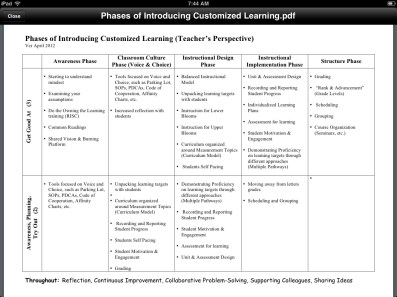
Here is a phases chart you can share with your staff.


Modeling of Customized Learning (Paradigm Shifting)

Although teachers can often apply familiar best practices to unfamiliar contexts, the integration of Customized Learning is often a paradigm shift for teachers, involving practices they are not familiar with. Rarely have teachers experienced Customized Learning themselves, and, collectively, Maine Cohort for Customized Learning districts are early enough in their implementation that many teachers have still received very little training.

Educators who effectively help teachers shift paradigms recognize that it requires more than sharing information and formal workshops.

Schema theory sheds the best light on how to structure professional development for large-scale change: provide models and experiences. Or as some school change experts say, “Teachers can’t do what they haven’t experienced.” Teachers are more often stumped with implementing an initiative by that lack of knowing what it looks like, feels like, tastes like – that not having a mental model of what it is like in action – than by any lack of technical information.

We are using a couple approaches to provide modeling to let teachers experience Customized Learning:

Visiting Classrooms: When teachers don’t have a lot of experience with an innovation, one way to get them that experience is by having them visit other teachers who are successfully doing similar work. Cohort districts are working to make sure that other teachers can come to visit classrooms so they can begin to expand their experience (although school leaders are trying to be careful how they schedule and manage such visits as not to distract too much from the learning that is supposed to be their first order of business!).

Vicarious Classroom Visits: Getting out to other classrooms, especially those in other districts, isn't always practical. Alternately, teachers can visit classrooms vicariously through videos or stories. Teachers can set up a Skype (or some other video conference) during their class so other teachers can see what is happening. Various videos are online. And teachers can read articles about Customized Learning classrooms – but not descriptive articles, so much as those that tell the story and paint a picture for the reader (remember, this is not about information, it is about experience).

Connecting with other Educators: A different approach to helping teachers and program leaders build models is to provide them opportunities to communicate with educators who are doing similar work. Networking is a powerful way for teachers to develop their own practice while helping colleagues (often in different states or countries!) to develop theirs. School leaders encourage teachers to consider tweeting or blogging about their experiences, since it can help build a diverse professional learning network for the teachers who do (although few teachers have taken on these options to date – Cohort teachers seem more eager to connect with teachers in more traditional ways: on the phone or via email).

These strategies are not limited to Customized Learning. These are Professional Development for Paradigm Shift strategies that schools can apply to any large-scale school change, any change that most teachers have not yet experienced themselves.

A Vision of Customized Learning

It is the vision of my district (and the others who are members of the Maine Cohort for Customized Learning) to expertly prepare every child for a future yet to be imagined. We look to achieve this by restructuring our schools for Customized Learning.

At the root of Customized Learning are two core principles: that students learn in different timeframes and that students learn in different ways.

We believe that many of our challenges with student achievement are based on the fact that our current school structure does not widely support these two principles. Through our reform work, we will strive to make learning the constant and time the variable, instead of trying to struggle for student academic success in our current school structures where time is the constant, resulting in learning being the variable.

Our vision has students working their way through a well-defined continuum of learning, using their passions to create a path and choose how they will demonstrate their understanding of the learning.

While teachers will still do targeted direct instruction and plan rich, interesting (standards-based) units of study, these are delivered when students need them (and we have the tools, so teachers will know!). Good Customized Learning takes skilled guidance, direction, and coaching from thoughtful teachers, who will place emphasis also on assessing frequently, providing timely formative feedback, coaching, motivating and nudging, monitoring progress, identifying learning resources and multiple pathways to demonstrating mastery, as well as timely direct instruction.

Teachers and students will work together to match student interests, strengths, and learning preferences to opportunities to learn. Ultimately, all students will be successful with our career- and college- ready curriculum, and teachers will be successful in creating learners who are well prepared to go wherever they want with their futures.

As educators, we work in a vocation that, for over a hundred years, has been geared toward the preparation of youth for the Industrial Age. Yet, today, we are acutely aware that we need to prepare students for the Information Age. Where in the Industrial Age, school appropriately developed the talents of a few and the compliance of the many, school today needs to apply a different tact for the Information Age. We need to develop everyone's talent.


Are We Ready to Trust Teachers with School Change?

It won't surprise any of you that once you really start digging into how to systemically implement Customized Learning, it doesn't take long to figure out that you need shared leadership, and that teachers need to be an active part of that shared leadership.

In Auburn, we're even working with teachers and the Association to see how we might re-envision the contract, so that it is both fair and flexible. Fair to teachers in terms of working conditions, compensation, training and support, and benefits. But flexible enough to the the new system to allow us to redefine professional development (and adjusting teacher roles), grouping (and regrouping) students, “courses” and other ways to organize “delivery” or “coverage” of the curriculum. (We've reached some interesting philosophical agreements about what a “from scratch” contract might look like, but, to help everyone bridge between that vision and what we have now, we'll probably focus on simply tweaking sections of the existing contract this round.)

But one of the issues that has come up several times, is an expanded role for teachers as decision makers: in allocating resources and creating budgets; in supervising and evaluating teachers, and working with those who need extra support; etc.

It's an interesting question. School leaders are asking teachers to trust them to change schools to a system that we may philosophically believe will be better for more students (including, perhaps some innovative, but unprecedented, changes to their contract!). But are school leaders ready to trust teachers to help design and lead that work, to help us all successfully implement customized learning?

Recently, I came across Trusting Teachers with School Success, a book that looks at 11 schools that have done exactly that, and relates their successes and challenges. You can learn more at their website: www.trustingteachers.org.


The Curriculum and Customized Learning Series

When you start changing how you organize school for performance-based learning and recognizing that people learn in different ways and in different time frames, you quickly realize that the center of school shifts from courses to the curriculum and where students are within the curriculum.

How you organize the curriculum and then make it transparent to students becomes critically important.

Here is the whole recent series of posts related to curriculum organization and learning progress management within customized learning:


I’ve Been Busy Writing, But Not On My Blog – Our Race to the Top Grant

I really enjoy writing. Especially about the great projects I'm lucky enougth to be involved in. I use them to populate the Maine Center for Meaningful Engaged Learning website, and to answer other educator's questions. And I like to post at least a couple days a week.

But I haven't been able to do that lately (my last post was more than a month ago!). But not because I haven't been writing. In fact, I've probably been doing more writing lately than I usually do. That's because I'm part of a great writing team preparing a Race to the Top – District grant for a consortium of 5 districts. Here's some info about what we've been working on:

A consortium of schools from across Maine are looking to support their adoption of Customized Learning by applying for a federal grant. The Customized Learning Consortium will apply for a U.S. Department of Education Race to the Top – District Grant to further and support their implementation of Customized Learning. Auburn School Department will act as Lead LEA. Other districts in the Consortium include RSU 3 (Unity, Thorndike), RSU 10 (Dixfield, Rumford, Buckfield), SAD 15 (Gray, New Gloucester), RSU 57 (Waterboro).

All districts are members of the Maine Cohort for Customized Learning, and already collaborating at implementing this approach to personalized learning. All schools in each of the 5 district are participating, so this is a Pre-K/12 initiative, representing over 13,000 students.

The Consortium is eligible to request up to $30M over 4 years. It is still early in the proposal development process, and the exact amount the Consortium will request is yet to be determined. The grant is due October 30, and must include a 10-day comment period by the state and local communities, which is currently underway.

Customized Learning is based on the two core principles: that students learn in different timeframes and in different ways. Research shows that when schools are designed to support these two principles, students learn better. Making a change to Customized Learning requires a lot of capacity building (training, coaching, support, etc) and infrastructure (policies, structures, tools, resources, etc.). The grant will support Consortium district’s implementation of Customized Learning by focusing on these two areas. Grant activities include the following:

Capacity Building

  • Teacher Development
  • Pedagogical Coach Development
  • Leadership Development
  • Community Development
  • Development of Strategies Successful with Students and Families of Poverty

Infrastructure

  • Curriculum Development & Organization (content knowledge; critical reasoning skills; lifelong habits of mind)
  • Learning Progress Management System Development
  • Educational Resources (learning materials, educational devices, apps, etc.)

Please note, that not only is this the work that Consortium districts are currently involved in, but it is the work that all districts in the Maine Cohort for Customized Learning are working on. It is also consistent with the Commissioner of Education’s strategic plan: Education Evolving. Receiving the grant would insure that districts in the Consortium have sufficient resources to successfully complete this work in a timely fashion. Further, lessons learned and products from the Consortium’s involvement in grant activities will be made available to be shared with other Maine schools.

Perhaps the irony is that I'm not sure I could have contributed as much as I did to the narrative sections I drafted if I didn't have my old blog posts to draw from, and the new writing will contribute to new blog posts once the grant is submitted.


Keep the MLTI RFP focused on Learning: Talking Points

I have had some great conversations and email exchanges with many of you since posting my concerns about keeping the new MLTI RFP focused on learning. Some of you have asked if you wanted to reach our to the Commissioner to express similar views, what might you say?

Here are my talking points:

  • Instead of tech specs, the RFP should describe what we would like to do with the devices (what is the change in learning that we would like to see?)
  • Technology is expensive, and we should not invest in it if we are simply going to use it to do what we do without it (what is the change in learning that we would like to see?)
  • Looking at the work in Maine, perhaps that change in learning should be Customized Learning and the Education Evolving recommendations
  • In keeping with the components of Customized Learning, the learning activities described should include both those for low level learning and for high level learning.
  • Low level activities (recall, understanding, simple application) could include the following: access to online resources, information gathering, note taking, communicating, studying, accessing online educational tools, etc.
  • High level activities (non-routine application, analysis, evaluation, creating) could include the following: creating simulations, project-based with multimedia, coding and programming, writing for a purpose and audience, digital storytelling, engineering and design, etc.


Creating a Shared Vision: The Whole Process

Destination Matters.

This is true with schools, too. Our destination should be more than just the work we do: taking attendance, direct instruction, providing practice, reviewing and assessing work, providing feedback, etc. Why are we bothering to do this work? For that matter, how do we know this is the right work to do?

A fundamental and critical component for the success of any large-scale school change effort is the thoughtful creation, and formal acceptance, of a shared vision for that effort. Education for what? Why bother? A vision tells us what our desire outcome is, and a shared vision has a lot of buy-in, because a large cross-section of people connected to the school were involved in creating it.

The series of posts linked below both explores the need for having a shared vision, as well as describes an easy to implement process for working with a stakeholder group to create your own shared vision.

I like this process enormously.

I like it because it is quick and dirty: it can be accomplished in one or two afternoon or evening meetings. And I like it because it gets right to the crux of the matter: what is our preferred future for the children we care about and what do they need to be doing right now so they can get there?

I like it so much that I used it with my team, when I took a new job.

I know this process is effective, because it was introduced early in the implementation of MLTI and I have used with a variety of schools and districts across the country since.

Building a Shared Vision Part 3: How Will We Get There?

If you are reading this, I suspect you want to help move your school or district forward, and recognize that a critical first step is developing a shared vision with stakeholders, including your staff and community.

This is the third post describing a process to quickly build an effective vision. The first post set up the activity. The second post described how to collaboratively envision a preferred future for students you care about. This post will describe the final step in the process, developing a plan for preparing students for that preferred future.

The process enters its final phase with reflecting on your vision of where you’d like students to live, work, and learn, then asking your participants to return to “today” and think “Let’s all get to work …”

Without a plan, the vision created in the futuring phase will remain at best a dream. The worse outcome would be that it would not be used to improve teaching and learning. In short, given a clear view of what this stakeholder group wants the future to hold for their students, it is now time to use that vision to help design the kind of schools, school community, and classroom practices that can be reasonably expected to deliver those desired outcomes.

If this is our preferred future for our students, what do students, teachers, administrators, and tech coordinators need to do now to prepare students for that future?

The Student Plan
By accepting that student practice has to be the center of the target, and given the vision created in the last post, ask participants what a student would be doing in the classroom today if they were going to be “on track” for becoming the learner they have envisioned.

Have a new chart paper sheet labeled “Student.” The prompt is, “If this is what we want for our students’ futures, what does the student need to be doing now to get ready?” Record everything that they call out.

Sample Student Plan List

  • Action based
  • Connected to the community
  • Critical and creative thinking
  • Engaged in problem solving; both real world and simulations
  • Group – more collaboration and integration
  • Independent & self directed
  • Information – equity of access to resources – not limited by location or time of day
  • Initiative – connections to student interest
  • Organize – self-organized & time management
  • Presenting, sharing, and teaching others
  • Problem solving skills (learning them) (real problems, community based)
  • Projects – authentic, integrated projects
  • Real world problem solving and service learning
  • Questioning and research skills
  • Self assessment
  • Comfortable with technology

Once the student practices have been described (which you can expect to focus on inquiry, self-directed learning, teaming, research rather than memorization, growing as a learner, etc.) the participants will be ready to think about the kinds of changes in student practice we need in our classrooms.

This is an interesting process. If you start here with student practice, you get a list of preparatory activities that really does reflect the future you have described, but it also suggests how teacher practice needs to change. But not following these steps can derail the process and not give you the information you need.

I once worked with a group that ended up skipping the step of starting with what students need to be doing now to get ready for this future, and instead simply asked what needs to happen in the classroom to prepare for this future. This group happened to be all teachers, not a larger stakeholders group. Interestingly, they simply generated a list of traditional teaching practices and “shoulds” for students (They should do their homework. They should behave. Etc.).

I think a couple things happened. One was a little bit of paradigm paralysis. When we asked what should happen in the classroom, we thought right away about what we were used to doing in the classroom. And this was exasperated by the fact that the notion of what should happen in the classroom is just that much further removed from that preferred future than the notion of what a student should be doing now to get ready (the preferred future, after all, is about students, not classrooms). The combination of paradigm paralysis and being further removed from our preferred future kept us from coming up with a plan that was likely to get us to that future.

So the lesson is: starting with student practice is critical.

The Teacher Plan
Once the student practices have been described, ask participants to envision a classroom of today where those student practices were a reality, and describe what the teacher would be doing. In this way, they will define the “teacher practices” that would effectively support the visioned student practices.

Add another chart paper sheet labeled “Teacher” and ask the group, “If this is what the students need to be doing to get ready, what do the teachers need to do?” Record what they call out.

Sample Teacher Plan List

  • Collaboration with both kids and adults
  • Facilitator / coach
  • Flexible
  • Learner & being co-learners with kids
  • Mentor and modeling
  • Taking risks, supporting risk taking, and letting go
  • Technology as a tool, not as a add on

The Administration & Support Plan
With teacher practices defined, ask participants to move out another level to describe the Principal and Tech Coordinator actions that would be seen if one were to visit a school in which the visioned student practices were happening. It will also be important to describe central office administrative practices that would support the now-visioned building Principal and Tech Coordinator practices.

Add a last chart paper sheet labeled “Administration & Support” (or maybe separate sheets for each subgroup) and ask the group, “If this is what the students and teachers need to be doing to get ready, what do the administrators, assistants, curriculum coordinators, tech directors, and other support teams need to do?” Record everything that they call out.

Sample Administrator Plan List

  • Communicator, especially with community
  • Goal setting and establishing high expectations
  • Applaud failures as learning experiences and encourage reflection
  • Involved – visible, consulting with teachers, and working with kids
  • Modeling learning, and the use of technology
  • PR – advocating vision, and working for systematic change
  • Supporting and encouraging risk taking, and making it safe for teachers
  • Support – providing professional development, encouraging teachers, and removing and managing obstacles
  • Allow time for collaboration, planning, and learning

Sample Tech Directors Plan List

  • Keeping current
  • Learning constantly
  • Make it work /keep it working
  • Provide infrastructure, tools, and professional development
  • Share information, wisdom, and some of the control
  • Supporting & championing the vision
  • Understands education and learning, not just the equipment
  • Team teach with classroom teacher (while teaching the teacher)

Congratulations!
Your stakeholder group should now be congratulated! By working outwards from the student, a clear focus throughout will be maintained on the students and their practices, and all other efforts would be in support of those changes. You now have a draft vision that can be used to drive your work, including decisions about resource selection and allocation, the use of technology, and professional development.

There are still a couple steps. What was generated on chart paper should be typed up and the language cleaned up a little and made clearer. The two part vision document (the preferred future and the plan) are now ready to be shared with the wider school community, including those who were not part of the stakeholder group that created it. You might even go through a process of collecting feedback from those who weren’t at the event and then seek formal approval of the vision from the educators, and then from the community.

Building a Shared Vision Part 2: Where Will They Be?

Creating a shared vision is a critical step in school improvement efforts. This post is the continuation of an effective process for creating such a shared vision. In the previous post, we discussed the background of the process, who to invite, and some of the set up.

This portion focuses on how to arrive at the preferred future we have for students we care about. The next post will highligh the last steps in the process. You’ll like this process for the same reasons I like it: it is quick and dirty, and gets to the crux of what we want for students.

Think of a Student You Care About
You’ve welcomed the attendees and gotten them seated at their tables. The first step in the work (after introductions at tables), is to ask participants to think of a student they care about.

Participants should be directed to think of the students “as their own children.” This is considered a critical component to insure that during this visioning process they do not get “mired in current reality” (get too frustrated thinking about the students who frustrate them!), but rather allow and encourage them to “vision the best” for students they care as much about as they do their own children.

Where Will They Be In the Future?
Next ask them to think into the future for that student – through middle school, high school, college/military/training, to a time when they are living and working on their own.

And ask them to think about “where” their students will be, specifically in three domains:

  • Professionally (What work will your students be doing for work?)
  • Learning (What, where, and how will your students be learning?)
  • Physically (Where will your students be living?)

Have individuals (independently) record their own responses (you might provide each table with scratch paper, or a handout with boxes for each of these three domains, where participants can jot their thoughts).

Next, have each table compile their answers.

The table groups can then reconvene as a whole group to share their Where Will They Be? lists. The facilitator can have three chart paper sheets—one labeled “Physical Location,” one labeled “Learning Location,” and one “Working Location,” and list everything that tables report out. Have groups report out on only one of these three domains at a time. Perhaps use a Round Robin approach, where each group only shares one item on their list, then the next group shares one, and so on. Groups are asked to avoid repeats, and the facilitator keeps going around until all items have been shared and recorded.

Repeat similarly for each of the other two domains.

Occasionally, while asking “where will the be?”, someone will suggest something like “Walmart” or “in jail.” It’s usually good for a laugh from the group, and clearly they are focusing too much on the students they don’t know what to do with. But these kinds of comments can start to lead the group down a very negative path. It is prudent to ask the group, “Is this really our preferred future for students we care about?” This will get the group back on track to creating a desirable vision.

Sample Responses
Below are some of the common responses I have received from various groups.

What Kinds of Jobs Will Students Have?

  • Choice – doing something they enjoy – following a passion
  • Communication
  • Community – give to society
  • Data – analyzing data, patterns, predicting, managing information
  • Family – home – strengthening family connection
  • Flexible – very flexible – working smarter not harder
  • Global technology based industry
  • Healthcare
  • Home – working online from home and traveling to job sites
  • Medical, research and development, bio-tech
  • New – profession that has not yet been invented
  • Professional
  • Research
  • Service industry (stores)
  • Technology as part of work

Where Will They Live?

  • Choice – living where they would like
  • Close to family & Maine (home state), & their home town – staying connected
  • Return – go where they want, but come home
  • Community – feeling of community / connected environment (human)
  • Some particular part of the state (such as Southern Maine)

What Will Their Learning Look Like in the Future?

  • Choice – anywhere / anytime
  • Collaborate – unavoidably, in teams and groups – connection
  • Communication
  • Distance learning
  • Experiential – learn from experience on job
  • Face to face – personal interaction
  • Global
  • Higher degrees
  • Use & find various resources and solve problems and adapt to task
  • Self directed & independent
  • Technology based, wireless, online

I have shared these lists to give you a sampling of the kinds of preferred future groups might envision. But don’t make the mistake of trying to build a vision around these here (or any other list belonging to someone else). Your list only gains its value if it is your own. You need to ask the questions of your own stakeholder group.

But once you have your own lists of where the students will be in the future, let your participants know that this is their preferred future. This is what they want for the students they really care about. And remind participants that if this is what we want for the students’ future, then we need to start preparing them for it now.

But we tackle that in the next post…

Building a Shared Vision Part 1: Where To Begin?

Destination Matters.

This is true with schools, too. Our destination should be more than just the work we do: taking attendance, direct instruction, providing practice, reviewing and assessing work, providing feedback, etc. Why are we bothering to do this work? For that matter, how do we know this is the right work to do?

We can answer those questions if we work with our staff, students, families, and community to create a shared vision. A vision tells us what our desire outcome is and a shared vision has a lot of buy-in, because a large cross section of people connected to the school were involved in creating it.

A Vision Building Process That Works
This post describes the beginning of a process I like enormously. I like it because it is quick and dirty: it can be accomplished in one or two afternoon or evening meetings. And I like it because it gets right to the crux of the matter: what is our preferred future for the children we care about and what do they need to be doing right now so they can get there?

This is the same process that was introduced early in the implementation of MLTI.

In the spring of 2002, eighteen regional meetings were held around Maine in support of the Maine Learning Technology Initiative (MLTI). Each school sent a shared leadership team (a teacher leader, building principal, and technology coordinator). Hosted by the nine Exploration Schools of the MLTI, these meetings were designed and facilitated by Bette Manchester, Distinguished Educator at the Maine Department of Education, and members of her Design Team for Curriculum and Professional Development (I was involved in a couple of those, and have used this process with diverse groups since). Educators from all of the 239 MLTI schools attended the meetings.

Out of these meetings came both a statewide vision for the future of Maine’s students, including defining the role of technology in that vision, and a replicable process for building a shared visioning back at their own schools.

Who To Invite
The place to start, of course, is to think about who to invite.

It is important to have as many people as you can physically accommodate, and to have as broad a cross section of participants as you can. At a minimum, you should have representatives from administration, the staff, students, parents, and other community members. And don’t just invite the historically “supportive” people. A shared vision is a powerful tool precisely because it is shared, because it has broad approval. And when people of all perspectives are represented in that work, it is a very strong document.

The process will involve individual, small group, and large group interaction, so I’d recommend a venue with tables for small groups, rather than rows of chairs, or “theater seating.” You will need name tags, individual writing materials (pens or pencils, and scratch paper should be fine), chart paper, masking tape, and markers.

You should think about who will be attending and how you might want them grouped. At the MLTI meetings, participants were broken into groups of 6, including complete teams (Teacher Leaders, Principals, & Technology Coordinators) in the same group; we wanted the local shared leadership teams working together.

Once you have everyone at the meeting, the first half of the process is called, “Where will they be?” and focuses on the preferred future we have for students we care about. This will be the focus of the next post…

The Need For a Shared Vision

Destination matters.

What if you were a sailboat captain.

Let’s even say you’ve got a great boat and a wonderful crew. Together you’ve done a lot of sailing. Maybe you even work well together and know how to collaboratively operate the boat to maneuver well and go really fast, coaxing its peak performance.

But what does all this mean if you have no destination?

Or worse, what would happen if each of you had a different picture of where you were headed? What would the outcome be then?

In fact, you may only be able to judge how successful you are when you judge it against how well you did getting to a specific destination.

Perhaps a day sail out to the island is a different kind of work than a sail from Maine to the Keys. Maybe sailing to Antarctica is different than sailing to Spain (as Shackleton will tell you!). Maybe sailing the Intercoastal Waterway is different than sailing across the ocean. Destination matters and it defines the specifics of the work you need to do, despite the commonalities of the work. Doing the work isn’t the desired outcome. Getting to the destination is the desired outcome, and the work is how you get there.

Now, you might question my metaphor since sailing is just sometimes about heading out and enjoying the water, but I’d argue that that was a pretty specific destination. And think about how frustrated you would be, if the crew thought that was the destination and you thought you were headed to Vinalhaven Island!?

Schools also need to be on the same page about their destination. A fundamental and critical component for the success of any large-scale school change effort is the thoughtful creation and formal acceptance of a shared vision for that effort. Education for what? Why bother?

A shared vision in not only a description of what you want your desired outcome of school to be, but is one that is held in wide agreement with your administration, staff, students, families, and community.

In spite of the renewed interest in having a shared vision brought on by the Proficiency-Based Learning work going on in some Maine districts, I believe this is a piece of work that is overlooked all too often. Sometimes I think schools, districts, and state Departments of Education think their destination (vision) is simply to “do school,” to go through the motions of schooling as we’ve been going through them. It is no wonder that some districts see no reason to change (after all, if the purpose of sailing is simply to see how well you work the rudder and sails, any port will do, won’t it?), or just believe that the purpose of school is obvious and get frustrated with people who don’t and want to spend time on “this touchy feely stuff!”

And thus is the problem with schools and shared visions. Districts, schools, or states can either assume that their existing mission or purpose statements (despite often being created as so much rhetoric) can simply be spread to cover any new effort, or they simply assume that everyone understands that school, or the initiative, “is important” (especially if someone else has said that you have do it, such as implementing the Common Core).

The trouble with the former is that traditional mission or purpose statements are not future-focused enough to be effectively used in support of an large-scale change effort, such as 1to1 tablets or laptops, or Customized Learning. In the latter case, a lack of a fully developed shared vision (because you all just assume “it is important”) will mean that the time will inevitably come when it becomes clear that individual beliefs about what the vision “is” (but remember they don’t know, because they assumed) compete and contradict each other, and disrupt any forward momentum, unraveling (or at least stalling) your initiative.

So what should we do about a shared vision?

There are certainly lots of approaches. Which ever approach you choose, it should meet a couple criteria:

  • The vision should be both realistic and creative
  • It should reflect the contexts of both your students and school
  • It should also reflect what you hope for your students and their futures
  • The process should involve a broad a group of stakeholders (administration, staff, students, parents, community members)

I’m getting ready to blog (in three parts) one of my favorite approaches to creating a shared vision. Like a lot of my favorite strategies, it is based on lessons learned from MLTI, the first and only state-wide 1to1 learning with laptop initiative, now over a decade old. This post, and the next two on building a shared vision, come from materials that were jointly written by Jim Moulton and me, and were distributed to educators in the early years of MLTI. (Note: Those portions of these posts that may have been originally penned by Jim are used with his kind permission. Any inaccuracies, errors, or erroneous information are certainly all mine.)

We Had It All Backwards: The Two Types of Instruction

When I told my Curriculum Director, Shelly, about my thinking about there being two types of instruction (Instruction for Lower Level Thinking and Instruction for Higher Order Thinking), she seemed to think the idea made a lot of sense to her, especially in the context of our work around Customized Learning.

She agreed that given how curriculum is organized within Customized Learning, we couldn’t continue to emphasize lower level thinking.

And we got talking about how, since all our middle and high school students had laptops, probably the low level learning, the recall and simple application, was something that students could largely do on their own (with guidance, and coaching).

And then Shelly said, you know, we’ve had it all backwards…

She told me about when she was a high school science teacher, she did a cell unit with students. She used to spend about two weeks of direct instruction to insure that students knew all the parts of a cell. Then she would turn students loose to do an analogy project, where they would write about how a cell and it’s parts were like something else (maybe a football team, or a corporation) and its parts. Students largely worked on this project on their own.

And we reflected on the irony that we (teachers) would spend so much time on something students could probably do on their own (looking up background information). And we did so little direct teaching on something that students probably needed more modeling and assistance with, the higher order thinking.

And we reflected on how teachers should really do a unit, like the cell unit, the other way around. Turn kids loose to learn about the parts of a cell, then do a bunch of instruction and scaffolding on how to make a good analogy (or what ever kind of complex reasoning we’re asking students to apply).

Other places do it that way. Carpe Diem is a 6-12 public school in Arizona that allocates its teaching resources directed at the higher order thinking more than the lower level thinking. Students use online curriculum, supervised by educational technicians, to learn the basics within a unit. Then students spend a large block of time each day, working directly with certified teachers, doing projects and other activities that require higher order thinking (nontrivial application, complex reasoning, and creating) with the content and skills from the unit. Watch this video about Carpe Diem’s approach.


What impact would it have on your students, if we turned them loose to use technology to learn the basic information in a unit, and then we spent quality time with them, both instructing students in how to do complex reasoning, and in applying complex reasoning to the content?

Thinking of Instruction as Two Types

When our pilot teachers were visiting a school that is a little further along than we are at implementing Customized Learning, a colleague and I got talking about how we (us and our colleagues) had a lot of work to do on instruction if we were going to be successful with our implementation.

Then it hit us that a lot of teachers would say they already do a pretty good job with instruction and would object to being told that we had a lot of work to do on it.

And then I realized that both perspectives were right. We just weren’t talking about the same kind of instruction in each instance.

There are two kinds of instruction.

There is Instruction for Lower Order Thinking and Instruction for Higher Order Thinking.

So, it doesn’t matter if you use Bloom’s Taxonomy, New Bloom’s, Marzano’s Taxonomy, or Webb’s Depth of Knowledge, Instruction for Lower Level Thinking is focused on recall and simple application, and Instruction for Higher Order Thinking is focused on nontrivial application, complex reasoning, and creating.

Our teachers are really pretty good at Instruction for Lower Order Thinking. But we have a lot of work to do on Instruction for Higher Order Thinking.

The distinction, thinking of instruction as two types, doesn’t just help clarify our thinking.

This distinction would actually help us in a couple different ways.

We now could say, “You guys are really good at Instruction for Lower Level Thinking. But now, to do Customized Learning well, we need to help you get better at Instruction for Higher Level Thinking.” The message about getting better at instruction would have always been about support, but could have been taken as criticism of their abilities. Now, we can differentiate between validating their abilities, and identifying a need, and offering support to address that need.

And it helps us think about when should teachers apply each type of instruction.

And it will help teachers think about how the two kinds of instruction are different and which strategies support which type.

And it helps us think about leveraging what kinds of interventions to support teachers.

What would thinking of instruction as two types mean to you and the work you are doing in your school?

What is Our Purpose for Education?

As I have mentioned, there were recently some interesting conversations on the MiddleTalk listserve around each of the points in the Forbes article, “Nine Dangerous Things You Were Taught In School.”

Number 9 is “The purpose of your education is your future career.”

Rick Wormeli reminded us that we are all more than just our job descriptions.

And Chris Toy thought that developing these would make for a noble educational purpose:

  • Curiosity
  • Wonder
  • Love of Learning
  • Finding Out
  • Imagination
  • Experimenting
  • Exploring

This listserve thread prompted me also to reflect on various expressed goals and purposes of education (both those expressed through words and those expressed through actions and practices)…

I think it’s great if one outcome for a young graduate is that they are work-ready and can find employment. Our Chamber of Commerce would certainly agree.

But I don’t think that’s the only purpose we have for an education. I think there are several other purposes, if we both think back to public cries for education, and if we watch what people’s behavior and actions seem to say about what they believe. Some I believe in and some I clearly don’t.

John Dewey suggested that education was both preparation for life and life itself.

Folks involved in customized learning (in all the many forms it exists and names it goes by) would say that education is for developing the talents and passions of each child.

Every time we get a new wave of immigrants, some suggest that the purpose of education is to acclimate the new arrivals to being Americans, while others suggest that it is to prepare us to understand and appreciate diversity.

Our founding fathers would say that it is to prepare citizens to live in (and contribute to) a democracy.

I think some folks are very concrete (perhaps they would say “practical”) and say the purpose is to learn math, science, social studies, English, and some other content.

Sometimes I think the US Department of Education believes the purpose of education is to teach students how to pass tests.

I heard on NPR recently, during a conversation about homework, a statement that would suggest that some believe education should teach young people the “life lesson” of doing things they don’t want to do (sorry, I just gagged a little…).

Sometimes I think some groups believe the purpose of education is to prove that some people (mostly their own kids) are better than other people (the whole sorting thing…).

I also believe (sadly) that in some small circles, the purpose of education is to preserve the institution of schools as they exist today.

Monte Selby pointed out that when he teaches various educational philosophies to college students wanting to be teachers, even undergraduates represent each of those different philosophies passionately! He wrapped up by saying:

It was very clear for them to see how I taught, and they could accurately “label” my philosophy. And they liked how that impacted them in the classroom. But, even though they thought my philosophy was ideal for them, many still thought that “their” philosophy was what other children needed.

To simplify – nearly all liked receiving a personalized, self-improvement, “differentiated” format to develop their own talents and passions – a good philosophy for them. Even when their own philosophy stated a different ideal approach to educating youth.

(I think, as ironic as it sounds, we sometimes forget that working in schools is about working with people, not widgets, and Monte’s anecdote is a reminder of what I have said here before: we need to use more psychology in our educational decision making, and less logic!)

I do believe that some of the ongoing trouble we face is that we don’t have any agreement on the purpose(s) of public education, beyond some agreement that kids should be in school to a certain age and learn something in agreed upon content areas (even if we can’t agree on specific content within those subject areas).

For me, I wish the purpose we agreed was our goal was developing the talents and passions of each child. I wonder how many other goals that would achieve at the same time. But I also think that would require that we make some substantial changes to our schools and how they operate….


Mexican Food Schools

I remember being in high school, and frustrated with school, and thinking, “I can do this better than it’s being done to me!”

I think that thought alone is the main reason I became a teacher.

But it is also the reason I worked on what I called “the Making Algebra Meaningful Project” (Surprisingly not an oxymoron! But it took me a long time to come to that conclusion…). And it was why I started looking at teaching and learning with technology, became a technology integrator, and later a partner in the first statewide learning with laptop initiative. And it was why I did my graduate research on motivating underachievers.

Keep in mind that when I started teaching, I didn’t really know how to teach any way other than “how it was done to me,” but it was my motivation to explore how to reach more learners.

An innovative educational program

For about five years, I had the opportunity to work with a great group that focused on creating schools designed to motivate students (well, still focuses, I just work in Auburn now). Among other projects, we helped the School District of Philadelphia write and support a Magnet School grant, and we created a successful nontraditional school that combines online curriculum with project-based learning and graduated students at a high rate. And they helped me create Projects4ME, the statewide virtual project-based program for at-risk and dropout youth in Maine, that got me connected to Auburn in the first place.

We were/are big believers in multiple pathways to graduation, and that educators will only be successful raising graduation rates and decreasing dropout rates when districts offer students several different approaches to learning, so they can choose the one that works for them.

When we would talk to a superintendent about creating a school for them, we liked to say, “No one really cares if you like Chinese food and I like Mexican food and we go to different restaurants. But we tend to only have Chinese food schools and say there is something wrong with me for being a Mexican food learner.”

We were trying to make those Mexican food schools.

Now I’m in Auburn, where we’re working hard not just to make Mexican food schools for students, but Mexican food programs inside of schools, and lots of other “flavors,” as well.

What are you doing to make sure your students’ diverse tastes in how they learn well are being addressed?


Not All At Once: The Phases of Implementing Customized Learning

Some folks have started hearing grumblings from educators and community members about their school’s work on implementing Customized Learning. And these grumblings make us worry (rightly) if working toward Customized Learning is really the right move.

Here are some of the actual grumblings I’m hearing from within my own district and from other Maine districts working toward customized learning:

  • Parents in District A have made their concerns well known (and well publicized) that they do not like, nor do they want, the changes to grading and report cards that the district has implemented.
  • Principal B wants to know how we can possibly do this work without first changing how we schedule and group students, as well as change our grading system.
  • Teachers in School C wonder what they’ll do with students who finish a course-worth of work by mid-March.
  • Teacher D says he has posted the poster-like tool that is supposed to solicit students’ questions, ideas, and feedback, but students won’t use it.
  • Colleagues and students of Teacher E don’t think the way he is implementing customized learning is working and are saying, “If the way he is doing customized learning is what customized learning is all about, we don’t want to do it.”

Hearing these kinds of concerns, it’s not hard to understand why some people might think there are (serious) problems with Customized Learning, and maybe schools shouldnt do it.

And yet, I know that schools have implemented it successfully.

I’ve enjoyed having the chance to talk with some of the educators from some of those schools about their lessons learned. And from this initiative and others, I’ve learned that by looking at the contrasts between where an initiative works and where it doesn’t, you can learn something about what the successful schools have done and what the less successful schools might not have done.

I’ve grown to believe the root of the problems I’ve shared above is not with Customized Learning itself, but with thinking of Customized Learning as some gigantic, monolithic monstrosity that must be dropped on a school all at once. There is no doubt that there are a lot of moving parts, and that those parts are interrelated, and that it is hard to imagine implementing one component completely without implementing another component completely.

And yet, all of the lessons I learned from conversations with educators in schools where it is working have focused on the opposite of doing it all at once:

  • Schools should think of implementing Customized Learning as something that will take about 5 years.
  • Although flexible, there is one general sequence (phases) of change that seems to work better than others.
  • The sequence is a little counter-intuitive, but, again, works better than others, so should be stuck to, even if it is counter-intuitive.
  • Trying to skip phases, or jump ahead phases, or doing phases out of sequence doesn’t work and derails and delays the change process.
  • Although it is always ok to experiment with and try out strategies and techniques from up-coming phases, each phase has strategies and techniques that teachers and leaders should be working to perfect prior to moving on to the next phase.
  • It is ok to have educators in the same school/district in different phases at the same time, but it is also ok to refer to the phase where the school or district is in general, as a whole.
  • It seems to help to have some early adopters in each school, who are a phase or two ahead of the rest of the staff.
  • Save the school structure changes (grading, scheduling, etc.) for last; although you can readily identify that you need new structures now, you won’t know what structures you need until you have been doing the work for a while.
Phases of Implementing Customized Learning

For Auburn, Shelly Mogul, our Curriculum Director, and I created (with some help and input from colleagues) a chart highlighting 5 phases of implementing Customized Learning (download it here). Within each phase, the chart clarifies what we have learned about what staff should be getting good at and the kinds of things they should start dabbling in. We see the following five phases:

  • Awareness Phase
  • Classroom Culture Phase (Voice & Choice)
  • Instructional Design Phase
  • Instructional Implementation Phase
  • School Structures Phase

And notice how understanding the phases of implementing Customized Learning actually helps us understand the problems described in the beginning of this post. It’s important to recognize that when we implement pieces too soon, they can cause problems or might end up being the wrong pieces. That the purpose of being in a particular phase is to get good at the strategies and techniques of that phase, both by seeking out support and resources, and by school leaders bringing support and resources to the staff in that phase. And that it is ok to say, “Yes that is a concern, but we’re only in Phase X and we should wait to deal with that when we reach Phase Y.” And it helps to be able to say, when things are running roughly for a teacher with the courage to try things out, but others bring up concerns, “Well, remember that Teacher E is in Phase X and trying out ideas two phases ahead of that, without training, and has in fact recognized himself that it isn’t going well and has asked for suggestions and support.”

I don’t believe that all the challenges of Customized Learning will be solved just by thinking about phases of implementation. Clearly some come from thinking about leadership for school change, or about the role of technology, or about student motivation. But I do think that many of the ground floor challenges that come during early implementation are related to trying to do everything at once (or out of order).

How could reflecting on and having conversations about the Phases of Implementing Customized Learning help your school or district?