Moving a District Towards More Verbs

I recently started a new journey to be (Learning Through) Tech Director in a small, rural, but innovative, 1to1 school district. I’m going to start sharing our journey to focus on more verbs (what we want to do with our tech) and fewer nouns (the devices, gadgets, and tools).

New journeys are both exciting and full of detours, breakdowns, and bumps in the road!

Bethel, MaineBethel is wonderful small town nestled in a beautiful section of Western Maine. The White Mountains raise all around us here. There is a beautiful downtown with a well stocked, but relatively small, grocery, and an old fashioned hardware store across the street (Ironically named Brooks Brothers!). And there are plenty of really good restaurants – mostly because the town sits between two popular ski resorts. But it will take 30-40 minutes in any of four directions to find a big box store.

This wonderful little town is at the center of Maine School Administrative District #44.SAD 44 has three schools (well, sort of four): Crescent Park Elementary School (where about 3/4 of the K-5 students attend), Woodstock Elementary School (where the other 1/4th are), and Telstar Middle/High (although it’s one building, they divide it so 6-8 is fairly separate from 9-12). There are only about 775 students district-wide (about 50 students per grade level).

And I have just become their Tech Director.

The district may be small, and they may be rural, but they are fairly innovative. They have a Freshman Academy that all 9th graders participate in. They hold classes most of the day at a 4H Camp and subject learning targets are integrated into hands-on, environment and outdoor themed projects and units. The district also has 1to1 technology for all it’s K-12 students (iPads in K-2 and MacBooks in 3-12).

This is the perfect opportunity to work on living “more verbs” (focus more on what you want to do with the technology) and “fewer nouns” (focus less on the “stuff”, the hardware and the software)!

The district has a small tech team, made up of an elementary technician (who retired just before I came on – an early task was filling the position!), a MS/HS technician, and the Tech Director (me). Historically, the Tech Director was also a technician, working with the others, keeping hardware and software functioning (all “nouns” work).

David Murphy, the Superintendent responsible for much of the innovation in the district, and I have been wanting to work together for years, and the former Tech Director had been wanting to retire for a long time! So the superintendent brought me in with the intention of the Tech Director becoming learning and teaching focused (more verbs!!), letting the two technicians take over all the hardware and software pieces (all the nouns).

That sounds wonderful! And an easy transition to accomplish! (And frankly, these teachers, who have had teacher and student devices for years, are enormously welcoming and excited to have someone to work with them on better leveraging their technology for learning!) 

But transitions like these are full of challenges and bumps and fails and detours, with needing to hire a new elementary technician, and “But the previous Tech Director did this!” and tech challenges that come up requiring skills none of the three of us on the district tech team have much experience with, and folks not knowing who to contact about what, and some critical info (including accounts and passwords) falling between the cracks as one Tech Director retires and the new one comes in, and everyone getting used to this new guy (me) who shifts nearly every conversation to the topic of learning experiences… And… And…

So it feels good to be blogging again and I plan on chronicling pieces of our journey and transition toward making tech systems seamless and invisible because they function well and leveraging technology to create better learning experiences for more students. Toward more verbs and fewer nouns!!

Onwards!
MLTI is not a Tech Buy or Commodity. It’s a Learning Initiative.

A recent “Concept Draft” bill came to Maine’s Legislative Education Committee to make the Maine Learning Technology Initiative “more cost effective.” It greatly misunderstands MLTI. Read my testimony to the Ed Committee in opposition to this bill.

The Maine Learning Technology Initiative (MLTI) has been around since 2001, providing 7th & 8th Grade students and teachers with devices and more.

Recently a new piece of “Concept Draft” legislation popped up: LD 137: An Act To Make the Maine Learning Technology Initiative More Cost-effective. In so many ways it represents what people don’t understand about MLTI.

It states: “This bill proposes to enact measures designed to make the Department of Education’s Maine Learning Technology Initiative, or ‘MLTI,’ more cost-effective for schools and for the State, thus allowing participation by increased numbers of students. The cost- saving measures may include, but are not limited to, eliminating the ability of school administrative units to choose higher-cost technology options.” 

In fact, that’s the only thing the Concept Draft bill says.

Here is the testimony I have submitted:

MLTI - Learning Through TechnologyI’m writing in opposition to LD 137.

I have been involved in learning through technology initiatives for more than 20 years. I was an early technology integrator, leveraging technology for learning academic content rather than primarily learning technology skills, served on the original design team for MLTI with Bette Manchester, was part of the team that created the first district-wide primary grades iPad initiative in the country (in Auburn, ME), and served for 2 years as the Learning Through Technology Director and MLTI Director at the Maine Department of Education.

It’s easy to walk into a big box store or search eBay and look at some of the inexpensive tablets and laptops that are available, then look at the per-pupil cost of a MLTI and think that it could be made less expensive.

But to focus on simply trying to make MLTI less expensive would be to fundamentally misunderstand MLTI in several critical ways.

The first misunderstanding is that MLTI simply buys a laptop or tablet for each student. MLTI provides much more than devices to students. The per-pupil cost represents an entire solution including a device, software and apps, classroom WiFi, device management, ongoing technical support, and professional development. Any effort to improve the cost of MLTI must examine the cost of similar packages that include all of these elements and not simply the cost of a device.

The second misunderstanding is that the cost for MLTI is high. When one looks at cost, one should look at the value for the entire package and the relative cost of the entire package. MLTI‘s RFP process already ensures that MLTI is cost-effective. The RFP process reviews vendor’s proposals for the adequacy of each component in the solution, as well as the overall cost for the entire package. Districts have tried to replicate the MLTI solution on their own, thinking they can save money, but find that they have to either leave components off of their homegrown solution to maintain MLTI’s price point, or end up paying more than the MLTI price.

The third misunderstanding is that all devices are created equal, and therefore a more expensive device can be readily replaced by a less expensive device. Maine’s MLTI RFP process outlines minimum specifications for the device, based on initiative goals and anticipated desired use of the tools. Numerous device options have already been ruled out because they do not meet the minimum specifications for the initiative. Cost-effectiveness should always be examined from the perspective of goodness of fit to a purpose and not simply compare one device to other devices without consideration for how the device will be used.

The fourth misunderstanding is that MLTI is a tech buy or a commodity purchase. MLTI has always been about learning. Even in its name, the word “learning” comes before the word “technology.” It is true, MLTI has helped close the digital divide. There are schools, especially our rural schools north and east of Bangor, that the only significant access to technology students have is to MLTI provided devices. But there are two digital divides. This first one is the Digital Access Divide.

MLTI was designed to address the second digital divide. While research shows that technology can be effective in the classroom, it’s not being used effectively in every classroom. This the second-level digital divide, the Digital Use Divide, and it disproportionately impacts low-income students. MLTI was intended to help address the Digital Use Divide through its networking and professional learning to encourage impactful use of technology in the classroom. A simple focus on word processing, presenting, online learning, and high stakes test taking is an insufficient rationale for the state funding technology solutions for students. It must include supports, models, and professional learning that drives improved learning, such as student skill development, creativity, critical thinking, collaboration, and agency. 

MLTI should not be reduced to a simple “tech buy” or commodity arrangement. Any revisions or update to MLTI should remain focused on supporting quality improvements to teacher practice and in learning experiences for Maine’s children. This will not be achieved by a simple cost reducing effort.


Maine Learning Technology Framework

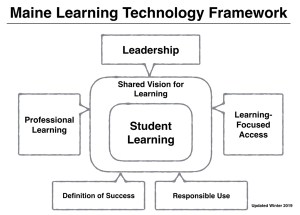
The Maine Learning Technology Framework describes the key elements and components needed to achieve the greatest learning benefit from a district’s technology investment. The Framework is intended to support teachers, tech leads, librarians and other school leaders in their efforts to leverage technology to improve student learning experiences related to learning targets and outcomes.
Maine Learning Technology FrameworkThe Maine Learning Technology Framework describes the key elements and components needed to achieve the greatest learning benefit from a district’s technology investment. The Framework is intended to support teachers, tech leads, librarians and other school leaders in their efforts to leverage technology to improve student learning experiences related to learning targets and outcomes.

At the center of the Framework is a focus on creating good learning experiences for students, recognizing that the quality of the pedagogy and learning experiences drive student learning and achievement. The core of the Framework are student learning experiences and a district’s Shared Vision for Learning.

Student Learning – Many 1to1 technology initaitves leverage a common model to guide teacher practice and the integration of technology into instruction and learning: Technological, Pedagogical, Content Knowledge (TPCK) by Drs. Punya Mishra and Matthew Koehler. TPCK suggests that technology serves education best at the intersection of content knowledge and pedagogy and instruction.

Using TPCK terminology, this portion of the Framework focuses on the following instructional practices (from the Plain English Instrucitonal Model), and thinking about how technology can support these practices:

  • Instruction for Foundational Knowledge: Helping students learn the basics in subject area content.
  • Instruction for Practice and Deepening Understanding: Helping students develop some fluency and automaticity with those basics, or develop conceptual understanding beyond simple memorization.
  • Instruction for Using Knowledge: Students demonstrating their proficiency with content and skills by applying them in a real world context and at a higher level of complex reasoning.
  • Assessment, Feedback & Continuous Improvement: Providing timely feedback to drive continuous improvement, or capturing evidence of what they know and can do.
  • Student Motivation & Engagement: Ensuring that students are mentally and physically present and engaged. Educators creating the conditions for student self-motivation.

Shared Vision for Learning – An school’s Shared Vision for Learning is a powerful tool to help describe what kinds of learning experiences the school’s educators, parents, students, and community value and want to see in their schools. Note: this is not intended to be a vision for technology, nor a general vision for school. Where the Vision should focus on desired learning experiences or conditions for learning, technology should be considered one collection of tools applied to help advance classroom practice toward that Vision.

Student learning, the core of the Framework, is supported and undergirded by five pillars:

  1. Leadership – Achieving the Vision for Learning takes a diverse team of school leaders who can both help build buy-in for the Vision and for the role of technology within the Vision, but also to help manage the implementation of the development, adjustments, and alignment required of the Vision.
  2. Professional Learning – The strategies used by the district to provide timely professional learning opportunities, and other supports designed to effectively encourage and assist teachers’ successfully bolstering and broadening classroom practices.
  3. Learning-Focused Access – Each learner (adult and child) has access to the device, connectivity, apps, programs and services they need, as they need them for their learning, with a minimum of barriers to engaging in purposefully designed learning experiences.
  4. Definition of Success – How the district defines success for applying technology to learning, how they ensure that definition is broadly known and understood, and how they measure progress against clear goals.
  5. Responsible Use – How the district ensures they are meeting CIPA requirements. How they are applying their technology to improving accessibility for students. The approaches and strategies they are using to help students learn to use technology responsibly and safely.

The Maine Learning Technology Framework was originally created for the Maine Department of Education to support MLTI (the Maine Learning Technology Initiative) and other learning through technology efforts across the state.

Are We Talking Technology or Are We Talking Learning

We will never be successful having our technology help improve student learning if we continue to primarily discuss the technology. Our technology conversations must focus on the kinds of learning we want for students.

More and more, educators are recognizing that the true value of technology isn’t learning how to use the tools and devices, but rather using the tools and devices to learn (see here, here, and here).

Even a recent meta analysis of the research on 1to1 learning environments shows that when the studies focused simply on the presence of technology, there was no real improvement in learning. Yet, when a study focused on how the devices were used, certain types of use (those focused on effective instructional practices) showed a real improvement in learning.

We will never be successful having our technology help improve student learning if we continue to primarily discuss the technology.  Our technology conversations must focus on the kinds of learning we want for students. After all, if the goal of our technology initiative is simply to make sure that students have technology, when we are successful, all we have are students with devices (and perhaps distracted students at that!).

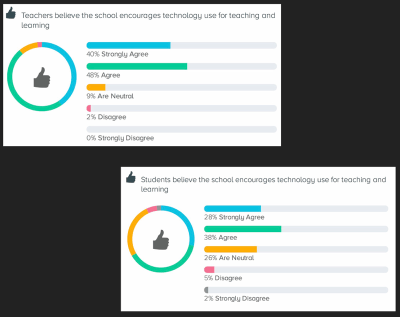
The good news is that Maine’s 2016 statewide BrightBytes data on technology and learning show that students and teachers feel they are encouraged to use their technology for learning:

Teachers and students encouraged to use tech for learning

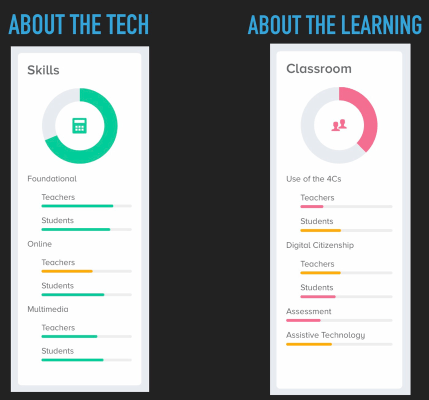
But those data also show that, although we’ve done a pretty good job of teaching teachers and students how to use the devices and tools, we have a ways to go for implementing those tools and devices for learning:

Knowing skills and using for learning

So, these data reinforce the need for our push for “More Verbs, Fewer Nouns” – our need to talk less about the devices and tools and more about the way we want to use them.

How can you tell if you are talking about Tech or talking about Learning?

You are talking about tech when you talk about the following:

  • Cost of devices
  • How easy it is (or isn’t) to manage
  • Wanting same device/platform K-12
  • Teaching skills or about the tools (out of context)
  • Tips and Tricks PD
  • Latest Gimmick/Gadget PD

And you are talking about learning when you talk about the following:

  • Specific academic content focus
  • Used meaningfully for learning task
  • Beyond facts to deeper understanding, to creativity and complex reasoning
  • Student engagement
  • Teaching tech skills as foundation to completing learning activity
  • PD on good instruction (with tech)

There is no doubt that we need “noun people” as part of ensuring technology is used purposefully for learning. We still need a technology infrastructure to support the learning activities for which we want to use technology. I refer to that as Learning-Focused Access.

In Taking Classroom Tech Use to the Next Level: Specific Traits to Look For, the author points out that Alan November recommends six questions to determine if technology adds any value to the learning:

  1. Did the assignment create capacity for critical thinking on the Web?
  2. Did the assignment reach new areas of teaching students to develop new lines of inquiry?
  3. Are there opportunities to broaden the perspective of the conversation with authentic audiences from around the world?
  4. Is there an opportunity for students to publish (across various media) with an opportunity for continuous feedback?
  5. Is there an option for students to create a contribution (purposeful work)?
  6. Were students introduced to the best example in the world of the content or skill?

As the author points out, “Three of the most important traits they look at when evaluating a lesson are whether it is discipline specific, promotes critical thinking and whether technology is used in transformative ways.”


Let’s Focus on the Learning

As I have moved through the state and talked with educators about learning through technology, including while working with MLTI (the Maine Learning Technology Initiative), too often the conversations focused on laptops and tablets and folks wondering if we could find devices that were less expensive.

Is it possible that in their thinking, all laptops and devices were created equal, in such a way that the only variable is cost?

Possibly it is the wrong conversation completely. The conversation shouldn’t be about price; it should be about value.

We may have missed the boat on the value conversation when we started spending too much time talking about the technology and the tools, or about providing technology and procurement.

We need to spend most of our time talking about what kinds of learning we would like to make happen with the technology. You can only get to the value conversation when you can discuss what you want to do with the devices and compare different devices and tools around how well suited they are to those purposes.

A really wonderful professor of elementary educational technology, Ralph Granger, used to say, “When you go to the hardware store to buy a new drill bit, you don’t really want a drill bit. You want a hole.” When it comes to educational technology, we need to talk less about our “drill bits” and more about the “holes” we want.
Or, as Marc Prensky is given credit for saying, we need more verbs and fewer nouns.

And, as TPACK reminds us, when we align our educational arrows, we are talking about content, pedagogy, and technology (What instructional strategies might we use to teach this learning target, and how might we leveraging our devices?).

How are you prepared to help make our educational technology conversations focus more on learning?

The Advantages of a Plain English Instructional Model

How a Plain English Instructional Model provides an opportunity for typical teachers to expand their thinking and skill around instruction.

Recently I have started to promote a Plain English Instructional Model to help promote pedagogical conversations in school and to help contextualize our conversations about education technology around learning.The primary advantage of having a plain English instructional model is that it is often more easily adapted by our staff who are strong “Joe” and “Jane Average” instructors. These are the folks who do a solid job of educating their students, but leave at the end of the school day and don’t tend to get excited by new programs or innovations. If we want these teachers to change (expand their skill set), then we need to introduce programs and approaches

framed in a way that they can relate to and validates the pieces they are already good at. (After all, these typical teachers make up the bulk of the educators in our schools.)

For example, there was a strong focus placed on project-based learning at the beginning of MLTI. I wonder sometimes if PBL didn’t really take off because, although the enthusiastic teachers implemented it, the much larger group of conventional teachers simply didn’t see themselves in PBL (“Oh, project-based learning. Tammy does that, God bless her. Her kids love it and she does a great job. But that’s not what we do…”). Those solid conventional teachers live most of the time in the Foundational Knowledge bucket. PBL lives mostly in the Putting Knowledge to Use bucket. When we simply spoke about PBL, without the larger context of a more comprehensive instructional model, there was no bridge or on-ramp for those typical teachers.

Using the Plain English Instructional Framework, however, provides those bridges and on-ramps. Every time a teacher does a great job helping students learn foundational knowledge, they can point to that bucket and say, “I did that.” They receive validation for what they do. But at the same time they point to something they did, they also see buckets that they do less frequently. It creates the opportunity for them to say, “I wonder how I might help my students develop deeper learning?” And maybe eventually other buckets such as Motivating Students or Putting Knowledge to Use.

Another advantage of a Plain English Instructional Model is that it is in plain English. Many conventional teachers seem to dislike or distrust jargon. Is it because of the long list of innovations that have been introduced in school but never lasted long? Is it because we all wonder why we have to use fancy words for ideas that can be explained plainly? Is it because you have to be “in the know” to understand jargon, but anyone can understand plain English?

Our goal is to help improve the learning for all students in all classrooms. That means the bulk of teachers we want to help expand their teacher practice aren’t the early adopters or the folks who excitedly jump on new ideas. It is the solid, conventional teachers, who will change with good reason, if it makes their life easier in the classroom, or if they quickly see it benefiting students, but who are suspicious of change and “innovation.” This is the group we need to support and the group we must target with our efforts.

The Plain English Instructional Model is one way we are trying to support these educators.

A Plain English Instructional Model

A Plain English instructional model provides a framework around which educators and school leaders can discuss teaching and learning and the role of technology in pedagogy and instruction.

We’ve been working hard to help Maine’s schools adopt a “More Verbs, Fewer Nouns” stance when thinking about the technology in our schools. We want schools to be sure they are focused more on what they want to do with the devices than with the devices themselves. There is no doubt that there is a lot of “noun” work that needs to happen to make the learning (the “verb” work) happen, but we want to make sure that when we talk about tools and devices that it is in service to the kinds of learning experiences we provide for students.

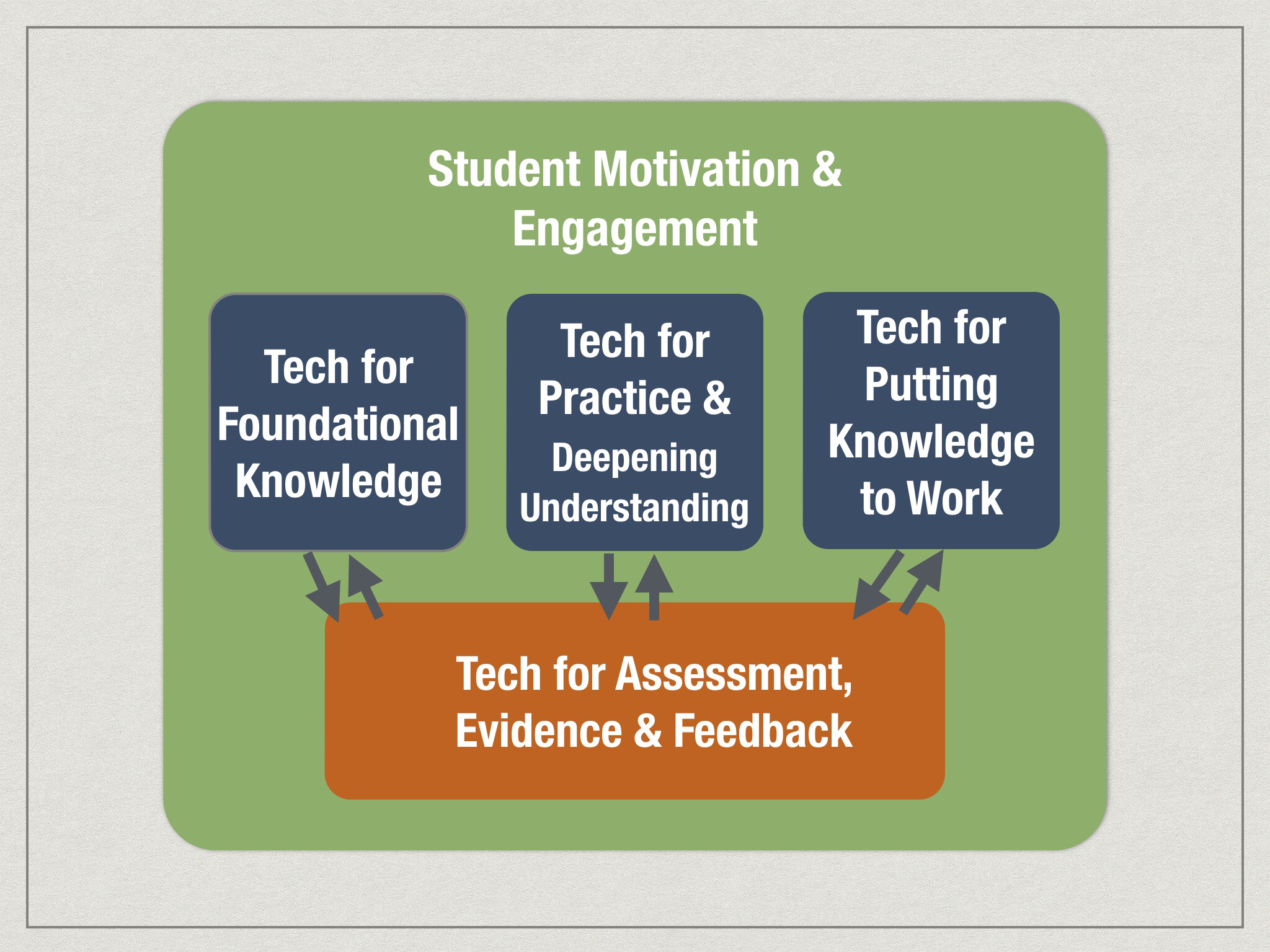
One way we’re trying to further that conversation is by introducing what we call a plain English instructional model. That model includes the following components:

  • Tech for Foundational Knowledge: How can we help students learn the basics?
  • Tech for Practice and Deepening Understanding: What tools and resources help students develop some fluency with those basics?
  • Tech for Using Knowledge: How can we contextualize learning and make learning engaging and meaningful? How can students use their knowledge? What is the role for creating and creativity, and for project-based learning.
  • Tech for Assessment, Evidence of Learning & Feedback: How can technology help us capture what students know and can do, and provide feedback to help drive continuous improvement?
  • Student Motivation & Engagement: How do teachers ensure that students are mentally and physically engaged? How can teachers create the conditions for student self-motivation?

This instructional model is not intended to replace any general or content specific instructional model that a school has already adopted. In fact, it is quick work to do a crosswalk between those models and this one.

The goal of this Plain English Instructional Model it to provide a framework around which educators and school leaders can have a conversation (a plain English conversation!) about teaching and learning and the role of technology in pedagogy and instruction.


In the next post, we describe the advantages of a Plain English Instructional Model.


Are We Talking Technology or Are We Talking Learning

We will never be successful having our technology help improve student learning if we continue to primarily discuss the technology. Our technology conversations must focus on the kinds of learning we want for students.

More and more, educators are recognizing that the true value of technology isn’t learning how to use the tools and devices, but rather using the tools and devices to learn (see here, here, and here).

Even a recent meta analysis of the research on 1to1 learning environments shows that when the studies focused simply on the presence of technology, there was no real improvement in learning. Yet, when a study focused on how the devices were used, certain types of use (those focused on effective instructional practices), there was a real improvement in learning.

We will never be successful having our technology help improve student learning if we continue to primarily discuss the technology.  Our technology conversations must focus on the kinds of learning we want for students. After all, if the goal of our technology initiative is simply to make sure that students have technology, when we are successful, all we have are students with devices (and perhaps distracted students at that!).

The good news is that Maine’s statewide BrightBytes data on technology and learning show that students and teachers feel they are encouraged to use their technology for learning:

Teachers and students encouraged to use tech for learning

But those data also show that, although we’ve done a pretty good job of teaching teachers and students how to use the devices and tools, we have a ways to go for implementing those tools and devices for learning:

Knowing skills and using for learning

So, our state data reinforce the need for our push for “More Verbs, Fewer Nouns” – our need to talk less about the devices and tools and more about the way we want to use them.

How can you tell if you are talking about Tech or talking about Learning?

You are talking about tech when you talk about the following:

  • Cost of devices
  • How easy it is (or isn’t) to manage
  • Wanting same device/platform K-12
  • Teaching skills or about the tools (out of context)
  • Tips and Tricks PD
  • Latest Gimmick/Gadget PD

And you are talking about learning when you talk about the following:

  • Specific academic content focus
  • Used meaningfully for learning task
  • Beyond facts to deeper understanding, to creativity and complex reasoning
  • Student engagement
  • Teaching tech skills as foundation to completing learning activity
  • PD on good instruction (with tech)

There is no doubt that we need “noun people” as part of ensuring technology is used purposefully for learning. We still need a technology infrastructure to support the learning activities for which we want to use technology. In the Maine Learning Technology Framework, they refer to that as Learning-Focused Access.

In Taking Classroom Tech Use to the Next Level: Specific Traits to Look For, the author points out that Alan November recommends six questions to determine if technology adds any value to the learning:

  1. Did the assignment create capacity for critical thinking on the Web?
  2. Did the assignment reach new areas of teaching students to develop new lines of inquiry?
  3. Are there opportunities to broaden the perspective of the conversation with authentic audiences from around the world?
  4. Is there an opportunity for students to publish (across various media) with an opportunity for continuous feedback?
  5. Is there an option for students to create a contribution (purposeful work)?
  6. Were students introduced to the best example in the world of the content or skill?

OoAnd the author points out, “Three of the most important traits they look at when evaluating a lesson are whether it is discipline specific, promotes critical thinking and whether technology is used in transformative ways.”

One approach to making sure that your education technology conversations are well grounded in learning is to create a shared vision for learning with a diverse group of stakeholders (at least including educators, students, parents, and community members). That shared vision isn’t a vision for the school or a vision for education technology, but rather a vision for the kids of learning experiences the school community want for its students.

Here are two easy-to-implement strategies for creating a shared vision for learning. Neither takes a lot of time to implement. One asks participants to think about a preferred future for children they care about and then the kinds of learning that they would need to be doing now to achieve that perfected future. The other asks participants to think about a good learning experience and then about the characteristics of that experience.


Ed Tech Research is Clear: Owning a Device Does Not Improve Learning

It’s easy to find stories and reports in the media frustrated with technology in schools, promoting caution, or even advocating for banning tech. But to what extent to these look at how the technology was being used, consider desired learning experiences for students, or the support offered teachers?

Scanning the media on education technology could easily lead one to believe we are wasting our money when putting devices into the hands of students.

Whether it is districts that have had disturbing problems trying to implement technology for learning (such as here, or here), or folks who tell us why we shouldn’t have devices in school, or schools that have decided that technology is too disruptive and have banned it, or authors who caution about the over-promising with technology (such as here, or here), it is not surprising that we are dubious of investing in education technology, and wonder “why bother?”

Digital LearningOn the other hand, educators in Washington County, PA, find that their devices benefit students, and in Auburn, ME, educators found that when they carefully selected apps aligned to their curriculum or participated in professional learning focused on using apps to build conceptual understanding of mathematics, student learning improved.

So what’s different between these two groups?

From my perspective, each of these instances are really just reflections of either the problems we experience when we focus on the device more than we do the learning, or the benefits of doing the reverse (the notion of “more verbs, fewer nouns”). It is ludicrous to look inside a classroom and decide if technology is a waste of investment or a distraction without also investigating how we are using them for learning. Simply having technology does not improve learning.

And there are plenty of authors and organizations out there who are anxious to help us be successful with education technology:

Here is our advice to your school when considering the value of your education technology:

  • If the goal of your technology initiative is to provide students with technology, then all you will end up with is students with devices (and probably distracted, off-task students at that).
  • Your technology initiative should consider the kinds of learning experiences you want for your students and the supports you put in place to help teachers create those experiences.
  • Keep in mind that student distraction is almost never a device problem. It is almost always a boredom problem. We must stop blaming technology and get better at engaging students with our teaching.
  • Make classroom management in technology rich classrooms a part of your school’s professional learning plan. Support teachers in developing strategies beyond sending kids to the principal and requesting that devices be locked and blocked.
  • When reviewing research on technology in schools, ask yourself if the study simply looks at the presence of technology, or if it looks at how the technology was used. Further, did the study measure student engagement? Don’t put too much value in the incomplete studies – we already know that owning devices doesn’t improve learning.

In short, start with the pedagogy, then think about the devices.