Do One Small Thing!

A couple small things teachers can do for a big impact down the road.

A fellow educator recently asked if i had a suggestion for one small thing a teacher could make that would have a big impact down Impact students by doing the right small things.the road. I had two: 

  1. Treat your students “as if.” As if they are capable. As if they are trying to do the right thing. As if they are nice and kind. As if they are bright. As if they are likable and lovable. As if they are worthy of your every effort to support their success in school. The irony is that the more you treat them “as if” the more they act “as if.
  2. Spend less time thinking about why students should learn your content and more time wondering why would they want to. This is NOT a suggestion that students should only learn what they want to, but rather how might we spark curiosity, wonder, and interest in the content we’re working with them to learn (especially if we think they SHOULD learn our content!).

Is Research on Cursive and the Brain Enough?

Ok. There are clearly better ways to spend a Sunday morning…

But I came across this article about what research says learning cursive does to your brain.

As I am sure is happening in many districts, some parents, community members, and School Committee members have raised the issue of how much emphasis they believe we should be placing on handwriting, especially cursive.

Others will undoubtedly find this article, and it will certainly become part of our handwriting/cursive conversation.

I'm especially concerned because our handwriting conversations seem to have an undercurrent of, at best, iPads interfere with the teaching of handwriting, and, at worst, we shouldn't have primary grades iPads because they interfere with the teaching of handwriting, conclusions that I'm not sure are valid, even if iPads may draw attention to a larger issue.

The article points to improved “efficiency thinking” and “fine motor control” when teaching cursive, over print or keyboarding. The article does not make the argument that “therefore cursive should continue to be emphasized in school,” but this article is likely to be used to make that argument.

I want to be clear. I am not concerned about this article or the research-based conclusions it shares. I am concerned about the inappropriate ways others might try to use this article to further arguments/conclusions that cannot actually be drawn from this article (in fairness, I think it would happen from a place of naïveté, not duplicitiy).

So, although the research in this article seems valid and reliable and the conclusions it shares seem appropriate, I believe using the results from this article to further an argument that we should continue teaching cursive is invalid. There are significant issues with using the article in this way.

Fallacy 1: The Rubiks Cube Curriculum
The biggest issue is that the demonstrated benefits have nothing to do with the purpose of cursive or handwriting. There is nothing here about improving the quality or efficiency of (written) communication, just of certain kinds of thinking.

That is akin to suggesting we teach chess because it improves logical thinking. Even the argument that we should teach geometric proofs to build logical thinking has lost traction in favor of teaching logical thinking in authentic, not contrived (even if traditional and conventional) contexts. At other times, I have referred to this as the “Rubiks Cube Curriculum” – placing curricular focus and value on something of little practical value in order to garner some theoretical gain in some abstract cognitive ability, even though early psychological research shows there is little to no transfer of those abilities to real world application when taught that way (out of context).

The very next question that should arise from this research is, “Are there other, more authentic ways to efficiently develop efficiency thinking or fine motor control in students?” The question after that should be, “Is there a significant difference, in any practical way, not just statistically, in these two 'benefit areas' using cursive over print or keyboarding?”

Only if the answer is “no” to the first and “yes” to the second should we start having the conversation about if cursive should be the vehicle we use to develop those skills. The article does not raise these questions (And frankly, it may not be their responsibility to do so. But it is of anyone trying to use the article to say anything beyond what the article actually says.).

Fallacy 2: The Importance of Teaching Both Cursive and Print
The next problem with how some might try to leverage this article is to point to the “importance of teaching both print and cursive over keyboarding” (or even arguing we need to teach all three). Why not choose only one form of handwriting, print or cursive? It is true that schools traditionally teach print in the primary grades and then introduce cursive a couple years later. But other schools teach only cursive, starting in the primary grades. No research findings on this issue are presented in the article (again, recognizing that it is likely legitimately beyond the scope of this article).

Fallacy 3: The False Dichotomy
The third issue is that a misinterpretation of the conclusions in the article could be used to set up a false “dichotomy” (trichotomy?). The potential argument leveraging these results to say “cursive over keyboarding” (or even cursive over handwriting) assumes that we are only going to pick one. In truth, people in our society need to develop a practical level of proficiency in written communication, both “electronic” and “manual.” There is no research here about “blended” environments, learning both keyboarding and handwriting…

Fallacy 4: Handwriting Passes the Straight-Face Test on Return On Investment
The fourth issue is the assumption that schools have an infinite amount of instructional time and can teach everything anyone in the community (parents, businesses, community groups, seniors, other community members) believe students ought to learn (or even just believe “it would be good for them to know”)…

In truth, state curricular mandates have never been larger or more demanding (and cursive is not even part of the Common Core Curriculum for Language Arts!).

Schools have to examine every potential topic someone thinks we should teach from the perspective of return on investment, bang for the buck. So, requests for teaching content need to be weighed against how much time they take to teach well, and the practical value of developing such knowledge or skills in students, COMPARED TO ALL OTHER REQUESTS/DEMANDS. We have to be selective and deliberate in choosing where we put our energies. It is our responsibilty to be choosy and discriminating in what we choose to teach. (I feel the same way when businesses seem to be asking to shift their responsibility for job training onto public schools…)

I'm not even sure that advocates for an emphasis on teaching handwriting have looked at how much of modern written communication is hand written vs electronic. Clearly, the proportion of hand written to electronic written communication has shifted enormously, even since most of the parents of our current students were themselves students…

The real question should be, “How good do people today need to be at handwriting in order to do the amount of handwritten written communication needed today (and therefore, how much time and emphasis should schools put on it – what's 'good enough')?” The arguments about how nice it is to receive a handwritten (cursive) letter just have no real bearing when return-on-investment is considered (unless, perhaps, if we are discussing moving cursive to the Fine Arts curriculum).

I'm not sure that handwriting passes the straight face test on return on investment. Regardless, this article presents no such analysis (not the authors' job, but certainly the responsibility of anyone using the article to argue for the teaching of cursive).

Final Thoughts

And I won't get into questions around what are the best (not simply traditional) methods, approaches, and strategies for young people to develop proficiency in handwritten or electronic writing.

And I won't get into questions about why we are spending so much time debating the mechanical “drawing” of letters and words, rather than debating how to help young people use those words to express, inform, create, and persuade.

So, this article presents some interesting (research based) conclusions about the teaching of handwriting and cursive. But it is important to remember (and I'm sure the authors would echo this thought) that the only conclusions that can be drawn from this article are the specific conclusions this article shares.

In response to folks who share this article as evidence we should continue (or return to) our emphasis on teaching cursive, our questions should include the following:

  • If we believe schools are responsible for teaching efficiency thinking, what are the best evidence-based ways to do so?
  • What are the best evidence-based ways to develop fine motor control?
  • What is the research on the impact of learning handwriting on the development of effective communication skills?
  • What form of handwriting should we teach? What are the criteria for deciding?
  • To what level of proficiency should we develop handwriting? What's good enough?

 

A Child Struggles in School: Where Does the Problem Lie?

In a conversation recently with a caring, conscientious teacher, she commented that she had success working with struggling learners and helping to make them feel smart.

But when they got to the next grade and perhaps had a teacher that wasn't as effective at reaching those children, or perhaps thought there was a pace for learning and students should stick to it, or perhaps simply saw the onus for learning as being on the student, the students really struggled again.

She worried that perhaps she had led those students to have an unrealistic view of themselves by not being more up front with them about being struggling learners. She wondered, despite her success helping those students to learn, to feel successful, and to feel smart, if she shouldn't be more direct with them about being struggling learners, to prepare them for possible pain and disappointment later.

And I caught myself wondering, is the problem that each child isn't where the school is in the curriculum?

Or is the problem that the school isn't where the child is in the curriculum?


We Must Invest in Our Early Learners

Throughout my career as an educator, most of the initiatives, opportunities, and concerns about public education seem to have focused on the upper grades, on high school.

And yet, if we want the biggest bang for our buck, the largest return on investment, it is the opposite end of the spectrum we should be focusing on. We need to be putting our education dollars behind pre-school and early childhood education.

And business owners know its true! Watch this video from the Maine Early Learning Investment Group (MELIG):

Three of the MELIG's key members are retired high ranking military officers: retired U.S. Army Maj. Gen. Earl Adams, retired Air Force Brig. Gen. Ralph Leonard, and retired Army Brig. Gen. Robert Carmichael.

MELIG also commissioned UMaine Economics Professor Philip Trostel’s Independent Cost-Benefit Analysis of Early Childhood Investments in Maine. The summary of the independent analysis suggests that costs for early childhood education programs would be recovered by the time a student was 14, and over the life of the child and into adulthood would continue to offer a 7.5% return on investment.


Valentines Day: Showing Love and Care of Others via Technology

The bad things kids (and adults, too) do with technology seem to get a ton of press. Kids “hacking” their school devices, playing games instead of doing learning activities, going to inappropriate sites, intentionally damaging equipment…

Platform for Good blog

So it was quite refreshing to find a post called “14 Ways People Showed Love Online This Year” (but, then again, what would you expect from a blog called A Platform For Good?!).

Besides, it's Valentines Day, and it's nice to remember that love isn't reserved for our partners and our families, but is also represented by how we show care for others.

So take a few minutes to explore this article.

And maybe think about:

  • How might we shift focus in the public from kids being bad (especially with technology), to how they can also be very, very good?
  • How do these examples give us ideas for our own classrooms?
  • How can we engage students in academic content, while they get to contribute to something they find to be of social significance?
  • How else might we leverage technology to show love and care for others?

Happy Valentines Day!


MLK, Poverty, Schools, and the War Against the Poor

Today is Martin Luther King Day.

As much as we remember Dr. King’s civil rights efforts for African Americans, he was above all else a civil rights activist. A civil rights activist for all. In fact, he was in Memphis at the end, working to improve wages for garbage workers. All garbage workers, not just African American garbage workers. If there was a category of people he worked the hardest for, that category wasn’t a race. It was poverty.

And 5 decades later, the civil rights movement has widened its efforts, most recently working to insure that gay and lesbian people are treated simply as people, with all the rights of people.

But I worry we have forgotten about poverty. Or worse, that we have substituted “the war against the poor” for “the war against poverty.”

We have made poverty a scapegoat. By blaming people of poverty for their own lack of resources, we are seeing a trend toward cutting social services and programs, all while increasing support to government contractors, corporate bailouts, and tax breaks for the rich. In a country many claim to be Christian, I can think of few things less Christian.

Even if the motivation is not greed, but rather simply recognizing that programs for the poor are expensive, I would reply with a corollary to one of my favorite expressions about education, “If you think programs for the economically disadvantaged are expensive, you should try not having them!” What is the impact on society, on the economy, and on employers of not having supports in place?

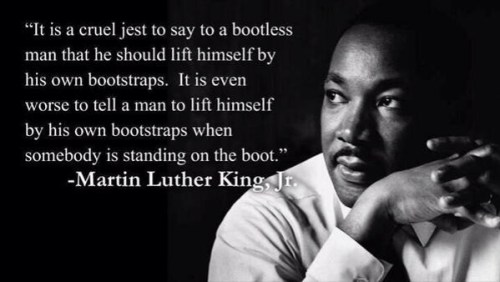
Did I hear you suggest that the poor need to take responsibility for themselves and for providing for their families (as some of Nicholas Kristof’s readers do in his editorial, “Where is the Love?“)? One of my favorite Dr. King quotes is “It’s all right to tell a man to lift himself by his own bootstraps, but it is cruel jest to say to a bootless man that he ought to lift himself by his own bootstraps.”

Dr. King Bootstrap quote

Perhaps nowhere is the war against the poor stronger that in public education. (Or maybe I just notice it more because schools are where I try to do my social justice work.)

We have known – at least since I was in my teacher preparation program in college (and my slate tablet tells me that was a VERY long time ago) – that the strongest correlate to standardized test scores was the socioeconomic status (SES) of the students. Almost no factor came close to SES. Not the curriculum. Not the educational program. Not the qualifications of the teachers. Not time on task. Not attendance rates. Not high expectations. Certainly not the level of threats of punishments and consequences for schools and teachers not raising their test scores. Just SES. Just poverty.

And yet, politicians are cutting funding to education programs that make a difference.

They are cutting early childhood funding to things like Pre-K, and Head Start, despite the evidence that each $1 spent on early childhood education returns $16 later.

They are creating school report card systems designed to “prove” our schools are failing. (Sorry, when you set the report card system up not with criteria for passing or failing, but rather to insure x% are “A” schools and y% are “F” schools – regardless of performance! – then run around proclaiming schools are failing and the school report cards prove it, you have constructed a lie to propagate a lie.) Surprise, surprise! Researchers at the University of Southern Maine found that Maine schools with higher poverty levels have lower student performance, that although poverty doesn’t explain everything, it was the single best predictor of student performance, and that SES was the strongest correlate to school report card grade.

And politicians are using the cry of school failure to shift public dollars to private schools and corporate run “public” charter schools. And where “school choice” makes good rhetoric, it ignores the fact that the poor don’t have the mobility and transportation resources to take advantage of school choice.

And politicians have set up school improvement grants so that a major evaluative component of your proposal is actually showing that your test scores are already on target (I thought the schools with struggling test scores needed the support to improve…?). And if test scores are strongly correlated to poverty, how do schools with the largest populations of low SES students ever get those supports? I guess politicians are only interested in supporting the race for those who are already at the top.

And yet, more than a 150 years ago, this country made a compact with its citizens to educate all the children of all the people.

So if we really want to address achievement and test scores (I mean, if we are serious about doing that and aren’t simply using it as an excuse to shift public dollars to private entities), or even if we simply want our schools to prepare all students to become contributing citizens, then we have to forget about the war on the poor and return to the war on poverty.

Thanks Dr. King. Thinking of you this morning.

We Need Keyboards With Our iPads. Not!

This past summer, Maine's schools got the choice for the first time to purchase tablets as part of the statewide 1to1 learning with “laptop” initiative (MLTI). It has spotlighted an interesting demand related to tablets: we need to get keyboards so students can use the tablets.

I kind of understand why people might think this. The virtual keyboard on the iPad does take a little getting used to, especially if you're a pretty good typer on a regular, physical keyboard. Also, adults and students hear other adults say, “we need keyboards for our tablets.” And the idea is reinforced by the TV ads for some tablets that state theirs come with a keyboard “so you can do real work.” Locally, we even have an owner of a call center claiming (while pounding his fist on the table…) he won't hire any of our graduates because they won't be able to type on a physical keyboard.

My own experience with a full sized iPad is that it took me a couple weeks to get used to the virtual keyboard, but now I type on it as fast or faster than I do on a physical keyboard. And I have heard similar stories of parents or community leaders in other districts demanding keyboards because of the hard time they personally are having typing on the onscreen keyboard, but a couple weeks later saying “never mind” when they have developed familiarity with it.

Admittedly, if I'm doing any quantity of writing on my iPad mini, such as writing this post, I do use a bluetooth keyboard. My hands are just too big to do anything more than a modified hunt and peck on the smaller keyboard. But the core of this debate is not about the size the keyboards on the (smaller) screens, but rather about onscreen vs physical keyboards.

I do believe that some folks really do need a different keyboard or sometimes need a physical keyboard. MLTI provided keyboards in something like a 1-to-10 or 1-to-7 ratio to the number of student iPads. We have put those in a keyboard lending program in our school libraries (students can check them out as needed), and a few students with a specific need have one permanently assigned to them. We even have students and families who have bought their own keyboards or keyboard cases (but that was a personal choice rather than a universal demand).

But the real issue that keeps coming up is the question, does everyone (or even just most students) need a keyboard? Districts in Maine that have experience with 1to1 iPad initiatives had interesting things to say when the question of keyboards was posed on the state technology email list.

The Cape Elizabeth tech director reported:

In our high school, we bought around 40-50 iPad keyboards for use in English and Social Studies, and also in our Library. This was in response to concerns from teachers, rather than from students, and although they did get used, they got used primarily because the teachers wanted them to be used rather than students needing to use them. They certainly got used less and less as the year went on and even teachers who borrowed them stopped using them as they ended up finding the onscreen keyboard just more practical.

The high school in RSU 57 has had a 1to1 iPad initiative in place for about 2 years. Their tech person talked about the keyboard cases they had provided students:

This was based on concerns from the administration and staff that student's would need a keyboard especially for typing long papers. Two years later and (my opinion) most students do not use the physical keyboards. Last year's class used it less than the previous class. What I am seeing is that the more the iPad and its virtual keyboard become mainstream the more the students are used to virtual typing before they are ever issued an iPad. Had we stayed with our original plan, I was not going to purchase keyboards this year.

In South Portland, the high school has had a 1to1 initiative for about 3 years, involving about 400 iPads. They have had “almost zero 'real' keyboard use/demand for the few we had purchased to allay concerns.”

Similarly, folks from Falmouth shared:

We bought 50 keyboards for our Elementary School iPads when we started the program 2 years ago. The thought was that 5th graders were going to need them to be able to type papers. 48 of the keyboards are still sitting in a closet unopened because they just have not been needed. The other two I have loaned out to staff but they always bring them back because they don't use them.

Foxcroft Academy has had one of the first high school 1to1 iPad initatiives in Maine. Their Assistant Head of School for Academics pointed out:

We're beginning year 3 of our 1:1 iPad program for all of our grade 9-12 students. We bought a few keyboards in year 1…They've received almost no use. There are plenty of barriers to student writing, but I can assure you that the virtual keyboard is not a substantive one. And, with built-in speech-to-text on these fancy new MLTI iPads, the virtual keyboard is even less a barrier. In short – buy a few (no more than a handful) if you must, to show that you're listening, but know that they are very likely to gather dust.

The Tech Integrator from Bar Harbor responded this way:

We plan to disallow external keyboards for iPads in school, unless the school determines that a student needs one. The thinking is that students will learn the iPad quickly enough, and that we don't want to set up for “have's and have-nots,”…. also the experience of our teachers using iPads, is that even an adult can learn to process text on an iPad.

That educator went on to say that when parents inquire, they have been referencing the articles here and here.

The issue is primarily an adult issue. Surprisingly, much of the demand for keyboards came before any of the schools even had their iPads! As one educator stated in the online discussion:

Some can't understand how you can interact in an educational setting with a device that does not have a keyboard with keys on it. An English teacher here, who was using Edmodo, had a student submit a lengthy paper the student had “thumb typed” on their iPhone!! Don't worry, the kids are all ready there or they will adapt very quickly. We just need to get out of the way.

I am empathetic to folks having fears and concerns about “new” technology they have only a cursory understanding of. This keyboard issue is a common perception about iPads.

But being a common perception does not mean that we have to respond to it, especially if we have adequate reason to believe it is a MISperception. (Nor do we have to respond to a concern just because it is stated repeatedly, or loudly, or with confidence, or by condemning those who disagree, etc.)

It is on us to make the argument (politely and diplomatically) about what works (not what is perceived or guessed or intuited or philosophized…) and provide the evidence that it works (such as through the stories that have been shared here).


“How Is Technology Changing Schools?” is The Wrong Question

I keep hearing people ask the question “How is technology changing schools?”

But I think that's the wrong question.

I think the right question is “How is technology changing learning?”

I see technology (outside of school) playing a critical and ubiquitous role in how students learn what they want to know. (And, for that matter, how adults and organizations learn and grow.)

Maybe the real question is “Will schools respond to those changes?”

(And I worry the subtext will become, “or if we don't, will we (schools) become less and less relevant to students?”)

How will we respond?


The Connection Between Facilities and Learning

Auburn needs a new high school, and we're working through the process to get a new one built. The issues were especially brought to light by our accredidation, which placed us on warning status in the curriculum and program category because of our facility. Also, until recently, we thought we'd have to go it on our own, without state funding.

This led (naturally) to questions from the public about what the connection might be between facilities and learning. Plenty of folks believe that you can throw a tent up in the ball field and teach kids (effectively) there…

So I did a little digging.

Turns out there's strong research on the connection between the quality and condition of a school building and student academic achievement, student behavior, and teacher stress levels.

Key elements that impact learning include natural lighting, noise reduction, heating, cooling, and air quality, and overall conditions, such as maintenance and cleanliness. (Maybe this is why an academically oriented accreditation process examines the state of the facilities…)

Studies have controlled for family factors (such as family background, free and reduced lunch rates, race/ethnicity, attendance, and suspension rates), and found that building condition not only significantly impacted achievement and behavior, but was a stronger predictor of academic achievement than many family background factors and socioeconomic conditions.

Researchers also found that many of the environmental factors that contribute to student learning can be improved with proper building maintenance, construction, or renovations.

See Barnes, R., Chandler, J., Thomsen, B. A Problem Based Learning Project Analyzing State Assessment Instruments Used for School Facilities. pp 32-35 for a summary of the research.


Getting Girls Interested in Science

How can we get more girls (especially middle grades girls!) interested in science, technology, engineering, and math?

So maybe we should be working to insure that our middle grades programs feature hands-on science and technology activities, field trips, role models, and female-friendly contexts for learning content. And maybe Maine's middle schools should also pursue successful, evidence-based curricula that have demonstrated their ability to deliver positive outcomes and success in stimulating girls’ interest in STEM subjects and instilling self-confidence in their abilities…

Read more at the Bright Futures blog.


If It Sounds Crazy, That’s Probably Not How They’re Doing It

Teachers can sometimes have wild ideas about how a new initiative will work, but a recent experience helped us figure out how to lower teachers's anxiety.

A while back, one of the schools I'm working with had a staff meeting where we talked with middle grades students what had been student reporters at a conference focused on Customized Learning and iPads.

The students were enthusiastic and passionate about their involvement in the conference, as well as what they were starting to learn about Customized Learning.

Other than a handful of pilot teachers, this school has not received any significant training on Customized Learning and is very much at the beginning of their journey to implementation. Therefore the teachers were very interested in what the students had to say and their enthusiasm, and started asking student all their numerous questions about CL and even started to ask the students lots of “how to” questions about how things worked in CL.

I had to quickly remind the teachers that these students had simply attended and reported on a handful of conference sessions about CL and had experienced very little of it themselves. All the questions were perfectly legitimate, and reflect the natural curiosity that you would expect teachers to have at the Awareness Phase of implementation, but that we should probably save our practical, how-to questions for teachers and students who are more experienced! (and we all laughed – the student passion had certainly left us all feeling for the moment that the students were all-knowing experts about Customized Learning! And, of course, these middle grades students never hesitated to create an answer if they didn't actually know it!)

What was really interesting, however, were the teachers' questions. They were asking how they could work with 100 students all in different places in their learning? How did they just let students work at what ever pace they wanted? And how did teachers create a 100 different lesson plans a day to customized the learning? And did teachers just let unmotivated students do nothing? And how could students learn things if there was no direct instruction?

These are all understandable and appropriate questions of teachers early in the Awareness Phase of implementation. But they largely represented enormously false assumptions about Customized Learning. But these were false assumptions that many teachers brand new to Customized Learning seemed to have. And these false assumptions generated an enormous amount of anxiety in the teachers (largely, of course, because the teachers didn't yet know that the assumptions were false).

And it dawned on me that there was actually a fairly simple heuristic that teachers could apply that would help tame their assumptions and lower their anxiety.

So I shared it with the staff at this meeting: There are lots of schools that are very successfully implementing Customized Learning. So if an idea about how it might work seems totally crazy or undoable to you, then that's probably not how they're doing it!

It was so simple!

Does doing 100 lesson plans a night seem crazy to you? Then that's probably not how they're doing it!

Does letting unmotivated students do nothing seem unproductive? Then that's probably not how successful schools are doing it!

Does letting students do what they want seem untenable? Then that's probably not how they're doing it!

So next time you begin to wonder about a specific way you think folks are implementing Customized Learning, apply the Crazy Test. If it doesn't pass, then that's probably not how successful teachers are doing it!


A Response to the Sandy Hook Elementary School Shooting

I have remained quiet, until now, about the recent Sandy Hook Elementary School shooting.

I have seen all the thoughtful posts friends have made to Facebook and Twitter. Not to take away from the heartfelt nature of the posts, but they all started to sound the same, and I wasn't sure a what I could add. And I wasn't sure what I wanted to say that matched what I was feeling.

And I have seen all the sound bites and stories suggesting this happened because there wasn't enough God in schools, or men in schools, or guns and shootists in schools, but I wasn't sure what I could say about those other than to slowly shake my head and say, “You. Have. Got. To. Be. Kidding…”

But a friend at work was really upset about the shooting, even last Friday when we joined with others across the county in a moment of silence, a week after the tragedy, and I realized that there were two things that did comfort me; made me feel better. I shared those two things with my friend and now I share them here.

The first was a Fred Rogers quote which I saw all over social media last week:

“When I was a boy and I would see scary things in the news, my mother would say to me, ‘Look for the helpers. You will always find people who are helping.’ To this day, especially in times of ‘disaster,’ I remember my mother’s words, and I am always comforted by realizing that there are still so many helpers – so many caring people in this world.”

The other was a parent's response to the idea that this happened because there isn't enough God in school. What it really is is a wonderful testimony to the great work teachers do, way beyond making sure children learn the 3 Rs.

These made me feel a little better. Maybe they will you, too.


We Must Do More Than Fill Students’ Vessels

I was especially dissatisfied with my own teaching when I started.

Early in my teaching career, I was presented with a paradox that continues to shape my interests in education. When I was teaching high school computer application courses, my students would learn to use a word processor (in the day when stuents were likely to only have access to computers at school). I was very thorough and made sure they learned how to use nearly every feature (although word processors then had many fewer features than they do today!). We spent a lot of time on it, and together we worked hard so that nearly everyone would be successful on the challenging word processing test.

What surprised me, however, was that a few weeks later, students would return to me, announce that they had a paper to write, and ask me to show them how to use “that word processor thing” again!

I couldn't understand why these students didn't remember how to use the program. These were bright students who had had no problems during class, and who had done well on the test. Very little time had gone by since we had last used the word processor. There was no reason that they should not know how to use it.

There was obviously something I didn't understand about learning. It was the first time I started to question how learning took place, and prompted my inquiry into how people learn.

I fear that during my first few years of my teaching, all I had really taught most of my students was that I was knowledgeable within my field. I tried to convey my knowledge to my students but I was simply trying to “fill their vessels.”

The way I organized the curriculum wasn't even oriented toward learning; it was organized for teaching. I was mostly concerned with questions like when were the standardized tests and what would be on them, when would other teachers be teaching related ideas, what would kids need to know for the next course? All my content was organized the way an expert might look at it. It was neatly categorized and sequenced like it might be done by someone who was already familiar with the information.

I never asked myself how people might learn the same information. I never asked how experts had acquired their vast knowledge; was it through a logical sequence or some other order?

Some of my kids seemed to do okay, but not enough of my students to make me feel like I had done a satisfactory job. I knew I was teaching the way all my teachers had taught me, so I knew I was teaching correctly. But somehow contradictions, like with the word processor, kept happening, and I started to doubt if it really were the right way to teach…

Those contradictions and doubts led me to question my assumptions about teaching and learning. Eventually, I found tidbits that helped shape my work, such as the quote from the classical Greek philosopher, Plutarch, “A mind is a fire to kindled, not a vessel to be filled.

My job wasn't to give students information but to inspire and nurture them. And like Ian Jukes says, “Teachers don't need to be fire kindlers, they need to become arsonists!”


School is Boring

School is boring.

We all know it.

Kids know it.

Parents know it, but don’t want to think about it.

We teachers know it, too, but defend it. In some small way, I think we don’t want to think that the subject(s) we love could possibly be boring! But we do go on to say things like: It’s preparation for life after school. We all have to do things in life that we don’t want to do. Or, I wish students would start taking responsibility for their own learning. Or, it is the students’ job to learn.

My problem with putting the onus on students is that we are all quick to forget that kids are not in school by choice. They are in school by law. Ironically, it is we, the educators, who are in school by choice. In fact, we are getting paid to help kids learn. In fact, we are the only ones getting paid – if learning were the children’s job, wouldn’t they get paid, too? To me this all shifts the moral responsibility.

And we are quick to forget that kids are kids. And that being a kid when you are a kid is appropriate. It is what you are supposed to be!

And we are the adults.

And we spend WAY too much time trying every possible crazy thing so solve the problem, EXCEPT trying to engage students. It’s enough to make you tired!

I think teachers defend school being boring because we fear we will be blamed.

But I don’t blame teachers.

(Well, if you lecture through an 80 minute block, perhaps you should be blamed…)

Edwards Demming, the father of Total Quality Management, says that 95% of our problems come from structures, not people. And Roger Schank actually makes the argument that it is school being boring that is to blame for kids not learning more, not teachers! In response to Tom Friedman’s blaming teachers, Schank writes:

So one more time for Tom: the problem is that school is boring and irrelevant and all the kids know it. They know they will never need algebra, or trigonometry. They know they will never need to balance chemical equations and they know they won’t need random historical myths promoted by the school system. When all this stuff was mandated in 1892 it was for a different time and a different kind of student.

I’m not denying that it’s hard, or that teachers get frustrated when we are trying what we think we can and not getting any further than we do. Why wouldn’t we feel like we were treading water as fast as we can?! And maybe that even makes it (a little) understandable when we blame kids for not learning.

But, the the solution to ALL this is teachers doing more to engage students.

Not be because it is our fault.

Because it is what we have control over.

And if we want teachers to engage students, then we sure better support the heck out of teachers!

And even though its true, we can’t simply say to teachers, you just have to focus on these five things: inviting schools, higher order thinking, learning by doing, real world connections, and student voice and choice.

We need to get teachers training. And into classrooms with teachers who do a good job engaging students. And we all better remove the barriers that are keeping us from creating the conditions that students find engaging (even if it means changing our curriculum, or how we schedule students, or how we group and regroup students, or how we connect with the community and the potential classrooms outside the building).

And the good news is that when kids aren’t bored, they don’t only learn more (making teachers/us look good), they behave better (making teachers/us happier!).

We need to get beyond the (irrelevant) question of who is to blame, or the (senseless) debate of whether we should or not, and just do it! Just work to engage students!

Engaging students is a win-win! It’s good for kids and it’s good for teachers. Just do it!


How will you help make school less boring?


What is Our Purpose for Education?

As I have mentioned, there were recently some interesting conversations on the MiddleTalk listserve around each of the points in the Forbes article, “Nine Dangerous Things You Were Taught In School.”

Number 9 is “The purpose of your education is your future career.”

Rick Wormeli reminded us that we are all more than just our job descriptions.

And Chris Toy thought that developing these would make for a noble educational purpose:

  • Curiosity
  • Wonder
  • Love of Learning
  • Finding Out
  • Imagination
  • Experimenting
  • Exploring

This listserve thread prompted me also to reflect on various expressed goals and purposes of education (both those expressed through words and those expressed through actions and practices)…

I think it’s great if one outcome for a young graduate is that they are work-ready and can find employment. Our Chamber of Commerce would certainly agree.

But I don’t think that’s the only purpose we have for an education. I think there are several other purposes, if we both think back to public cries for education, and if we watch what people’s behavior and actions seem to say about what they believe. Some I believe in and some I clearly don’t.

John Dewey suggested that education was both preparation for life and life itself.

Folks involved in customized learning (in all the many forms it exists and names it goes by) would say that education is for developing the talents and passions of each child.

Every time we get a new wave of immigrants, some suggest that the purpose of education is to acclimate the new arrivals to being Americans, while others suggest that it is to prepare us to understand and appreciate diversity.

Our founding fathers would say that it is to prepare citizens to live in (and contribute to) a democracy.

I think some folks are very concrete (perhaps they would say “practical”) and say the purpose is to learn math, science, social studies, English, and some other content.

Sometimes I think the US Department of Education believes the purpose of education is to teach students how to pass tests.

I heard on NPR recently, during a conversation about homework, a statement that would suggest that some believe education should teach young people the “life lesson” of doing things they don’t want to do (sorry, I just gagged a little…).

Sometimes I think some groups believe the purpose of education is to prove that some people (mostly their own kids) are better than other people (the whole sorting thing…).

I also believe (sadly) that in some small circles, the purpose of education is to preserve the institution of schools as they exist today.

Monte Selby pointed out that when he teaches various educational philosophies to college students wanting to be teachers, even undergraduates represent each of those different philosophies passionately! He wrapped up by saying:

It was very clear for them to see how I taught, and they could accurately “label” my philosophy. And they liked how that impacted them in the classroom. But, even though they thought my philosophy was ideal for them, many still thought that “their” philosophy was what other children needed.

To simplify – nearly all liked receiving a personalized, self-improvement, “differentiated” format to develop their own talents and passions – a good philosophy for them. Even when their own philosophy stated a different ideal approach to educating youth.

(I think, as ironic as it sounds, we sometimes forget that working in schools is about working with people, not widgets, and Monte’s anecdote is a reminder of what I have said here before: we need to use more psychology in our educational decision making, and less logic!)

I do believe that some of the ongoing trouble we face is that we don’t have any agreement on the purpose(s) of public education, beyond some agreement that kids should be in school to a certain age and learn something in agreed upon content areas (even if we can’t agree on specific content within those subject areas).

For me, I wish the purpose we agreed was our goal was developing the talents and passions of each child. I wonder how many other goals that would achieve at the same time. But I also think that would require that we make some substantial changes to our schools and how they operate….


Mexican Food Schools

I remember being in high school, and frustrated with school, and thinking, “I can do this better than it’s being done to me!”

I think that thought alone is the main reason I became a teacher.

But it is also the reason I worked on what I called “the Making Algebra Meaningful Project” (Surprisingly not an oxymoron! But it took me a long time to come to that conclusion…). And it was why I started looking at teaching and learning with technology, became a technology integrator, and later a partner in the first statewide learning with laptop initiative. And it was why I did my graduate research on motivating underachievers.

Keep in mind that when I started teaching, I didn’t really know how to teach any way other than “how it was done to me,” but it was my motivation to explore how to reach more learners.

An innovative educational program

For about five years, I had the opportunity to work with a great group that focused on creating schools designed to motivate students (well, still focuses, I just work in Auburn now). Among other projects, we helped the School District of Philadelphia write and support a Magnet School grant, and we created a successful nontraditional school that combines online curriculum with project-based learning and graduated students at a high rate. And they helped me create Projects4ME, the statewide virtual project-based program for at-risk and dropout youth in Maine, that got me connected to Auburn in the first place.

We were/are big believers in multiple pathways to graduation, and that educators will only be successful raising graduation rates and decreasing dropout rates when districts offer students several different approaches to learning, so they can choose the one that works for them.

When we would talk to a superintendent about creating a school for them, we liked to say, “No one really cares if you like Chinese food and I like Mexican food and we go to different restaurants. But we tend to only have Chinese food schools and say there is something wrong with me for being a Mexican food learner.”

We were trying to make those Mexican food schools.

Now I’m in Auburn, where we’re working hard not just to make Mexican food schools for students, but Mexican food programs inside of schools, and lots of other “flavors,” as well.

What are you doing to make sure your students’ diverse tastes in how they learn well are being addressed?


It’s a Matter of Using the Right Prompt: The Words of Gary Stager

This week, both Gary Stager and I were featured speakers at the Association for Independent Maryland and DC Schools’ (AIMS) technology conference.

Gary is an old friend and colleague, who has a long history of working with 1to1 learning with laptop schools (including the very first, in Australia) and with other schools interested in leveraging technology for learning and in constructivist learning. He clearly loves children and everything he advocates for schools is based on creating better experiences (especially learning experiences) for children. He is provocative and takes on a lot of populist education ideas with a very common sense approach. He always leaves his audience thinking.

What follows are some of the ideas and quotes Gary shared in his sessions at the AIMS conference.

  • The secret to engaging students is using the right prompts. A good prompt is worth a 1000 words – a good prompt, challenge, problem, or motivation; appropriate materials; sufficient time; supportive culture (including expertise) – kids can do works that is beyond them. Good prompts require a really different educational environment, one that values the kinds of things that Reggio Amelia values.
  • Gary has several articles on effective PBL on his “virtual handout.” (among other great resources)
  • We have to think less about teaching how to do computers, or about working at someone else’s pace. We need to stop teaching secretarial skills. We need good prompts. We need to teach students to use the computer to create what they want to create.
  • Alan Kay – the computer is simply an instrument whose music is ideas.
  • Gary’s only rule when he is working with students – you have to be doing something.
  • Teacher as “Ringmaster”
  • “Students will do it for themselves, when it matters to them, but not when it is arbitrary or coercive” – Gary Stager
  • Less us, more them
  • Gary likes it when schools/classrooms focus their work with children by asking the question, “What are the 5 big ideas of your grade level or course?”
  • Some of Gary’s recipe for being successful with students: Being sensitive to the passions, talents, and styles of kids. Being receptive to the learning differences of kids. If you are doing active learning activities, then you can get to know kids.
  • The best decisions about education are made closest to the child.
  • What if we simply reduced it all to waking up every morning and asking, “How do we make this the best 7 hours possible for these children?”
  • The biggest problem we have in school is we don’t get to know the kids and everything is taught disconnected from everything else. That’s followed by not trying to make things interesting for students, not finding out what is of interest or a passion to the students, not having resources, not letting students do things.
  • Gary on why teachers need lots of PD that puts them in different learning environments as learners: People can’t choose from what they haven’t experienced

18 Reasons We Need More Psychology (And Less Logic) In Our Education Thinking

Few systems are as complex as education.

I’ve been thinking a lot about education lately, I’m in the school change business, especially as it relates to creating schools that work for all children. Over the last years, my work has focused on designing schools that work for all students, programs for hard to teach students, and on technology-rich learning environments, especially 1to1 learning with laptop and ipad initiatives (these all usually overlap considerably when each is done well). And I especially wonder how it is that competent educators (good people) make decisions and policies that seem to not work very well.

From my perspective, a decision or policy works if it supports the working of the system. You can tell if it doesn’t work if the system is still upset or in some level of tourmoil.

I’m not sure I can explain this like I want to, but I guess I should say here that when I say “system,” I don’t mean the “education system” or “school system” (the policies that govern a district, school, classroom or other jurisdiction), but rather the system of learning. By my definition, if kids generally do their work, follow the rules, learn, and are engaged, then the system “works.” If kids are breaking rules, not learning, refusing to do their work, then the system doesn’t work. If a school has a high breakage rate on devices or they go missing, the the system isn’t working. When breakage and missing rates are negligible, then the system works.

So why do seemingly good policies not work?

I’ve come to the conclusion that problem lies with logic.

Good people use logic to make decisions. But education is a complex system based on people, not things. Therefore, we need to use psychology, not logic. By definition, logic makes sense in systems that focus on things or stuff. But it is psychology that makes sense in people systems.

So, from two decades of working with schools, including my own, around customized learning, or student motivation, or technology-rich learning environments, or leadership for school change (or, more often, all of these combined!), I’ve started to discern some of the “Logic vs. Psychology” problems schools have. In each case, the “logical” solution is certainly logical, but seems to have perpetuated (or even exasperated) the kinds of disruption or disequilibrium that the solution was trying to solve (it “didn’t work”), whereas the “psychological” solution seems to have had the desired effect.

So here are 18 reasons we should use more psychology and less logic:

  1. Logic says 1to1 is a technology initiative. Psychology says it is a learning initiative.
  2. Logic says students should learn (it is for their own good). Psychology says we must ask ourselves why students would want to learn.
  3. Logic says do workshops on how to use the various software on the laptops. Psychology says do workshops on how the software can be used to help students learn academic content.
  4. Logic says that a teacher must cover content. Psychology says that a teacher must connect with students personally.
  5. Logic says schools should ban disruptive technology (cell phones, mp3 players, blogs, chat, social networks, etc.). Psychology says if a tool is part of the child’s culture, then we should find academic uses for it.
  6. Logic says filter the Internet heavily. Psychology says filter some, but mostly educate students.
  7. Logic says use technology to do what teachers have always done, but more effectively. Psychology says use technology in new ways to engage students and help them learn.
  8. Logic says supplying the tools is enough. Psychology says apply some positive pressure and support to get teachers to use the technology effectively for academic purposes.
  9. Logic says breakage and theft is about the technology and the kids. Psychology says breakage and theft is about how the technology is being used for academics and the leadership around the technology initiative.
  10. Logic says tech folks need to protect the stuff. Psychology says tech folks need to enable engagement and the learning.
  11. Logic says a school is doing well if the easy to teach students are doing well. Psychology says that a school is doing well if the hard to teach students are doing well.
  12. Logic says give students information. Psychology says help students make meaning of information.
  13. Logic asks, did the teacher cover the material? Psychology asks, did the students learn it?
  14. Logic says that technology is a separate line item. Psychology says that all the expenses related to technology are integrated throughout the budget (infrastructure, instruction, staff, etc.).
  15. Logic asks, how smart are you? Psychology asks, how are you smart?
  16. Logic says teachers should speak to students with authority. Psychology says teachers should speak to students as people.
  17. Logic says a teacher can select which teaching styles they choose to employ. Psychology says that there are high-impact and low-impact pedagogies, and teachers should choose wisely.
  18. Logic says pass out laptops to teachers as soon as the school gets them. Psychology says pass out the laptops at an inservice where school leaders can set the tone on how they will be used in the classroom.

Let’s try to use a little less logic and a little more psychology.


What I Wish The Union Had Said

Maine has had two sets of educational announcements in the last month.  One was for the Commisisoner’s plan, focused on customized learning and a performance-based diploma.  The more recent came jointly from the Governor and the Commisioner, and focused on four proposed pieces of legislation: allowing public funding be used toward (certified) private religious schools, school choice, teacher evaluation and accountability, and greater focus on career and technical education.

Chris Galgay (president), and Rob Walker (executive director) from the Maine Education Association were at both announcements.  News stories focused, not just on the announcements, but on how the teacher union was critical of the announcements.

Nationally, teacher unions have developed quite the reputation of blocking any kind of educational advancement and have become the villain in tales of attempts to improve education for all students.

I have mixed feelings about teacher unions.  I think unions should be the defenders of the profession, negotiating contracts favorable to their membership, insuring good working conditions, monitoring evaluation procedures so they are fair and reasonable.

But the reputation teacher unions have is not for defending the profession, but for defending the least professional teachers, protecting mediocre performance, and preserving the right of teachers to do as they wish, not that that is needed to be done.

I suspect that this reputation is somewhat undeserved, but I also know I have experienced myself actions that reinforce this reputation.  At a special purpose, project-based learning school I was part of creating, several teachers in the union told us they wouldn’t implement the educational program because the union told them they didn’t have to. When we had a workshop day, had bought all the teachers lunch (which we did as a nice gesture), and told them what time lunch would be served, several teachers came to us and told us that we couldn’t require them to come to lunch because it violated union rules (who had required anyone to do anything?  We had just done something nice…)

And I worry that dour expressions of the MEA leadership and the news reports of their critical and negative message are reinforcing that image, as well.  And yet, my wife is involved in some very progressive projects of the MEA that demonstrate a very different kind of defending and preserving the profession…

Here is what I wish I had heard from the union:

The MEA and our membership are working hard to insure that every zip code has a great school, so families indeed choose their local school. – I heard the union say they didn’t like school choice because it would take resources away from local schools.  A long time ago, in the early 90’s when charter schools were first proposed in Maine, a teacher told me he was against charters because the public schools would just be left with the least desirable students.  Yet, these issues would only come to fruition if the local schools were schools people wouldn’t choose.  Is the MEA defending undesirable teaching, educational programs, and schools rather than promoting their own vision for creating “Great Public Schools for Every Maine Student“?

The MEA and our membership are working to propose a teacher accountability and evaluation system that is fair to teachers, uses multiple measures, and is based on best practice. – In the past, I have heard the union say that they are against teachers being evaluated based on the performance of their students. This sounds too much to me that the union doesn’t believe that workers (including professionals) should be expected to be effective in their jobs.  I fail to see how this helps defend and protect the profession. This also seems rather counter to their own efforts.  The Instruction and Professional Development Committee has been working for a while on adapting an evaluation system based on the MTA Teacher Evaluation program, endorsed by Charlotte Danielson and Linda Darling Hamond, and connected to the inTASC Model Core Teaching Standards. The MEA’s own position statement on teacher evaluation reads, “MEA wants a meaningful, high quality evaluation process that is based upon sound pedagogical criteria and multiple evaluation tools. It is in the best interests of students, programs, and career educators.”

Teachers ought to be given the training, support, and resources needed in order to do the job they are being asked to do. – With these new announcements, I heard Chris Galgay say that the MEA is against ineffective teachers being placed back on probation. Again, is the union really claiming that if you aren’t good at your job there should be no consequences? How does this give the message that teachers are professionals? On the other hand, it is a travesty when a teacher who needs help to get good or better at their job is not offered that assistance.  Every teachers deserves professional development, coaching, and support, especially is this day of educational change.  And it is right and proper for the MEA to be the organization that champions this on behalf of teachers.

In all fairness, I’m responding to what was reported on the news.  MEA leadership might have said these exact things and the reporters chose not to include them in their reports.

But I still believe that an organization would earn more power and cred by taking on the issues of the day and being the ones proposing quality solutions, rather that appearing to defend the least common denominator and waiting around for others to propose solutions and publicly denounce them. The MEA is doing some very progressive work, insuring that teaching be a quality profession contributing to the changing educational landscape.  But at the same time, they are getting the most press for when they simply criticize other’s work to improve education.

Or is perhaps the MEA simply caught between the days of the old unions that defended their workers no matter what, and the new unions that are trying to create a quality profession…

Myths About The Way We Do Schooling Now

Creating educational programs and systems that work for all kids has been my work for a long time. I have grown to understand that asking educators to change how they work produces a range of very human responses:

  • Let’s go!
  • Sounds good, but how?
  • Yes, but what about this?
  • NFW!

Of course, the challenge comes from the “Yes But’s” and the “NFW’s” (“No Bleeping Way!” – yes, this is widely accepted technical jargon…). They often raise the same objections, but with different objectives. The Yes Buts honestly want to know about the objection. If you satisfactorily address their concern, they will often say, “Oh. Ok,” and work with you. With the NFWs, if you address their concern, they will respond, “Well, maybe. but what about this?” and throw up another objection. The Yes Buts’ objective is to get their concerns addressed. The NFWs’ objective is not to do anything they don’t want to. (So don’t waste a lot of time and energy on the NFWs, except perhaps to have them reflect if they are in the right career or not…)

Either way, leadership is still responsible for addressing concerns and objections raised. Remember, sometimes folks have thought of something we haven’t, or remind us that we haven’t clearly articulated some aspect of what were doing. Responding to concerns is an incredibly helpful school change tool.

Change is hard, and today, often involves learning how to teach and organize school in ways we have never experienced ourselves. The current, Industrial Age approach to schooling is a strongly reinforced paradigm. So it is no surprise that even bright, caring, skilled teaches believe myths about the current approach to schooling.

What follows are some of the things that teachers have said to me that I believe to be myths, and my response to those statements.

Since some of our students go on to the military, we need to teach them to be compliant – This one often comes up when I’m doing a workshop on motivating underachievers. A wonderful young lady and teacher, who I consider one of my daughters, is a veteran.  She served in the Army before going to college and getting her teaching degree. Our experience with the military was that they have an amazing, well designed educational system.  It all starts with Boot Camp, which does a surprisingly good job of teaching how to follow orders and take direction (even for those quite reluctant to learn the lesson).  I’m not sure th military needs our help teaching compliance.  In fact, I believe they would be much happier if we were simply better at engaging learners in general, teaching them basic skills, lots of content knowledge, and how to think and communicate.  Besides, people are better at taking direction when they are working on things that they are interested in, believe in, feel like they are contributing to, good at, and have had some choice in doing, not when those with authority are bossy…

Our schools are working just fine – Part of me understands that it looks like we are doing a good job and that schools are working when teachers look at some of the amazing successes of our easy to teach kids, or the auditorium filled with graduates each June. But I am acutely aware that whether we look at graduation rates, test scores, or the comments from employers, there are WAY too many students for whom we are not successful.  It’s not 30%, you say! It’s only 20% (or 15% or 5%)… We could debate the numbers, but how ever you slice it, that’s way too many. (And again, I don’t believe it’s the teachers, but rather that we’re trying to meet Information Age goals with Industrial Age structures.)

Life isn’t about “redo’s” – This one is just blatantly false.  Any teacher new to the profession knows you can redo the Praxis test until you pass it. If things in your life don’t work out the way you want the first time, you can go back and try again. Redo’s aren’t without consequences and always take work, but they are available. (And my wife hates it when I joke, “I’ve been married way too many times to not think life is all about do overs!” – my “current” wife, that is!). 😉

What about our Ivy League students? – I have seen no innovative approach that works for reluctant learners that has not also worked for our best and brightest.  Some honors students get upset because they have been good at the game of school and now the game is changing (but once they get beyond that, they do every bit as well as they did before).  Some (misguided) parents have been upset because other students can now succeed, not just their children. I know that Maine’s Commissioner of Education contacted more than a 100 colleges (including Ivy League colleges) to see if they would accept a standards based diploma, and all but one not only said yes, but that they were already accepting international students with standards-based diplomas.  Massabesic High School has had its first student in two decades accepted into Harvard, BECAUSE of this Maine district’s focus on teaching differently. (And REALLY! What percentage of our kids go on to the best colleges?  Are we really not going to get better at meeting the needs of our students for such a small fraction of our population?)

Let’s be thoughtful about how we respond to concerns raised.  Whether they are legitimate concerns or not, most come from the right place.  But let’s also make sure that concerns raised pass scrutiny and the “straight face” test.

It’s Your Turn:

What educational myths do you experience?