Are We Taking On Too Much Too Fast?

We have lots of tech-focused projects to work on. And we’ve done a good job of identifying all the tasks that need to happen to be successful. And I’d love to have them all done soonest! But it looks like I haven’t accounted for how much time each takes. We might need to adjust our timetable…

I had an epiphany the other afternoon: I think we may be trying to do too much, too quickly.

We (the Tech Team) have plenty going on: updating the Central Office servers and getting them working efficiently (and without fail!); a K-2 iPad refresh; figuring out the easy way of doing inventory and device management; managing a network update/upgrade at our middle school/high school; figuring out the easy way to manage device access to our networks; device and systems prep for state testing; rearranging responsibilities for tech support and managing student information systems; managing eRate (which is new to me); developing a device refresh rationale and plan…

All without letting education or support services suffer hiccups for long, and making sure all the behind-the-curtain tasks get taken care of.

And all while I try to get into classrooms and initiate tech integrator support for all our teachers in all four of our schools (for the first time!).

All my upcoming tasks, written on small Post-It Notes, spread out all over my desk in an attempt to organize them by week.I started to lay out all our immediate tasks on small Post-It notes and then set them out by week, over the next 7 weeks.

And what I realized quickly was that, although we had done a great job of identifying our top priorities, we were trying to take them on too quickly, and all at once. I easily had 3 weeks’ worth of work (as evidenced by the stack of Post-It notes aligned to each week) for each of next three weeks.

The message to me was that we needed to give ourselves more time to get the work done, so we could do it well and get it done right. It probably also means that we have to put some of that work back a couple weeks.

This was reinforced when Michelle, one of our technicians, came back having visited with a tech director she used to work for, and shared that she had told him about 3 of our major projects (the K-2 iPad Refresh, the Central Office Server work, and the eRate-funded network upgrade at our middle/high school), and his response was that that was a lot to take on for one year! (And we’re working on so much more!)

Ok. I might be slow, but I’m trainable. So in the next day or two, the Tech Team will meet and we’ll not only provide updates on each of our projects, but we’ll map them out on the calendar and see if we can’t creat a more effective timeline.

Honoring Controversy – The Series

One of the truly challenging parts of leading large-scale school change is how upset some people can be about the change. Large-scale school change, especially paradigm shifting change, invariably generates controversy. The question is how to deal with it…

School Administrators working on controversyOne of the truly challenging parts of leading large-scale school change is how upset some people can be about the change (School Change Truth 2 reminds us that people seem to abhor change). Large-scale school change, especially paradigm shifting change, invariably generates controversy.

The question is how to deal with it. Understandably, many of us don’t like confrontation and would rather not deal with it or hope that it will simply go away.

But this is one instance where ignoring the situation will not make it go away and will likely make it worse. What to do?

The Series:

How well your initiative deals with controversy and critics will depend on how calm you remain, how productively you listen to your critics, and how good you get at determining when to simply acknowledge a critique and when to do something about it.

How We Listen Matters

When dealing with controversy, it is important to listen closely to your critics (even when how they say things makes it hard to listen!). They may tell you what you need to say and haven’t yet and which words you’re using are helping your cause and which are hurting your cause.

Adding the “barking dogs who bite” parent, mentioned in the previous post, to the design team taught us something else about dealing with controversy. The way critical community members deliver their message, especially when they are forceful or angry, can keep us from listening productively to their message.

For example, we certainly intended to use iPad apps to reinforce letter formation and spelling. The way angry parents were telling us we shouldn’t use tablets to teach young learners had us dismissing them (and their message) as extremist.

But then a small statement in an otherwise enflamed tirade made me realize that they thought we were going to teach students to handwrite only using the devices!

It had never occurred to us that we should be directly stating that the correct way (the only way) to properly teach handwriting was with pencil and paper. Once we made that statement, they cooled quite a bit. We were debating the benefits of using apps to reinforce letter formation when what no one had said (and needed to be said) was that handwriting needed to be taught with pencil and paper. It was so obvious to us, we never thought to say it.

But listening productively to the critics (even when it’s hard) told us the message we should be sharing.

Similarly, when working with a middle school to implement interdisciplinary, project-based learning, our group talked a lot about problem-solving, connecting learning to the students’ world, and active learning. Critics were angry because they saw us throwing out the curriculum and dismissing Math, English, Science, and Social Studies. It was a lesson in how listening productively to your critics can also tell you when you’re using the wrong words or wording.

Of course we were teaching Math, English, Science, and Social Studies!

But in our excitement about the learning power of connecting subjects and using projects and active learning, we had said nothing about the content students would be learning. Our critics quieted and were less frequent when we started talking about how we could make Math more meaningful by using it to address issues in Science and Social Studies, and how applying reading and writing to solving real world problems makes learning the reading and writing skills more meaningful to students, and how active, hands on learning strategies, help students better learn Math, English, Science, and Social Studies.

Our critics helped us know what we were not saying that would be helpful and what terms we were using that were generating less buy-in, than other terms that helped promote buy-in.

Barking Dogs and Barking Dogs Who Bite

When folks from the school community are expressing their concerns around your initiative, you need to decide quickly if they simply need to be listened to, or if additional action is needed. You must decide if they are “barking dogs” or “barking dogs who bite”!

Thinking of school change from the framework of being intentional and rational about moves and counter moves, as mentioned in the previous post, can be helpful. Remember, a confrontational and forceful community member perceives their job as saying whatever it takes to have you NOT make the school change you are in the process of making.

Part of thinking through moves and counter-moves is knowing when you can and should ignore the issue, or take no action, and when you must do something, perhaps quickly. You have to be able to distinguish between “barking dogs” and “barking dogs that bite.” Many of the critics of the primary grade iPad initiative in Auburn said their piece, then went away. But we had one parent who kept returning to the school committee and to other community groups to blast the initiative. Her arguments were starting to gain traction, even though to those of us implementing the initiative none of them had any credence or basis in fact. She had become a barking dog that bites.

My superintendent was surprised by my solution. I put the parent on our design team. My superintendent wasn’t so sure about the move but trusted that I knew what I was doing. I’m not so sure that I knew what I was doing at the time (and frankly, part of it was the old “keep your friends close and your enemies closer”), but my instinct proved correct. The parent saw how decisions were made and saw that “what was good for children” was at the heart of what we were doing.

She also had a voice in our decisions (as did every design team member) and was now in the position of not being able to pontificate at a board meeting about what she thought we should or shouldn’t do, but now had to work with the team to convince us to do what she thought was right. When her ideas were what one might call extreme or crazy, she was only one voice and her ideas didn’t go far. When her ideas were on point, we collaborated on finding the right way to address the idea. She made quality contributions to the design and implementation of the initiative and even became a cautious supporter, advocating for continued funding for the project at budget time!

Dealing with Controversy Requires the Right Mindset and Temperment

Ignoring the situation will not make controversy go away and will likely make it worse. What to do? How should we react?

As discussed in the previous post, large-scale school change, especially paradigm shifting change, invariably generates controversy. The question is how to deal with it. Understandably, many of us don’t like confrontation and would rather not deal with it or hope that it will simply go away. 

But this is one instance where ignoring the situation will not make it go away and will likely make it worse. What to do?

The first step is, to the greatest extent you can, to not take it personally. If you care deeply about your initiative, which is often the case when you play a strong role in designing or implementing an initiative, it’s hard not to take the criticisms and concerns personally, especially the ones that seem unrealistic and crazy or when the community member is so angry or forceful in their convictions. It’s almost impossible to avoid taking it personally when they make it personal about you (I once had a parent at a school committee meeting attack me by name and try to shame me for supporting our work).

It’s critical to remain calm. This is not simply an issue between you and the angry community member. There are others watching. Some will agree with the community member. Some will think that the community member is being unreasonable and will sympathize with you (perhaps feeling bad that you have to sit through this onslaught!). In many cases, you can simply thank them for sharing their perspective and let their comments (and how they were delivered) stand on their own.

If you respond too strongly, sharply, or angrily, no matter how justified you may be to feel these things, you are the one whose argument loses every time. It doesn’t matter that the community member thinks they are correct and is being angry or forceful, when you lose it, you lose your supporters. It is for them and for you that you remain calm, no matter what.

If possible, provide a counter example. When Maine decided to be the first 1-to-1 laptop initiative in the country (The Maine Learning Technology Initiative, MLTI) by providing all 7th and 8th grade teachers and students laptops, WiFi, and training (probably the largest middle school initiative in the country!), teachers, principals, and tech directors were highly anxious. At the time (2001), no other state was doing this. Few schools across the country were doing this. Then-Governor King got calls saying that if he wanted to improve Maine’s economy, he should give every middle school student a chainsaw, not a laptop. He even got death threats!

Even caring educators’ imaginations were rife with worries about all the bad things that might happen: students going to inappropriate sites, students being distracted from focusing on learning activities, equipment not working properly when needed, laptops going missing. As a new initiative, it’s hard to counteract supposition because there may be no counter-examples to point to. Fighting supposition with supposition is difficult (”My belief it won’t happen should be stronger than your belief it will happen!”).

But he had the advantage of having one middle school, Piscataquis Community Middle School in Guilford, Maine, who had initiated 1-to-1 laptops with their eighth grade earlier that year.

When a critic shared their worst fears about what would happen when every seventh and eighth grade teacher and student had an internet-connected laptop, Governor King could publicly turn to the Guilford teachers and say, “I see this person’s concern. Has this been an issue with your program?” The teachers could then state that it has not been, or if it had, what the scope of the problem had been and what their solution was. It also helped that the response came from someone other than the governor. It wasn’t just the program advocate’s response, but a response from someone who is already doing the work. Bottom line, those teachers, in this instance, had more credibility with the critics than the governor did.

Keep in mind, too, that your critics aren’t trying to ruin your day. Initiatives are “initiatives” because they are new. They haven’t been done much (if at all) before. They aren’t “tried and true.” And they are unlikely to be what your stakeholders and learning community have experienced in school. As I pointed out previously, all they have to work from is supposition and their imagination, both of which are charged by emotion. And without real counter-examples, you are fighting an uphill battle. Trying to debate an emotional worry without real counter-examples is simply a debate of opinions and in the end will simply give credence to the critic’s concern. I’m reminded of a Facebook meme: “That is a very well laid out rational point, but I will still hold to my emotional opinion based on no facts or evidence.” 

In such a situation, remaining outwardly calm and simply thanking them for sharing and letting their comments stand on their own is the only practical path forward for you.

That can be quite discouraging, feeling like you have no way to parry what you perceive to be an irrational assault on your initiative. Maybe this will help. I was working with a small group creating a career academy for challenging and at-risk students in a mid-sized city. It became quite a political hot potato, and, as the superintendent’s project, a pawn in battles between the superintendent and other groups (having little to do with the school itself). My colleague had friends–who were not connected to the school project–over socially one evening and was telling them about our challenges in that district. One of the friends was a veteran combat pilot now working as a commercial airline pilot. He told my colleague, “You know, they only shoot at you when you’re over the target.” It became a metaphor that has energized me through this and other initiatives since!

I also find it helpful to think of implementing an initiative in the midst of controversy a bit like chess, as a complex game of moves and counter-moves to win the game. I don’t so much want you to start thinking of implementing your initiative as a game or to turn this into another situation where someone wins and someone loses. But the framework of being intentional and rational about moves and counter moves is a helpful one. Remember, a confrontational and forceful community member perceives their job as saying whatever it takes to have you NOT make the school change you are in the process of making.

In the next post, we’ll explore sizing up the individuals expressing concern about your initiative.

School Change Generates Controversy

School Change can generate quite a bit of angst and controversy among the school community.

One of the truly challenging parts of leading large-scale school change is how upset some people can be about the change (School Change Truth 2 reminds us that people seem to abhor change). Some parents worry their children won’t do as well as they do now. Some teachers worry about the work and adjustments they’ll have to make with the change, or fear they’ll fail at the initiative or that it’s another initiative they’re expected to implement well without adequate training or support. Some just think that the initiative doesn’t look “like school,” so you’re clearly doing it wrong!

Parents will resist and fight back against the change. Teachers will resist and fight back against the change. Community members will resist and fight back against the change. Some directly: telling you –or your superintendent or the school committee–exactly what they don’t like about the initiative or what their worries and concerns are. Others are less direct, telling you what they think will make you stop or change your mind, rather than telling what they really fear, or that they don’t want to put the effort into the change. And if your initiative is the kind that few others have implemented to date, and you have no examples to point to, then your stakeholder group has only their imagination, good and bad. And some of those stakeholders will rail against the worst their imaginations can come up with! Without counter-examples, you have no proof they are wrong.

When Auburn Schools ventured to be the first district to have a district-wide 1-to-1 kindergarten iPad initiative, there were no other kindergarten iPad initiatives to point to. We had educators and partners who were excited about the opportunity. Our imaginations told us about all the good that was possible from such an effort. But we also had some angry community members who came to testify at school committee meetings about all the worst things their imaginations could conjure:

  • We would reduce the number of teachers and just teach students through online learning
  • Students would spend all their time on the tablets and would no longer play outside, draw with crayons, sculpt with clay, sing songs, or sift through sand
  • Predators would get to the children through the cameras on the devices
  • The kindergarteners would spend all their time playing games they downloaded or going through Facebook instead of doing the learning activities
  • Students eyes would go bad using the tablet screens, and they would all need glasses
  • The children would never learn to write with pencil and paper

Many years later, none of these predictions came to fruition. But that didn’t stop them from being hot topics in the beginning. (In fact, back then I blogged, “Rumor of our Locking Students in Closets with iPads Are Greatly Exaggerated!“)

Large-scale school change, especially paradigm shifting change, invariably generates controversy. The question is how to deal with it. Understandably, many of us don’t like confrontation and would rather not deal with it or hope that it will simply go away.

This series will help address how to deal with the controversy your initiative generates.

Are We Talking Technology or Are We Talking Learning

We will never be successful having our technology help improve student learning if we continue to primarily discuss the technology. Our technology conversations must focus on the kinds of learning we want for students.

More and more, educators are recognizing that the true value of technology isn’t learning how to use the tools and devices, but rather using the tools and devices to learn (see here, here, and here).

Even a recent meta analysis of the research on 1to1 learning environments shows that when the studies focused simply on the presence of technology, there was no real improvement in learning. Yet, when a study focused on how the devices were used, certain types of use (those focused on effective instructional practices) showed a real improvement in learning.

We will never be successful having our technology help improve student learning if we continue to primarily discuss the technology.  Our technology conversations must focus on the kinds of learning we want for students. After all, if the goal of our technology initiative is simply to make sure that students have technology, when we are successful, all we have are students with devices (and perhaps distracted students at that!).

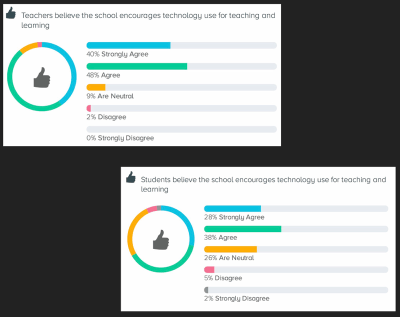
The good news is that Maine’s 2016 statewide BrightBytes data on technology and learning show that students and teachers feel they are encouraged to use their technology for learning:

Teachers and students encouraged to use tech for learning

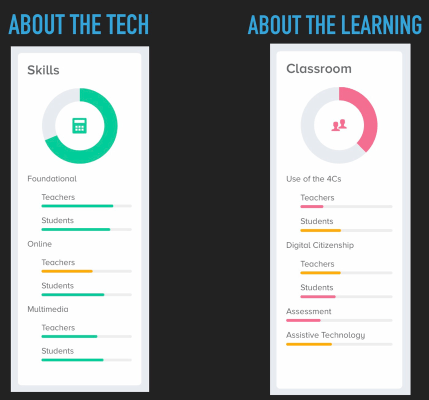
But those data also show that, although we’ve done a pretty good job of teaching teachers and students how to use the devices and tools, we have a ways to go for implementing those tools and devices for learning:

Knowing skills and using for learning

So, these data reinforce the need for our push for “More Verbs, Fewer Nouns” – our need to talk less about the devices and tools and more about the way we want to use them.

How can you tell if you are talking about Tech or talking about Learning?

You are talking about tech when you talk about the following:

  • Cost of devices
  • How easy it is (or isn’t) to manage
  • Wanting same device/platform K-12
  • Teaching skills or about the tools (out of context)
  • Tips and Tricks PD
  • Latest Gimmick/Gadget PD

And you are talking about learning when you talk about the following:

  • Specific academic content focus
  • Used meaningfully for learning task
  • Beyond facts to deeper understanding, to creativity and complex reasoning
  • Student engagement
  • Teaching tech skills as foundation to completing learning activity
  • PD on good instruction (with tech)

There is no doubt that we need “noun people” as part of ensuring technology is used purposefully for learning. We still need a technology infrastructure to support the learning activities for which we want to use technology. I refer to that as Learning-Focused Access.

In Taking Classroom Tech Use to the Next Level: Specific Traits to Look For, the author points out that Alan November recommends six questions to determine if technology adds any value to the learning:

  1. Did the assignment create capacity for critical thinking on the Web?
  2. Did the assignment reach new areas of teaching students to develop new lines of inquiry?
  3. Are there opportunities to broaden the perspective of the conversation with authentic audiences from around the world?
  4. Is there an opportunity for students to publish (across various media) with an opportunity for continuous feedback?
  5. Is there an option for students to create a contribution (purposeful work)?
  6. Were students introduced to the best example in the world of the content or skill?

As the author points out, “Three of the most important traits they look at when evaluating a lesson are whether it is discipline specific, promotes critical thinking and whether technology is used in transformative ways.”


Not All At Once: Breaking Your Initiative Into Phases

Leading large-scale school change is a challenge. These kinds of initiatives are often complex and include numerous parts and components. Further, the initiative often includes practices educators, the folks responsible for implementing the initiative, have never experienced themselves as learners. Such initiatives often seem overwhelming to teachers! Breaking your initiative into phases is the solution to these challenges!

Leading large-scale school change is a challenge. These kinds of initiatives are often complex and include numerous parts and components. Further, the initiative often includes practices educators, the folks responsible for implementing the initiative, have never experienced themselves as learners. Such initiatives often seem overwhelming to teachers!

While I was with Auburn schools, one lesson we learned from working with other districts further along implementing Customized Learning (proficiency-based learning) than we were was “not all at once!” Although there are many components to this school reform effort, following a certain sequence seemed to lead to successful implementation more often than other processes or approaches.

We teased out those lessons about sequence into phases for implementing Customized Learning and started applying them to plans for training and supporting teachers, as well as plans for implementing a statewide requirement for a proficiency-based diploma.

Seeing the practical benefits of breaking our proficiency-based learning work into phases led us to also consider our work around learning through technology within a 1to1 environment, and we created phases for implementing technology for learning, as well.

Although there is flexibility in how districts implement each phase, or even in how they might break an implementation into phases, there seems to be real, practical advantages to thinking of a complex initiative in phases. Each phase focuses on building the capacity of teachers to implement the key components of a complex initiative, but by making the transition manageable by breaking it down into doable steps.

The Power of Breaking an Initiative into Phases (as viewed from the example of Proficiency-Based Learning)

The Phases – Customized Learning

The Phases – Technology for Learning

Are We Talking Technology or Are We Talking Learning

We will never be successful having our technology help improve student learning if we continue to primarily discuss the technology. Our technology conversations must focus on the kinds of learning we want for students.

More and more, educators are recognizing that the true value of technology isn’t learning how to use the tools and devices, but rather using the tools and devices to learn (see here, here, and here).

Even a recent meta analysis of the research on 1to1 learning environments shows that when the studies focused simply on the presence of technology, there was no real improvement in learning. Yet, when a study focused on how the devices were used, certain types of use (those focused on effective instructional practices), there was a real improvement in learning.

We will never be successful having our technology help improve student learning if we continue to primarily discuss the technology.  Our technology conversations must focus on the kinds of learning we want for students. After all, if the goal of our technology initiative is simply to make sure that students have technology, when we are successful, all we have are students with devices (and perhaps distracted students at that!).

The good news is that Maine’s statewide BrightBytes data on technology and learning show that students and teachers feel they are encouraged to use their technology for learning:

Teachers and students encouraged to use tech for learning

But those data also show that, although we’ve done a pretty good job of teaching teachers and students how to use the devices and tools, we have a ways to go for implementing those tools and devices for learning:

Knowing skills and using for learning

So, our state data reinforce the need for our push for “More Verbs, Fewer Nouns” – our need to talk less about the devices and tools and more about the way we want to use them.

How can you tell if you are talking about Tech or talking about Learning?

You are talking about tech when you talk about the following:

  • Cost of devices
  • How easy it is (or isn’t) to manage
  • Wanting same device/platform K-12
  • Teaching skills or about the tools (out of context)
  • Tips and Tricks PD
  • Latest Gimmick/Gadget PD

And you are talking about learning when you talk about the following:

  • Specific academic content focus
  • Used meaningfully for learning task
  • Beyond facts to deeper understanding, to creativity and complex reasoning
  • Student engagement
  • Teaching tech skills as foundation to completing learning activity
  • PD on good instruction (with tech)

There is no doubt that we need “noun people” as part of ensuring technology is used purposefully for learning. We still need a technology infrastructure to support the learning activities for which we want to use technology. In the Maine Learning Technology Framework, they refer to that as Learning-Focused Access.

In Taking Classroom Tech Use to the Next Level: Specific Traits to Look For, the author points out that Alan November recommends six questions to determine if technology adds any value to the learning:

  1. Did the assignment create capacity for critical thinking on the Web?
  2. Did the assignment reach new areas of teaching students to develop new lines of inquiry?
  3. Are there opportunities to broaden the perspective of the conversation with authentic audiences from around the world?
  4. Is there an opportunity for students to publish (across various media) with an opportunity for continuous feedback?
  5. Is there an option for students to create a contribution (purposeful work)?
  6. Were students introduced to the best example in the world of the content or skill?

OoAnd the author points out, “Three of the most important traits they look at when evaluating a lesson are whether it is discipline specific, promotes critical thinking and whether technology is used in transformative ways.”

One approach to making sure that your education technology conversations are well grounded in learning is to create a shared vision for learning with a diverse group of stakeholders (at least including educators, students, parents, and community members). That shared vision isn’t a vision for the school or a vision for education technology, but rather a vision for the kids of learning experiences the school community want for its students.

Here are two easy-to-implement strategies for creating a shared vision for learning. Neither takes a lot of time to implement. One asks participants to think about a preferred future for children they care about and then the kinds of learning that they would need to be doing now to achieve that perfected future. The other asks participants to think about a good learning experience and then about the characteristics of that experience.


We’re Looking for a Wonderful Middle School Principal

Auburn Middle School

Are you looking to be the school leader of a terrific middle school, with a strong staff, who are working to implement innovative work around developmental responsiveness (see here and here), teaching and learning with technology, and customized learning? Would you like to be part of such a school that didn’t stand alone in its work, but was in a district doing strong innovative work in the same areas, and with strong, supportive leadership at the top? Do you know of another educator who would be interested in such a position?

Then please check out the Auburn Middle School Principal job posting on School Spring (use 809452 as the Job ID).

But move quickly. We are already reviewing applicants and hope to start interviewing soon.

Frankly, we’d love to find another team member, who is enthusiastic about driving and leading meaningful school change through shared leadership, might have some experience in one or more of our three innovation areas and could come up to speed on the others quickly (they aren’t trivial initiatives!), and is just plain fun to work with!

Did I mention that you’d get to work with an innovative district, making exciting progress on implementing innovative programs to help all children learn at their peak, a district that actively supports and empowers its educators in their professional learning, leadership, and educational entrepreneurship?

Learn more about Auburn Middle School or Auburn School Department. And don’t hesitate to contact me, if you have questions about the position, the school, our work, or the district.

Please share this post with your network and help us find a terrific principal for our innovative school!


Another View on iPad Keyboards

Note: This is a guest post by Auburn Middle School (AMS) Technology Integrator, Carl Bucciantini. The article originally appeared in the Dec. 2013 Issue of the Auburn Middle School Newsletter.

Over the past few days I’ve received several phone calls from parents wondering what kind of keyboard to purchase for their children. While there are lots of options available, I find myself wondering if a keyboard really necessary and what is the driving force behind the “need” to have one?” I think decisions such as these are often made based upon perception or personal experience. Further, as adults I think we assume that our children can’t possibly “type” as well using a touch pad as they could on a keyboard, partly because of our own challenges with touchpads.

This controversy has been swirling around for a long time, so I recently posed the keyboard vs. touchpad question to Dr. Ruben Puentedura, a consultant to the MLTI project since its inception, asking if he is aware of any research which indicates that one is better than the other. Here’s what he’s found:

The research to date is pretty clear-cut: there is little to no significant difference between using a physical keyboard and a virtual keyboard, particularly as users become more experienced in the use of the iPad. Here are some relevant recent references:

Brady Cline did a nice small-scale study with students in grades 3-6, which showed no significant benefit to using the physical keyboard.

Some people criticized that study, saying that none of the students were particularly fast typists. So, it's worthwhile seeing how well an adult who is a reasonably experienced typist performs with the iPad. A 2010 study by Chaparro et al. (when the iPad had just been introduced) showed that people who had never typed on an iPad performed at around 45 words per minute (wpm) right off the bat. The same people typed about 15wpm faster on a netbook keyboard – but they had a higher error rate on the physical keyboard, and overall reported higher typing satisfaction on the iPad. A 2013 followup study by Chaparro et al., this time using a dedicated external keyboard on the Microsoft Surface, confirmed these results.

Needless to say, practice improves iPad keyboarding speeds. I don't know of any study that has final numbers on improvement, but light regular use is reported to get you to about 54wpm, and there are multiple videos on YouTube and elsewhere of people typing 60wpm to over 100wpm on an iPad without breaking a sweat.

One of the major advantages to using the iPad is that it’s so easy to use it on the go. Dr. Puentedura continues:

There are some very interesting studies coming out on using the iPad “on the go” (Trudeau et al., 2013), where using a regular keyboard is difficult or impossible. As you might expect, typing speed goes down in these scenarios (to about 23wpm on a split keyboard layout, 25wpm on a regular layout), but the split keyboard layout (mostly thumb typing) was found to be considerably more comfortable. Given that in these scenarios the physical keyboard performs at about 0wpm, I would consider those numbers quite respectable.

My personal belief is that whether they use a touchpad or a more traditional keyboard, kids have an uncanny ability to adapt. My advice is if you’re looking at purchasing a keyboard, ask your child why they think they need one, how it will make things better for them and suggest that they borrow one from the AMS library for a week or two to try it out.


We Need Keyboards With Our iPads. Not!

This past summer, Maine's schools got the choice for the first time to purchase tablets as part of the statewide 1to1 learning with “laptop” initiative (MLTI). It has spotlighted an interesting demand related to tablets: we need to get keyboards so students can use the tablets.

I kind of understand why people might think this. The virtual keyboard on the iPad does take a little getting used to, especially if you're a pretty good typer on a regular, physical keyboard. Also, adults and students hear other adults say, “we need keyboards for our tablets.” And the idea is reinforced by the TV ads for some tablets that state theirs come with a keyboard “so you can do real work.” Locally, we even have an owner of a call center claiming (while pounding his fist on the table…) he won't hire any of our graduates because they won't be able to type on a physical keyboard.

My own experience with a full sized iPad is that it took me a couple weeks to get used to the virtual keyboard, but now I type on it as fast or faster than I do on a physical keyboard. And I have heard similar stories of parents or community leaders in other districts demanding keyboards because of the hard time they personally are having typing on the onscreen keyboard, but a couple weeks later saying “never mind” when they have developed familiarity with it.

Admittedly, if I'm doing any quantity of writing on my iPad mini, such as writing this post, I do use a bluetooth keyboard. My hands are just too big to do anything more than a modified hunt and peck on the smaller keyboard. But the core of this debate is not about the size the keyboards on the (smaller) screens, but rather about onscreen vs physical keyboards.

I do believe that some folks really do need a different keyboard or sometimes need a physical keyboard. MLTI provided keyboards in something like a 1-to-10 or 1-to-7 ratio to the number of student iPads. We have put those in a keyboard lending program in our school libraries (students can check them out as needed), and a few students with a specific need have one permanently assigned to them. We even have students and families who have bought their own keyboards or keyboard cases (but that was a personal choice rather than a universal demand).

But the real issue that keeps coming up is the question, does everyone (or even just most students) need a keyboard? Districts in Maine that have experience with 1to1 iPad initiatives had interesting things to say when the question of keyboards was posed on the state technology email list.

The Cape Elizabeth tech director reported:

In our high school, we bought around 40-50 iPad keyboards for use in English and Social Studies, and also in our Library. This was in response to concerns from teachers, rather than from students, and although they did get used, they got used primarily because the teachers wanted them to be used rather than students needing to use them. They certainly got used less and less as the year went on and even teachers who borrowed them stopped using them as they ended up finding the onscreen keyboard just more practical.

The high school in RSU 57 has had a 1to1 iPad initiative in place for about 2 years. Their tech person talked about the keyboard cases they had provided students:

This was based on concerns from the administration and staff that student's would need a keyboard especially for typing long papers. Two years later and (my opinion) most students do not use the physical keyboards. Last year's class used it less than the previous class. What I am seeing is that the more the iPad and its virtual keyboard become mainstream the more the students are used to virtual typing before they are ever issued an iPad. Had we stayed with our original plan, I was not going to purchase keyboards this year.

In South Portland, the high school has had a 1to1 initiative for about 3 years, involving about 400 iPads. They have had “almost zero 'real' keyboard use/demand for the few we had purchased to allay concerns.”

Similarly, folks from Falmouth shared:

We bought 50 keyboards for our Elementary School iPads when we started the program 2 years ago. The thought was that 5th graders were going to need them to be able to type papers. 48 of the keyboards are still sitting in a closet unopened because they just have not been needed. The other two I have loaned out to staff but they always bring them back because they don't use them.

Foxcroft Academy has had one of the first high school 1to1 iPad initatiives in Maine. Their Assistant Head of School for Academics pointed out:

We're beginning year 3 of our 1:1 iPad program for all of our grade 9-12 students. We bought a few keyboards in year 1…They've received almost no use. There are plenty of barriers to student writing, but I can assure you that the virtual keyboard is not a substantive one. And, with built-in speech-to-text on these fancy new MLTI iPads, the virtual keyboard is even less a barrier. In short – buy a few (no more than a handful) if you must, to show that you're listening, but know that they are very likely to gather dust.

The Tech Integrator from Bar Harbor responded this way:

We plan to disallow external keyboards for iPads in school, unless the school determines that a student needs one. The thinking is that students will learn the iPad quickly enough, and that we don't want to set up for “have's and have-nots,”…. also the experience of our teachers using iPads, is that even an adult can learn to process text on an iPad.

That educator went on to say that when parents inquire, they have been referencing the articles here and here.

The issue is primarily an adult issue. Surprisingly, much of the demand for keyboards came before any of the schools even had their iPads! As one educator stated in the online discussion:

Some can't understand how you can interact in an educational setting with a device that does not have a keyboard with keys on it. An English teacher here, who was using Edmodo, had a student submit a lengthy paper the student had “thumb typed” on their iPhone!! Don't worry, the kids are all ready there or they will adapt very quickly. We just need to get out of the way.

I am empathetic to folks having fears and concerns about “new” technology they have only a cursory understanding of. This keyboard issue is a common perception about iPads.

But being a common perception does not mean that we have to respond to it, especially if we have adequate reason to believe it is a MISperception. (Nor do we have to respond to a concern just because it is stated repeatedly, or loudly, or with confidence, or by condemning those who disagree, etc.)

It is on us to make the argument (politely and diplomatically) about what works (not what is perceived or guessed or intuited or philosophized…) and provide the evidence that it works (such as through the stories that have been shared here).


Communicating with the Community: Getting the Message Right

I attended messaging training this summer while at the Association for Middle Level Education Affiliate Summit. The training was put on by the Learning First Alliance, a partnership of 16 leading education associations all focused on improving learning in America's schools.

I know we are facing some communication challenges presently, and I suspect some of you are, too, so here are my notes on that session (cleaned up a little).

Key Questions to Shape Your Messaging:

  • What's your issue/messaging challenge?
  • Who should you be reaching out to?
  • What's your ask?

Key Findings from National Public Opinion Polls and Survey Data

  • Recent growing support for teachers
  • A belief that there is a lack of adequate funding
  • Rank local schools high but think country's schools are in trouble
  • Parents want to know how their child is progressing

Common Assumptions (from that national data)

  • The community can be influenced primarily by parents, students, teachers
  • Top education problems & issues: motivation, character, discipline, effort
  • Student success and teacher effectiveness = caring
  • Choice is good
  • Reforms need a lot more money
  • Everyone should have the opportunity to go to college
  • Individualization is needed to strengthen basics (not for innovation)
  • Education is a limited commodity (there is only so much to go around)

Common Agreements (from that national data)

  • Public schools are key to a nation's economic future
  • High quality pubic education is a right, not a luxury
  • Public education benefits society
  • Innovation is important, but don't experiment on my children – we need improvement
  • Goal of pubic education is the preparation needed to support our country's quality of life

Values That Work in the Community (from the national data)

  • Education is a shared investment
  • The current system needs updating to prepare students to live in a rapidly changing world
  • Improving education requires a practical set of iterative steps toward an ultimate goal
  • Issues of equity are about the distribution of resources, not about bad people (maybe about unlucky people, not bad people)
  • Don't say “my child” say “every child”


The Series on the New MLTI: Choice, Auburn, and Learning

Maine has long had the first (and, unfortunately, only) 1to1 learning with technology initiative: MLTI.

The MLTI contract was up for renewal this year, and, for the first time, Maine is allowing each district to choose from 5 finalist proposals, producing a lot of conversation about the choices and how to choose.

Below is the series of blog posts I have written about the MLTI renewal, Auburn's choice and choice process, and my interest that MLTI selection focus on learning:


What Did Auburn Choose for MLTI and Why?

Auburn chose the Apple Primary Solution (iPads for students; MacBook Airs and iPad Minis for teachers) for MLTI.

Here is a two-page FAQ document we prepared for our teachers and community. Among other things, it explains our rationale for making this choice.

(Again, we aren't asking anyone to choose what we choose, but rather we're trying to share about our process and how we chose.)


The Phases of Implementing Customized Learning

One lesson our district has learned from working with other districts further along with implementing Customized Learning is “not all at once!” There are many components to the school reform effort, and following a certain sequence seems to lead to successful implementation more often than other processes. Although there is flexibility in how districts implement each phase, successful implementation of Customized Learning moves through these five phases:

  • Awareness Phase
  • Classroom Culture Phase
  • Instructional Design Phase
  • Instructional Implementation Phase
  • School Structures Phase

Each phase focuses on building the capacity of teachers to implement a system of Customized Learning, but by making the transition manageable by breaking it down into doable steps. Below are the posts that will help you better understand and leverage the Phases:

How the Phases Help Support Implementation and Teachers

The Phases of Implementation are actually a tool to leverage in support of teachers and the school's or district's implementation of Customized Learning. The components of Customized Learning are certainly not new to schools, but successfully implementing CL depends on raising the level of level of implementation and the consistency of implementation across the school and school year so they don't simply occur in certain classrooms or during certain units. But learning to implement all those moving parts, in a sequence that actually works, can seem daunting! The Phases take a complex initiative (Customized Learning) and break it into manageable chunks, supporting implementation (and teachers!) in several ways.

The Phases Help Leaders Articulate Where the Staff and School are in Their Implementation
The notion of phases is helpful to leadership because they can classify their educators by the phase each is in. Not only can teachers be identified as being in a specific phase, but so can teams (grade levels, interdisciplinary teams, departments, etc.), schools, and districts based on the phase of the majority of their teachers. This helps with articulating to the district, parents, and community where you are on your journey toward implementing Customized Learning, and reminds everyone that this work will not be completed over night (our district has a 5-year plan for implementation!), and helps everyone manage expectations about what should be happening in our schools at this point in the implementation.

Keep in mind that teachers within a school will be at different phases. Districts in the Maine Cohort for Customized Learning have had success with having early adopters pilot a phase ahead of the rest of the staff, and even when the majority of staff in a school are ready to move to the next phase, there will be new staff needing initial training, or staff who are progressing at a different pace than their colleagues.

The Phases Help Teachers Focus Their Professional Learning and Implementation
The phases help educators know the “curriculum” of implementing Customized Learning, where they are in the scope and sequence of that curriculum, and what goals and next steps they might need for progressing to the next level. The goal of any phase is to develop proficiency in the skills related to that phase. This will lead to a strategic progression of more and more skill at creating a personalized learning environment for students, where we expect students to have an improved sense of having their learning needs met, resulting in increased competence, engagement, and academic success.

It is always okay for teachers to dabble, try out, and explore features of a phase or two ahead of where they are, but only within the context of informal learning (“dabbling”). Educators' primary responsibility is getting good at the skills of their current phase.

“Plan, Do, Check, and Adjust” is a crucial component of implementation at each phase, insuring that reflection, continuous improvement, collaborative problem-solving, supporting colleagues, and sharing ideas are hallmarks of the teachers' work.

The Phases Help Leaders Plan for Professional Development
Leadership can more easily plan for training, support, coaching, and professional development because of the Phases : (a) leaders can articulate where their staff are in their professional learning progression; (b) the kinds of resources, training, and coaching needed differs by phase; and (c) how much of that support is needed depends on how many staff are in each phase. Similar to how students will move through the curriculum via Customized Learning, teachers demonstrate mastery of components in one phase before moving on to the next phase.

The first three phases each begin with educators participating in specific training designed to kick off that phase by orienting them to the key components and the work that awaits them (I have come to think of them as “same page” trainings since they are intended to get everyone on the same page.). Other trainings (offered as teachers need them, see below) help teaching staff become more familiar with the curriculum organization, the complex reasoning and life-long habits of mind curriculum strands, various instructional strategies, learning progress management, student motivation, etc.

In fact, from the Classroom Culture phase on, we do not automatically provide teachers the “next” trainings and professional development until they have demostrated some proficiency with the skills, tools, and concepts of the phase they are currenty in. They must get good at the current phase before moving on.

The Phases Help Leaders Focus Positive Pressure and Support
Level of implementation matters, and leaders increase level of implementation through Positive Pressure and Support. Positive Pressure and Support has three pieces: Expectations, Supervision, and Support. We have just discussed support, but the Phases help focus Positive Pressure and Support, as well, by making clear the expectations (getting good a skills in the phase you're teachers are in), and by clarifying what to look for in classrooms when supervising and supporting (those same skills of the current phase).

Even if the Phases help provide clarity, leaders still need training and support themselves so they know the phases and what each phase's skills look like. For example, are teachers in the Classroom Culture Phase actually working within their phase toward getting feedback from students, or are they jumping ahead? Have teachers simply posted some of the tools (such as a Parking Lot) or are they actually providing students with opportunities and guidance on providing feedback using a Parking Lot. Is the absence of a Parking Lot a sign that a teacher isn't focused on Student Voice and Choice, or is the teacher simply using other strategies?


This approach to scaling the reform is successful specifically because, at any given moment, the work is personalized to the immediate needs of the teacher, team, school, or district. Team level, school level, district level, and consortium level. Shared leadership teams (a) determine where their educators and communities are in the process of implementing customized learning (using the phases as a guide), (b) design individualized implementation plans and interventions for their group, and (c) provide positive pressure and support for moving to the next level.


 

Form Follows Function: The Phases Inform Structural Change

One of the big mistakes schools and districts new to Customized Learning make too often is to make structural changes to things like grading, grade levels, courses, and student grouping too early in the change process.

I think this happens for a couple reasons.

One may be that much of the work in the early phases is to address a shared vision and burning platform, to examine our beliefs about learning, to explore what Customized Learning looks like in action, to build the right kind of culture in your classroom, and to make the curriculum more transparent and navigable for students and teachers. This is heady work that often doesn’t seem like action. Changing grading or the schedule is tangible and is action.

Another reason I think it happens is that it doesn’t take long doing even the early stages of this work to realize that how we currently grade, and schedule, and group students, and organize curriculum into courses probably will need to be changed to do Customized Learning well.

There is a major problem with these reasons (even if it is perfectly understandable why educators would feel them): change those structures to what?

It is understandable to want more tangible action. And it is obvious quickly that the structures will need to change. But until a critical mass of the staff have built a classroom culture of voice and choice, made the curriculum transparent and navigable, and have developed some proficiency at a balanced instructional model that provides for both learning higher-order thinking and lower-level thinking, it will not be clear what kind of grading will work for you, or scheduling, or organizing “courses” or “seminars,” etc.

Then there are the political or strategic issues around the public being ready for those kinds of changes (heaven forbid school look different than when they were students!). Making structural changes too soon has led to public backlash (this, for example). When the school is further along with implementation, and there have been strong efforts to build understanding and support among parents, the public understands why those changes are being made and sees a need for them.

Recently, I discussed the phases of implementation. You might have noticed how each of the early phases said “In the Current System.” This is a reminder that those big structural changes come later. The phases should follow the Biology principal of “form follows function.” The initial phases are implemented within the current school system, but the changes in curriculum organization, classroom culture, and instruction inform us about how school structures (student grouping, grades, courses, schedules, etc.) need to change. Even early implementation makes clear the inadequacy of the current approach of these components for Customized Learning, leading to educators often wanting to jump to making these structural changed early in the process.

But, in truth, we don’t know what to change them to until we’ve had a chance to get good at the components of earlier phases in the process.

They are important changes. And they will come. But wait until the right time.

MLTI: How Will a Multi-state RFP Help Us?

Maine is nearly ready to enter a new contract cycle for the Maine Learning Technology Initiative, and is currently working to craft a new request for proposals from vendors.

The DOE is considering exercising an organizational agreement that would allow other states to buy-in to the terms of our contract.

I recently shared my concerns about this possibility with both Commissioner Bowen and state Tech Director Jeff Mao, and asked them to please consider NOT framing the new MLTI RFP as a multi-state buy-in.

It is generous that the tech director is thinking about how he might help other states by using a provision that would allow other states to essentially access the same agreement that we reach with the successful vendor.

But I’m afraid I don’t see how such an arrangement will benefit us (Maine) and, in fact, I’m worried that it will hurt us. I have worked in both the public sector and the private sector, and although I can see why other states might like the option, I can’t imagine that vendors would.

If part of the motivation is to get a better price by suggesting they’d sell more units (and I admittedly don’t know the reasons the DOE is considering including the option allowing other states to sign on), then I worry that the reasoning is false. I would think that a vendor is more likely to give a better price to a single, well-designed, targeted initiative that had a good chance to showcase their solution.

Also, if our RFP is based on the kinds of changes in learning we’d like to promote (as I advocated in my previous post), it would generate the kinds of proposals that might include very specific software solutions and professional development, as well as hardware and network solutions. These would all be based on Maine’s context, our schools, our learning. How do other states benefit from that? Maybe I could see that if MLTI were simply a tech buy, but we’re not. We’re a learning initiative.

I worry, too, that this arrangement would needlessly make things difficult for a vendor. I would imagine that, even if there is a provision in an agreement between states allowing other states to buy in given our terms, that the vendor would have to still negotiate separate contracts with each state. I don’t think that there is a way for a different state to buy on our terms without having a separate contract with the vendor. And I worry that that which makes things unnecessarily difficulty for a vendor only hurts Maine and the possibilities of our getting a proposal that would include an attractive solution that meets our needs.

And my biggest fear, is that if a multi-state buy-in option is awkward and difficult for vendors, then vendors who could offer us the most attractive solutions will simply choose not to submit a proposal. Frankly, I worry that quality potential applicants will choose not to submit a proposal.

And worse. We can’t even ask our best partner in MLTI what they think. I would imagine that Apple would feel, now that the DOE is working to shape the RFP, that they couldn’t talk to the state about any topic that might even be perceived as related to the RFP. I would imagine that any vendor would think that that was too close to conflict of interest, or even illegal. So a partner that has been very helpful in the past and always quick to collaborate with us on all our challenges is likely to now be a mute partner.

So, if you are also worried about the unintended consequences of including a multi-state buy-in option in the new MLTI RFP, please contact the Commissioner of Education (624-6620; commish.doe@maine.gov) and state Tech Director (624-6634; jeff.mao@maine.gov) to encourage them to frame the RFP around Mane’s needs.

MLTI: What Change in Learning Would You Like to See?

I think one of things that MLTI, the Maine Learning Technology Initiative, did well, right out of the gate, was to say it isn't a “tech buy,” but rather a learning initiative. I think this one point is a major reason why the first (and still only) statewide learning with laptop initiative did so well and is more than a decade old. Even the first RFP to prospective vendors focused on what we wanted to do with the technology, rather than tech specs.

And the focus on learning was especially evident in our professional development.

Our PD focused on project-based learning, and the writing process, and mathematical problem solving, etc. We focused on how to teach with technology, not so much on how to use it. And when we did focus on how to use it, it was in the context of how to teach with that tool. We didn't do workshops on how to use a spreadsheet; we did workshops on how to analyze data and the participants left also knowing how to do spreadsheets.

But I've grown concerned that MLTI may be moving away from that focus on learning. To listen to conversations about the initiative, they seem to focus much more on the “stuff” (comparing devices, network and filtering solutions, and discussing software fixes and specifications…) than on teaching and learning. I am not saying that I've heard that from Jeff Mao, Maine's Tech Director, or the DOE, as much from out in the general public. But even so, it has me worried a little…

I think one of the tricks of keeping a mature initiative going is to reflect on what made it great in the first place, and make sure that we keep those pieces fresh, even if they may have gotten a little stale and need refreshing. That's not to say that the MLTI team isn't doing their job. Every initiative needs freshening up when things have been routine for a while!

Right now, the MLTI contract is getting ready to run out and the Department of Education is working to craft a new RFP. What better (and perhaps more appropriate!) time to freshen up an initiative than when designing that initiative's RFP.

So I recently had conversations with both Commissioner of Education Bowen and Jeff Mao, asking them to please consider framing the new MLTI RFP around the change in learning they would like to see in our classrooms. This post reflects some of what I shared with them, first in my phone conversations, and then in a follow up email.

So, I'm hoping that MLTI is still committed to being a “learning initiative” and not a “tech buy.” And if it is, I'm hoping that the RFP can be crafted in such a way that this is evident.

And if so, then what is the change in learning that the Commissioner and the MLTI team are hoping will come about by leveraging the technology? Is it Customized Learning? What would Education Evolving, Maine's new education strategic plan, look like in action and how could technology help bring about? Is it the practices highlighted in the DOE's new Center for Best Practices? What are we hoping students would be doing each day, both on and off their devices, that we would recognize is a change in learning?

Or as I say in presentations, if we're just going to use technology to do what we're already doing, why put the money into technology?

I'm hoping that the Commisioner and the MLTI team will consider framing the RFP in such a way as to make obvious that we are looking for a change in learning, and allow the responding vendors to propose the technical solutions that they think can help get us there.

So, if you think that MLTI should be more than a tech buy, please contact the Commissioner of Education (624-6620; commish.doe@maine.gov) and state Tech Director (624-6634; jeff.mao@maine.gov) to encourage them to frame the RFP around desired changes in learning.