Positive Pressure and Support: All 3 Pieces

Level of implementation matters.

Unfortunately, simply participating in training and having the right resources available does not mean that students will do better or that your initiative will have it’s desired impact. The degree to which teachers implement your initiative and related strategies matters.

So, how do you drive your initiative to a high level of implemention?

Providing Positive Pressure and Support is how school leaders affect the level of implementation. Positive Pressure and Support is made up of three easy pieces: Expect, Supervise, & Support

The series of posts linked below explore each these pieces.


The Need For a Shared Vision

Destination matters.

What if you were a sailboat captain.

Let’s even say you’ve got a great boat and a wonderful crew. Together you’ve done a lot of sailing. Maybe you even work well together and know how to collaboratively operate the boat to maneuver well and go really fast, coaxing its peak performance.

But what does all this mean if you have no destination?

Or worse, what would happen if each of you had a different picture of where you were headed? What would the outcome be then?

In fact, you may only be able to judge how successful you are when you judge it against how well you did getting to a specific destination.

Perhaps a day sail out to the island is a different kind of work than a sail from Maine to the Keys. Maybe sailing to Antarctica is different than sailing to Spain (as Shackleton will tell you!). Maybe sailing the Intercoastal Waterway is different than sailing across the ocean. Destination matters and it defines the specifics of the work you need to do, despite the commonalities of the work. Doing the work isn’t the desired outcome. Getting to the destination is the desired outcome, and the work is how you get there.

Now, you might question my metaphor since sailing is just sometimes about heading out and enjoying the water, but I’d argue that that was a pretty specific destination. And think about how frustrated you would be, if the crew thought that was the destination and you thought you were headed to Vinalhaven Island!?

Schools also need to be on the same page about their destination. A fundamental and critical component for the success of any large-scale school change effort is the thoughtful creation and formal acceptance of a shared vision for that effort. Education for what? Why bother?

A shared vision in not only a description of what you want your desired outcome of school to be, but is one that is held in wide agreement with your administration, staff, students, families, and community.

In spite of the renewed interest in having a shared vision brought on by the Proficiency-Based Learning work going on in some Maine districts, I believe this is a piece of work that is overlooked all too often. Sometimes I think schools, districts, and state Departments of Education think their destination (vision) is simply to “do school,” to go through the motions of schooling as we’ve been going through them. It is no wonder that some districts see no reason to change (after all, if the purpose of sailing is simply to see how well you work the rudder and sails, any port will do, won’t it?), or just believe that the purpose of school is obvious and get frustrated with people who don’t and want to spend time on “this touchy feely stuff!”

And thus is the problem with schools and shared visions. Districts, schools, or states can either assume that their existing mission or purpose statements (despite often being created as so much rhetoric) can simply be spread to cover any new effort, or they simply assume that everyone understands that school, or the initiative, “is important” (especially if someone else has said that you have do it, such as implementing the Common Core).

The trouble with the former is that traditional mission or purpose statements are not future-focused enough to be effectively used in support of an large-scale change effort, such as 1to1 tablets or laptops, or Customized Learning. In the latter case, a lack of a fully developed shared vision (because you all just assume “it is important”) will mean that the time will inevitably come when it becomes clear that individual beliefs about what the vision “is” (but remember they don’t know, because they assumed) compete and contradict each other, and disrupt any forward momentum, unraveling (or at least stalling) your initiative.

So what should we do about a shared vision?

There are certainly lots of approaches. Which ever approach you choose, it should meet a couple criteria:

  • The vision should be both realistic and creative
  • It should reflect the contexts of both your students and school
  • It should also reflect what you hope for your students and their futures
  • The process should involve a broad a group of stakeholders (administration, staff, students, parents, community members)

I’m getting ready to blog (in three parts) one of my favorite approaches to creating a shared vision. Like a lot of my favorite strategies, it is based on lessons learned from MLTI, the first and only state-wide 1to1 learning with laptop initiative, now over a decade old. This post, and the next two on building a shared vision, come from materials that were jointly written by Jim Moulton and me, and were distributed to educators in the early years of MLTI. (Note: Those portions of these posts that may have been originally penned by Jim are used with his kind permission. Any inaccuracies, errors, or erroneous information are certainly all mine.)

Positive Pressure & Support Part 3: Support

Schools need effective, practical approaches to helping more students succeed academically.

A focus on student motivation and meaningful, engaged learning, on project- or problem-based learning, on personalized, customized learning, or on technology rich learning environments are all approaches that can help make that happen, but require a paradigm shift for teachers, since few of them have experienced these approaches themselves.

Successfully implementing initiatives that require a paradigm shift for educators requires strong, deliberate leadership for school change. The key pieces of Positive Pressure and Support (setting expectations, supervising for those expectations, and supporting those efforts) are necessary components of that leadership, and is the primary way to drive your initiative to a higher level of implementation.

Teachers will start using more core strategies of your initiative when they know it is expected of them and is being monitored—but they need (and deserve) support in getting there. What follows are some of the support strategies that I’ve found helpful.

Support: Celebrating Successes
Celebrating successes is the place to start. Implementing signficant school change is a long road, so the people working to implement those changes need encouragement and to know they are on the right track. Your expectations may be high, but teachers, like students, need to progress (to some extent) at their own pace and within their own capabilities. Nudging, prodding, and pushing are much more effective when combined with pats on the back and kind words, even if it is just small things being noticed.

For the teachers most resistant to change or the most challenged by the change, celebrating baby steps is especially important. With our own children, we didn’t wait to get excited until they could run. We got excited when they could crawl, then when they could stand, and again when they could put one foot in front of the other, and on and on. We need to celebrate each developmental growth step the staff passes through.

Often the best “celebrations” aren’t time consuming or expensive. As you’re walking down the hall, walk beside the teacher and say, “Your kids were pretty engaged during that lesson. You must have done a great job with that new strategy!” Or stick your head in the door during the teacher’s break and say, “Do you mind taking 5 minutes at our next meeting to tell the staff about that thing I saw you do this week? I think others will want to know how to do that.” Or as you leave a walk through, hand the teacher a 3×5 note card, where you’ve written, “I know you were frustrated with how things went in general, but I think you need to remember that the part where you did X, Y or Z went pretty well.” (Notice how the whole thing doesn’t even have to go well to celebrate the parts that did!)

Celebrating growth, progress, and success gives the message that this is important, that you noticed what they have done, and that they are on the right track. This is the fuel that keeps a staff working on hard work.

Support: Facilitate the Sharing of Ideas
By definition, this is “new” work: new to the teachers, new to the students, new to the leadership team. Sure, this initiative may be similar to others, or share components with those you’ve worked on in the past. But I’ve been defining large-scale school change as often being A change that teachers don’t have much experience putting into action, even if they have read about it, have heard about it, or are familiar with the key ideas.

And I have a friend who likes to say, “Teachers can’t do what they haven’t experienced.” Teaches are more often stumped with implementing an initiative by that lack of knowing what it looks like, feels like, tastes like, that not knowing for sure how to put it into action, than by any intent or determination to block or sabotage (even if blocking and sabotaging are how fear of failure most often surfaces for teachers!).

As the high school in Auburn is working toward implementing Customized Learning, many of our teachers are starting to use a Parking Lot, a kind of poster used to solicit students’ ideas, questions, feedback, and input. One of our teachers recently told us that he doesn’t believe in the Parking Lot because he put one up and students don’t use it. But, if we want teachers to put into practice something they haven’t done before, we owe it to them to help them find ideas on how to put it into action – how to make it work. We know that Parking Lots have been implemented effectively elsewhere. What strategies did those teachers use, and how could we connect our teacher with those strategies?

I wrote quite a bit in the last post about how talking about the initiative in meetings and modeling lessons can help with sharing ideas. Having teachers share in staff meetings and professional development sessions about their challenges and successes with their work in the classroom provides opportunities to get advice from their colleagues and to learn new strategies. So can having teachers visit schools and classrooms where the initiative is already in action (even within your own building or district!). Alternately, have teachers watch videos or read stories of how others implemented similar work – not informational pieces “about” the initiative, but those that actually illustrate “how” the initiative works, those that provide vicarious experiences.

Regardless of how you make it happen, you need to be thinking about where you can help teachers find their new ideas on how to implement the core strategies of your initiative.

Support: Provide Opportunities for Training and Professional Development
Part of support is looking for ways to provide further training and professional development. In fact, PD may be the first thing you think of when you think “support.” I know if you are thinking of a new initiative, you are already thinking about how to get your staff trained.

But you can’t think about this only in terms of initial training. If this is a big initiative, such as Customized Learning, then you need to be thinking about implementing it in phases, that means delivering training in phases, too. In Maine, the training for the first couple phases of implementing Customized Learning is generally “Own The Learning” (awareness), “Classroom Design and Delivery” (creating a culture of voice and choice), and “Instructional Design and Delivery” (working with the curriculum and organizing instruction around it). Not all the staff needs to be trained in the phases at the same time. In fact, staggering the training for staff can mean that folks a phase or two ahead can become resources for the rest of the staff.

But even if an initiative doesn’t lend itself to clearly defined phases, make sure that you are thinking of training in ongoing, not “one shot,” terms. In our kindergarten iPad initiative, we had one training at the end of the school year for teachers new to the initiative to get their iPads, learn how to use it for as a personal tool, and how to start identifying apps that might relate to their teaching. That was followed, late in the summer, with a two-day training helping teachers think more about teaching with the iPads. Then, throughout the year, we took advantage of Early Release Wednesdays, meeting nearly every other week.

Where are there other opportunities to get staff trained? Can you cajole your colleagues in another district for a handful of seats in their training? Is there a workshop or conference coming up in your region that directly addresses a need within your initiative? Do you have staff that you could groom to train others on some aspect of the initiative? Do you have someone you could free up to go into colleagues’ classrooms and coach them?

Your walkthrough data, teacher survey data, and conversations about the initiative at staff meetings should help you focus on the training and support your staff needs most at that moment.

Support: Provide Resources
Do your staff have the resources they need for this initiative? Do they have their own school-issued iPad or laptop? Does the wireless network adequately support as many simultaneous users as you are likely to have? Are there apps or programs your teachers need? Can teachers get to the websites they need to get to? Is there a book that will will help them design their lessons? Are there materials teachers need to execute those lessons? Do teachers have access to the expertise (perhaps in the form of books or of people) to put their learning activities into action? Do they have a reasonable number of the texts or equipment they need?

I was once involved with a non-traditional school in a mid-sized city. The school was trying to be a project-based career academy for students who were over-aged, but under-credentialed. We had a pretty effective and engaging online literacy program for students who were struggling because of their literacy ability. But the district Director of Curriculum (who also used to be a literacy specialist) insisted that we only use the district-approved literacy program (you know, the one that hadn’t worked for these students yet…). But we said ok, and she promised to send us the materials.

What showed up were the left over materials from the other schools in the district. Not only were there not enough of any item for there to be a class set (and we had 12 classes), there wasn’t even at least a single copy of each key set of materials in the program!

If you want your teachers to put your initiative into action, then make sure they have all (reasonable) materials they may need to do so.

Support: Remove Barriers and Run Interference
Doing something new is hard enough. But it is almost impossible if you see barriers around you, or you are left exposed to criticism. One of the most important ways you can support your staff is also something that they may never know that you do: removing barriers and running interference. Teachers making a good faith effort to implement your initiative deserve support in getting obstacles out of their way.

Many of the typical barriers you’ll remove simply by following the other suggestions in this post. Does a teacher not know how to implement a component of your initiative? Connect them with training or other teachers who can share their ideas on how to do it. Is not having certain resources or materials interfering with the teacher increasing their level of implementation? Find a way to get them the resources they need.

Time may be the largest perceived barrier for teachers. Find ways to create protected, designated time for planning and collaboration. Even if you have the protected time, sometimes teachers have so much going on that the time is used for other things, or to vent (perhaps not even about the initiative). Working to have those planning and collaboration times, and creating an agenda for each meeting to guide the work can remove that barrier.

Another type of barrier is the unhappy parent or colleague member. Such complaints are often based on a little truth, but often with a lot of missing information. As a leader, you have an opportunity to protect your staff from attacks and distractions. You can deal directly with the unhappy person and take the heat, then bring the legitimate pieces of the concern to the staff member in a much more calm, safe, supportive way.

Another way you help run interference for your teachers is by encouraging everyone (especially yourself) to “seek first to understand” (one of Stephen Covey’s habits of highly successful people). What is the full story of the thing the person is upset about? Students don’t like the way the teacher is teaching? What exactly is the teacher trying? What parts does the teacher think are going well and not so well? What does the teacher see as his next steps? It may be perfectly appropriate to respond to the parent or colleague, “Well, that teacher is working hard to implement the initiative beyond where he has been trained. He’s aware of the challenges he is having and has already asked for help in addressing those challenges.” And frankly, we need teachers who are willing to take those kinds of risks and blaze a trail of the rest of the staff.

My mantra is that if we want teachers to learn how to do things they haven’t experienced before, then we better be ready to support the heck out of them. If you want to drive your school initiative to a high level of implementation, help your teachers help you get there. How you get your teachers the training and ideas they need, work to remove barriers for staff doing this work, run interference as they make good faith attempts to implement new ideas, and how you connect staff to resources will also leave your teachers feeling supported as they work to meet higher expectations.

How do you plan to support your teachers as they strive to implement your large-scale school change?

 

Harassment & Engagement – Social Media Study Group

Note: This is one in a series of blog posts to be used by Auburn’s Social Media Design Team to conduct a study group before making recommendations for social media policy. If unfamiliar with this series, you might find reading this post helpful.

Core Issues Study Questions (Bullying & Boredom)

  • What are Auburn schools current doing related to bullying and school climate?
  • What are Auburn schools current doing related to fostering student engagement in academics?
  • What is considered best practice around bullying?
  • What is considered best practice around engaging students?

Although intended as a tool for Auburn’s Social Media Design Team, everyone is invited to use these posts as a resource. And if you are not a member of Auburn’s Social Media Design Team, you are welcome to post comments, too. But please limit/be thoughtful of the sharing of opinion and stay focused on the focus questions – we a trying to use these posts for fact-finding, identifying resources, identifying best practice, etc. Thanks!


Impact of Social Media – Social Media Study Group

Note: This is one in a series of blog posts to be used by Auburn’s Social Media Design Team to conduct a study group before making recommendations for social media policy. If unfamiliar with this series, you might find reading this post helpful.

Impact of Social Media Study Questions

  • How many social media-related discipline issues have been logged?
  • Of the logged social media-related discipline issues, what percent were about being distracted, what percent were about bullying, and what percent were about something else (and what was that)?
  • What are the reasons we would not want access to social media at school?
  • What are the reasons we would want social media at school?

Although intended as a tool for Auburn’s Social Media Design Team, everyone is invited to use these posts as a resource. And if you are not a member of Auburn’s Social Media Design Team, you are welcome to post comments, too. But please limit/be thoughtful of the sharing of opinion and stay focused on the focus questions – we a trying to use these posts for fact-finding, identifying resources, identifying best practice, etc. Thanks!


Banning & Blocking – Social Media Study Group

Note: This is one in a series of blog posts to be used by Auburn’s Social Media Design Team to conduct a study group before making recommendations for social media policy. If unfamiliar with this series, you might find reading this post helpful.

Banning/Filtering Study Questions

  • What is the impact of blocking Facebook?
  • What methods of blocking are available to us and what are the untended consequences of each?
  • How easy is it to circumvent any filtering?
  • What is considered best practice around filtering?


Although intended as a tool for Auburn’s Social Media Design Team, everyone is invited to use these posts as a resource. And if you are not a member of Auburn’s Social Media Design Team, you are welcome to post comments, too. But please limit/be thoughtful of the sharing of opinion and stay focused on the focus questions – we a trying to use these posts for fact-finding, identifying resources, identifying best practice, etc. Thanks!


Auburn’s Social Media Design Team

Auburn has long had a pretty progressive social media policy. We didn’t block Facebook or Twitter, even thought nearly all the districts around us do. As you can imagine, it was pretty controversial, but it was based on the idea that effective communication through social media has become a job skill, that there are appropriate (even academic) uses for social media, and that we needed to teach young people appropriate use.

So, if leaving social media open was half of the approach, we certainly were struggling with the other half: teaching staff how to teach with it, figuring out how to integrate digital citizenship training, etc., etc.

Then, over the last 6 weeks or so, we had a couple high impact instances of bullying. Facebook was involved with both. One big one was student to student, but we also had one student to teacher.

It was time to do something.

So we blocked Facebook.

But the real problem is bullying, not Facebook.

So we put together a K-12 Social Media Design Team that will work as a study group, explore specific questions, do some fact finding, check in with parents, students, and educators for their perspective, and then make recommendations for social media policy.

So Facebook will remain blocked for now. But we’re going to collaborate toward a much more reasoned response.

We’re building our work around the lessons learned by veteran technology-using educators. When technology is viewed as a problem, blocking and banning (by itself) is usually not the answer. The answer usually is a combination four strategies:

The next couple blog posts (linked above) are going to be for the Social Media Design Team. We’re going to use them as a tool for collecting our evidence and resources. They will add these resources, ideas, data, etc., as comments to the posts.

Everyone is invited to use these posts as a resource. And if you are not a member of Auburn’s Social Media Design Team, you are welcome to post comments, too. But please limit/be thoughtful of the sharing of opinion and stay focused on the focus questions – we a trying to use these posts for fact-finding, identifying resources, identifying best practice, etc. Thanks!


Will the iPad Save Schools? – The 4 Pillars of The Schools We Need

Student using an iPad

I’ve been interviewed a couple times over the last few weeks, mostly about our iPad research results.

One journalist asked me if I now thought that the iPad would be the secret to helping more students succeed in school.

I don’t think it is any secret that I am a big iPad fan, both personally and professionally. But I don’t think any piece of technology, by itself, will be responsible for creating the kinds of schools we need, if we are really going to develop the talent of every child. Technology can and should be a critical piece of that, and the iPad is a wonderful piece of technology for learning. But my experience working with schools that are striving to be successful with all students is that there are several key components to consider.

I told the journalist that I thought there were four pillars to the formula for successful schools.

Pillar 1: Customized Learning
Customized learning are the structures and practices that are built around two principles: people learn in different ways and in different timeframes. It might be called individualized/personalized learning, standards-based learning, or performance-based learning, and includes approaches such as RISC or Mass Customized Learning.

Pillar 2: Motivation
Motivation could be thought of as the conditions educators put into place that make it easier for learns to be self-motivated. These include strategies such as creating real world connections to the learning, providing students with voice and choice, insuring that our schools and classrooms are inviting places for students, emphasizing activities that focus on upper level Blooms and involve learning by doing.

Pillar 3: Technology for Learning
Computers, laptops, tablets, and smart phones are the world’s modern tools for work, but they also have the potentinal to be our modern learning tools. But technology has to be looked at, not through the lens of the stuff, but rather through the lens of leveraging the stuff for learning. We need to look at how we use technology for various kinds of learning, as well as our leadership and policies around technology, and how we manage it.

Pillar 4: Leadership for School Change
Large-scale school change has a lot of moving parts that school leaders need to pay attention to and nurture if they wish the transition to be successful. How do we keep “the main thing the main thing”? What are the critical components and what are the supporting components that are still necessary to pay attention to? This is what is at the core of leadership for school change.


You won’t spend too much time thinking about each individual pillar before you realize that they overlap enormously and you can’t really think about one without thinking about aspects of the others. And you’ll realize that some pillars share components (or very similar components). In order to be successful, however, schools need to work on attending to all of four pillars simultaneously, so the fact that there is overlap is not a problem.

What I Did About It

That journalist interview and that question provided me with an aha! moment. Those of you who know me, know that I’ve been working on motivation, leadership, technology and other issues lated to student learning for a long time. But it was that conversation that helped me pull together and synthesize things that had been running around the back of my head.

So I just made a bunch of changes to both my website and my blog leveraging this new aha.

I spent the weekend rebuilding the McMEL (Maine Center for Meaningful Engaged Learning) website so that it was organized around these four pillars. There is also a Projects & Programs menu with links to various exemplars of the kinds of educational programs we need and projects that are a direct result of the kinds of thinking that went into McMEL.

I also went through this blog, reorganizing the categories. There are now categories, not just for each of these four pillars but for each major component of each pillar. I also went through all the old posts and made sure that they were linked to the appropriate categories.

And I have made sure that each page on the McMEL site has links to the appropriate blog posts (at least by category) so that the blog can help populate the information at McMEL.

This might be a rather complicated way of simply saying that I want to help insure that educators have access to good information on these topics both from the McMEL site and the Multiple Pathways blog, and to make it easier as they are looking for guidance on their own initiatives.

iPad may be one of my favorite tools in the Technology for Learning category, but I think it is only one component of the answer to the question, what will help schools be more successful with students. For me, the answer is Meaningful Engaged Learning, including not only Technology for Learning, but Customized Learning, Motivation, and Leadership.


What The Union Did Say (And I Was Glad They Did)

A while back, I wrote about what I wish the Union had said. I was responding to the announcement of Maine’s new education strategic plan (which I’m excited about) and the press coverage of the Union, which seemed like mostly they were poo-pooing the plan. Unions can and do a ton of good, but I’m frustrated with that public image that seems to say “Don’t ask us to change. Don’t ask us to be held accountable. And don’t you dare remove that teacher, even though she can’t do her job.” Some of that is the press and what they choose to focus on, and some of it is political expediency (let’s blame teachers and the union for all our economic and educational woes). But some of it is how the Union crafts it’s own public messages and how they respond publicly to real challenges in in our schools.

So I was really pleased, then, when I saw them post this. A great message about how they “don’t just say ‘no,'” and the various ways they work to develop and support teachers and the profession.

I still wish that the public saw and heard more of this kind of message. I believe that this was a newsletter that just went to members (I don’t think I could even find a direct link to it on their website).

They do support developing quality teachers through things like the Professional Issues Conference on March 24th. (I’ll be presenting there on Motivating Students and on Auburn’s Literacy and Math iPad Initiative.) You’ve got to register by March 9, if you’d like to attend.

Supporting teachers working toward National Board Certification. Taking the lead on quality teacher evaluation and accountability systems through their Instruction and Professional Development Committee work. Their Professional Issues Conference. These are the kinds of things that the Union needs press on also.

Myths About The Way We Do Schooling Now

Creating educational programs and systems that work for all kids has been my work for a long time. I have grown to understand that asking educators to change how they work produces a range of very human responses:

  • Let’s go!
  • Sounds good, but how?
  • Yes, but what about this?
  • NFW!

Of course, the challenge comes from the “Yes But’s” and the “NFW’s” (“No Bleeping Way!” – yes, this is widely accepted technical jargon…). They often raise the same objections, but with different objectives. The Yes Buts honestly want to know about the objection. If you satisfactorily address their concern, they will often say, “Oh. Ok,” and work with you. With the NFWs, if you address their concern, they will respond, “Well, maybe. but what about this?” and throw up another objection. The Yes Buts’ objective is to get their concerns addressed. The NFWs’ objective is not to do anything they don’t want to. (So don’t waste a lot of time and energy on the NFWs, except perhaps to have them reflect if they are in the right career or not…)

Either way, leadership is still responsible for addressing concerns and objections raised. Remember, sometimes folks have thought of something we haven’t, or remind us that we haven’t clearly articulated some aspect of what were doing. Responding to concerns is an incredibly helpful school change tool.

Change is hard, and today, often involves learning how to teach and organize school in ways we have never experienced ourselves. The current, Industrial Age approach to schooling is a strongly reinforced paradigm. So it is no surprise that even bright, caring, skilled teaches believe myths about the current approach to schooling.

What follows are some of the things that teachers have said to me that I believe to be myths, and my response to those statements.

Since some of our students go on to the military, we need to teach them to be compliant – This one often comes up when I’m doing a workshop on motivating underachievers. A wonderful young lady and teacher, who I consider one of my daughters, is a veteran.  She served in the Army before going to college and getting her teaching degree. Our experience with the military was that they have an amazing, well designed educational system.  It all starts with Boot Camp, which does a surprisingly good job of teaching how to follow orders and take direction (even for those quite reluctant to learn the lesson).  I’m not sure th military needs our help teaching compliance.  In fact, I believe they would be much happier if we were simply better at engaging learners in general, teaching them basic skills, lots of content knowledge, and how to think and communicate.  Besides, people are better at taking direction when they are working on things that they are interested in, believe in, feel like they are contributing to, good at, and have had some choice in doing, not when those with authority are bossy…

Our schools are working just fine – Part of me understands that it looks like we are doing a good job and that schools are working when teachers look at some of the amazing successes of our easy to teach kids, or the auditorium filled with graduates each June. But I am acutely aware that whether we look at graduation rates, test scores, or the comments from employers, there are WAY too many students for whom we are not successful.  It’s not 30%, you say! It’s only 20% (or 15% or 5%)… We could debate the numbers, but how ever you slice it, that’s way too many. (And again, I don’t believe it’s the teachers, but rather that we’re trying to meet Information Age goals with Industrial Age structures.)

Life isn’t about “redo’s” – This one is just blatantly false.  Any teacher new to the profession knows you can redo the Praxis test until you pass it. If things in your life don’t work out the way you want the first time, you can go back and try again. Redo’s aren’t without consequences and always take work, but they are available. (And my wife hates it when I joke, “I’ve been married way too many times to not think life is all about do overs!” – my “current” wife, that is!). 😉

What about our Ivy League students? – I have seen no innovative approach that works for reluctant learners that has not also worked for our best and brightest.  Some honors students get upset because they have been good at the game of school and now the game is changing (but once they get beyond that, they do every bit as well as they did before).  Some (misguided) parents have been upset because other students can now succeed, not just their children. I know that Maine’s Commissioner of Education contacted more than a 100 colleges (including Ivy League colleges) to see if they would accept a standards based diploma, and all but one not only said yes, but that they were already accepting international students with standards-based diplomas.  Massabesic High School has had its first student in two decades accepted into Harvard, BECAUSE of this Maine district’s focus on teaching differently. (And REALLY! What percentage of our kids go on to the best colleges?  Are we really not going to get better at meeting the needs of our students for such a small fraction of our population?)

Let’s be thoughtful about how we respond to concerns raised.  Whether they are legitimate concerns or not, most come from the right place.  But let’s also make sure that concerns raised pass scrutiny and the “straight face” test.

It’s Your Turn:

What educational myths do you experience?

One Auburn Student & Maine’s New Education Strategic Plan

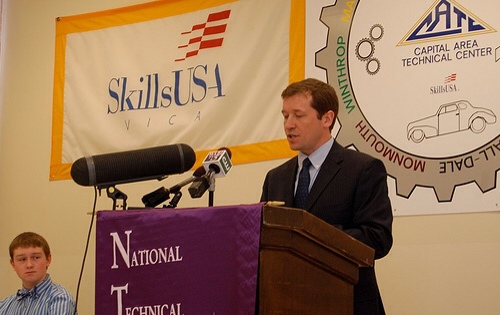
Commissioner Steve Bowen Announces his strategic Plan

Big news in Maine on January 17th was the Commissioner of Education’s announcement of his new strategic plan.  The plan promise’s to put “learners first” and promote customized, standards-based learning. Access the plan here.

In Auburn, we’re excited about the plan, because it promises support to the kinds of initiatives we (and other Maine Cohort for Customized Learning member districts) are involved in. We recognize that students learn in different ways and in different time frames, and are working hard to create systems that honor these two principles: our long history with MLTI; Advantage 2014, our primary grades literacy and math initiative that includes 1to1 iPads in kindergarten; Expeditionary Learning and projects at the middle grades; and multiple pathways and customized learning at the high school.  Auburn is also a funding partner of Projects4ME, Maine’s virtual project-based program for at-risk and drop-out youth.

Gareth Robinson

But Auburn is also excited about the plan because we were invited to participate in the roll out.  Commissioner Stephen Bowen invited 5 students to speak at the announcement.  Each was asked to talk about how the innovative work at their schools was helping them learn and succeed.  We brought Gareth Robinson, an Auburn Middle School 8th grader, who spoke about the role technology has played in his learning. Gareth has used technology for learning going back to elementary school, both at school and personally for hobbies, like playing guitar. Among other things, he related how, for a recent social studies project, he and his group used iMovie to make a newscast of the battle of Bunker Hill. 

You can read Gareth’s comments and watch a video of his talk here.  Or watch this WCSH Channel 6 news coverage of the Commissioner’s strategic plan, featuring Gareth. Scroll to the bottom of this page to find links to the talks of each of the 5 students who presented, or go here for photos from the event.


It’s Your Turn:

What does the Commissioner’s strategic plan mean to you, your school, or your district?