Overview of The Phases of Implementing Customized Learning

Implementing Customized Learning can certainly seem like a daunting task! I have written previously about the need to find a way to think of approaching implementation in a manageable way.

In reviewing the work of other schools and organizations further along in the process of implementing Customized Learning than we are, there are lessons for school leaders about effective and less effective approaches to implementation. By looking at the contrasts between the implementation efforts of an initiative that works and those that do not, educators can learn something about what the successful schools have done and what the less successful schools might not have done.

One of the major lessons for leaders has been “not all at once!”

There are many components to the school reform effort, and following a certain sequence seems to lead to successful implementation more often than other processes. Although there is flexibility in how districts implement each phase, successful implementation of Customized Learning moves through these five phases:

  • Awareness Phase
  • Classroom Culture Phase
  • Instructional Design Phase
  • Instructional Implementation Phase
  • School Structures Phase

Each phase focuses on building the capacity of teachers to implement a system of Customized Learning, but by making the transition manageable by breaking it down into doable steps. Below is an overview (the “deliverables,” if you will) for each phase:

Awareness Phase (In the Current System)

  • Overall Goals for this Phase: Examine our collective beliefs about learning and school; Start to build a mental picture of Customized Learning
  • Own the Learning Training (Customized Learning Awareness)
  • Shared Vision, Burning Platform, Beliefs of Learning Documents Established
  • Able to Articulate Beliefs of Learning, Vision, Mission
  • Explore How Beliefs Match Practice
  • Familiarity with Curriculum Organization
  • Start to Make Learning Transparent to Students
  • Able to Articulate Basic Information about Customized Learning and a Student Centered Environment


Classroom Culture Phase (In the Current System)

  • Overall Goals for this Phase: More consistently create a learner-centered classroom culture, including procedural efficiencies; Make the curriculum more transparent and navigable to students
  • Classroom Design & Delivery Training
  • Create a Learner Centered Culture that Honors Student Voice and Choice
  • Create Procedural Efficiency in a Learner Centered Classroom (e.g. Rules, Student Input, Standard Operating Procedures)
  • Tracks Student Progress on Specific Learning Goals/Targets vs Activities/Assignments
  • Learning is Transparent so Students Can Navigate Their Own Learning (e.g. Student Goal Setting, Use of Curriculum Organization)
  • Initial Use of Mission, Vision, etc., as Decision-Making Screen
  • Recognize It Is Not About the Tools, But Rather About How the Tools Are Used (Parking Lot, SOPs, PDCAs, Code of Cooperation, Affinity Charts, etc.)


Instructional Design Phase (In the Current System)

  • Overall Goal for this Phase: Designing lessons and units for Customized Learning that reflect instruction for both lower-level and higher-level thinking
  • Instructional Design & Delivery Training
  • Balanced Instructional Model
  • Unpacking Learning Targets with Students
  • Instruction Organized Around Measurement Topics (Curriculum Model)
  • Student Self Pacing & Acceleration
  • Instruction for Lower Taxonomy Levels (e.g. identifies online resources for Level 2 Goals)
  • Instruction for Upper Taxonomy Levels (e.g. Seminars, Projects, etc.)
  • Consistent Use of Mission, Vision, etc., as Decision-Making Screen
  • Separates Academic Feedback from Non-Academic Feedback


Instructional Implementation Phase (In an Evolving System)

  • Overall Goal for this Phase: Become skilled at consistently implementing the practices (motivation, interventions, grading and assessment, etc.) to carry out the lessons and units.
  • Has and Uses an Explicit Model/Language of Instruction (e.g. The Art & Science of Teaching)
  • Uses a System of Recording and Reporting Student Progress
  • Use of Individualized Learning Plans
  • Applies Assessment for Learning (Formative Feedback)
  • Uses Formative Approach to Calculate Progress and Rubrics, Instead of Points and Percentages
  • Applies Effective Practices in Student Motivation & Engagement
  • Demonstrating Proficiency on Learning Targets Through Different Approaches (Multiple Pathways)


Structure Phase (The New System)

  • Overall Goal for this Phase: Design and implement the schools systems and structures to support pedagogical practices developed and implemented over the previous phases.
  • Grading and Reporting System
  • “Rank & Advancement” (Grade Levels)
  • Scheduling Students
  • Grouping and Regrouping of Students
  • Course Organization (Seminars, “Merit Badges,” etc.)
  • Understands and Embraces Invention Reasoning


We are quick to point out that staff are alway free to “dabble” a phase or two ahead of where they are now. In fact, their explorations often help us figure out how to better implement the coming phases. Using the term “dabble” also helps make clear that, although their explorations are welcome, their task is to get good at the deliverables for the phase they are currently in.

Here is a phases chart you can share with your staff.


How Does Auburn Select Apps?

Ever since we started Advantage 2014, our primary grades literacy and math initiative that includes 1to1 iPads in Kindergarten and 1st Grade, we’ve had educators and parents ask us what apps we’re using. (We have an apps page on our web site with 2 links, one to just our list of “district recommended” apps and one with the correlation of those apps to our curriculum – at least for one academic area…)

But occasionally, I’ll be asked how we select our apps.

For the most part, teachers guide our selection.

Teachers are free to use what ever apps they would like (especially free ones), but they are responsible for organizing their app library and syncing the devices in their classroom. This, by itself, eventually leads to teachers being more selective about which (and how many) apps they use! (One kindergarten teacher spent a couple weeks taking home a few iPads each night to spend the evening deleting the couple hundred apps she no longer wanted on the iPads!). 🙂

In general, we made “educational resource selection” part of our professional development. We didn’t want app selection to be some centralized function, and we wanted teachers to get good (and deliberate) about how they selected the resources they used with their students (which never happens if “someone else” is responsible for deciding which resources are ok for teachers to use). In a post about our professional development, I referred to our it as using a Constructivist approach:

As we thought about designing PD for our teachers, we didn’t want to just hand teachers information or resources; for example, we didn’t just want to hand them “approved” apps. We wanted teachers to have an intimate understanding of various components of the initiative they were on the front lines of implementing, including app (educational resource) selection. We decided to take a constructivist approach. For example, we had our teachers start by simply exploring apps. They had a limited budget for apps, but could also download as many free apps as they wanted. Then teachers made recommendations for apps that they thought would be the “core collection” of apps, those apps the district would purchase for every classroom. We would give teachers two similar apps and ask, “which one’s better?” to get them thinking about criteria for app selection; this eventually was developed into a rubric. Finally, we correlated apps to our kindergarten curriculum. The constructivist approach insures a deeper understanding based on their own experience.

We decided we didn’t like the term “district approved” apps, and now refer to them as “district recommended” apps.

Also, with teacher input, we revised our app selection rubric a couple times. Then we came across Tony Vincent’s work with iPads and his fabulous resources. We now use his rubric, since we think it captures our thinking about app selection better than we did. (Here are some other recommendations by Tony Vincent on how to evaluate/select apps.) Now, when a teacher requests that an app be installed on all the classroom iPads, we start by asking how it faired against Tony Vincent’s rubric.

In all cases, we tried to focus app selection (and teacher practice with iPads) on our goals for the program. From our PD post:

Content of Professional Development – All of our PD and training has focused on a couple of topics. We wanted to expand our teachers’ skill at applying literacy best practice, and to insure that our teachers and specialists working with kindergarten students had the capacity to select and apply appropriate apps directly toward student academic needs, as well as how to manage the iPads and work within the unique demands of this initiative.

Through our professional development, we also worked with teachers to create expectations for iPad use in the classrooms (which further helped us with app selection):

iPad Use – Minimum Requirements

  • iPads are used daily during centers.
  • iPads are used daily during whole group and/or small group instruction.
  • iPads are used as an intervention tool with below benchmark students.
  • iPad apps reviewed by the district are used.

This year, recognizing that we need to address both instruction for low-level thinking and higher-level thinking, we have some teachers exploring “Using iPads for Projects, Problem-Solving, and Creating.” So even with new explorations, we are working to link app selection to the best practices.

I haven’t really talked about how we pay for apps (mostly district volume purchase program vouchers, and iTunes cards purchased by various groups), and I recognize that budget does have an impact on app selection, and when a district purchase is involved, we involve the Tech Director in the decision (or the Special Ed Director, if it is a Special Education related purchase). But as much as possible, we try to give the teachers the lion’s share of the say in what apps we get. Leadership’s job isn’t to tell them which apps are ok to use or what best practice is, but rather to support their individual and collaborative work toward becoming their own experts in best practice and educational resource selection.

Modeling of Customized Learning (Paradigm Shifting)

Although teachers can often apply familiar best practices to unfamiliar contexts, the integration of Customized Learning is often a paradigm shift for teachers, involving practices they are not familiar with. Rarely have teachers experienced Customized Learning themselves, and, collectively, Maine Cohort for Customized Learning districts are early enough in their implementation that many teachers have still received very little training.

Educators who effectively help teachers shift paradigms recognize that it requires more than sharing information and formal workshops.

Schema theory sheds the best light on how to structure professional development for large-scale change: provide models and experiences. Or as some school change experts say, “Teachers can’t do what they haven’t experienced.” Teachers are more often stumped with implementing an initiative by that lack of knowing what it looks like, feels like, tastes like – that not having a mental model of what it is like in action – than by any lack of technical information.

We are using a couple approaches to provide modeling to let teachers experience Customized Learning:

Visiting Classrooms: When teachers don’t have a lot of experience with an innovation, one way to get them that experience is by having them visit other teachers who are successfully doing similar work. Cohort districts are working to make sure that other teachers can come to visit classrooms so they can begin to expand their experience (although school leaders are trying to be careful how they schedule and manage such visits as not to distract too much from the learning that is supposed to be their first order of business!).

Vicarious Classroom Visits: Getting out to other classrooms, especially those in other districts, isn't always practical. Alternately, teachers can visit classrooms vicariously through videos or stories. Teachers can set up a Skype (or some other video conference) during their class so other teachers can see what is happening. Various videos are online. And teachers can read articles about Customized Learning classrooms – but not descriptive articles, so much as those that tell the story and paint a picture for the reader (remember, this is not about information, it is about experience).

Connecting with other Educators: A different approach to helping teachers and program leaders build models is to provide them opportunities to communicate with educators who are doing similar work. Networking is a powerful way for teachers to develop their own practice while helping colleagues (often in different states or countries!) to develop theirs. School leaders encourage teachers to consider tweeting or blogging about their experiences, since it can help build a diverse professional learning network for the teachers who do (although few teachers have taken on these options to date – Cohort teachers seem more eager to connect with teachers in more traditional ways: on the phone or via email).

These strategies are not limited to Customized Learning. These are Professional Development for Paradigm Shift strategies that schools can apply to any large-scale school change, any change that most teachers have not yet experienced themselves.

More Indications of Positive Results from Auburn’s iPads

We’ve had iPads in our Kindergarten classrooms for more than a year now. This fall, we also rolled out iPads to our 1st grade students. All in the name of improving students’ mastery of literacy and math.

We know that we have too many students who aren’t demonstrating proficiency, so for several years, we’ve been making sure that teachers are getting quality training in literacy and math instruction, and we’re hopeful that, combined with the access to educational resources made possible through iPads, that we’ll increase that level of proficiency.

And when we examined gains made by last year’s kindergarten students, that’s what we found. Our kindergarten students had made more gains than in years past, leading our Curriculum Director to proclaim that taxpayers’ money is well spent.

Read more about our gains in the Sun Journal article Educators Say iPads Help Scores, and the MPBN radio story Auburn Educators Tout Benefits of iPads for Kindergartners (sorry iPad users; you need flash to listen to the story, but you can still peruse the article).

Keep the MLTI RFP focused on Learning: Talking Points

I have had some great conversations and email exchanges with many of you since posting my concerns about keeping the new MLTI RFP focused on learning. Some of you have asked if you wanted to reach our to the Commissioner to express similar views, what might you say?

Here are my talking points:

  • Instead of tech specs, the RFP should describe what we would like to do with the devices (what is the change in learning that we would like to see?)
  • Technology is expensive, and we should not invest in it if we are simply going to use it to do what we do without it (what is the change in learning that we would like to see?)
  • Looking at the work in Maine, perhaps that change in learning should be Customized Learning and the Education Evolving recommendations
  • In keeping with the components of Customized Learning, the learning activities described should include both those for low level learning and for high level learning.
  • Low level activities (recall, understanding, simple application) could include the following: access to online resources, information gathering, note taking, communicating, studying, accessing online educational tools, etc.
  • High level activities (non-routine application, analysis, evaluation, creating) could include the following: creating simulations, project-based with multimedia, coding and programming, writing for a purpose and audience, digital storytelling, engineering and design, etc.


It’s Not About Blaming Teachers, It’s About Locus of Control

I keep writing about, and presenting about, how teachers need to teach differently… Pretty soon you'll start thinking that I'm blaming teachers for the challenges in our schools…

Most of what I write about in this blog is educational change, usually focused on instruction and/or technology integration (which, of course, is just a subset of “instruction”). But when you talk a lot about changing expectations for teaching and learning, and how teachers teach, and paradigms, and getting them to focus on the right thing instead of the wrong thing, and supervising for those changes, it's easy to start to think that I believe that teachers are the reason that schools aren't changing or that more students aren't learning.

Nothing could be farther from the truth.

First off, I write about the changes that need to happen and how to help teachers make those changes because they are things that most teachers have not experienced before themselves.

I believe that the rules for education have changed. The world of work has changed and we now need every child to learn in school what we used to only need the college prep kids to learn (well, actually what has changed is that we now need every kid to be college prep!). Second, new tools (laptops, tablets, cell phones, iPods, information access, personal broadcasting, the read/write web, multimedia, etc.) have changed how kids work, necessitating changing how schools have students learn (or risk becoming irrelevant to students).

As I described when Bea McGarvey came to Auburn, she points out that schools still do industrial age education, when we need an educational system for the information age:

During the industrial age, schools’ goal was to sort out talent and make the rest compliant. We got really good at that. But for this economy, the goal needs to be to develop talent in every child. That’s why we’re so frustrated: we’re trying to meet one goal with a tool that was designed for another…

It doesn’t matter how much we agree with the burning platform that our schools need to work for all our children, or how well we understand that the root problem is how our goals have changed and it isn’t “the teachers’ fault” (Bea says, according to Deming: 95% of the problems are not with the people; they are with the structure), the fact is, at some point teachers understand that they are good at a system designed for an old goal, and that they might not know how to do the system for the new goal…

So teachers are now working in an environment they didn't really experience as students themselves, and probably weren't trained for professionally. Even if teachers need to be the ones making most of the changes, the reason is that the rules have changed, not because they weren't doing a good job.

But even more importantly, we focus on teachers making the changes because teachers are the ones who can solve our challenges. They have the power, the locus of control. When we look at all the factors that impact our students being successful, the one we (schools, educators) have the most control over is teacher practice: what happens in the classroom.

And if teachers have to make changes for a new environment they haven't experienced or been trained for, and if they are the ones who have the power to make the changes, then we have to be very, very clear that we don't blame teachers. Nothing could be more inappropriate, nor unproductive for achieving our new goals.

Instead, what we need to do is support the heck out of teachers.

We need to provide teachers support to a level like we never have before. Side by side with an expectation to teach in ways so all students can learn a high status curriculum, and that makes use of the modern tools for intellectual work, we have to be making a promise to support teachers in this work, making clear we believe in our teachers, and that we know that they can do this hard work. We have to provide training, resources, and time. We have to let teachers try, and allow them to make mistakes, and also to get better – and hold them harmless in this important work. That includes sticking up for them and their efforts, even when (maybe especially when!) it doesn't go well the first time.

If we don't, we guarantee failure: for our schools, for our teachers, and for our students.


MLTI: How Will a Multi-state RFP Help Us?

Maine is nearly ready to enter a new contract cycle for the Maine Learning Technology Initiative, and is currently working to craft a new request for proposals from vendors.

The DOE is considering exercising an organizational agreement that would allow other states to buy-in to the terms of our contract.

I recently shared my concerns about this possibility with both Commissioner Bowen and state Tech Director Jeff Mao, and asked them to please consider NOT framing the new MLTI RFP as a multi-state buy-in.

It is generous that the tech director is thinking about how he might help other states by using a provision that would allow other states to essentially access the same agreement that we reach with the successful vendor.

But I’m afraid I don’t see how such an arrangement will benefit us (Maine) and, in fact, I’m worried that it will hurt us. I have worked in both the public sector and the private sector, and although I can see why other states might like the option, I can’t imagine that vendors would.

If part of the motivation is to get a better price by suggesting they’d sell more units (and I admittedly don’t know the reasons the DOE is considering including the option allowing other states to sign on), then I worry that the reasoning is false. I would think that a vendor is more likely to give a better price to a single, well-designed, targeted initiative that had a good chance to showcase their solution.

Also, if our RFP is based on the kinds of changes in learning we’d like to promote (as I advocated in my previous post), it would generate the kinds of proposals that might include very specific software solutions and professional development, as well as hardware and network solutions. These would all be based on Maine’s context, our schools, our learning. How do other states benefit from that? Maybe I could see that if MLTI were simply a tech buy, but we’re not. We’re a learning initiative.

I worry, too, that this arrangement would needlessly make things difficult for a vendor. I would imagine that, even if there is a provision in an agreement between states allowing other states to buy in given our terms, that the vendor would have to still negotiate separate contracts with each state. I don’t think that there is a way for a different state to buy on our terms without having a separate contract with the vendor. And I worry that that which makes things unnecessarily difficulty for a vendor only hurts Maine and the possibilities of our getting a proposal that would include an attractive solution that meets our needs.

And my biggest fear, is that if a multi-state buy-in option is awkward and difficult for vendors, then vendors who could offer us the most attractive solutions will simply choose not to submit a proposal. Frankly, I worry that quality potential applicants will choose not to submit a proposal.

And worse. We can’t even ask our best partner in MLTI what they think. I would imagine that Apple would feel, now that the DOE is working to shape the RFP, that they couldn’t talk to the state about any topic that might even be perceived as related to the RFP. I would imagine that any vendor would think that that was too close to conflict of interest, or even illegal. So a partner that has been very helpful in the past and always quick to collaborate with us on all our challenges is likely to now be a mute partner.

So, if you are also worried about the unintended consequences of including a multi-state buy-in option in the new MLTI RFP, please contact the Commissioner of Education (624-6620; commish.doe@maine.gov) and state Tech Director (624-6634; jeff.mao@maine.gov) to encourage them to frame the RFP around Mane’s needs.

MLTI: What Change in Learning Would You Like to See?

I think one of things that MLTI, the Maine Learning Technology Initiative, did well, right out of the gate, was to say it isn't a “tech buy,” but rather a learning initiative. I think this one point is a major reason why the first (and still only) statewide learning with laptop initiative did so well and is more than a decade old. Even the first RFP to prospective vendors focused on what we wanted to do with the technology, rather than tech specs.

And the focus on learning was especially evident in our professional development.

Our PD focused on project-based learning, and the writing process, and mathematical problem solving, etc. We focused on how to teach with technology, not so much on how to use it. And when we did focus on how to use it, it was in the context of how to teach with that tool. We didn't do workshops on how to use a spreadsheet; we did workshops on how to analyze data and the participants left also knowing how to do spreadsheets.

But I've grown concerned that MLTI may be moving away from that focus on learning. To listen to conversations about the initiative, they seem to focus much more on the “stuff” (comparing devices, network and filtering solutions, and discussing software fixes and specifications…) than on teaching and learning. I am not saying that I've heard that from Jeff Mao, Maine's Tech Director, or the DOE, as much from out in the general public. But even so, it has me worried a little…

I think one of the tricks of keeping a mature initiative going is to reflect on what made it great in the first place, and make sure that we keep those pieces fresh, even if they may have gotten a little stale and need refreshing. That's not to say that the MLTI team isn't doing their job. Every initiative needs freshening up when things have been routine for a while!

Right now, the MLTI contract is getting ready to run out and the Department of Education is working to craft a new RFP. What better (and perhaps more appropriate!) time to freshen up an initiative than when designing that initiative's RFP.

So I recently had conversations with both Commissioner of Education Bowen and Jeff Mao, asking them to please consider framing the new MLTI RFP around the change in learning they would like to see in our classrooms. This post reflects some of what I shared with them, first in my phone conversations, and then in a follow up email.

So, I'm hoping that MLTI is still committed to being a “learning initiative” and not a “tech buy.” And if it is, I'm hoping that the RFP can be crafted in such a way that this is evident.

And if so, then what is the change in learning that the Commissioner and the MLTI team are hoping will come about by leveraging the technology? Is it Customized Learning? What would Education Evolving, Maine's new education strategic plan, look like in action and how could technology help bring about? Is it the practices highlighted in the DOE's new Center for Best Practices? What are we hoping students would be doing each day, both on and off their devices, that we would recognize is a change in learning?

Or as I say in presentations, if we're just going to use technology to do what we're already doing, why put the money into technology?

I'm hoping that the Commisioner and the MLTI team will consider framing the RFP in such a way as to make obvious that we are looking for a change in learning, and allow the responding vendors to propose the technical solutions that they think can help get us there.

So, if you think that MLTI should be more than a tech buy, please contact the Commissioner of Education (624-6620; commish.doe@maine.gov) and state Tech Director (624-6634; jeff.mao@maine.gov) to encourage them to frame the RFP around desired changes in learning.


Positive Pressure and Support: All 3 Pieces

Level of implementation matters.

Unfortunately, simply participating in training and having the right resources available does not mean that students will do better or that your initiative will have it’s desired impact. The degree to which teachers implement your initiative and related strategies matters.

So, how do you drive your initiative to a high level of implemention?

Providing Positive Pressure and Support is how school leaders affect the level of implementation. Positive Pressure and Support is made up of three easy pieces: Expect, Supervise, & Support

The series of posts linked below explore each these pieces.


The Need For a Shared Vision

Destination matters.

What if you were a sailboat captain.

Let’s even say you’ve got a great boat and a wonderful crew. Together you’ve done a lot of sailing. Maybe you even work well together and know how to collaboratively operate the boat to maneuver well and go really fast, coaxing its peak performance.

But what does all this mean if you have no destination?

Or worse, what would happen if each of you had a different picture of where you were headed? What would the outcome be then?

In fact, you may only be able to judge how successful you are when you judge it against how well you did getting to a specific destination.

Perhaps a day sail out to the island is a different kind of work than a sail from Maine to the Keys. Maybe sailing to Antarctica is different than sailing to Spain (as Shackleton will tell you!). Maybe sailing the Intercoastal Waterway is different than sailing across the ocean. Destination matters and it defines the specifics of the work you need to do, despite the commonalities of the work. Doing the work isn’t the desired outcome. Getting to the destination is the desired outcome, and the work is how you get there.

Now, you might question my metaphor since sailing is just sometimes about heading out and enjoying the water, but I’d argue that that was a pretty specific destination. And think about how frustrated you would be, if the crew thought that was the destination and you thought you were headed to Vinalhaven Island!?

Schools also need to be on the same page about their destination. A fundamental and critical component for the success of any large-scale school change effort is the thoughtful creation and formal acceptance of a shared vision for that effort. Education for what? Why bother?

A shared vision in not only a description of what you want your desired outcome of school to be, but is one that is held in wide agreement with your administration, staff, students, families, and community.

In spite of the renewed interest in having a shared vision brought on by the Proficiency-Based Learning work going on in some Maine districts, I believe this is a piece of work that is overlooked all too often. Sometimes I think schools, districts, and state Departments of Education think their destination (vision) is simply to “do school,” to go through the motions of schooling as we’ve been going through them. It is no wonder that some districts see no reason to change (after all, if the purpose of sailing is simply to see how well you work the rudder and sails, any port will do, won’t it?), or just believe that the purpose of school is obvious and get frustrated with people who don’t and want to spend time on “this touchy feely stuff!”

And thus is the problem with schools and shared visions. Districts, schools, or states can either assume that their existing mission or purpose statements (despite often being created as so much rhetoric) can simply be spread to cover any new effort, or they simply assume that everyone understands that school, or the initiative, “is important” (especially if someone else has said that you have do it, such as implementing the Common Core).

The trouble with the former is that traditional mission or purpose statements are not future-focused enough to be effectively used in support of an large-scale change effort, such as 1to1 tablets or laptops, or Customized Learning. In the latter case, a lack of a fully developed shared vision (because you all just assume “it is important”) will mean that the time will inevitably come when it becomes clear that individual beliefs about what the vision “is” (but remember they don’t know, because they assumed) compete and contradict each other, and disrupt any forward momentum, unraveling (or at least stalling) your initiative.

So what should we do about a shared vision?

There are certainly lots of approaches. Which ever approach you choose, it should meet a couple criteria:

  • The vision should be both realistic and creative
  • It should reflect the contexts of both your students and school
  • It should also reflect what you hope for your students and their futures
  • The process should involve a broad a group of stakeholders (administration, staff, students, parents, community members)

I’m getting ready to blog (in three parts) one of my favorite approaches to creating a shared vision. Like a lot of my favorite strategies, it is based on lessons learned from MLTI, the first and only state-wide 1to1 learning with laptop initiative, now over a decade old. This post, and the next two on building a shared vision, come from materials that were jointly written by Jim Moulton and me, and were distributed to educators in the early years of MLTI. (Note: Those portions of these posts that may have been originally penned by Jim are used with his kind permission. Any inaccuracies, errors, or erroneous information are certainly all mine.)

We Must Do More Than Fill Students’ Vessels

I was especially dissatisfied with my own teaching when I started.

Early in my teaching career, I was presented with a paradox that continues to shape my interests in education. When I was teaching high school computer application courses, my students would learn to use a word processor (in the day when stuents were likely to only have access to computers at school). I was very thorough and made sure they learned how to use nearly every feature (although word processors then had many fewer features than they do today!). We spent a lot of time on it, and together we worked hard so that nearly everyone would be successful on the challenging word processing test.

What surprised me, however, was that a few weeks later, students would return to me, announce that they had a paper to write, and ask me to show them how to use “that word processor thing” again!

I couldn't understand why these students didn't remember how to use the program. These were bright students who had had no problems during class, and who had done well on the test. Very little time had gone by since we had last used the word processor. There was no reason that they should not know how to use it.

There was obviously something I didn't understand about learning. It was the first time I started to question how learning took place, and prompted my inquiry into how people learn.

I fear that during my first few years of my teaching, all I had really taught most of my students was that I was knowledgeable within my field. I tried to convey my knowledge to my students but I was simply trying to “fill their vessels.”

The way I organized the curriculum wasn't even oriented toward learning; it was organized for teaching. I was mostly concerned with questions like when were the standardized tests and what would be on them, when would other teachers be teaching related ideas, what would kids need to know for the next course? All my content was organized the way an expert might look at it. It was neatly categorized and sequenced like it might be done by someone who was already familiar with the information.

I never asked myself how people might learn the same information. I never asked how experts had acquired their vast knowledge; was it through a logical sequence or some other order?

Some of my kids seemed to do okay, but not enough of my students to make me feel like I had done a satisfactory job. I knew I was teaching the way all my teachers had taught me, so I knew I was teaching correctly. But somehow contradictions, like with the word processor, kept happening, and I started to doubt if it really were the right way to teach…

Those contradictions and doubts led me to question my assumptions about teaching and learning. Eventually, I found tidbits that helped shape my work, such as the quote from the classical Greek philosopher, Plutarch, “A mind is a fire to kindled, not a vessel to be filled.

My job wasn't to give students information but to inspire and nurture them. And like Ian Jukes says, “Teachers don't need to be fire kindlers, they need to become arsonists!”


What Makes for Good Learning Experiences?

The more we try to to help build the talents of every student and help every learner succeed in school, the more we have to be deliberate about creating good learning experiences in our classrooms. I have certainly added to the conversation about what I believe gives students good learning experiences.

The roots of those ideas are not just my own experiences as a learner and a teacher, and not just conducting research and reviewing research, but from actually asking people about their own good learning experiences. The Good Learning Experiences Activity is one of the ways I have explored different people’s perspectives on how they think they learn well.

“Think of a good learning experience,” the script for the activity begins. “It can be in school, or out of school. It can be when your grandfather taught you how to cast a fly rod, or when your teacher worked with you to write that really good essay. But think of a time when you had an ‘aha!’ or something finally made sense, or you could finally do something. Think of a good learning experience.”

I give small groups of participants a few minutes to share their stories. Next, I ask them to jot down on scratch paper what it was that made it a good learning experience. What were the characteristics of the experience? After a few more minutes to share their lists with their neighbors, we compile a class list on chart paper, an overhead, or on a projected computer.


Before reading on, just take a second to think about a good learning experience of your own, and what it was that made that a good learning experience.


I have conducted the activity with people of nearly every age group: upper elementary students, middle school students, high school students, college students, teachers, and parents. Only a few learners state that they can’t think of any good learning experience. Many of the learners state that their best learning experiences have taken place outside of school. No one has ever said that their best learning experience came from a terrific lecture, or an interesting textbook, or an engaging worksheet (although I believe each of these can be a useful teaching tool when applied wisely).

Having conducted this activity with so many groups, I am intrigued by the results. I was surprised to find that, regardless of the group involved, there were common elements with other groups’ lists. Since 1992, I informally tracked the results and found that certain characteristics of good learning experiences come up in nearly every list:

  • The work was well connected to other ideas and to the real world
  • The content of the learning experience was personally relevant, interesting, useful, or meaningful to the learner
  • The learner had choices, shared authority, control, and responsibility
  • The learning was hands-on and experiential
  • The learner learned from and taught others
  • The learner had the support of a patient, supportive, and nurturing mentor
  • The learning was individualized and although there were standards for the work, the learner could meet them in his or her own way
  • There was a positive aesthetic component to the experience: it was fun or left the learner feeling good
  • The experience helped the learner understand him or herself
  • The learner had success and accomplishment with challenging work

Now, these are my words synthesizing the lists I have collected over the two decades I’ve been doing this activity. Certainly elementary students aren’t going to use these word exactly. But doesn’t this list reflect what made your own good learning experience good?

Much can be learned by investigating how students believe they learn well. What better source for finding out what motivates students to learn than themselves?

But with knowledge comes responsibility. If you know what makes for good learning experiences, don’t you now have an obligation to insure that you model these in our own teaching? – Or at least start learning how to do these in the classroom?


(Note: I have been with educators who have used the prompt “think of a good experience” or “think of a good school experience”, and it never gets to the right information about when people learn well. If you are considering doing this activity with your own students or teachers or parents, I highly recommend that you stick with the prompt “think of a good learning experience.”)


Thinking of Instruction as Two Types

When our pilot teachers were visiting a school that is a little further along than we are at implementing Customized Learning, a colleague and I got talking about how we (us and our colleagues) had a lot of work to do on instruction if we were going to be successful with our implementation.

Then it hit us that a lot of teachers would say they already do a pretty good job with instruction and would object to being told that we had a lot of work to do on it.

And then I realized that both perspectives were right. We just weren’t talking about the same kind of instruction in each instance.

There are two kinds of instruction.

There is Instruction for Lower Order Thinking and Instruction for Higher Order Thinking.

So, it doesn’t matter if you use Bloom’s Taxonomy, New Bloom’s, Marzano’s Taxonomy, or Webb’s Depth of Knowledge, Instruction for Lower Level Thinking is focused on recall and simple application, and Instruction for Higher Order Thinking is focused on nontrivial application, complex reasoning, and creating.

Our teachers are really pretty good at Instruction for Lower Order Thinking. But we have a lot of work to do on Instruction for Higher Order Thinking.

The distinction, thinking of instruction as two types, doesn’t just help clarify our thinking.

This distinction would actually help us in a couple different ways.

We now could say, “You guys are really good at Instruction for Lower Level Thinking. But now, to do Customized Learning well, we need to help you get better at Instruction for Higher Level Thinking.” The message about getting better at instruction would have always been about support, but could have been taken as criticism of their abilities. Now, we can differentiate between validating their abilities, and identifying a need, and offering support to address that need.

And it helps us think about when should teachers apply each type of instruction.

And it will help teachers think about how the two kinds of instruction are different and which strategies support which type.

And it helps us think about leveraging what kinds of interventions to support teachers.

What would thinking of instruction as two types mean to you and the work you are doing in your school?

School is Boring

School is boring.

We all know it.

Kids know it.

Parents know it, but don’t want to think about it.

We teachers know it, too, but defend it. In some small way, I think we don’t want to think that the subject(s) we love could possibly be boring! But we do go on to say things like: It’s preparation for life after school. We all have to do things in life that we don’t want to do. Or, I wish students would start taking responsibility for their own learning. Or, it is the students’ job to learn.

My problem with putting the onus on students is that we are all quick to forget that kids are not in school by choice. They are in school by law. Ironically, it is we, the educators, who are in school by choice. In fact, we are getting paid to help kids learn. In fact, we are the only ones getting paid – if learning were the children’s job, wouldn’t they get paid, too? To me this all shifts the moral responsibility.

And we are quick to forget that kids are kids. And that being a kid when you are a kid is appropriate. It is what you are supposed to be!

And we are the adults.

And we spend WAY too much time trying every possible crazy thing so solve the problem, EXCEPT trying to engage students. It’s enough to make you tired!

I think teachers defend school being boring because we fear we will be blamed.

But I don’t blame teachers.

(Well, if you lecture through an 80 minute block, perhaps you should be blamed…)

Edwards Demming, the father of Total Quality Management, says that 95% of our problems come from structures, not people. And Roger Schank actually makes the argument that it is school being boring that is to blame for kids not learning more, not teachers! In response to Tom Friedman’s blaming teachers, Schank writes:

So one more time for Tom: the problem is that school is boring and irrelevant and all the kids know it. They know they will never need algebra, or trigonometry. They know they will never need to balance chemical equations and they know they won’t need random historical myths promoted by the school system. When all this stuff was mandated in 1892 it was for a different time and a different kind of student.

I’m not denying that it’s hard, or that teachers get frustrated when we are trying what we think we can and not getting any further than we do. Why wouldn’t we feel like we were treading water as fast as we can?! And maybe that even makes it (a little) understandable when we blame kids for not learning.

But, the the solution to ALL this is teachers doing more to engage students.

Not be because it is our fault.

Because it is what we have control over.

And if we want teachers to engage students, then we sure better support the heck out of teachers!

And even though its true, we can’t simply say to teachers, you just have to focus on these five things: inviting schools, higher order thinking, learning by doing, real world connections, and student voice and choice.

We need to get teachers training. And into classrooms with teachers who do a good job engaging students. And we all better remove the barriers that are keeping us from creating the conditions that students find engaging (even if it means changing our curriculum, or how we schedule students, or how we group and regroup students, or how we connect with the community and the potential classrooms outside the building).

And the good news is that when kids aren’t bored, they don’t only learn more (making teachers/us look good), they behave better (making teachers/us happier!).

We need to get beyond the (irrelevant) question of who is to blame, or the (senseless) debate of whether we should or not, and just do it! Just work to engage students!

Engaging students is a win-win! It’s good for kids and it’s good for teachers. Just do it!


How will you help make school less boring?


Positive Pressure & Support Part 3: Support

Schools need effective, practical approaches to helping more students succeed academically.

A focus on student motivation and meaningful, engaged learning, on project- or problem-based learning, on personalized, customized learning, or on technology rich learning environments are all approaches that can help make that happen, but require a paradigm shift for teachers, since few of them have experienced these approaches themselves.

Successfully implementing initiatives that require a paradigm shift for educators requires strong, deliberate leadership for school change. The key pieces of Positive Pressure and Support (setting expectations, supervising for those expectations, and supporting those efforts) are necessary components of that leadership, and is the primary way to drive your initiative to a higher level of implementation.

Teachers will start using more core strategies of your initiative when they know it is expected of them and is being monitored—but they need (and deserve) support in getting there. What follows are some of the support strategies that I’ve found helpful.

Support: Celebrating Successes
Celebrating successes is the place to start. Implementing signficant school change is a long road, so the people working to implement those changes need encouragement and to know they are on the right track. Your expectations may be high, but teachers, like students, need to progress (to some extent) at their own pace and within their own capabilities. Nudging, prodding, and pushing are much more effective when combined with pats on the back and kind words, even if it is just small things being noticed.

For the teachers most resistant to change or the most challenged by the change, celebrating baby steps is especially important. With our own children, we didn’t wait to get excited until they could run. We got excited when they could crawl, then when they could stand, and again when they could put one foot in front of the other, and on and on. We need to celebrate each developmental growth step the staff passes through.

Often the best “celebrations” aren’t time consuming or expensive. As you’re walking down the hall, walk beside the teacher and say, “Your kids were pretty engaged during that lesson. You must have done a great job with that new strategy!” Or stick your head in the door during the teacher’s break and say, “Do you mind taking 5 minutes at our next meeting to tell the staff about that thing I saw you do this week? I think others will want to know how to do that.” Or as you leave a walk through, hand the teacher a 3×5 note card, where you’ve written, “I know you were frustrated with how things went in general, but I think you need to remember that the part where you did X, Y or Z went pretty well.” (Notice how the whole thing doesn’t even have to go well to celebrate the parts that did!)

Celebrating growth, progress, and success gives the message that this is important, that you noticed what they have done, and that they are on the right track. This is the fuel that keeps a staff working on hard work.

Support: Facilitate the Sharing of Ideas
By definition, this is “new” work: new to the teachers, new to the students, new to the leadership team. Sure, this initiative may be similar to others, or share components with those you’ve worked on in the past. But I’ve been defining large-scale school change as often being A change that teachers don’t have much experience putting into action, even if they have read about it, have heard about it, or are familiar with the key ideas.

And I have a friend who likes to say, “Teachers can’t do what they haven’t experienced.” Teaches are more often stumped with implementing an initiative by that lack of knowing what it looks like, feels like, tastes like, that not knowing for sure how to put it into action, than by any intent or determination to block or sabotage (even if blocking and sabotaging are how fear of failure most often surfaces for teachers!).

As the high school in Auburn is working toward implementing Customized Learning, many of our teachers are starting to use a Parking Lot, a kind of poster used to solicit students’ ideas, questions, feedback, and input. One of our teachers recently told us that he doesn’t believe in the Parking Lot because he put one up and students don’t use it. But, if we want teachers to put into practice something they haven’t done before, we owe it to them to help them find ideas on how to put it into action – how to make it work. We know that Parking Lots have been implemented effectively elsewhere. What strategies did those teachers use, and how could we connect our teacher with those strategies?

I wrote quite a bit in the last post about how talking about the initiative in meetings and modeling lessons can help with sharing ideas. Having teachers share in staff meetings and professional development sessions about their challenges and successes with their work in the classroom provides opportunities to get advice from their colleagues and to learn new strategies. So can having teachers visit schools and classrooms where the initiative is already in action (even within your own building or district!). Alternately, have teachers watch videos or read stories of how others implemented similar work – not informational pieces “about” the initiative, but those that actually illustrate “how” the initiative works, those that provide vicarious experiences.

Regardless of how you make it happen, you need to be thinking about where you can help teachers find their new ideas on how to implement the core strategies of your initiative.

Support: Provide Opportunities for Training and Professional Development
Part of support is looking for ways to provide further training and professional development. In fact, PD may be the first thing you think of when you think “support.” I know if you are thinking of a new initiative, you are already thinking about how to get your staff trained.

But you can’t think about this only in terms of initial training. If this is a big initiative, such as Customized Learning, then you need to be thinking about implementing it in phases, that means delivering training in phases, too. In Maine, the training for the first couple phases of implementing Customized Learning is generally “Own The Learning” (awareness), “Classroom Design and Delivery” (creating a culture of voice and choice), and “Instructional Design and Delivery” (working with the curriculum and organizing instruction around it). Not all the staff needs to be trained in the phases at the same time. In fact, staggering the training for staff can mean that folks a phase or two ahead can become resources for the rest of the staff.

But even if an initiative doesn’t lend itself to clearly defined phases, make sure that you are thinking of training in ongoing, not “one shot,” terms. In our kindergarten iPad initiative, we had one training at the end of the school year for teachers new to the initiative to get their iPads, learn how to use it for as a personal tool, and how to start identifying apps that might relate to their teaching. That was followed, late in the summer, with a two-day training helping teachers think more about teaching with the iPads. Then, throughout the year, we took advantage of Early Release Wednesdays, meeting nearly every other week.

Where are there other opportunities to get staff trained? Can you cajole your colleagues in another district for a handful of seats in their training? Is there a workshop or conference coming up in your region that directly addresses a need within your initiative? Do you have staff that you could groom to train others on some aspect of the initiative? Do you have someone you could free up to go into colleagues’ classrooms and coach them?

Your walkthrough data, teacher survey data, and conversations about the initiative at staff meetings should help you focus on the training and support your staff needs most at that moment.

Support: Provide Resources
Do your staff have the resources they need for this initiative? Do they have their own school-issued iPad or laptop? Does the wireless network adequately support as many simultaneous users as you are likely to have? Are there apps or programs your teachers need? Can teachers get to the websites they need to get to? Is there a book that will will help them design their lessons? Are there materials teachers need to execute those lessons? Do teachers have access to the expertise (perhaps in the form of books or of people) to put their learning activities into action? Do they have a reasonable number of the texts or equipment they need?

I was once involved with a non-traditional school in a mid-sized city. The school was trying to be a project-based career academy for students who were over-aged, but under-credentialed. We had a pretty effective and engaging online literacy program for students who were struggling because of their literacy ability. But the district Director of Curriculum (who also used to be a literacy specialist) insisted that we only use the district-approved literacy program (you know, the one that hadn’t worked for these students yet…). But we said ok, and she promised to send us the materials.

What showed up were the left over materials from the other schools in the district. Not only were there not enough of any item for there to be a class set (and we had 12 classes), there wasn’t even at least a single copy of each key set of materials in the program!

If you want your teachers to put your initiative into action, then make sure they have all (reasonable) materials they may need to do so.

Support: Remove Barriers and Run Interference
Doing something new is hard enough. But it is almost impossible if you see barriers around you, or you are left exposed to criticism. One of the most important ways you can support your staff is also something that they may never know that you do: removing barriers and running interference. Teachers making a good faith effort to implement your initiative deserve support in getting obstacles out of their way.

Many of the typical barriers you’ll remove simply by following the other suggestions in this post. Does a teacher not know how to implement a component of your initiative? Connect them with training or other teachers who can share their ideas on how to do it. Is not having certain resources or materials interfering with the teacher increasing their level of implementation? Find a way to get them the resources they need.

Time may be the largest perceived barrier for teachers. Find ways to create protected, designated time for planning and collaboration. Even if you have the protected time, sometimes teachers have so much going on that the time is used for other things, or to vent (perhaps not even about the initiative). Working to have those planning and collaboration times, and creating an agenda for each meeting to guide the work can remove that barrier.

Another type of barrier is the unhappy parent or colleague member. Such complaints are often based on a little truth, but often with a lot of missing information. As a leader, you have an opportunity to protect your staff from attacks and distractions. You can deal directly with the unhappy person and take the heat, then bring the legitimate pieces of the concern to the staff member in a much more calm, safe, supportive way.

Another way you help run interference for your teachers is by encouraging everyone (especially yourself) to “seek first to understand” (one of Stephen Covey’s habits of highly successful people). What is the full story of the thing the person is upset about? Students don’t like the way the teacher is teaching? What exactly is the teacher trying? What parts does the teacher think are going well and not so well? What does the teacher see as his next steps? It may be perfectly appropriate to respond to the parent or colleague, “Well, that teacher is working hard to implement the initiative beyond where he has been trained. He’s aware of the challenges he is having and has already asked for help in addressing those challenges.” And frankly, we need teachers who are willing to take those kinds of risks and blaze a trail of the rest of the staff.

My mantra is that if we want teachers to learn how to do things they haven’t experienced before, then we better be ready to support the heck out of them. If you want to drive your school initiative to a high level of implementation, help your teachers help you get there. How you get your teachers the training and ideas they need, work to remove barriers for staff doing this work, run interference as they make good faith attempts to implement new ideas, and how you connect staff to resources will also leave your teachers feeling supported as they work to meet higher expectations.

How do you plan to support your teachers as they strive to implement your large-scale school change?

 

Positive Pressure & Support Part 2: Supervision

So, you’re waist deep in your school’s initiative. Maybe it’s improving learning by taking advantage of 1to1 tablets or laptops, or through Mass Customized Learning, or with a focus on student motivation and engagement.

And you are providing teachers with training and resources. And you are working to leverage Positive Pressure and Support to drive your initiative to a high level of implementation. You’ve taken the first step and set expectations with your staff. In general, your staff are working to put those into action.

And you’re ready to move your implementation to the next level. It’s time to focus on supervision.

Most educators really do work hard at trying to do a good job in all aspects, not just for the initiative, and that means that they are busy and have lots of (sometimes contradictory) priorities they are trying to address. Knowing what school leaders are keeping an eye on can help focus their efforts. Frankly, even the best teachers are more likely to address priorities that they know are being supervised. An expectation that is simply stated is not as likely to be implemented as one that is both stated and monitored. Think of the old assessment adage, “What gets measured gets done.”

Several strategies help leaders supervise for the implementation of their initiative.

Supervise: Check With Teachers
Periodically checking in with teachers can go a long way toward increasing implementation. Check their lesson plans. Are they clearly planning to use desired strategies as often as you’d like? You don’t necessarily have to have everyone turn in their plans weekly. Random spot checks can be powerful and not a time-sink for you. You can always increase the frequency of checks with teachers who need a little extra encouragement.

Alternately, give teachers a weekly survey. In Advantage 2014, our iPads in kindergarten initiative, we used a Google form to survey the teachers each week. They simply had to select drop down choices for each item, such as how many times this week did you use iPads in literacy centers? Or how often this week did you use iPads for individual student interventions? These survey questions came directly from our expectations for the program. We also included “what have been your successes?” and “what have been your challenges?” as open response questions in the survey. This has been an added bonus, because it provides invaluable information on when a teacher might be a resource to others and where teachers need additional (and timely!) support.

Supervise: Talk About Implementation at Staff Meetings
Take a little time at every staff meeting (or grade level meeting, or department meeting, etc.) to talk about the initiative. I like to make sure there is time for teachers to share what specific things they have done and what has gone well or what has been challenging. Sometimes I’ll use information I’ve gotten from the surveys to either offer a tip that might be a quick fix to a challenge, or to ask a teacher who has had a success to take 5-10 minutes to describe what they did, or to model a lesson.

It doesn’t hurt to review the specific expectations and even have a conversation about any of them that teachers want to talk about. Of course, people are people, so such open conversations about expectations, expectations that some might be struggling with, takes good facilitation skills (e.g. have you collaboratively set norms with your staff for discussions in staff meetings?).

(Note: if you want to be a leader for school change, one of the biggest favors you can do for yourself is to learn effective strategies for facilitating difficult conversations. No one really enjoys conflict or when emotions are running high, but, in the end, your colleagues will appreciate you’re working to deal with those situations is a respectful, safe way, rather than avoid them and brush them under the rug – or worse! Deal with them ineffectively to increase conflict and make emotions higher…)

It is clear that taking the time to talk about their strategies for implementing the initiative (and meeting expectations) will reinforce the expectations. And this strategy will tell the staff that this is important and we want to keep moving toward our vision.

But it is also a supervisory move. Who is sharing and who isn’t? What does what each teacher shares tell you about how they are doing with the initiative? Are they just “yes ma’am”-ing you, or are they really trying strategies (even if they aren’t being entirely successful yet)? Do their comments show depth (like they’re really trying and thinking about what they are trying), or are comments kind of superficial (like they want you to think they are trying)?

Supervise: Conduct Walk Throughs
“Walk throughs” can mean different things to different people, or in different contexts. Here, I mean frequent, brief classroom visits. It is helpful to use some short of checklist or form to collect a little data on observable instructional characteristics connected to your initiative and to your explicit expectations. So, in the context of Positive Pressure and Support, walk throughs are when you quietly drop into the room, watch, make a few marks on a form, smile at the teacher, and leave.

And I especially do not mean the classroom observations that are used for evaluation. Walk throughs work best when they are used as formative assessment (information to guide and inform your efforts to increase the level of implementation), rather than as evaluative data. Teachers will behave differently when they believe they are being evaluated, not simply observed or supported. The best walk through data (data that will help you increase the level of implementation of your initiative) comes when teachers feel safe when being observed.

In fact, if you are the one doing teacher appraisals and evaluations, you may not be the right person to do the walk throughs. If you are going to do these walk throughs, you may have to do some groundwork with your staff to help them understand the difference between this data and appraisal data, and reassure staff that this data will be used to help the school get better at the initiative, not for their evaluations. (Of course, it goes without saying that the quickest way to undermine your own initiative is to violate staff trust by using this walk through data for evaluations.)

Alternately, having teachers do walk throughs on each other can be a powerful strategy that produces added benefits. You can free staff to take a period every couple of weeks to do drop-in walk throughs of their peers. Not only do teachers often feel safer being observed by their peers, but teachers are often isolated from each other, and seeing other teachers teach can give the visiting teacher ideas for their own practice.

Observations forms should match your initiative’s goals and your expectatons. A quick google search will help you find samples, or you can create your own. For Advantage 2014, we created this walk through form for principals, connected directly to our expectations. When working with schools on using Meaningful Engaged Learning, I have used this walk through form that looks for low-impact and high-impact motivators. There is a wonderful online walk through service called iWalkThrough. It allows you to use a laptop, tablet, or smart phone to record your observable data using one of their pre-established observation forms.

Supervise: Talk About Walk Through and Level of Implementation Data
Clearly there is little “positive pressure” unless you use the data you have collected. How do you leverage that data, if you aren’t going to use it for evaluation? How can it be used to increase the level of implementation?

Start with tabulating data so that you can get a quick picture of where the staff is as a whole. One advantage of iWalkThrough is that it automatically does this for you (in fact, because everyone using iWalkThrough is using the same observation forms, you can even see how your school is doing against the agregate performance of all iWalkThrough users). Sharing this data at a staff meeting gives you the opportunity to have the staff comment on the school’s progress (including praise, and recognizing effort and progress), and even brainstorm how they might move to the next level. This is especially helpful as data is collected over time and the school can track its progress month to month, or term to term.

Tools like iWalkThrough will even allow you to use the data in interesting ways. In one staff meeting at a school I was working with, we called up the data and created a graph mapping “level of student engagement” onto “level of Blooms.” Wasn’t that telling! You can do similar kinds of investigations if you put your own data into a spreadsheet, but that’s a little more involved.

Tabulating individual teacher data will let you know where each staff member is, and provides the opportunity to have conversations with each teacher about their own progress and about setting individual goals (but I don’t recommend this unless you have been using the school data alone for a while and are starting to see progress). Having teachers examine their own level of implementation against the school’s agregate data can be a reality check. Sometimes, teachers who are struggling think everyone else is, too, and they believe they are doing just fine. But seeing that the school as a whole is ahead of them can lead them to ask what others are doing that they are not (if they feel safe and supported). Conversely, teachers who are way ahead of the school as a whole can shift from being frustrated that others aren’t further, to thinking about how they might support their colleagues.


Supervising is where you create the “positive pressure” to move your initiative to a higher level of implementation. Supervising helps provide your staff the feedback and evidence they need to continue to move toward the school’s vision. But keep in mind that it is “positive” pressure you’re looking for. Negative pressure is likely to take you in the other direction, toward a lower level of implementaiton. You need the pressure to help drive your initiative, but you need to be mindful of whether you are creating positive or negative pressure.

Other than the strategies described here, how else might you create positive pressure?


Driving Your Initiative: Positive Pressure & Support (Part 1: Expectations)

So you’re working on your school initiative, and you really believe in it, and you really want it to make a difference.

And you are trying to pay attention to leadership for school change, and have certainly provided training to your staff and have made resources available.

Unfortunately, simply participating in training and having the resources available does not mean that students will do better or that your initiative will have it’s desired impact. The degree to which teachers implement your initiative and related strategies matters. Level of implementation matters.

So, how do you get your level of implemention up?

Providing Positive Pressure and Support is how school leaders affect the level of implementation. Positive Pressure and Support is made up of three easy pieces:

  • Expect
  • Supervise
  • Support

This is the first in a series of three posts on Positive Pressure and Support, each on one of the three pieces, and this first focusing on setting expectations.

Expect – Start Simple
When MLTI, the country’s first statewide learning with laptop initiative, first got started in 2001, there were still an awful lot of teachers who had not used technology much themselves, let alone used it in the classroom with students. The goal, of course, was to impact learning, but more than a few teachers were a little intimidated by either having to teach differently (especially with a device they weren’t that familiar with), or by having every middle schooler sitting in front of them having a laptop (that the student was probably a lot more comfortable with it than they were!).

But we started seeing good progress in schools where the principal made a simple expectation: Do one unit, between now and Christmas, that involves students using the laptops.

That seemed to take the pressure off of teachers who may have assumed that since laptops were everywhere, they needed to be used all the time. In fact, many of those teachers then did their single unit (perhaps to get it out of the way) and discovered that it wasn’t so bad and started using the laptops pretty regularly.

But without the expectation, reluctant teachers may have continued to put off using all the technology in their classrooms.

Similarly, setting initial expectations for Meaningful Engaged Learning can be as simple as letting teachers know you expect to see greater implementation of the Focus Five strategies. Setting expectations for an iPad initiative can be as simple as letting staff know you’d like to see the iPads used in centers. Expectations for getting started in another initiative might be the following: participate in the offered training; increase the use of higher order thinking strategies in daily lessons and activities; do at least one engaging task with students each week; and do one project in a unit in one class before the end of the next grading period.

But setting expectations (even starting with simple ones) can help overcome the (often understandable) inertia that some teachers may feel at the start of a new initiative.

Expect – Participate Yourself
Another way to set expectations is to participate yourself. Busy leaders sometimes find it hard to take the time to attend trainings. But doing so sends the vital message that you value the training and think it’s important. Participating in the training also means that you know what you can expect your staff to be able to do in their classrooms and can better supervise and support the implementation of those strategies.

I once worked with a school where the principal would announce the professional development then leave. We had a hard time getting staff to an adequate level of implementation, I’m sure in no small part because many staff felt that if the initiative wasn’t important enough for the prinicpal’s time, why should it be important enough for theirs…

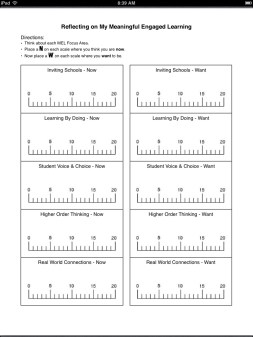
Meaningful Engaged Learning goal setting form

Expect – Have Teachers Set Goals
Teachers seem to do better with expectations when they have a voice in setting them. One way to do that is to have teachers set goals. When I have worked with schools using Meaningful Engaged Learning as their School Improvement Program, I have had teachers think about the five components of Meaningful Engaged Learning, and asked them to rate themselves on where they think they are in implementing each component (I have used this form).

I then ask them to think about where they would like to be on implementing each component at the end of some timeframe (the end of the semester, for example). When that time frame is up, we can reflect again on what progress has been made.

This approach sets the expectation that we will get better at each component, while both validating that the teacher may already be good at some of those components (is already meeting that expectation), and giving the teacher a voice in deciding how much energy to put into each component, and which they will focus on the most.

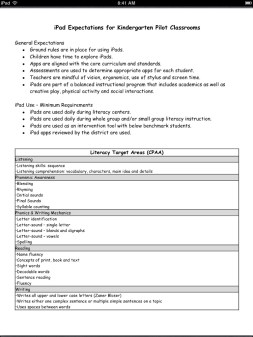
iPad expectations

Expect – Collaboratively Set Expectations
Another way to give teachers voice is to collaborate with them on setting those expectations. That’s what we did in Auburn, as we started Advantage 2014, our math and literacy initiative that includes iPads in Kindergarten. We simply had a conversation. What should our expectations be? In what kinds of activities should we expect to see the iPads used? How often?

The consensus that grew from those discussions became our expectations for the program. This included general guidelines, like apps should correlate to our curriculum, and that iPads are part of of balanced educational program that includes traditional approaches, and included minimum expectations for use, such as using iPads daily in literacy stations, or using iPads for interventions with students.

When collaboratively planning expectations related to implementing new initiatives and strategies, it should be a goal to set specific expectations on those strategies:

  • How many?
  • How often?
  • By when?
  • By whom?


These four strategies for setting expecations should help you get started with Positive Pressure and Support. How will you set expectations with your staff? What will those expectations focus on?


3 Tools to Assess and Guide Your Deliberate Leadership

So, you’re working on your school’s big change. Maybe it’s getting instruction shaped up for the introduction of the Common Core. Or maybe all your students and teachers are getting laptops or tablets. Or maybe you’re making the move to customized learning, or project-based learning, or…

And if you’re reading this blog, then you’ve probably found this model for school change to use when it’s a biggie, such as when it requires a paradigm shift for educators (and perhaps the community) because it’s different than when they were a student and maybe they have never taught this way or been trained to teach this way.

And maybe, like a lot of schools, you had a good start and you paid attention to all the Key and Supporting components of the model, but as the year went on, and the initiative went on, and the day to day running of the school/district loomed big, you have begun to wonder, how do I know we’re still paying attention to all the moving parts of our initiative? How can you get a little check to make sure you’re still on track?

The three tools described below are designed to do exactly that. The three work in concert to help you or your team identify what you’re doing in the initiative, where there may be gaps in providing leadership for the initiative, and what can be done to make the initiative more complete.

This process can be done individually by an initiative leader, or with a leadership team, or with a larger group of stakeholders. I’m partial to using a team effort. Over and over and over again, I’m surprised about the things that are captured and dealt with because team members have perspectives and strengths different than my own. These were always things that would have fallen through the cracks, if it hadn’t been for the diverse perspectives of team members. When working with a group, decide if it is most appropriate to work through each component as a whole group or to divide up into smaller groups, each working on a different component.

A group can work through all three of these tools in 2-3 hours.

The Lead4Change Check-In Tool
The Lead4Change Check-In tool has one sheet for each of the 7 components of the Lead4Change Model. The intent is to reflect on what work is currently underway in each category. It’s a way to gather your list of efforts toward your initiative. The intent is to determine what is going on right now, in preparation of asking the question, are we dealing with all the parts we should be dealing with?

As each effort is listed on the form, the note taker can check which piece(s) of the Component the effort relates to. Some efforts will not only relate to more than one piece of a Component, but to more than one Component. There is no problem with listing an effort on more than one sheet. In fact, you want to make sure that all your efforts toward each Component are recorded.

I’ve done this work with a leadership team through a modified Carousel Activity. I broke the large team into smaller groups. Each small group worked on a different Component for a certain amount of time, then passed the individual Component sheet to the next group. The next group would add to the sheet, passing it to the next group when time was up. Each Component sheet would eventually visit each group. One advantage is that this kind of small group work is more likely to engage every member of the large group than when the same work is done in a “whole group” approach.

The Where Are The Holes? Tool
The Where Are The Holes? tool let’s the same group of reflective practitioners to then look back over the Check-In documents and think about each piece of each Component. They would decide if that piece is “covered” or a “hole.”

Why not skip the Check-In and jump right to here? I think that sometimes, when presented with a checklist, it is too easy just to look at an item and say “Yup! Doing that!” without really stopping to think about “how are you doing that?” Using the the Check-In tool forces you to provide the evidence of if you have covered it or not.

Is it always a problem when there is a hole? No. Large-scale school change initiatives take time and have lots of pieces to pay attention to. There are times when you will look at a hole and say something like, “It is okay that that is a hole right now, because it isn’t time yet to do that. We will be addressing that next semester/year/etc.” But finding the holes insures that any current hole is a hole on purpose, for a good reason, and not just because the team has overlooked it.

The What Could We Do? Tool
So now you know what is going on, and where you have holes and need to pay attention. Now is the time to capture some ideas of what the initiative could do, especially to fill those “overlooked” holes in implementation.

The What Could We Do? Tool helps with this. Groups fill in their ideas of what could be done, recording whose idea it was, who could be a contact person, as well as, what Component and piece it relates to. Special attention should be paid, of course, to those pieces that you identified as holes.

The ideas listed on the sheet are brief and sometimes the sheet sits for a while before the leadership team gets back to it. Capturing whose idea it was allows the leadership team to go back later and find out more about the idea if they have clarifying questions.

Listing a contact person allows the group to get in touch either with who would be responsible for getting the suggested idea going, or with an outside contact person who has implemented similar work.


Having your leadership team work through these three tools, could be a useful approach to revisiting the Lead4Change Model as a piece of your continuous improvement plan.

Correct Answers vs. Building Understanding: What Do Learners Need?

My step-son, Sam, is one of those otherwise bright students who struggles with math. Back when he was in high school, his mom asked me to help him. He had gotten a question wrong on a Geometry quiz and didn’t understand the correct answer. My wife hoped that since I was a former high school math teacher that I could help him out.

The question was, “What is the intersection of two planes?”

He told me that he had answered that the intersection was a point, since only lines intersect. Sam went on, “I went in to ask my teacher about the question, but she just kept giving me the right answer. I really don’t understand it at all.”

“So, you’ve only talked about lines intersecting?”

Sam nodded.

“And you haven’t really talked at all about planes and how they intersect?”

Sam shook his head.

“Then I could see why you thought it was a point,” I told him. “But look at this.” His notebook was on the kitchen counter where we were talking and I said, “Let’s say this is one of the planes,” while tapping his notebook. I grabbed a magazine, saying it was the other plane. I held the spine of the magazine at an angle against the face of Sam’s notebook.

“How do these two planes come together? What kind of geometric shape?” I asked.

Sam got one of those “Oh, my gosh! Is it that simple?!” looks on his face and said it was a line.

Now, there was nothing wrong with the teacher asking the plane intersection question without first modeling it for students. It is a great way to have students apply the concept of intersection of geometric shapes and see if they really understand it. And the teacher was a kind and knowledgeable math teacher.

But students who struggle with a subject need more than just someone who is sensitive and kind and knowledgeable. Sam needed more than the correct answer. I think teachers who are intuitive mathematicians (or social scientists, or literacy specialists, or scientists) know their subjects in an intuitive way that makes it hard for them to explain ideas to students who do not understand their subject intuitively.

When students get an incorrect answer, it is too easy for teachers who understands their content intuitively to assume that the student simply made a mistake (perhaps in calculating), or didn’t study hard enough, or is simply a slow student in their subject.

What they don’t understand is that more often than not, a student’s wrong answer is actually a correct answer within the student’s current (but incorrect) schema for the topic – the student’s internal model that tells him how things work.

If the teacher’s goal is to have the student understand the material correctly, then simply offering the correct answer is less productive than trying to understand the student’s misconception and then think of an example or a way to model the material that will create a bridge between the student’s misunderstanding and the correct understanding.

Sam’s schema said only lines intersect and he knew that lines intersect in a point. We could either stop with proving that Sam was wrong by giving him the correct answer, or we could work to understand his thinking so we could lead him in the right direction.

I don’t blame the teacher. She simply did what I did when I was a math teacher. It wasn’t until long after I stopped teaching math and became of student of learning that I grew to understand this principle.

How much more effective would our teaching be if we approached our students’ incorrect answers as misconceptions rather than missing information?


Introduction to Twitter for Educators: 12 Resources & Strategies

The irony is that at the same time my district has banned Facebook and has a team working on a social media policy, our administrators are learning how to use Twitter for both Branding and Buzz and their own professional development.

(Well, maybe it isn’t irony. I think maybe it is exactly the Yin and Yang of social media that has schools confused about what to do with it. On one hand social media seems to lead to distraction and bullying. On the other hand, it is a powerful marketing tool and tool for building a professional learning community.)

Auburn’s administrative team will soon get a brief Introduction to Twitter inservice. These are the resources I will be sharing with them.

What other resources would you share? (please add your suggestions in the comments)


Getting Started with Twitter:


Leveraging Twitter as Your Professional Learning Community:


Leveraging Twitter for Building Branding and Buzz Around Your School:


Leveraging Twitter for Teaching and Learning