Harassment & Engagement – Social Media Study Group

Note: This is one in a series of blog posts to be used by Auburn’s Social Media Design Team to conduct a study group before making recommendations for social media policy. If unfamiliar with this series, you might find reading this post helpful.

Core Issues Study Questions (Bullying & Boredom)

  • What are Auburn schools current doing related to bullying and school climate?
  • What are Auburn schools current doing related to fostering student engagement in academics?
  • What is considered best practice around bullying?
  • What is considered best practice around engaging students?

Although intended as a tool for Auburn’s Social Media Design Team, everyone is invited to use these posts as a resource. And if you are not a member of Auburn’s Social Media Design Team, you are welcome to post comments, too. But please limit/be thoughtful of the sharing of opinion and stay focused on the focus questions – we a trying to use these posts for fact-finding, identifying resources, identifying best practice, etc. Thanks!


Impact of Social Media – Social Media Study Group

Note: This is one in a series of blog posts to be used by Auburn’s Social Media Design Team to conduct a study group before making recommendations for social media policy. If unfamiliar with this series, you might find reading this post helpful.

Impact of Social Media Study Questions

  • How many social media-related discipline issues have been logged?
  • Of the logged social media-related discipline issues, what percent were about being distracted, what percent were about bullying, and what percent were about something else (and what was that)?
  • What are the reasons we would not want access to social media at school?
  • What are the reasons we would want social media at school?

Although intended as a tool for Auburn’s Social Media Design Team, everyone is invited to use these posts as a resource. And if you are not a member of Auburn’s Social Media Design Team, you are welcome to post comments, too. But please limit/be thoughtful of the sharing of opinion and stay focused on the focus questions – we a trying to use these posts for fact-finding, identifying resources, identifying best practice, etc. Thanks!


Banning & Blocking – Social Media Study Group

Note: This is one in a series of blog posts to be used by Auburn’s Social Media Design Team to conduct a study group before making recommendations for social media policy. If unfamiliar with this series, you might find reading this post helpful.

Banning/Filtering Study Questions

  • What is the impact of blocking Facebook?
  • What methods of blocking are available to us and what are the untended consequences of each?
  • How easy is it to circumvent any filtering?
  • What is considered best practice around filtering?


Although intended as a tool for Auburn’s Social Media Design Team, everyone is invited to use these posts as a resource. And if you are not a member of Auburn’s Social Media Design Team, you are welcome to post comments, too. But please limit/be thoughtful of the sharing of opinion and stay focused on the focus questions – we a trying to use these posts for fact-finding, identifying resources, identifying best practice, etc. Thanks!


Auburn’s Social Media Design Team

Auburn has long had a pretty progressive social media policy. We didn’t block Facebook or Twitter, even thought nearly all the districts around us do. As you can imagine, it was pretty controversial, but it was based on the idea that effective communication through social media has become a job skill, that there are appropriate (even academic) uses for social media, and that we needed to teach young people appropriate use.

So, if leaving social media open was half of the approach, we certainly were struggling with the other half: teaching staff how to teach with it, figuring out how to integrate digital citizenship training, etc., etc.

Then, over the last 6 weeks or so, we had a couple high impact instances of bullying. Facebook was involved with both. One big one was student to student, but we also had one student to teacher.

It was time to do something.

So we blocked Facebook.

But the real problem is bullying, not Facebook.

So we put together a K-12 Social Media Design Team that will work as a study group, explore specific questions, do some fact finding, check in with parents, students, and educators for their perspective, and then make recommendations for social media policy.

So Facebook will remain blocked for now. But we’re going to collaborate toward a much more reasoned response.

We’re building our work around the lessons learned by veteran technology-using educators. When technology is viewed as a problem, blocking and banning (by itself) is usually not the answer. The answer usually is a combination four strategies:

The next couple blog posts (linked above) are going to be for the Social Media Design Team. We’re going to use them as a tool for collecting our evidence and resources. They will add these resources, ideas, data, etc., as comments to the posts.

Everyone is invited to use these posts as a resource. And if you are not a member of Auburn’s Social Media Design Team, you are welcome to post comments, too. But please limit/be thoughtful of the sharing of opinion and stay focused on the focus questions – we a trying to use these posts for fact-finding, identifying resources, identifying best practice, etc. Thanks!


18 Reasons We Need More Psychology (And Less Logic) In Our Education Thinking

Few systems are as complex as education.

I’ve been thinking a lot about education lately, I’m in the school change business, especially as it relates to creating schools that work for all children. Over the last years, my work has focused on designing schools that work for all students, programs for hard to teach students, and on technology-rich learning environments, especially 1to1 learning with laptop and ipad initiatives (these all usually overlap considerably when each is done well). And I especially wonder how it is that competent educators (good people) make decisions and policies that seem to not work very well.

From my perspective, a decision or policy works if it supports the working of the system. You can tell if it doesn’t work if the system is still upset or in some level of tourmoil.

I’m not sure I can explain this like I want to, but I guess I should say here that when I say “system,” I don’t mean the “education system” or “school system” (the policies that govern a district, school, classroom or other jurisdiction), but rather the system of learning. By my definition, if kids generally do their work, follow the rules, learn, and are engaged, then the system “works.” If kids are breaking rules, not learning, refusing to do their work, then the system doesn’t work. If a school has a high breakage rate on devices or they go missing, the the system isn’t working. When breakage and missing rates are negligible, then the system works.

So why do seemingly good policies not work?

I’ve come to the conclusion that problem lies with logic.

Good people use logic to make decisions. But education is a complex system based on people, not things. Therefore, we need to use psychology, not logic. By definition, logic makes sense in systems that focus on things or stuff. But it is psychology that makes sense in people systems.

So, from two decades of working with schools, including my own, around customized learning, or student motivation, or technology-rich learning environments, or leadership for school change (or, more often, all of these combined!), I’ve started to discern some of the “Logic vs. Psychology” problems schools have. In each case, the “logical” solution is certainly logical, but seems to have perpetuated (or even exasperated) the kinds of disruption or disequilibrium that the solution was trying to solve (it “didn’t work”), whereas the “psychological” solution seems to have had the desired effect.

So here are 18 reasons we should use more psychology and less logic:

  1. Logic says 1to1 is a technology initiative. Psychology says it is a learning initiative.
  2. Logic says students should learn (it is for their own good). Psychology says we must ask ourselves why students would want to learn.
  3. Logic says do workshops on how to use the various software on the laptops. Psychology says do workshops on how the software can be used to help students learn academic content.
  4. Logic says that a teacher must cover content. Psychology says that a teacher must connect with students personally.
  5. Logic says schools should ban disruptive technology (cell phones, mp3 players, blogs, chat, social networks, etc.). Psychology says if a tool is part of the child’s culture, then we should find academic uses for it.
  6. Logic says filter the Internet heavily. Psychology says filter some, but mostly educate students.
  7. Logic says use technology to do what teachers have always done, but more effectively. Psychology says use technology in new ways to engage students and help them learn.
  8. Logic says supplying the tools is enough. Psychology says apply some positive pressure and support to get teachers to use the technology effectively for academic purposes.
  9. Logic says breakage and theft is about the technology and the kids. Psychology says breakage and theft is about how the technology is being used for academics and the leadership around the technology initiative.
  10. Logic says tech folks need to protect the stuff. Psychology says tech folks need to enable engagement and the learning.
  11. Logic says a school is doing well if the easy to teach students are doing well. Psychology says that a school is doing well if the hard to teach students are doing well.
  12. Logic says give students information. Psychology says help students make meaning of information.
  13. Logic asks, did the teacher cover the material? Psychology asks, did the students learn it?
  14. Logic says that technology is a separate line item. Psychology says that all the expenses related to technology are integrated throughout the budget (infrastructure, instruction, staff, etc.).
  15. Logic asks, how smart are you? Psychology asks, how are you smart?
  16. Logic says teachers should speak to students with authority. Psychology says teachers should speak to students as people.
  17. Logic says a teacher can select which teaching styles they choose to employ. Psychology says that there are high-impact and low-impact pedagogies, and teachers should choose wisely.
  18. Logic says pass out laptops to teachers as soon as the school gets them. Psychology says pass out the laptops at an inservice where school leaders can set the tone on how they will be used in the classroom.

Let’s try to use a little less logic and a little more psychology.


Some Students Need More Than Direct Instruction

Direct instruction

An old friend provided me with a wonderful opportunity. She’s the Middle Level Director for a city in the South. I’ve been doing workshops for her schools and teachers for about 14 years. A couple summers ago, I worked with the teachers at two schools that have high populations of at-risk and hard to teach students. I introduced the teachers to several strategies for reaching these students. The following winter, I returned to the district and got to spend a day at each of the schools. I was able to conduct classroom observations and focus groups at the schools.

Surprisingly (at least it was an “aha” for me!), I didn’t see out of control classrooms or bad teaching. What I did see was order and a lot of competent (and in some cases outstanding) direct instruction.

Even so, I often only saw about half of each class “engaged” (showing signs of being on task) and, in conversations and focus groups, teachers indicated that many students don’t care, won’t do the work or study, and there isn’t much support from home.

One teacher called this “lazy disease.”

But maybe it wasn’t just laziness or home support. Maybe, for some kids, how we teach doesn’t work for them. Any parent with more than one child knows that they learn in different ways. Why do we expect our students to all learn the same way?

This helped me realize that some students need more than direct instruction.

The teachers also unknowingly provided me with the answer to the question, “When do you know that you need to do more than direct instruction?” The answer: “When the students don’t care, won’t do the work or study, and there isn’t much support from home. When they have hard to teach students.” Simple, right?

I think that maybe direct instruction isn’t enough for these students because it focuses more on the content than on how students might learn it. We are often quick to get frustrated with hard to teach students exactly because we covered the material and they didn’t learn it.

And yet shipping companies, such as UPS, would never think to say that they “delivered” a package if a customer did not receive it. It might be accurate to say they left the package on the porch, but it isn’t “delivered” until the resident actually gets the package. Dewey puts it a little differently:

Teaching may be compared to selling commodities. No one can sell unless someone buys. We should ridicule a merchant who said that he had sold a great many goods although no one had bought any. But perhaps there are teachers who think they have done a good day’s teaching irrespective of what people have learned. There is the same exact equation between teaching and learning that there is between selling and buying. (Dewey, 1933, p. 35-36)

Underserved populations, including underachieving students from all learning styles, career aspirations, cultures, and socioeconomic levels deserve a quality education.

It is not surprising that improved instruction, which involves students in meaningful, engaged learning, is viewed as a remedy to the growing concern over the high social and economic cost of large numbers of disengaged and at-risk youth. Identifying practices which help these diverse populations learn well is a step toward creating an educational system intent on serving all students. Finding out what motivates our underachieving and hard to teach students will help inform and equip teachers in the struggle to lead all students to academic achievement.


References

Dewey, J. (1933). How we think. Chicago: Henry Regnery.


Don’t Miss the Second Annual iPads in Primary Grades Institute

Auburn's Leveraging Learning Institute

Save The Date!

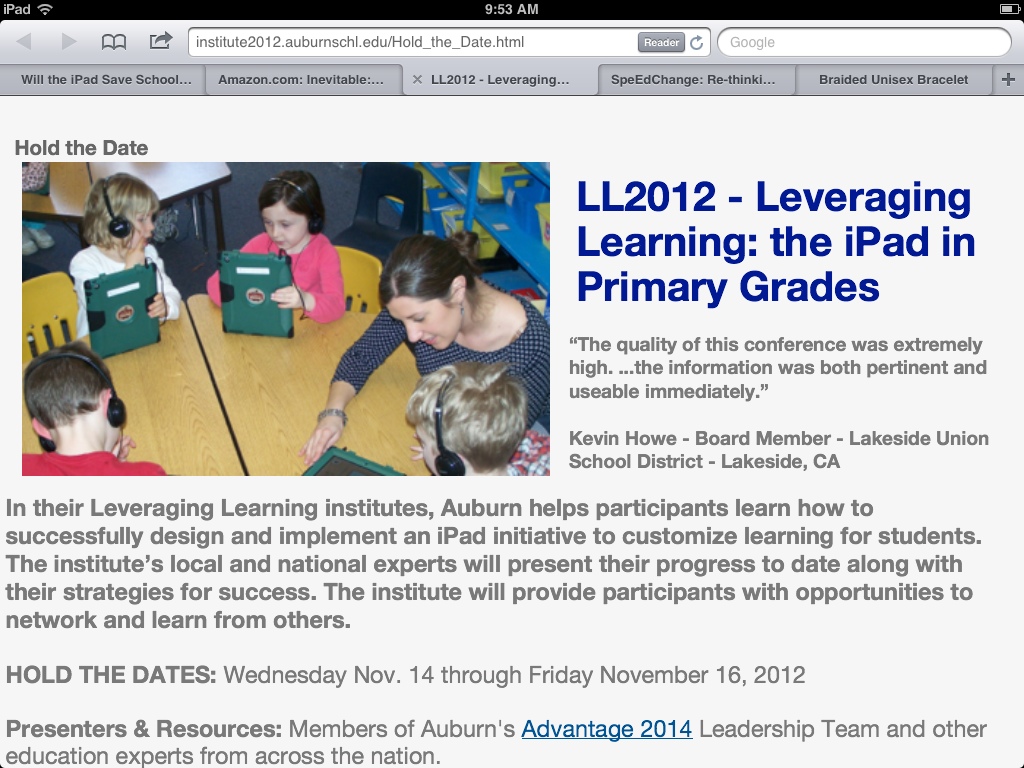
Auburn is hosting its second annual iPads in Primary Grades Institute on November 14-16, 2012.

This is a great opportunity to learn more about how Auburn is structuring their initiative and the key components to pay attention to for your own district’s initiative. Just look at what participants had to say last year:

  • “The quality of this conference was extremely high. …the information was both pertinent and useable immediately.” – Kevin Howe, Board Member, Lakeside Union School District, Lakeside, CA
  • “The emphasis on teams was great and I wish I had brought more team members. Next time!” – Jenni Voorhees, Academic Technology Coordinator, Sidwell Friends School, Washington, DC
  • “We were able to fine tune our current practice and more effectively strategize for the future using what we learned with you.” – Gretchen Schaefer, Early Childhood Instructor, Waynflete School, Portland, ME

Here are some of the great resources from last Year’s conference.

We’ll let you know when registration opens, but for now, hold the date! (but when the time comes, register early! There are only 115 slots!)


Will the iPad Save Schools? – The 4 Pillars of The Schools We Need

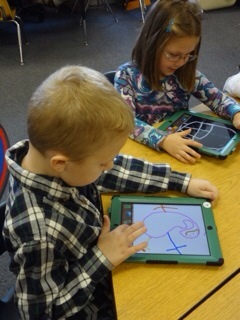
Student using an iPad

I’ve been interviewed a couple times over the last few weeks, mostly about our iPad research results.

One journalist asked me if I now thought that the iPad would be the secret to helping more students succeed in school.

I don’t think it is any secret that I am a big iPad fan, both personally and professionally. But I don’t think any piece of technology, by itself, will be responsible for creating the kinds of schools we need, if we are really going to develop the talent of every child. Technology can and should be a critical piece of that, and the iPad is a wonderful piece of technology for learning. But my experience working with schools that are striving to be successful with all students is that there are several key components to consider.

I told the journalist that I thought there were four pillars to the formula for successful schools.

Pillar 1: Customized Learning
Customized learning are the structures and practices that are built around two principles: people learn in different ways and in different timeframes. It might be called individualized/personalized learning, standards-based learning, or performance-based learning, and includes approaches such as RISC or Mass Customized Learning.

Pillar 2: Motivation
Motivation could be thought of as the conditions educators put into place that make it easier for learns to be self-motivated. These include strategies such as creating real world connections to the learning, providing students with voice and choice, insuring that our schools and classrooms are inviting places for students, emphasizing activities that focus on upper level Blooms and involve learning by doing.

Pillar 3: Technology for Learning
Computers, laptops, tablets, and smart phones are the world’s modern tools for work, but they also have the potentinal to be our modern learning tools. But technology has to be looked at, not through the lens of the stuff, but rather through the lens of leveraging the stuff for learning. We need to look at how we use technology for various kinds of learning, as well as our leadership and policies around technology, and how we manage it.

Pillar 4: Leadership for School Change
Large-scale school change has a lot of moving parts that school leaders need to pay attention to and nurture if they wish the transition to be successful. How do we keep “the main thing the main thing”? What are the critical components and what are the supporting components that are still necessary to pay attention to? This is what is at the core of leadership for school change.


You won’t spend too much time thinking about each individual pillar before you realize that they overlap enormously and you can’t really think about one without thinking about aspects of the others. And you’ll realize that some pillars share components (or very similar components). In order to be successful, however, schools need to work on attending to all of four pillars simultaneously, so the fact that there is overlap is not a problem.

What I Did About It

That journalist interview and that question provided me with an aha! moment. Those of you who know me, know that I’ve been working on motivation, leadership, technology and other issues lated to student learning for a long time. But it was that conversation that helped me pull together and synthesize things that had been running around the back of my head.

So I just made a bunch of changes to both my website and my blog leveraging this new aha.

I spent the weekend rebuilding the McMEL (Maine Center for Meaningful Engaged Learning) website so that it was organized around these four pillars. There is also a Projects & Programs menu with links to various exemplars of the kinds of educational programs we need and projects that are a direct result of the kinds of thinking that went into McMEL.

I also went through this blog, reorganizing the categories. There are now categories, not just for each of these four pillars but for each major component of each pillar. I also went through all the old posts and made sure that they were linked to the appropriate categories.

And I have made sure that each page on the McMEL site has links to the appropriate blog posts (at least by category) so that the blog can help populate the information at McMEL.

This might be a rather complicated way of simply saying that I want to help insure that educators have access to good information on these topics both from the McMEL site and the Multiple Pathways blog, and to make it easier as they are looking for guidance on their own initiatives.

iPad may be one of my favorite tools in the Technology for Learning category, but I think it is only one component of the answer to the question, what will help schools be more successful with students. For me, the answer is Meaningful Engaged Learning, including not only Technology for Learning, but Customized Learning, Motivation, and Leadership.


Is Middle School All About Grade Configuration?

There is a new study out which concludes that students take an academic plunge when they go to a 6-8 school rather than a k-8 school. The article is called The Middle Level Plunge.

At first glance, it seems to be a reasonably well designed study comparing student performance in a 6-8 school to those in a k-8 school (the old grade configuration dilemma!). Their fallacy is in essentially equating the 6-8 grade configuration to “middle schooling,” and actually say “Our results cast serious doubt on the wisdom of the middle-school experiment that has become such a prominent feature of American education.”

Here is the response that I posted as a comment on their article:

Thanks for adding to the research on the impact of school grade configuration. I especially appreciate that you didn’t just study the grade configurations, but also tried to control for various explanations, including teacher experience, school characteristics, and educational practices. You have defined each of these clearly in your article.

I am concerned, however, with your using the term “middle school” to mean the 6-8 configuration schools. You are clear that this is your definition in the article, but in middle level education circles, the term means something very different, and I fear your conclusions about 6-8 grade configuration will be misinterpreted as conclusions about middle school practices. Readers should be able to make their own distinctions, especially when the writing is clear, as your article is, but you and I both know that in our “sound bite lives” there are too many people who will see the words “middle school” and think that your definition is the same as my definition.

For middle level educators, “middle school” is essentially a set of developmentally appropriate educational practices applied in the middle level grades (generally considered grades 5-8), without regard to the grade configuration of the school housing those grades. Readers may find helpful the numerous resources available on the Association for Middle Level Education website (http://www.amle.org).

Further, the school characteristics and educational practices you examine are not those that define middle school practices. I would have looked for the characteristics defined in AMLE’s This We Believe (http://tinyurl.com/865xggv), or the Turning Points 2000 recommendations (http://www.turningpts.org/principle.htm).

Again, I am not criticizing your study or the clarity of your writing, but simply sharing the unfortunate possibility of confusion for school decision makers trying to make informed (especially research informed) decisions based on your article and the use of the term “middle school.”

Perhaps, I could invite you to refer to the schools in your study as “6-8 schools,” instead of “middle schools.”

So, my big objection is defining “middle school” as a grade configuration, and seeming to conclude that “the middle school experiment has failed” and the possibility that decision makers will interpret this as if it were our definition of middle school…

I want to be clear, though. It is right and proper for researchers to select a term, define it, and use it in their article as they define it. It is expected that the reader will read such an article closely and critically. The authors of this study have done nothing wrong. Could it have been better (more clear to a wider audience) if they had done it differently? Yes.

But it is also right and proper for a reader to add their critique (politely and professionally) to the conversation though avenues such as comments on posts.

(For those of you exploring the Lead4Change model, this is a Branding and Buzz issue. Situations like these go directly to the issue of public perception of our initiatives and what role we play in communicating our vision. It is on us to try to correct misperceptions and to work toward the integrity of models we subscribe to.)


It’s Your Turn:

Are you a middle level educator or advocate? What are your thoughts about this study? I often ask you to post your comments here, but perhaps this time, you could post your comments on their article. And maybe you’d pass the word to your circle of middle grades contacts and they could comment, too…


What The Union Did Say (And I Was Glad They Did)

A while back, I wrote about what I wish the Union had said. I was responding to the announcement of Maine’s new education strategic plan (which I’m excited about) and the press coverage of the Union, which seemed like mostly they were poo-pooing the plan. Unions can and do a ton of good, but I’m frustrated with that public image that seems to say “Don’t ask us to change. Don’t ask us to be held accountable. And don’t you dare remove that teacher, even though she can’t do her job.” Some of that is the press and what they choose to focus on, and some of it is political expediency (let’s blame teachers and the union for all our economic and educational woes). But some of it is how the Union crafts it’s own public messages and how they respond publicly to real challenges in in our schools.

So I was really pleased, then, when I saw them post this. A great message about how they “don’t just say ‘no,'” and the various ways they work to develop and support teachers and the profession.

I still wish that the public saw and heard more of this kind of message. I believe that this was a newsletter that just went to members (I don’t think I could even find a direct link to it on their website).

They do support developing quality teachers through things like the Professional Issues Conference on March 24th. (I’ll be presenting there on Motivating Students and on Auburn’s Literacy and Math iPad Initiative.) You’ve got to register by March 9, if you’d like to attend.

Supporting teachers working toward National Board Certification. Taking the lead on quality teacher evaluation and accountability systems through their Instruction and Professional Development Committee work. Their Professional Issues Conference. These are the kinds of things that the Union needs press on also.

7 Social Media Articles to Help Your School’s Communication Impact

Schools and educational organizations are starting to realize that even though they are doing great work, they need to get that message out to their parents, communities, members, and constituents. “Branding and Buzz” is one of the “Supporting but Necessary” components of the Lead4Change Model, and encourages schools and organizations to state their case for the work they are doing, communicate with their community and beyond, tell their story, and present their evidence.

So begins my recent Bright Futures blog post on schools using social media to get their message out.

The post points readers toward the Social Media Examiner, a wonderful resource for helping organizations leverage social media. In particular, I highlighted 7 articles focused on getting the most from Facebook, Twitter, and blogging.

A lot of schools already have a Facebook page. Some are even using twitter. Others have administrators or teachers who blog. But are they using these avenues to connect with parents, communities, and colleagues as effectively or with as much impact as they could?

I think these 7 articles can help insure that schools do. The articles share wonderful tips from folks who are getting the most from their social media. Where can a school start?

Use the post as a jumping off point. Do a deep dive into one or the articles, or have your staff or leadership team jigsaw a couple of them. Your school could take what they learn and decide on a couple things that they want to try out.

The Bright Futures Partnership did just that. We read the article 26 Tips For Writing Great Blog Posts, and decided on 5 or 6 things we were going to try (look for changes coming to the Bright Futures blog and see if you can spot which tips we put into action!). By the way, reading the article also allowed us to pat ourselves on the back for 5 or 6 things we were already doing!


It’s Your Turn:

What are your best strategies for getting your school’s or educational organization’s message out via social media?


Auburn’s iPad Research Project on the Seedlings Podcast

Seedlings is a great little podcast that, although about educational technology, is really about good teaching and learning.

So I felt honored when the Seedling hosts invited me to return to talk about Auburn’s research on their Advantage 2014 program, best known for giving iPads to Kindergartners. You can download that podcast and access related links here.

This was a follow up to the previous podcast, where we talked both about Advantage 2014, and Projects4ME, the statewide virtual project-based non-traditional program, where students can earn high school credit by designing and doing projects, instead of taking courses.

Responding to Critiques of Auburn’s iPad Research Claims

When we announced our research results last week, Audrey Watters was one of the first to cover it. Shortly thereafter, Justin Reich wrote a very thoughtful review of our research and response to Audrey’s blog post at his EdTechResearcher blog. Others, through comments made in post comments, blogs, emails, and conversations, have asserted that we (Auburn School Department) have made claims that our data don’t warrant.

I’d like to take a moment and respond to various aspects of that idea.

But first, although it may appear that I am taking on Justin’s post, that isn’t quite true (or fair to Justin). Justin’s is the most public comment, so the easiest to point to. But I actually believe that Justin’s is a quite thoughtful (and largely fair) critique from a researcher’s perspective. Although I will directly address a couple things Justin wrote, I hope he will forgive me for seeming to hold up his post as I address larger questions of the appropriateness of our claims from our study.

Our Research Study vs. Published Research
Our results are initial results. There are a lot of people interested in our results (even the initial ones – there are not a lot of randomized control trials being done on iPads in education), so we decided to share what we had so far in the form of a research summary and a press release. But neither of these would be considered “published research” by a researcher (and we don’t either – we’re just sharing what we have so far). Published research is peer reviewed and has to meet standards for the kinds of information included. We actually have more data to collect and analyze (including more analyses on the data we already have) before we’re ready to publish.

For example, Justin was right to point out that we shared no information about scales for the ten items we measured. As such, some of the measures may seem much smaller than when compared proportionally to their scale (because some of the scales are small), and we were not clear that it is inappropriate to try to make comparisons between the various measures as represented on our graph (because the scales are different). In hindsight, knowing we have mostly a lay audience for our current work, perhaps we should have been more explicit around the ten scales and perhaps created a scaled chart…

Mostly, I want my readers to know that even if I’m questioning some folks’ assertions that we’re overstating our conclusions, we are aware that there are real limitations to what we have shared to date.

Multiple Contexts for Interpreting Research Results
I have this debate with my researcher friends frequently. They say the only appropriate way to interpret research is from a researcher’s perspective. But I believe that it can and should also be interpreted as well from a practitioner’s perspective, and that such interpretation is not the same as a researcher’s. There is (and should be) a higher standard of review by researchers and what any results may mean. But practical implementation decisions can be made without such a high bar (and this is what makes my researcher friends mad, because they want everyone to be just like them!). This is just like how lawyers often ask you to stand much further back from the legal line than you need to. Or like a similar debate mathematicians have: if I stand some distance from my wife, then move half way to her, then move half way to her again, and on and on, mathematicians would say (mathematically) I will never reach her (which is true). On the other hand, we all know, I would very quickly get close enough for practical purposes! 😉

Justin is very correct in his analysis of our research from a researcher’s perspective. But I believe that researchers and practitioners can, very appropriately, draw different conclusions from the findings. I also believe that both practitioners and researchers can overstate conclusions from examining the results.

I would wish (respectfully) that Justin might occasionally say in his writing, “from a researcher’s perspective…” If he lives in a researcher world, perhaps he doesn’t even notice this, or thinks it implied or redundant. But his blog is admittedly not for an audience of researchers, but rather for an audience of educators who need help making sense of research.

Reacting to a Lay Blog as a Researcher
I think Justin has a good researcher head on him and is providing a service to educators by analyzing education research and offering his critique. I’m a little concerned that some of his critique was directed at Audrey’s post rather than directly at our research summary. Audrey is not a researcher. She’s an excellent education technology journalist. I think her coverage was pretty on target. But it was based on interviews with the researchers, Damian Bebell (one of the leading researchers on 1to1 learning with technology), Sue Dorris, and me, not a researcher’s review of of our published findings. At one point, Justin suggests that Audrey is responding to a graph in our research summary (as if she were a researcher). I would suggest she is responding to conversations with Damian, Sue, and me (as if she were a journalist). It is a major fallacy to think everyone should be a researcher, or think and analyze like one (just as it is a fallacy that we all should think or act from any one perspective, including as teachers, or parents, etc). And it is important to consider individual’s context in how we respond to them. Different contexts warrant different kinds of responses and reactions.

Was It The iPads or Was It Our Initiative
Folks, including Audrey, asked how we knew what portion of our results were from the iPads and which part from the professional development, etc. Our response is that it is all these things together. The lessons we learned from MLTI, the Maine Learning Technology Initiative, Maine’s statewide learning with laptop initiative, that has been successfully implemented for more than a decade, is that these initiatives are not about a device, but about a systemic learning initiative with many moving parts. We have been using the Lead4Change model to help insure we are taking a systemic approach and attending to the various parts and components.

That said, Justin is correct to point out that, from a research (and statistical) perspective, our study examined the impact that solely the iPad had on our students (one group of students had iPads, the other did not).

But for practitioners, especially those who might want to duplicate our initiative and/or our study, it should be important to note that, operationally, our study studied the impact of the iPad as we implemented them, which is to say, systemically, including professional development and other components (Lead4Change being one way to approach an initiative systemically).

It is not unreasonable to expect that a district who simply handed out iPads would have a hard time duplicating our results. So although, statistically, it is just the iPads, in practice, it is the iPads as we implemented them as a systemic initiative.

Statistical Significance and the Issue of “No Difference” in 9 of the 10 Tests
The concept of “proof” is almost nonexistent in the research world. The only way you could prove something is if you could test every possible person that might be impacted or every situation. Instead, researchers have rules for selecting some subset of the entire population, rules for collecting data, and rules for running statistical analyses on those data. Part of why these rules are in place is because, when you are only really examining a small subset of your population, you want to try to control for the possibility that pure chance got you your results.

That’s where “statistical significance” comes in. This is the point at which researchers say, “We are now confident that these results can be explained by the intervention alone and we are not worried by the impact of chance.” Therefore, researchers have little confidence in results that do not show statistical significance.

Justin is right to say, from a researcher’s perspective, that a researcher should treat the 9 measures that were not statistically significant as if there were no difference in the results.

But that is slightly overstating the case to the rest of the world who are not researchers. For the rest of us, the one thing that is accurate to say about those 9 measures is that these results could be explained by either the intervention or by chance. It is not accurate for someone (and this is not what Justin wrote) to conclude there is no possitive impact from our program or that there is no evidence that the program works. It is accurate to say we are unsure of the role chance played on those results.

This comes back to the idea about how researchers and practitioners can and should view data analyses differently. When noticing that the nine measures trended positive, the researcher should warn, “inconclusive!”

It is not on a practitioner, however, to make all decisions based solely on if data is conclusive or not. If that were true, there would be no innovation (because there is never conclusive evidence a new idea works before someone tries it). A practitioner should look at this from the perspective of making informed decisions, not conclusive proof. “Inconclusive” is very different from “you shouldn’t do it.” For a practitioner, the fact that all measures trended positive is itself information to consider, side by side with if those trends are conclusive or not.

“This research does not show sufficient impact of the initiative,” is as overstated from a statistical perspective, as “We have proof this works,” is from a decision-maker’s perspective.

We don’t pretend to have proof our program works. What is not overstated, and appropriate conclusions from our study, however, and is what Auburn has stated since we shared our findings, is the following: Researchers should conclude we need more research. But the community should conclude at we have shown modest positive evidence of iPads extending our teachers’ impact on students’ literacy development, and should take this as suggesting we are good to continue our program, including into 1st grade.

We also think it is suggestive that other districts should consider implementing their own thoughtfully designed iPads for learning initiatives.

More News on Auburn’s iPad Research Results

The other day, I blogged about our Phase 1 research results on the impact of Advantage 2014, our literacy and Math initiative that includes 1to1 iPads in kindergarten. Now the press and blogosphere is starting to report on it, too.

Auburn’s press release, the research summary, and slides from the School Committee presentation are here.

It’s Your Turn:

Have you found press about this elsewhere? Please share!

Professional Development for Auburn’s iPad Kindergarten Teachers

Auburn is excited that our initial research results strongly suggest that our initiative is extending the impact our teachers are having on their students. It has prompted lots of requests to know more about what we’re doing for professional development with our teachers. Professional development is, clearly, one critical component to any school change initiative, and designing and providing the right kind of PD and support is a critical leadership role.

What professional development did we conduct with our kindergarten teachers?

Content of Professional Development – All of our PD and training has focused on a couple of topics. We wanted to expand our teachers’ skill at applying literacy best practice, and to insure that our teachers and specialists working with kindergarten students had the capacity to select and apply appropriate apps directly toward student academic needs, as well as how to manage the iPads and work within the unique demands of this initiative. We have summed this up at the beginning of each of our PD session agendas with the following goals:

  1. Link iPads to learning.
  2. Problem-solve technology-related issues.
  3. Discuss best practices.
  4. Discuss and review apps.

How did we manage professional development and support that achieved these goals?

PD for Paradigm Shfit – Although teachers can often, sometimes with coaching, apply best practice they are familiar with to unfamliliar contexts, the integration of technology at this level is often a paradigm shift for teachers. Rarely have teachers experienced learning with technology themselves, and many have received very little training with computers, let alone iPads. “PD for Paradigm Shift” recognizes that changing paradigms requires more than sharing information. Schema theory sheds the best light on how to structure professional development for large change: provide models and experiences. See it in action. Live it in action. That’s what we’ve tried to do for our teachers.

Getting Technology into the Hands of Teachers – A terrific first step for professional development is to get the technology into the hands of teachers, so they can become used to it through their own use. We made sure that every teacher had an iPad to use over the summer for this purpose. But it is important to keep in mind that this will develop a teacher’s personal use skill, not their integration for learning skill. That’s not a problem. The problem comes from thinking that if teachers know how to use their iPad that they also know how to leverage it for their students’ learning…

Modeling: Visiting Classrooms – When teachers don’t have a lot of experience with an innovation, one way to get them that experience is by having them visit other teachers who are successfully doing similar work. This can be done in person, or vicariously through videos or stories (not descriptive articles, so much as those that tell the story and paint a picture for the reader – remember, this is not about information, it’s about experience). Unfortunately, there weren’t a lot of classrooms for us to visit when we got started. We have tried to make it easy for our teachers to visit each other’s rooms, and we have had teachers video (on their iPads!) and share examples of what they are doing. Now we’re working to make sure that other teachers can come to visit our classrooms so they can begin to expand their experience (although we’re trying to be careful how we schedule and manage such visits as not to distract too much from the learning that is supposed to be our first order of business!).

Modeling Effective Practices – Did we see a teacher do a great lesson? We had her model that lesson to the other teachers in a PD session. Did we learn a better way to sync or manage apps? We modeled that approach in a PD session. Did we think the press might start contacting teachers? We’d review procedures for dealing with press requests, as well as share talking points and provide them language they could choose to use if interviewed. (Our teachers’ favorite talking point: “That’s a great question! You should ask the superintendent.” I think they might be a little press shy!) 🙂

Connecting with other Educators – A different approach to helping teachers and program leaders build models is to provide them opportunities to communicate with educators who are doing similar work. Networking is a powerful way for teachers to develop their own practice while helping colleagues (often in different states or countries!) to develop their own. Although few teachers have taken us up on these options to date, we encourage them to consider tweeting or blogging about their experiences, since it can help build a diverse professional learning network for the teachers who do. Our teachers are more eager to connect with teachers in more traditional ways: on the phone or via email. One avenue which has really opened possibilities for these connections was the national iPads in primary grades education conference we hosted last November. About half our participants were from Maine, and the other half from across the country (we even had one from India!). We’re already planning next year’s conference.

Constructivist Approach – As we thought about designing PD for our teachers, we didn’t want to just hand teachers information or resources; for example, we didn’t just want to hand them “approved” apps. We wanted teachers to have an intimate understanding of various components of the initiative they were on the front lines of implementing, including app (educational resource) selection. We decided to take a constructivist approach. For example, we had our teachers start by simply exploring apps. They had a limited budget for apps, but could also download as many free apps as they wanted. Then teachers made recommendations for apps that they thought would be the “core collection” of apps, those apps the district would purchase for every classroom. We would give teachers two similar apps and ask, “which one’s better?” to get them thinking about criteria for app selection; this eventually was developed into a rubric. Finally, we correlated apps to our kindergarten curriculum. The constructivist approach insures a deeper understanding based on their own experience.

Collaboratively Designed – I think one of our best secrets to successful professional development and support is realizing that none of us is as smart as a group of us together. We have tried to have a team approach to all design work for this initiative. Our Advantage 2014 Design Team includes central office administrators, our grant writer, a couple School Committee members, a couple parents and community members, as well as our some of our teach folk, and one of our elementary principals (and, of course, me, the Multiple Pathways Leader). We have smaller groups working on specific aspects of the program: funding, research, the Institute, and professional development. Our professional development planning group includes our Tech Director, our elementary Technology Coach, an elementary principal, one of our Special Education administrators, and myself. And even though no teacher is officially on the PD design team, in reality, they all are. We solicit their input in a variety of ways and work hard to be responsive to their needs (see the next section). Teachers helped us craft our policies and procedures, our expectations for teachers, our core collection of apps and our app selection rubric, and other significant components of our initiative.

I can’t over state this: this work MUST be a team effort. I can’t tell you how many times in the last few weeks I’ve said, “See! That’s exactly why we have a team planning this!” And not just for PD, but for lots of different aspects of this work. I don’t care how good some individuals in your district are; he or she doesn’t have the capacity represented by a collection of your staff, with various experience bases, perspectives, and areas of expertise.

Continuous Improvement Focus – We’ve tried to be highly responsive to the needs of our teachers. In additional to listening to our teachers, asking them directly, and being tuned in to situations as they develop, we use two tools. On a regular basis, we have our teachers complete one of two surveys we created in Google Docs. One asks questions about how often they used the iPad that week for various types of tasks (these correspond to our expectations for teachers that we collaborately created with the teachers, and essentially gets to fidelity of implementation). The other survey simply asks about their recent successes and challenges within the program. Although quite simple, both provide us with amazing data on what the teachers need right now. Although we plan our PD sessions in advance, we’ve been known to completely redesign a session hours before it starts based on what we’ve learned the teachers need.

Imbedded Support – Our district has three technology integrators: one for the high school, one for the middle school and one serving our elementary schools. As you can imagine, we’ve had our elementary technology coach spend much of her time working in our kindergarten classrooms. A good technology coach is really a good pedagogical coach. She can collaboratively design lessons with teachers, co-teach lessons, model lessons, sit back and observe and provide feedback, make recommendations to resources and otherwise support teachers. Although the technology coach becomes eyes and ears for program leaders, it is not an evaluative position. The teacher needs to feel safe with the coach working in her room, and we only use information from the coach to help direct resources and support.

Built On A Strong Literacy Foundation – Our teachers had been working on literacy instruction for several years prior to Advantage 2014 and the introduction of iPads to their classrooms. Auburn had been part of the Maine Literacy Project out of the Univerrsity of Maine and our teachers had done graduate level work with the Project. Adding the iPads and its apps was a logical extension of this work, and training we conducted specficially about the iPads was intended to extend this earlier work, not replace it.

Where Did We Find the Time? – We used the usual approaches: taking advantage of workshop days, after-school opportunities, and scheduling a couple days in the summer prior to school starting. But we also had the advantage of the district already having “Early Release Wednesdays” available for our elementary schools. We have used nearly every other Wednesday to provide several hours of training. Some days we met just with the “September Teachers” (the first round of teachers to get the iPads). Other times we met with all the kindergarten teachers, or just the specialists, or everyone all at once.

It’s Your Turn:

What are your best strategies for delivering professional development and support to your staff?

What Apps is Auburn Using and Other Advantage 2014 Information

Since the initial results of our research on improving kindergarten literacy with iPads has come out, we’ve received quite a few questions about what apps we are using, and other basic questions about our program.

Our teachers can largely choose which apps they use. A major component of our professional development with our teachers has focused on exploring apps, deciding what makes for a good app, correlating apps to our curriculum, selecting the apps for our common collection, and getting better at customizing apps to student needs.

This page has both our rubric for app selection and our core collection of apps correlated to our K literacy curriculum.

Additionally, here is where you can find lots of other basic information about Advantage 2014, Auburn’s literacy and math initiative that includes 1to1 iPads in kindergarten.

You can read much more about our program at our Advantage 2014 website.

There are lots of links to resources from the national iPads in Primary Grades Ed conference we hosted last November. (We’re planning now for next November’s conference!)

And this blog has posts about our work. Here are the ones in the Adv2014 category.

It’s Your Turn:

What are your favorite kindergarten apps?

Confirmed: iPads Extend a Teacher’s Impact on Kindergarten Literacy

I’m excited! I’m REALLY excited!

Our “Phase I” research results are in…

iPads in Kindergarten

We (Auburn School Department) took a big risk last May when we started down the path to have the first 1to1 kindergarten learning with iPads initiative. We had confidence it would help us improve our literacy and math proficiency rates. One of our literacy specialists had used her own iPad with students to great success (one of the big reasons we moved forward). But there were also segments of the community that thought we were crazy.

Now we have pretty good evidence it works!

We did something not a lot of districts do: a randomized control trial. We randomly selected half our kindergarten classrooms to get iPads in September. The other half would use traditional methods until December, when they received their iPads. We used our regular kindergarten literacy screening tools (CPAA, Rigby, Observation Survey) for the pre-test and post-test. And across the board, the results were emerging positive for the iPad classrooms, with one area having statistical significance.

These results are a strong indication that the iPad and it’s apps extend the impact our teachers have on our students’ literacy development. We definitely need more research (and will be continuing the study through the year, including comparing this year’s results to past years), but these results should be more than enough evidence to address the community’s question, “How do we know this works?”

And I’m especially excited that we went all the way to the Gold Standard for education research: randomized control trials. That’s the level of research that can open doors to funding and to policy support.

Why do we think we got these results?

We asked our kindergarten teachers that question. Anyone walking by one of the classrooms can certainly see that student engagement and motivation is up when using the iPads. But our kindergarten teachers teased it out further. Because they are engaged, students are practicing longer. They are getting immediate feedback, so they are practicing better. Because we correlate our apps to our curriculum, they are practicing the right stuff. Because we select apps that won’t let students do things just any way, we know the students are practicing the right way. Because they are engaged, teachers are more free to work one on one with the students who need extra support at that moment.

We also believe we got the results we got because we have viewed this as an initiative with many moving parts that we are addressing systemically. A reporter asked me, how do you know how much of these results are the iPad, how much the professional development, and how much the apps. I responded that it is all those things together, on purpose. We are using a systemic approach that recognizes our success is dependent on, among other things, the technology, choosing apps wisely, training and supporting teachers in a breadth of literacy strategies (including applying the iPad), partnering with people and organizations that have expertise and resources they can share with us, and finding data where we can so we can focus on continuous improvement.

And we’re moving forward – with our research, with getting better at math and literacy development in kindergarten, with figuring out how to move this to the first grade.

So. We have what we were looking for:

Confirmation that our vision works.

It’s Your Turn:

What do you think the implications of our research are? What do our findings mean to you?

Learn More about Projects4ME and Auburn’s iPad Program

The other night, I had the pleasure of joining Cheryl Oaks, Alice Barr, and Bob Sprankle on their Seedlings podcast.

We had a chance to talk about Auburn’s literacy and math initiative at includes 1to1 iPads in kindergarten and Projects4ME, Maine’s statewide virtual project-based program for at-risk youth.

Check out the links and podcast here.

Getting a School Back on Track

A friend from out of state recently wrote me asking for some suggestions for helping a school she’s involved with.

She wrote (edited to add some anonymity):

I have been appointed recently to serve on a Commission for a high school that was reconfigured and provided with $54 million for building and equipment in 2000.  It was the investment child of a foundation with matching funds from several local corporate donors for the intention and purpose of establishing a state-of-the art trade and tech school. It has a 99-year intergovernmental agreement among the local university, tech college, and school district that allows the school to be directed by a Commission.  The IGA allows more flexibility and autonomy than I have seen in most charter contracts.

Unfortunately, the Commission has not really held anyone accountable, and never implemented the very cool (albeit unrealistic) curriculum and programs.  Twelve years later, the school is a pack of trouble.  Donors are squealing about wasted investments, and the neighborhood (Latino) kids won’t go to the school since it is now mostly African American.

She wanted suggestions on model programs they could look at (and I suggested one), but mostly she wanted some ideas on how to get the school back on track.

I’m wondering if there aren’t other schools and districts out there that also feel like they have gotten off track and are wondering what to do next.  So I’ll share here a version of my respone to my friend.

I think the answer is working on your school’s “Burning Platform” and on your Shared Vision.

In school change circles, the Burning Platform is that big reason you have that screams “WE NEED TO CHANGE OUR SCHOOLS!” to all the stake holders.  For us (Auburn School Departement), it’s that 70% of our kids are doing well – which really means that our schools don’t work for 30% of our kids.

So, the first step is to work with your leadership team to involve stakeholders in identifying the Burning Platform.  But the Burning Platform can’t be something like “we got away from our plan” (teachers & students are just as likely to say, “so what!” to this as anything).  It’s got to be that one big reason that will pull everyone together to say, “Let’s do it!”

Then you need a shared vision.  There are lots of approaches to creating a shared vision (I promise to blog about a visioning process I like very much in the near future). But which ever way you do it, make sure you are involving TONS of stakeholders – students, teachers, admin, parents, community members, local employers, school committee/commission folk, donors/investors…  Literally having hundreds of people involved with creating your shared vision is not a bad thing.  The more the merrier – but much more importantly, the harder it will be for anyone to criticize your vision after it is created.  But you need a good facilitator and a good process, especially if you are going to involve lots of diverse stakeholders. 

I guess the other piece is leadership.  I suggested to my firend that either their Commission needed to lead hard or they needed to hire a good principal for the school (or both).  Maine’s major lesson from MLTI (our statewide learning with laptop initiative): Leadership is everything. (Judy Enright, another friend who works with schools on large scale change, likes our Lead4Change model to help insure that school change leaders are being systematic and paying attention to all the moving parts.)

Anyway, it seems to me that the only way you start getting back on track is to first bring everyone together – through the Burning Platform and the Shared Vision.

It’s Your Turn:

What are your suggestions for getting a school back on track?

Entrepreneurial Thinking for Educators

I’ve been thinking a lot lately about entrepreneurial thinking.  Branding and Buzz is one of the “Supporting But Necessary” components to the Lead4Change model, but it is becoming clear to me that educators generally do not think entrepreneurially or about how to market their good work.  It is generally not part of their creative problem solving skill set. (Nor can I think of a single reason why they would have, up to this point. Educators generally haven’t had to live entrepreneurially, so why would they think that way? This isn’t blaming or criticism. It’s just observation.)

Not only am I thinking about how we might fund our innovative programs in schools (when we can barely get core services funded), but I know several groups of wonderful educators who put together conferences that always get the best reviews from participants, and nonetheless are facing greatly declining enrollments. We haven’t seen schools in such financial dire straights in a long time, and it doesn’t look like there will be any more money from the state or the Feds in the near future. And, just as in all perceived survival situations, all the supporting systems get shut down to keep the core systems operating… So it’s not surprising that PD is getting cut way back and conferences and institutes are struggling.  

In other words, there is a growing need for educators to think entrepreneurially.

I’ll concentrate in this post on the notion of entrepreneurial thinking when trying to put together professional development opportunities for others, since a version of these thoughts was originally a response to a friend’s inquiry about how to improve registrations and attendance for a summer institute she was helping to put together.

So, what are the the important pieces?

Entrepreneurial thinking has to move beyond us simply thinking about why things should be funded.  I think teachers readily recognize that initiatives or conference are worthwhile because they leverage strategies such as being quality work, involve partnerships, or utilize social media in productive ways.  These points aren’t wrong.  They are great reasons for educators to get involved in those professional opportunities.  But I think these points come up short when resources (funding) are scarce.

I fully believe that “doing quality work” is an important (critical!) component of living entrepreneurially. But it is clearly not sufficient. I doubt we have too many folks leaving the the wonderful conferences they attend feeling that it wasn’t an awesome and professionally valuable experience. I doubt we have too many educators who aren’t drawn to the well-known names on the program. But if “doing quality work” were sufficient, we wouldn’t be struggling with registration… (And clearly if we did crappy work, it wouldn’t matter what else we did, we’d still struggle with getting folks to register.)

I put strategies such as partnering with others and leveraging social networks in the “doing quality work” category. Although they are critical to making sure that the conference goes well for the participants, they aren’t critical pieces to the challenge of getting people to register in the first place. Certainly they play a supporting role, just not a critical role. For example, Apple helped us with logistical support for our iPads in primary grades conference. Were we a success because of that? Certainly it contributed (HEAVILY) to the quality of experience that participants had during the conference, but it didn’t contribute to getting folks to sign up in the first place. (But I feel differently about a different Apple contribution described below.)

So, what then needs to be in place beyond “doing good work”? That’s what I’ve been thinking a lot about lately. Having our iPad in Primary Grades Education conference do so well and go so well at least has given me a real experience to dissect… So what did we have that other conferences that don’t fill might not? Here are some of my initial thoughts…

1) We had something THEY wanted (not something we wanted FOR them), and we promised to show them how they could get it, too. iPads in Ed are REALLY hot right now, and tech in primary grades is controversial enough for folks who want to try it to wonder how others are doing it… Therefore, also “right place, right time” is a piece of this.

2) We were bold, perhaps to the point of being odatious. We claimed openly and publicly and in the press that we were going to be the first 1to1 kindergarten iPad initiative (maybe we were, but maybe not), and we were going to offer a national conference where others could learn about our success. (Odatiousness: where do we get off leading a national conference on an initiative we’ve been working on for less than 6 months!?!)

3) Building on the idea that others wanted to know how we were doing this, we built some sense of urgency by publicizing that we only had 100 slots (hurry now before they are all gone!). The irony is that we were also limited by how much room we had. If we wanted to do this conference locally, then our limited options for venue limited how much space we had…

4) We could easily market directly to our targeted customer base. Apple reps let their primary grades customers know about the conference (This is the “other” Apple contribution mentioned above), and we’re a member of the Maine Cohort for Customized Learning, and we let the other member districts know (one of those MCCL member districts brought 13 people! They were the largest team attending.). Other avenues helped (press releases, ACTEM list serve, etc.) but weren’t where we got the bulk of our attendees.

So, “doing good work” is one piece of creating a good event for folks, but I think it is good marketing that gets them there in the first place (especially when PD is disappearing for survival…). In fact, I think we need to separate our thinking about (A) how do we make a good experience for participants and (B) how do we get people to register. When resources are rich (A) is probably sufficient for (B), but when resources are scarce, (A) doesn’t cut it alone.

So when I think about working on (B) in our Institute, I think #s 3 & 4 are just good, standard marketing, and not probably the factors that greatly impacted our enrollment. I think 1 and 2 are the biggies.

Granted, we were pretty lucky that we moved when we did and we had a history with not just Apple but our Apple contacts (Jim Moulton & Tara Maker), and we were lucky that both our former and current Superintendents’ style were bold and odatious.

So the question is, do you have to wait until fortuitous circumstances provide you with the right stuff THEY need (right place, right time) and bold/odatious partners, or can these be engineered? And, of course, I believe these can be engineered. That doesn’t mean that it will be easy, just that with cleaver and different thinking it can be done.  I’m thinking about these issues again, now, as we begin to plan our second iPad conference.

So I  recommend (for my own team’s work and for my colleagues working to organize other opportunities), first, focusing on what is it that you have that they want. I think this kind of thinking requires two things: first that you suspend thinking about what you want for them and instead think empathetically from their perspective, and second that you reengineer what you want for them into the thing they want. Thats not to say that “what you want for them” is off base. It just means that it isn’t all that helpful to marketing…

Next, focus on being bold and odatious.

And remember. Marketing isn’t sharing information. Marking is making them want what you are offering.

It’s Your Turn:

What about a conference or institute would make you (or your principal, or your district) be willing to have you register and attend when funding is tight?