Working With A Diverse Staff: The Complete Series

This series is for school leaders working on implementing large-scale, learning-focused school change. Your success depends not just on your technical knowledge about the initiative, but also how well you understand the three kinds of staff in your school (Yahoos, Yes Buts, and NFWs) and how their support needs differ.

This series is for school leaders working on implementing large-scale, learning-focused school change.

Your success depends not just on your technical knowledge about the initiative, but also how well you understand the three kinds of staff in your school (Yahoos, Yes Buts, and NFWs) and how their support needs differ.

The Yahoos are those folks who are always excited about new and interesting practices, programs and resources and were anxious to try them out in their own classroom.

The Yes Buts seem hesitant and skeptical of the initiatives with their questions of “but what about this and what about that?”

The NFWs are the folks who look a little like Yes Buts with their questions of “but what about this and what about that?” but who are really saying to themselves and their fellow NFWs, “No freaking way am I doing this!”

How to Best Support NFWs

This post is part of a series for school leaders working on implementing large-scale, learning-focused school change by understanding how to best support 3 types of educators. This post focuses on how to best support NFWs.

This post is part of a series for school leaders working on implementing large-scale, learning-focused school change. The NFWs are the folks who look a little like Yes Buts with their questions of “but what about this and what about that?” but who are really saying to themselves and their fellow NFWs, “No freaking way am I doing this!”

This post focuses on how to best support NFWs.

The best way to support NFWs is to begin by acknowledging who they are and how they are likely to respond to the initiative. Ironically, acknowledging that you will likely have little control over the NFWs in relation to the initiative is very freeing. Frustration is when reality doesn’t match expectations. But when you know what to expect from NFWs, you can let go of the frustration, making it much easier to be patient with them. Simply let them be who they are, and take pride in the effort and energy you are putting into the Yes Buts.

Respond to NFWs inquiries (patiently) with the same legitimate answers that you’d give Yes Buts, and don’t react when they throw  up the next question. Offer them all the same resources and professional learning opportunities (that are within reason and are practical) that you would the Yes Buts.  But don’t get too hung up on responding to their every request and concern. Be polite, be patient, but don’t engage or get drawn into a debate.

Don’t put any more than 10% of your energy and effort into NFWs. They are not the ones who will help you move the needle. Sometimes NFWs will eventually come along, but generally only after they realize “the train has left the station.” That only happens when enough of the Yes Buts have changed their practice to have really moved the needle for the school.

What We Misunderstand about NFWs

This post is part of a series for school leaders working on implementing large-scale, learning-focused school change by understanding how to best support 3 types of educators. The NFWs are the folks who look a little like Yes Buts with their questions of “but what about this and what about that?” but who are really saying to themselves and their fellow NFWs, “No freaking way am I doing this!” This post focuses on how we misunderstand NFWs.

This post is part of a series for school leaders working on implementing large-scale, learning-focused school change. The NFWs are the folks who look a little like Yes Buts with their questions of “but what about this and what about that?” but who are really saying to themselves and their fellow NFWs, “No freaking way am I doing this!”

This post focuses on how we misunderstand NFWs.


Sometimes, when we are new to school change work, or when we are new to working with a particular staff, we will misidentify an NFW as being a Yes But. That is because they raise the same kind of objections. But we must remember that NFWs have a different objective. The Yes Buts honestly want to know about the objection and can be appeased when they receive a response they view as legitimate.

On the other hand, with the NFWs, if you address their concern, they will quickly respond, “Well, maybe. But what about this?” and throw up another objection. Their motivation in asking is not the same as Yes Buts. The NFWs’ objective is to avoid doing something they don’t want to do. Generally, they are not really concerned about the question they asked, they just think maybe it will be the “legitimate” thing that will get you to say, “Well, I guess we shouldn’t do it then…”

Don’t worry. You will quickly start to tell the Yes But questioners from the NFW questioners.

The much larger problem than misidentifying NFWs is that we think we can or should change their minds about the work.

I have worked with wonderful, caring Learning Coaches and Technology Integrators who so believed in the work what they ended up putting most of their time and energy into trying to get the NFWs to do a better job with the initiative. The problem of course, is that they forgot that, by definition, these educators were going to do everything in their power NOT to implement the initiative in anything other than some superficial “check list” approach. The travesty, of course, is that all that high quality time and energy from the Coaches and Integrators went into a black hole, instead of working with the Yes Buts, where it would have made a difference.


Next in the series: How to best support NFWs.

How to Best Support Yes Buts

This post is part of a series for school leaders working on implementing large-scale, learning-focused school change by understanding how to best support 3 types of educators. This post focuses on how to best support the Yes Buts.

This post is part of a series for school leaders working on implementing large-scale, learning-focused school change. Your success depends not just on your technical knowledge about the initiative, but also how well you understand the three kinds of staff in your school (Yahoos, Yes Buts, and NFWs) and how their support needs differ.

The Yes Buts seem hesitant and skeptical of the initiatives with their questions of “but what about this and what about that?”

This post focuses on how to best support the Yes Buts.

As described in the previous post, Yes Buts will work with you when they feel supported.

And that support is critical. We cannot assume that they know how to do the work of the initiative nor that they are willing to put a lot of their own time and energy into inventing new strategies. They need good examples.  They need good “how-to” instruction. And they need support trying it out in their classroom and getting to a practical and reasonable level of implementation.

Where Yahoos have little legitimacy with Yes Buts, other Yes Buts have a lot of legitimacy with their peers.  As much as possible, we must share Yes But strategies and Yes But examples of success. You can share Yahoo examples, but you better just share them as good examples/strategies, but mask the fact that it came from a Yahoo, or the idea will loose legitimacy.

When Yes Buts have their anxieties authentically addressed, and they feel supported, they sometimes get to the level of implementation in an initiative where they see positive results of the effort (e.g., better student results, better student attitude, the new way is easier than the old way, the new way gets better outcomes than the old way), and they become a Convert!

A Convert is a powerful tool for moving your school initiative forward. They have the enthusiasm that a Yahoo brings, but with all the legitimacy of being a Yes But. Treat your Converts well and use them liberally to help move the other Yes Buts deeper into the initiative.

You should be putting about 70-80% of your energy into supporting the Yes Buts.  This is the group where you will get real results and have a chance of actually seeing the needle move. But, conversely, not putting enough support, or the right kind of support, into your Yes Buts will stall your initiative.

Next in the series: How we misunderstand NFWs.

What We Misunderstand about Yes Buts

This post is part of a series for school leaders working on implementing large-scale, learning-focused school change by understanding how to best support 3 types of educators. The Yes Buts seem hesitant and skeptical of the initiatives with their questions of “but what about this and what about that?” This post focuses on how we misunderstand Yes Buts.

This post is part of a series for school leaders working on implementing large-scale, learning-focused school change. Your success depends not just on your technical knowledge about the initiative, but also how well you understand the three kinds of staff in your school (Yahoos, Yes Buts, and NFWs) and how their support needs differ.

The Yes Buts seem hesitant and skeptical of the initiatives with their questions of “but what about this and what about that?”

This post focuses on how we misunderstand Yes Buts.

The biggest thing we misunderstand about the Yes Buts on our staff is that we think they are trying to block the initiative with their “Yes, but…” questions. In truth, the Yes Buts’ objective is to get their concerns addressed.

Pay attention to what they are asking. They may be hesitant or skeptical, but their questions represent their real concerns and worries about aspects of the initiative.

When you offer a response they view as authentic and credible, Yes Buts will view it as a satisfactory response. And if you satisfactorily address their concerns, they will often say, “Oh. Ok,” and work with you.

There will often be additional yes-but questions, but you need to assume Yes Buts are legitimately anxious or troubled by the issue and will similarly move forward when they receive a credible response.

In fact, Yes Buts are used to either having their questions and concerns blown off or getting lame answers. Your providing responses that they view as legitimate, authentic, practical, and doable will gain you enormous credibility with them and their willingness to try. Having those kinds of answers to Yes But questions is a critical component to moving your initiative forward, and not paying enough attention to them or not taking the questions seriously can be a major reason an initiative doesn’t move forward.

Further, most of their questions are practical in nature, focused on how to make the initiative not just be a good idea, but something that actually works.  Be prepared to go find answers to Yes But questions from others who are having success implementing the same kind of initiative.

The other thing we misunderstand about Yes Buts is their attitude. Just because we respond to their concerns does not mean that they will become enthusiastic or even happy about the work. We cannot assume that their lack of enthusiasm means that they will be difficult to work with  or block the work. Remember – they are skeptical. They are probably worried about failing or the initiative not working as promised. And they are probably tired of the Educational Flavor of the Month, requiring them to put time and energy into learning new things only to have the Flavor replaced by another. No wonder they don’t seem happy about it!

Remember, the Yes Buts are the heart and soul of the school.  They may not be the innovators nor demonstrate the enthusiasm and open curiosity of the Yahoos, but the Yes Buts are largely solid, capable, competent educators who establish the culture of the school. The Yes Buts will make or break your initiative, and should be treated accordingly.

If we have addressed their concerns, and if they feel supported, Yes Buts will work with us. They will put in the time and effort, even if they aren’t convinced yet that it will work. And we should be happy with their willingness and not get hung up on how convinced, happy, or enthusiastic they are or are not.


Next in the series: How to best support Yes Buts.

How to Best Support Yahoos

This post is part of a series for school leaders working on implementing large-scale, learning-focused school change. This post focuses on how to best support Yahoos.

This post is part of a series for school leaders working on implementing large-scale, learning-focused school change. Your success depends not just on your technical knowledge about the initiative, but also how well you understand the three kinds of staff in your school (Yahoos, Yes Buts, and NFWs) and how their support needs differ.

The Yahoos are those folks who are always excited about new and interesting practices, programs and resources and are anxious to try them out in their own classroom.

This post focuses on how to best support Yahoos.

Yahoos are easy to support.  They are largely self-sufficient, having lots of good ideas of their own and facility with identifying and tracking down resources.

When they do come to school leaders, it is generally for permission, for resources they can’t find on their own, or to authorize funding for resources.

The best way to support Yahoos is to find ways to say yes to their requests, or to help problem solve their needs.  Once they have those, they are quick to return to working on their own.

You should be spending about 10-20% of your time supporting your Yahoos.


Next in the series: How we misunderstand Yes Buts

What We Misunderstand about Yahoos

This post is part of a series for school leaders working on implementing large-scale, learning-focused school change. The Yahoos are those folks who are always excited about new and interesting practices, programs and resources and are anxious to try them out in their own classroom. This post focuses on how we misunderstand Yahoos.

This post is part of a series for school leaders working on implementing large-scale, learning-focused school change. Your success depends not just on your technical knowledge about the initiative, but also how well you understand the three kinds of staff in your school (Yahoos, Yes Buts, and NFWs) and how their support needs differ.

The Yahoos are those folks who are always excited about new and interesting practices, programs and resources and are anxious to try them out in their own classroom.

This post focuses on how we misunderstand Yahoos.


Yahoos seem a dream to work with.  We all wish we had more of them on our staff. Not only are they quick to implement any quality learning-focused school change initiative that school leadership brings forward, they are often already working on many of their own.  They are quick to learn new strategies and approaches, invent and design a few of their own, and implement at a high level.

Therefore, we often hold them and their work up to their colleagues as examples of where we’d like to go with the initiative and the kind of work we’d like from each staff member.

The problem is that the Yahoos don’t really have the right kind of “cred” with their colleagues for moving the initiative forward. Their colleagues certainly recognize that Yahoos work hard and do good work and generally respect that work. The problem is that the rest of the staff don’t consider Yahoos to be like them. They think, “Thats just what Yahoos do.” When school leaders hold up the work of the Yahoos, the rest of the staff don’t say, “Oh, I can do that!” They say, “Well, I’d do that, too, if I were a Yahoo.  …but I’m not.”

Frankly, just as we should not judge the “success” of a school by the successes of their high performing students (we really must look at the successes of their hard-to-teach kids!), we should not judge the success or progress of an initiative by the success of our Yahoos. We only have truly moved the needle when there is wide scale, proficient implementation of the initiative by the Yes Buts.


Next in the series: How to best support Yahoos.

Working With A Diverse Staff: The 3 Types of Colleagues in a Change Initiative

Leading your school change initiative involves knowing the challenges of working with 3 types of educators: Yahoo!’s, Yes Buts, and NFWs. There are also recommendations for supporting each.

Creating educational programs and systems that work for all kids has been my work for a long time. I have grown to understand that asking educators to change how they work produces a range of very human responses:

  • Let’s go!
  • Sounds good, but how?
  • Maybe… Can you show me that it works?
  • Yes, but what about this?
  • No Way!

Student Aspirations guru Dr. Russ Quaglia (Quaglia Institute for Student Aspirations) was one of my graduate professors and served on my dissertation committee. He used to talk about three kinds of educators, when it comes to school change:

  • Yahoos
  • Yes Buts
  • NFWs

The Yahoos are those folks who are always excited about new and interesting practices, programs, and resources and were anxious to try them out in their own classroom.

The Yes Buts seem hesitant and skeptical of the initiatives with their questions of “but what about this and what about that?”

The NFWs are the folks who look a little like Yes Buts with their questions of “but what about this and what about that?” but who are really saying to themselves and their fellow NFWs, “No freaking way am I doing this!”

Each present their own challenge to school change and each needs a different kind of attention and support.

This is the beginning of a series of posts exploring what we misunderstand about Yahoos, Yes Buts and NFWs, and how to best support each. Frankly, the advice is counterintuitive in places, but is based on practical experience successfully implementing large-scale, learning-focused school change.

Next in the series: How we misunderstand Yahoos.

12 Professional Learning Curriculum Buckets for Teaching and Learning with Tech

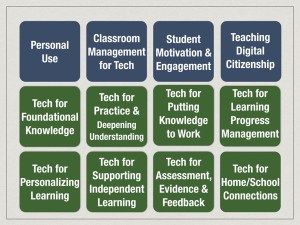
What should educators know and be able to do if they are to work in technology-rich learning environments? The 12 Professional Learning Buckets describe behaviors/professional learning that have been linked to fostering a quality, learning-focused 1to1 technology initiative.

As we think about our teachers becoming highly skilled at using technology in the classroom, we could certainly generate a very long list of abilities, approaches, tools, apps, strategies, and other competences we’d like them to get good at.

But there are certain behaviors/professional learning that have been linked to fostering a quality, learning-focused 1to1 technology initiative. These become our 12 buckets that would make up a professional learning curriculum for teachers.

Four of those buckets focus on teachers’ being able to use the technology themselves and create the conditions in the classroom for students to use the technology for learning.

  1. Personal Use: Can teachers use the device themselves as their own productivity and learning tool?12 Professional Learning Buckets for Learning Through Technology
  2. Classroom Management for Tech: How can teachers insure that students are focused and on-task when using technology in the classroom (especially when every student has a device in front of them!)?
  3. Student Motivation & Engagement: How do teachers ensure that students are mentally and physically engaged? How can teachers create the conditions for student self-motivation?
  4. Teaching Digital Citizenship: How do (all) teachers help students learn how to use technology safely and appropriately? (This isn’t just the responsibility of the computer teacher!)

And 8 of those buckets are the pedagogical approaches that make up “Powerful Uses of Technology” (notice that they focus on educational goals, not technology tools):

  1. Tech for Foundational Knowledge: How can we help students learn the basics?
  2. Tech for Practice and Deepening Understanding: What tools and resources help students develop some fluency with those basics?
  3. Tech for Using Knowledge: How can we contextualize learning and make learning engaging and meaningful? How can students use their knowledge? What is the role for creating and creativity, and for project-based learning.
  4. Tech for Learning Progress Management: How do we keep track of student learning? Promote a transparent curriculum? Make learning progressions clear? Help students navigate their learning? Maintain evidence of mastery?
  5. Tech for Personalizing Learning: How does technology help us tailor the learning to the student?
  6. Tech for Supporting Independent Learning: How can technology help the student do more on their own and need the teacher less?
  7. Tech for Assessment and Evidence of Learning: How can technology help us capture what students know and can do?
  8. Tech for Home/School Connection: How can technology help us stay better connected to parents?
Remember, we’d like to promote and encourage these buckets because they focus on creating quality learning experiences for students, not simply focusing on tools, skills, and devices. This keeps learning first, ensures we are talking about learning, not the tech, and promotes the idea of “More Verbs, Fewer Nouns.”
 
How might the 12 Buckets serve your school?

Not All At Once: Breaking Your Initiative Into Phases

Leading large-scale school change is a challenge. These kinds of initiatives are often complex and include numerous parts and components. Further, the initiative often includes practices educators, the folks responsible for implementing the initiative, have never experienced themselves as learners. Such initiatives often seem overwhelming to teachers! Breaking your initiative into phases is the solution to these challenges!

Leading large-scale school change is a challenge. These kinds of initiatives are often complex and include numerous parts and components. Further, the initiative often includes practices educators, the folks responsible for implementing the initiative, have never experienced themselves as learners. Such initiatives often seem overwhelming to teachers!

While I was with Auburn schools, one lesson we learned from working with other districts further along implementing Customized Learning (proficiency-based learning) than we were was “not all at once!” Although there are many components to this school reform effort, following a certain sequence seemed to lead to successful implementation more often than other processes or approaches.

We teased out those lessons about sequence into phases for implementing Customized Learning and started applying them to plans for training and supporting teachers, as well as plans for implementing a statewide requirement for a proficiency-based diploma.

Seeing the practical benefits of breaking our proficiency-based learning work into phases led us to also consider our work around learning through technology within a 1to1 environment, and we created phases for implementing technology for learning, as well.

Although there is flexibility in how districts implement each phase, or even in how they might break an implementation into phases, there seems to be real, practical advantages to thinking of a complex initiative in phases. Each phase focuses on building the capacity of teachers to implement the key components of a complex initiative, but by making the transition manageable by breaking it down into doable steps.

The Power of Breaking an Initiative into Phases (as viewed from the example of Proficiency-Based Learning)

The Phases – Customized Learning

The Phases – Technology for Learning

Reframing Professional Development (Again)

Professional Development is more than just workshops, readings, and online courses. So what is it? And why am I dissatisfied with PD being reduced to these usual components? I think I have rewritten (and rethought) this post more than any other. My earlier thinking is posted here, and here.

Why reframe it again now?

I think I finally figured out what it is that makes us (Auburn Schools) think differently about professional development.

It’s the proficiency piece.

Teacher and student

We aren’t interested in simply sharing techniques or information. We want changes in classroom practice.

I have collaborated with other districts and initiatives, and I hear frustrations about how much they have invested in professional development – how many sessions they have provided – and how it has resulted in very little change in practice.

I think it is because our thinking about professional development has been incomplete. Sometimes folks say that teachers are oppositional or unwilling to change, but I think it is that workshops are simply insufficient (and perhaps their role is misunderstood), even though they are a key component.

Over time, our understanding about what we need to pay attention to in terms of PD and support has expanded to include 3 overarching categories: clarity; support for foundational knowledge, and support for achieving proficiency.

Clarity

  • A Professional Learning Curriculum – If we have an initiative (technology integration, proficiency-based learning, math instruction, middle level practices, what ever it may be…), what do we want our educators to become good at? As with young learners, adult learners can excel when we are transparent about what we would like them to know and be able to do. What are the (clearly articulated) knowledge and skills we want our educators to become proficient in, and what scopes and sequences make sense?
  • A Professional Learning Progress Management System – How will we manage, acknowledge and certify adult learning (just as we should for student learning)? What system(s) will we use to help make the professional curriculum and pathways transparent, to certify teacher proficiencies as they move through their professional curriculum, and to record and manage their “certifications” (micro-credentialling, “badging,” Educate/Empower or other learning progress management systems)?
  • Answering “But What Does It Look Like?” – Simply stated, this is “models & examples”; a curated collection of possible documents, classroom visits, videos, photos, and articles, etc., to help teachers develop a sense of what an aspect of the strategy would look like in action. Teachers often have an intellectual understanding of what they are being asked to do, but not a practical understanding. These models and examples play a critical role in helping them move to the point of being able to try this new idea in their own classroom.

Support for Foundational Knowledge

  • “Same Page” Trainings – These are introductory workshops, getting teachers on the same page about a new set of concepts, skills, or strategies they will be working to implement. We used to think of teachers as leaving a workshop as proficient in the new skill. Now we think of these “same page” sessions as just the beginning. The real (professional) learning happens when they go back to their classrooms and try out the strategy (see the PD components in the next category).
  • Reusable Learning Objects – Instead of having to wait for a workshop, or for the Tech Integrator or Instructional Coach to visit her classroom, these how-to articles, lessons, short courses, videos, and other digital resources (aligned to our professional learning curriculum) are available to a teacher as she needs them.

Support for Achieving Proficiency

Lesson Invention
  • Lesson Invention and Tryouts – There is much to any new system that needs to be designed or invented (or at least adapted for our schools). The work teachers do to design, invent, prototype, refine, perfect, and share these systems and strategies is valuable professional learning for all of us. Even relatively simple ideas or strategies, if they are truly new to a teacher, require some level of “invention” for that educator to put them into action. Embedded in the idea of lesson invention and tryouts is the notion of continuous improvement, and the chance to try a skill in the classroom, reflect on how it went and how it could be done better, and then try it out again with the improvements (play-debrief-replay).
  • Coaching and Feedback – Keeping with the idea of continuous improvement, this includes the teacher working with any Technology Integrator, Instructional Coach, administrator, or peer, who models lessons or strategies, co-designs or plans with the teacher, observes, and/or provides formative feedback to support the teacher’s professional growth and ability to increase the level of fidelity with which they can implement the strategy.
  • Teacher Face-to-Face Time – Teachers need time to sit with other teachers working on the same initiatives to share experiences, ideas, and resources, as well as to ask questions and seek support. They need a chance to share things that they have tried that worked, and to seek assistance with those things they are still challenged by. And the notion of “face-to-face” can extend well beyond her school or district via the blogs and social networks the teacher builds and follows.
Teacher Face-to-Face Time

We don’t just see that there are 3 categories of professional learning, but we acknowledge that all three compliment each other and are needed. Teachers don’t get to proficiency without the foundational supports. To offer workshops without defining the desired broader professional learning at best leaves gaps in teachers’ learning and at worst becomes a collection of random workshops. To share a set of expectations with teachers (the professional curriculum) without providing training and supports is the irresponsible expectation that they can change practices without supports.

Successful changes in classroom practice come when there is clarity, as well as support for both building foundational understandings and growing to proficiency.

If your initiative isn’t progressing the way you would like, if you aren’t seeing the the classroom changes you’d like to see, I’d invite you to look at the strategies within the three categories. Is your initiative attending to each?


Progress on our Professional Learning Project

Like a lot of districts working on large initiatives, we're struggling with how we can provide all the professional development and support our staff needs and how to manage the professional learning. Much of that development and systems work for us (Auburn School Department) is now part of the Distributed PD Project (watch this overview of the project.)

The project is more about creating our professional learning systems, than it is about actual workshops, trainings, coaching, etc. The project started with looking at supporting teachers with technology integration (leveraging technology for learning), but we knew we needed a similar system for our around Customized Learning. Recent developments have increased Customized Learning as a priority, but we are continuing to put as much attention into the technology for learning piece – both as a subset of the Customized Learning work, but also to support the folks who are primarily interested in the technology professional learning.

We have just shared a draft professional curriculum grid for Technology for Learning and a draft professional curriculum grid for Customized Learning. Each is only a partial grid outlining the Measurement Topics and steps or learning progressions within each Strand. By partial, we mean incomplete, but we have shared them hoping that others will collaborate with us to complete them.

Also, we have started a heightened collaboration with Educate/Empower around this work and are collaborating more intensively with 3 other Maine districts who share the same needs. Working from a proficiency-based learning perspective, and recognizing the power of a transparent curriculum and easy access to resources and support, the project is, right now, focused on the following:

  • Creating a professional learning curriculum/continuum for transitioning to Customized Learning, including for leveraging technology for learning
  • Developing a micro-credentialing (badging) infrastructure for that curriculum (we have selected Educate/Empower for the platform)
  • Developing or collecting reusable learning objects (videos, online resources, online modules, etc.) aligned to our professional learning curriculum
  • Develop a system to recruit and certify a cross-district cohort of “certifiers,” who will review educators' evidence of proficiency in the professional learning


Benefits of Attending Auburn’s Leveraging Learning iPad Institute

Auburn Schools (ME), an early adopter of 1to1 iPads in primary grades, hosts the annual Leveraging Learning Institute on the topic. Registration for the Nov 12-14 Institute opens at noon (ET) on August 21.

Dr. David Murphy, RSU 44 Superintendent (Bethel, ME), has sent a team to the Institute every year. In this video, he discusses both what his district has gotten from attending the Institute, and the benefits of sending a team of teachers, administrators, tech integrators, and technicians.


Registration is limited to 135, so be sure to register early. Districts are encouraged to send teams, and the Institute is structured to support teamwork (but individuals are welcome, too!).

This year, we are expecting the Institute to be internationally rich! More than a third of our participants are likely to be educators from outside the United States. What a great opportunity to share your experiences and learn from educators from across the country and around the world!

Learn more by visiting the Leveraging Learning Hold the Date Page.  We hope to see you at the Institute!


The (New) Evolving Face of Professional Development

We’ve been thinking a lot lately about professional development. 

We’re working on a comprehensive project to define a professional learning curriculum related to our strategic initiatives (Customized Learning, Tech for Learning, etc), build modules and professional learning playlists around those learning targets, and provide a system for certifying teachers for their accomplishments and for what they know and can do. And I have written before about how our thinking about professional development has evolved over time.

This post captures our current (Summer 2014) thinking on the topic.

Not only are we recognizing that we just don’t have enough resources and opportunities to do traditional “everyone in the same room” professional development, but we have started thinking differently about the purpose of those workshops and other whole-group PD.

Until recently, I used to think of whole-group PD as the end. Teachers attend the PD session and they would leave being proficient at the skill taught in the session, ready and able to implement it well in their classroom.

Now, I think of whole-group PD as just the beginning, an opportunity to introduce a group to a new idea and get them all “on the same page” before they begin working in their own classrooms at learning how to implement the skill well. This is especially important given that the work we’ve been doing lately around Customized Learning, including teaching with iPads, is new to teachers (they haven’t experienced this themselves as learners) and have to invent many of the pieces. 

And that idea, the idea that these new skills are complex, and need inventing and development, and later need practice, and that teachers need to be supported throughout their work to get good at them, has us thinking about workshops as just one small piece of professional development.

For us, professional development for our teachers needs to include some fluid combination of these components:

  • “Same Page” Trainings – These are introductory workshops, getting teachers on the same page about a new set of concepts, skills, or strategies they will be working to implement.
  • Lesson Invention & Tryouts – There is much to this new system that needs to be designed or invented (or at least adapted for our schools). The work teachers do to design, invent, prototype, refine, perfect, and share these systems and strategies is valuable professional learning for all of us. Embedded in this idea is the notion of continuous improvement, and the chance to try a skill in the classroom, reflect on how it went and how it could be done better, and then try it out again with the improvements (play-debrief-replay).
  • Coaching & Feedback – Keeping with the idea of continuous improvement, this includes any Technology Integrator, Instructional Coach, administrator, or peer who models lessons or strategies, co-designs or plans with the teacher, observes, and/or provides formative feedback to support the teacher’s professional growth.
  • Teacher Face-to-Face Time – Teachers need time to sit with other teachers to share experiences, ideas, and resources, as well as to ask questions and seek support. They need a chance to share things that they have tried that worked, and to seek assistance with those things they are still challenged by. And the notion of “face-to-face” can extend well beyond her school or district via the blogs and social networks the teacher builds and follows.
  • On-Demand Modules & Play Lists – Instead of having to wait for a workshop, or for the Tech Integrator or Instructional Coach to visit her classroom, these how-to articles, lessons, short courses, videos, and other digital resources are available to a teacher as she needs them.
  • Answering “But What Does It Look Like?” – Simply stated, this is models & examples: a curated collection of possible classroom visits, videos, photos, and articles, etc., to help teachers develop a sense of what an aspect of the initiative would look like in action. Teachers often have an intellectual understanding of what they are being asked to do, but not a practical understanding.  These models and examples play a critical role in helping them move to the point of being able to try this new idea in their own classroom.
 
Of course, now we have to figure out how to do all of these well…. 
  

We Don’t Want Just Any PD, and Badges Are More Than Patches

We’re working on a project to get more professional development to more teachers as they need it. Two pieces that we mention frequently are reusable learning objects (including online modules) and digital badges. We do that, in part, because they may be the most interesting aspects, especially when trying to spark other educator’s interest and entice them to join us in the effort.

The Distributed PD Project is so much more than just those two components. But if you’d mostly been involved in brief conversations about the project, you might not think so. So, I guess I shouldn’t be surprised when colleagues say to me, “We found lots of resources that have badges. Why don’t we just use those?” Or, “Why don’t we just suProfessional Learningbscribe to this service? There are lots of PD modules, and it has badges.”

Now, I know they are well intentioned (these are good people, I like working with), and just trying to help (why reinvent the wheel, right?).

But the suggestions totally miss the point of what we’re trying to achieve with the project.

My first question to them probably should have been, “What are your criteria for selecting these resources?” In all fairness, although familiar with the type of resources, I haven’t spent real time looking at these specific ones, and I haven’t asked my colleagues this question. But I suspect that their answer would be, “They have lots of PD resources that our teachers would like or find useful, and they have badges.” And I’m sure there would be at least some resources there helpful to us and our work. 

But our goal is not simply to provide a buffet of PD, nor is it to simply have a badge at the end

In fact there are three key ways that these resource suggestions misunderstand our work. There are three key, distinguishing criteria we should apply to any resources or services we select to support this project.

1) We don’t want just any PD. We want targeted training aimed at supporting teachers as they work to implement our strategic initiatives (Customized Learning, Tech for Learning, etc.). We’re building out that professional learning curriculum so that we can be transparent about what we would like teachers to know and be able to do. 
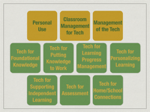
10 Tech Integration Professional Curriculum BucketsSo one criterion we’d want is for a high level of alignment between the training modules and the knowledge and skills needed for our initiatives. A question I could ask about the suggested products is, “How does the list of available modules match our professional learning curriculum?” Keep in mind that a subscription service might not meet that criterion, but still have tons of high quality modules, just not the ones that we really need. And that is ok. We are quite happy to build out our own modules and playlists of available reusable learning objects. But those will be targeted directly to our professional learning curriculum.

2) We aren’t looking for badges that show that an educator participated in a training. We’re looking for badges that indicate that the educator is proficient with the professional learning target. If the training module were for something like standards-based grading, for example, we would want the teacher to earn the badge when she demonstrates that she is skilled at analyzing student work for how it demonstrated proficiency, is skilled at providing standards-based feedback to students, and is skilled at rating a student’s level of proficiency in that learning target based on evidence from the student’s work. We are not looking for the badge to be awarded when the educator participated in the training.

So a second criterion we’d want is for badges to be awarded only when a teacher can show that she is skilled at or understands a particular professional learning target. A question I could ask about the suggested products is, “Are badges awarded for demonstrated proficiency?” This is why, in some ways, the professional learning curriculum and having a cohort of qualified certifiers to examine the teacher’s evidence and determine when she has earned a badge may be more important than finding good training materials.

3) We don’t want badges just so we have an icon to show that we did something. The image or patch of the earned badge OpenBadgesmay be the least important aspect. As I mentioned in notes from a forum on digital badges, badging is about credentialling. It’s about recognition, knowing something about someone in a verified way (evidence-based way), and represents an individual’s skills and achievements. Badges travel with the individual (do not reside solely within a single platform or system) and can come from a variety of sources – a badge needs transportability and interoperability. As such, badges need a standard. Such a standard supports their use by the folks who issue them, the folks who earn them, and the folks who are interested in which badges you have.

So a third criterion is that the badges meet the badging standard. OpenBadges.org provides that standardA question I could ask about the suggested products is, “Is the badging OpenBadges compliant?

So, what we’re looking for are professional learning resources that meet some specific criteria: 

  • They are highly aligned with our professional curriculum and strategic initiatives
  • They offer acknowledgement only upon demonstrated proficiency
  • They are OpenBadges compliant (if they use badges)
 

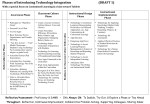
Not All at Once – Phases of Implementing Technology for Learning

Technology is new to many teachers, and leveraging technology for learning is new to even more. Supporting teachers in things they haven’t experienced as learners themselves is complex, paradigm shifting work involving many components. Breaking your initiative into phases makes the change manageable.

When working to implement complex initiatives (like technology integration, or Customized Learning), we want to support our educators by not dropping it  on them all at once.  Toward that end, we try to define a productive sequence or set of phases of implementation.

As part of the Distributed PD Project, a Auburn-and-friends work group developed a wpid-Photo-Jan-24-2014-601-PM.jpgdraft Phases of Tech integration document. It is a draft, but we want to live with it and use it for a while before working to revise and update it. (Practice provides better feedback for revision than theory!)

We wanted to think about developing teachers’ skills at leveraging iPads for teaching and learning beyond just googling topics and word processing. Beyond just projecting material. Beyond just thinking about getting good at various tools. Beyond just using apps connected to the curriculum.

We wanted to think about technology as a tool to help us customize learning. We wanted to focus more on pedagogical goals than technological goals. And we wanted to think about where technology could take us that we couldn’t easily go without technology.

So we set up our professional learning continuum, our phases of implementing technology integration, to be similar to our Phases of Implementing Customized Learning, and how such a structure helps support plementation and teachers. (Driver 1)

And we based it on our current thinking about powerful uses of technology for learning.(Driver 2)

And we tried to think about how the SAMR Model might inform our work. (Driver 3)

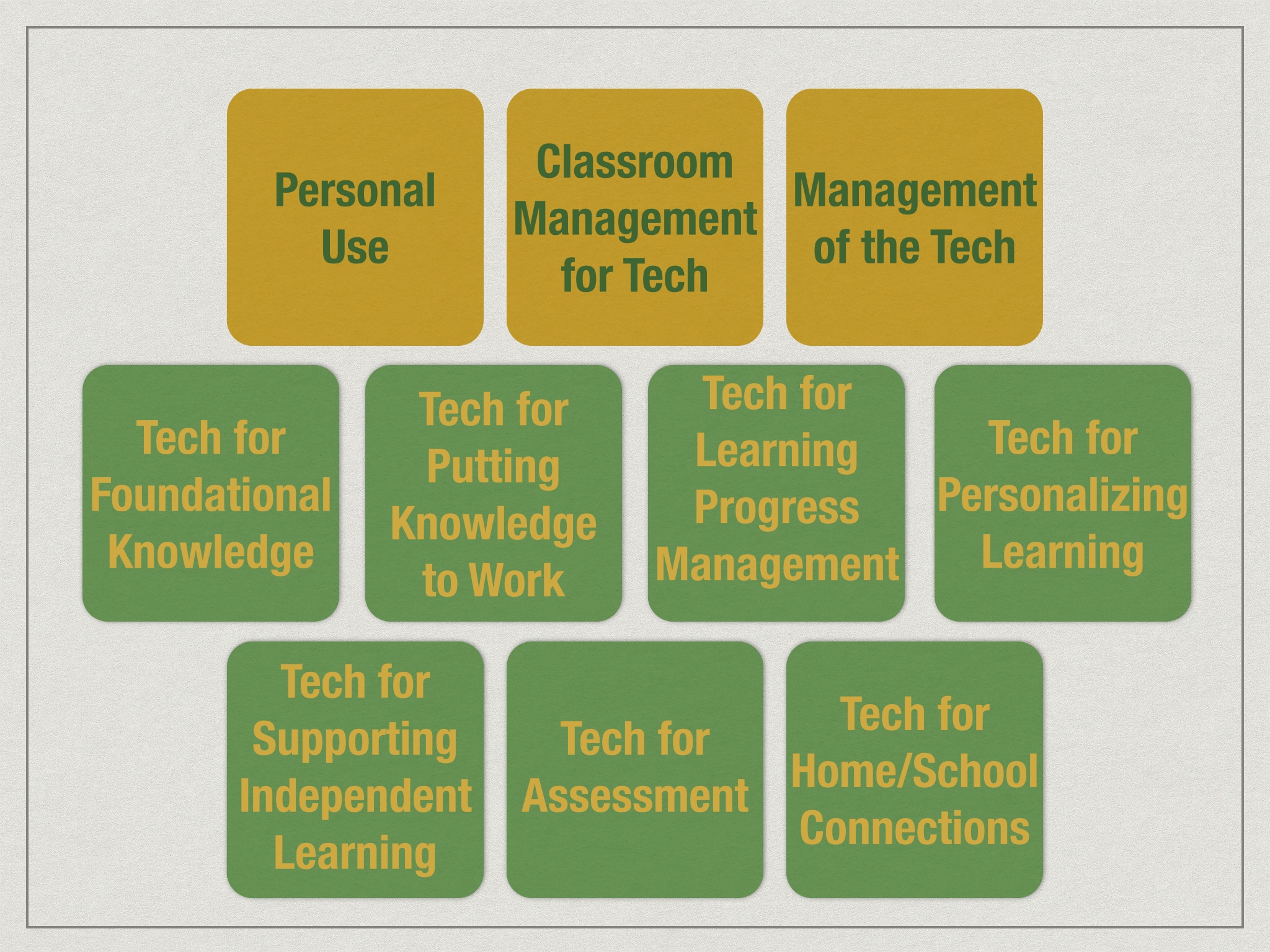
10 Professional Learning Curriculum Buckets for Teaching and Learning with Tech

(Note: This is cross posted at the Distributed PD Project, where Auburn School Department, and friends, are rethinking how we can provide training and support to teachers.)

As we think about our teachers becoming highly skilled at teaching and learning with iPads, we could certainly generate a very long list of skills, approaches, tools, apps, strategies, and other competences we'd like them to get good at.

But if we consider how we might group that very long list into categories, I think we have 10 buckets that would make up our professional learning curriculum.

10 Curric Buckets

Three of those buckets focus on teachers' being able to use the technology themselves and create the conditions in the classroom for students to use the technology for learning.

  1. Personal Use: Can teachers use the device themselves as their own productivity and learning tool?
  2. Classroom Management for Tech: How can teachers insure that students are focused and on-task when using technology in the classroom?
  3. Managing the Tech: How do teachers organize the technology (or collaborate with students to organize the technology) so it works and is available to be used for learning in the classroom?

And 7 of those buckets are the pedagogical approaches that make up the 7 Powerful Uses of Technology (notice that they focus on educational goals, not technology tools):

  1. Tech for Foundational Knowledge: How can we help students learn the basics?
  2. Tech for Using Knowledge: How can we contextualize learning and make learning engaging and meaningful? How can students use their knowledge? What is the role for creating and creativity, and for project-based learning?
  3. Tech for Learning Progress Management: How do we keep track of student learning? Promote a transparent curriculum? Make learning progressions clear? Help students navigate their learning? Maintain evidence of mastery?
  4. Tech for Personalizing Learning: How does technology help us tailor the learning to the student?
  5. Tech for Supporting Independent Learning: How can technology help the student do more on their own and need the teacher less?
  6. Tech for Assessment: How can technology help us capture what students know and can do?
  7. Tech for Home/School Connection: How can technology help us stay better connected to parents?


Does Technology Improve Learning – No! A Keynote

I recently had the honor of keynoting at the Illinois Computing Educators (ICE) conference.

My message was that technology alone will not improve learning; only teachers improve learning. But technology can be wonderful tool for teachers and for students under the guidance of teachers.

Watch the keynote here. And related resources are down below.


If we want to leverage technology well for learning, then these are the components we should attention to:

  • Focus on Learning
  • Deliberate, Shared Leadership
  • Community Engagement
  • How You REALLY Protect Stuff
  • Support the Heck Out of Folks

Resources

Technology:

Learning:

Leadership:

Community Engagement:

Supporting Educators (Professional Development):


iPads, Digital Badges, and Professional Development – Our New Project

Auburn Schools is starting a new project: the Distributed PD Project, working to support teachers leveraging iPads for teaching and learning. The project includes establishing a professional learning curriculum, modules to delver that curriculum and Digital Badges to acknowledge and document learning.

This video provides an overview:

What Can Scouting Teach Us About Proficiency-Based Learning

Scouting does pretty good work with curriculum.

I think our Customized Learning work (both for kids and the professional learning for educators) shares many characteristics with theirs: learning is customized; individuals progress at their own pace; they progress by demonstrating proficiency; learners have lots of voice and choice simultaneously with clear guidelines and expectations; learning is chunked into modules, instead of large all-encompassing courses; proficiency requires a mix of knowing and doing and applying/creating; responsibility for the teaching & learning is distributed; etc.

Auburn has a Distributed PD System Design project going on right now. They (we) just posted two activities that might help others think about curriculum organization and managing learning in a proficiency-based system: