
So, Apparently, There are No Verbs Without Nouns

This is how I learned that there are no Verbs without Nouns. You can’t work on instruction and learning experiences unless all the tech is working seamlessly. And that’s when I realized that you can only be Verb-focused when everything just works.

As I mentioned in my previous post, I finally have the opportunity to help shape an entire district toward More Verbs, Fewer Nouns. We were, with the Superintendent’s direction and blessing, going from a previous Tech Director who focused on techie things (Nouns) to my becoming Tech Director focused on learning and teaching (Verbs).
MSAD 44But that’s easier said than done! At least at first…

I was hired just before school started and there was, for a variety of reasons, and the passing on about systems, subscription, tools, and accounts from one Tech Director to the other was spotty. Plus the Elementary Technician had also retired when the previous Tech Director did. I’ve always been a technology for learning experiences guy and my own knowledge about how to handle the techie issues is VERY limited.

So, no matter how much I wanted to lead out the gate with conversations about pedagogy, and instruction, and good learning experiences, I was met, of course, with questions of “When can we distribute devices to students?” And “Are you ready for the eRate WiFi project at the middle school?” And “Is everything set for testing?” and “I can’t find my students’ passwords, can you help?” And “We have 3 new students; how quickly can we get them devices and accounts?” And “Don’t forget we need to move a SMART Board from Room A to Room B.” And “When will the new staff have email accounts and accounts in the student information system?”

These were certainly all Noun issues.

And just as certainly I wasn’t going to get to do any Verbs unless all these Nouns were addressed.

So I sent out an email to district administrators letting them know that I would do my best to address any issues they send to me and the Tech Team, but, for September, I would focus on these priorities:

1) Bring an Elementary Technician on board
2) Get student devices up and running and into the hands of all students
3) Do our best have NWEA testing go smoothly
And we were reasonably successful.

For the most part (with a handful of exceptions) teachers and we got student devices up and running for the year, and NWEA testing went relatively well. One of the elementary principals, who had been a teacher who leveraged her class’s technology fairly well, was especially helpful with making sure the MacBooks worked with the testing and assisting me as “elementary technician” until we could hire a new one.

The Elementary Technician position had been posted earlier in the summer, so I had a list of candidates to work with. The hiring process went fairly well, with the longest portion of hiring being waiting for our hire to be released from her position in another district.

Our Elementary Technician has been working with us for several weeks. She comes from tech-rich district and knows a great deal about working with MacBooks, and is quickly learning the iPads. She is picking up on new skills/duties quickly and works really well with both our Middle/High Technician and me. She’s a great addition to the team!!But most importantly, the lesson I learned very quickly is that there are no Verbs without Nouns. You can’t work on instruction and learning experiences unless all the tech is working seamlessly.

And that’s when I realized that you can only be Verb-focused when everything just works.

Moving a District Towards More Verbs

I recently started a new journey to be (Learning Through) Tech Director in a small, rural, but innovative, 1to1 school district. I’m going to start sharing our journey to focus on more verbs (what we want to do with our tech) and fewer nouns (the devices, gadgets, and tools).

New journeys are both exciting and full of detours, breakdowns, and bumps in the road!

Bethel, MaineBethel is wonderful small town nestled in a beautiful section of Western Maine. The White Mountains raise all around us here. There is a beautiful downtown with a well stocked, but relatively small, grocery, and an old fashioned hardware store across the street (Ironically named Brooks Brothers!). And there are plenty of really good restaurants – mostly because the town sits between two popular ski resorts. But it will take 30-40 minutes in any of four directions to find a big box store.
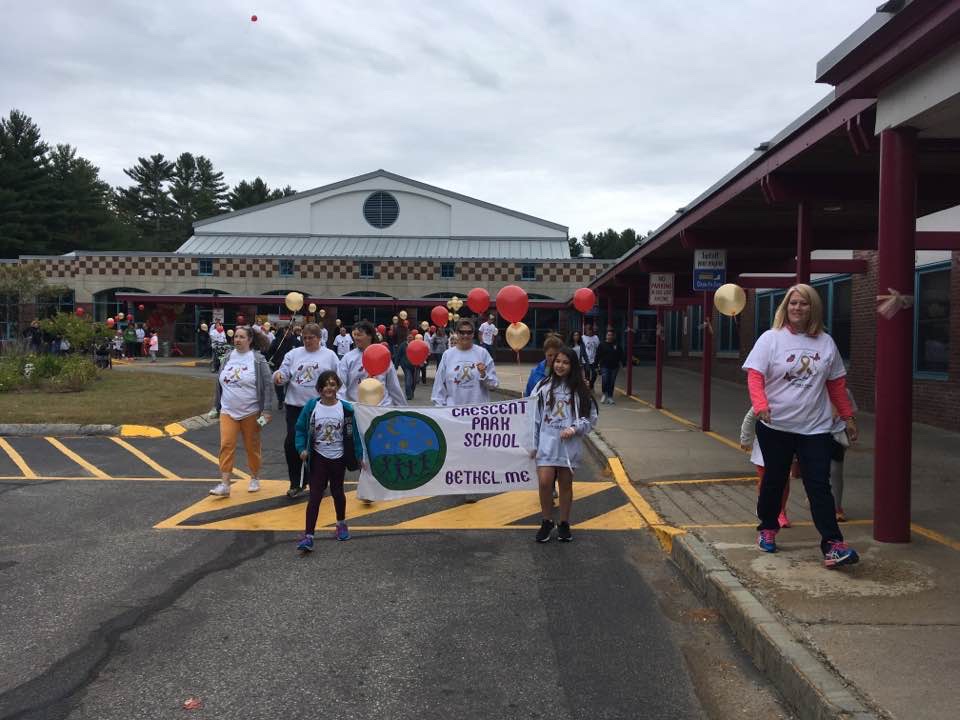
This wonderful little town is at the center of Maine School Administrative District #44.SAD 44 has three schools (well, sort of four): Crescent Park Elementary School (where about 3/4 of the K-5 students attend), Woodstock Elementary School (where the other 1/4th are), and Telstar Middle/High (although it’s one building, they divide it so 6-8 is fairly separate from 9-12). There are only about 775 students district-wide (about 50 students per grade level).

And I have just become their Tech Director.

The district may be small, and they may be rural, but they are fairly innovative. They have a Freshman Academy that all 9th graders participate in. They hold classes most of the day at a 4H Camp and subject learning targets are integrated into hands-on, environment and outdoor themed projects and units. The district also has 1to1 technology for all it’s K-12 students (iPads in K-2 and MacBooks in 3-12).

This is the perfect opportunity to work on living “more verbs” (focus more on what you want to do with the technology) and “fewer nouns” (focus less on the “stuff”, the hardware and the software)!

The district has a small tech team, made up of an elementary technician (who retired just before I came on – an early task was filling the position!), a MS/HS technician, and the Tech Director (me). Historically, the Tech Director was also a technician, working with the others, keeping hardware and software functioning (all “nouns” work).

David Murphy, the Superintendent responsible for much of the innovation in the district, and I have been wanting to work together for years, and the former Tech Director had been wanting to retire for a long time! So the superintendent brought me in with the intention of the Tech Director becoming learning and teaching focused (more verbs!!), letting the two technicians take over all the hardware and software pieces (all the nouns).

That sounds wonderful! And an easy transition to accomplish! (And frankly, these teachers, who have had teacher and student devices for years, are enormously welcoming and excited to have someone to work with them on better leveraging their technology for learning!) 

But transitions like these are full of challenges and bumps and fails and detours, with needing to hire a new elementary technician, and “But the previous Tech Director did this!” and tech challenges that come up requiring skills none of the three of us on the district tech team have much experience with, and folks not knowing who to contact about what, and some critical info (including accounts and passwords) falling between the cracks as one Tech Director retires and the new one comes in, and everyone getting used to this new guy (me) who shifts nearly every conversation to the topic of learning experiences… And… And…

So it feels good to be blogging again and I plan on chronicling pieces of our journey and transition toward making tech systems seamless and invisible because they function well and leveraging technology to create better learning experiences for more students. Toward more verbs and fewer nouns!!

Onwards!

Are We Talking Technology or Are We Talking Learning

We will never be successful having our technology help improve student learning if we continue to primarily discuss the technology. Our technology conversations must focus on the kinds of learning we want for students.

More and more, educators are recognizing that the true value of technology isn’t learning how to use the tools and devices, but rather using the tools and devices to learn (see here, here, and here).

Even a recent meta analysis of the research on 1to1 learning environments shows that when the studies focused simply on the presence of technology, there was no real improvement in learning. Yet, when a study focused on how the devices were used, certain types of use (those focused on effective instructional practices) showed a real improvement in learning.

We will never be successful having our technology help improve student learning if we continue to primarily discuss the technology.  Our technology conversations must focus on the kinds of learning we want for students. After all, if the goal of our technology initiative is simply to make sure that students have technology, when we are successful, all we have are students with devices (and perhaps distracted students at that!).

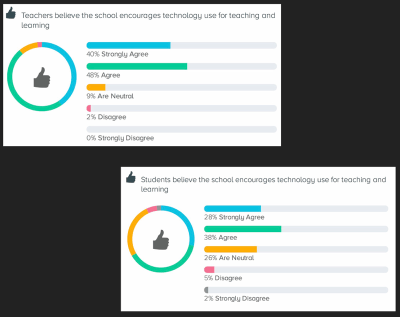
The good news is that Maine’s 2016 statewide BrightBytes data on technology and learning show that students and teachers feel they are encouraged to use their technology for learning:

Teachers and students encouraged to use tech for learning

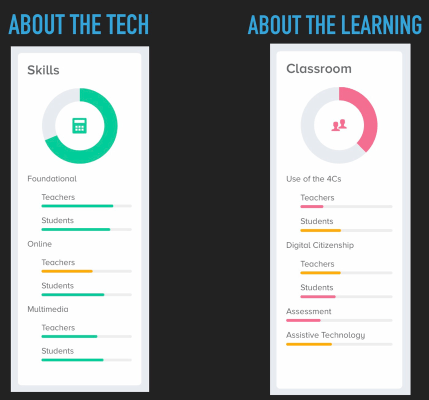
But those data also show that, although we’ve done a pretty good job of teaching teachers and students how to use the devices and tools, we have a ways to go for implementing those tools and devices for learning:

Knowing skills and using for learning

So, these data reinforce the need for our push for “More Verbs, Fewer Nouns” – our need to talk less about the devices and tools and more about the way we want to use them.

How can you tell if you are talking about Tech or talking about Learning?

You are talking about tech when you talk about the following:

  • Cost of devices
  • How easy it is (or isn’t) to manage
  • Wanting same device/platform K-12
  • Teaching skills or about the tools (out of context)
  • Tips and Tricks PD
  • Latest Gimmick/Gadget PD

And you are talking about learning when you talk about the following:

  • Specific academic content focus
  • Used meaningfully for learning task
  • Beyond facts to deeper understanding, to creativity and complex reasoning
  • Student engagement
  • Teaching tech skills as foundation to completing learning activity
  • PD on good instruction (with tech)

There is no doubt that we need “noun people” as part of ensuring technology is used purposefully for learning. We still need a technology infrastructure to support the learning activities for which we want to use technology. I refer to that as Learning-Focused Access.

In Taking Classroom Tech Use to the Next Level: Specific Traits to Look For, the author points out that Alan November recommends six questions to determine if technology adds any value to the learning:

  1. Did the assignment create capacity for critical thinking on the Web?
  2. Did the assignment reach new areas of teaching students to develop new lines of inquiry?
  3. Are there opportunities to broaden the perspective of the conversation with authentic audiences from around the world?
  4. Is there an opportunity for students to publish (across various media) with an opportunity for continuous feedback?
  5. Is there an option for students to create a contribution (purposeful work)?
  6. Were students introduced to the best example in the world of the content or skill?

As the author points out, “Three of the most important traits they look at when evaluating a lesson are whether it is discipline specific, promotes critical thinking and whether technology is used in transformative ways.”


Are We Talking Technology or Are We Talking Learning

We will never be successful having our technology help improve student learning if we continue to primarily discuss the technology. Our technology conversations must focus on the kinds of learning we want for students.

More and more, educators are recognizing that the true value of technology isn’t learning how to use the tools and devices, but rather using the tools and devices to learn (see here, here, and here).

Even a recent meta analysis of the research on 1to1 learning environments shows that when the studies focused simply on the presence of technology, there was no real improvement in learning. Yet, when a study focused on how the devices were used, certain types of use (those focused on effective instructional practices), there was a real improvement in learning.

We will never be successful having our technology help improve student learning if we continue to primarily discuss the technology.  Our technology conversations must focus on the kinds of learning we want for students. After all, if the goal of our technology initiative is simply to make sure that students have technology, when we are successful, all we have are students with devices (and perhaps distracted students at that!).

The good news is that Maine’s statewide BrightBytes data on technology and learning show that students and teachers feel they are encouraged to use their technology for learning:

Teachers and students encouraged to use tech for learning

But those data also show that, although we’ve done a pretty good job of teaching teachers and students how to use the devices and tools, we have a ways to go for implementing those tools and devices for learning:

Knowing skills and using for learning

So, our state data reinforce the need for our push for “More Verbs, Fewer Nouns” – our need to talk less about the devices and tools and more about the way we want to use them.

How can you tell if you are talking about Tech or talking about Learning?

You are talking about tech when you talk about the following:

  • Cost of devices
  • How easy it is (or isn’t) to manage
  • Wanting same device/platform K-12
  • Teaching skills or about the tools (out of context)
  • Tips and Tricks PD
  • Latest Gimmick/Gadget PD

And you are talking about learning when you talk about the following:

  • Specific academic content focus
  • Used meaningfully for learning task
  • Beyond facts to deeper understanding, to creativity and complex reasoning
  • Student engagement
  • Teaching tech skills as foundation to completing learning activity
  • PD on good instruction (with tech)

There is no doubt that we need “noun people” as part of ensuring technology is used purposefully for learning. We still need a technology infrastructure to support the learning activities for which we want to use technology. In the Maine Learning Technology Framework, they refer to that as Learning-Focused Access.

In Taking Classroom Tech Use to the Next Level: Specific Traits to Look For, the author points out that Alan November recommends six questions to determine if technology adds any value to the learning:

  1. Did the assignment create capacity for critical thinking on the Web?
  2. Did the assignment reach new areas of teaching students to develop new lines of inquiry?
  3. Are there opportunities to broaden the perspective of the conversation with authentic audiences from around the world?
  4. Is there an opportunity for students to publish (across various media) with an opportunity for continuous feedback?
  5. Is there an option for students to create a contribution (purposeful work)?
  6. Were students introduced to the best example in the world of the content or skill?

OoAnd the author points out, “Three of the most important traits they look at when evaluating a lesson are whether it is discipline specific, promotes critical thinking and whether technology is used in transformative ways.”

One approach to making sure that your education technology conversations are well grounded in learning is to create a shared vision for learning with a diverse group of stakeholders (at least including educators, students, parents, and community members). That shared vision isn’t a vision for the school or a vision for education technology, but rather a vision for the kids of learning experiences the school community want for its students.

Here are two easy-to-implement strategies for creating a shared vision for learning. Neither takes a lot of time to implement. One asks participants to think about a preferred future for children they care about and then the kinds of learning that they would need to be doing now to achieve that perfected future. The other asks participants to think about a good learning experience and then about the characteristics of that experience.