New Year’s Learning Resolution – Great Way to Engage Teachers

How might I find a way to reach more of my teachers? A colleague in another district has come up with a New Year’s Resolution professional learning program with personalized, bite-sized, monthly professional learning around topics like the 4Cs of 21st Century Learning, student reflection, formative assessment, and podcasts as professional learning. And now I’m thinking about how to apply a version to the educators in my district!

One of the things that has weighed on me with the new Tech Director position in Bethel is trying to figure out how to support all our staff (K-12) with coaching, professional learning, and support for learning through technology.

Much of my time this year has been taken with working with Michelle and James, our two technicians, to take over the work of Everything Just Works, especially the pieces the previous tech director did himself. The teachers in the district have not had a tech integrator to date, despite having had 1to1 devices for their students for years. They are thirsty for learning more about how to leverage their technology in the classroom.

And I’m thirsty to start working with them more directly, and am just about at the point where I can start getting into classrooms, and inviting teachers to work with me. But I worry about having a broader reach. Granted, we’re a small district (about 750 students K-12, and about 80 classroom teachers), but I still manage all the tech and tech projects in the district and manage the Tech Team, so I’m guessing I have a little more than half time to work as a tech integrator.

The question on my mind has been, “How can I reach more teachers across the district than simply collaborating with a handful?”
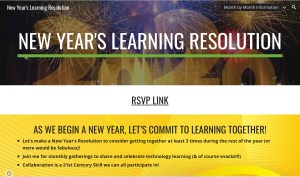
Saco’s New Year’s Resolution Professional Learning OpportunityThen my colleague, Alice Lee, who is doing graduate work in learning through technology, shared with me a professional learning opportunity one of her classmates had created. Wendy Cannon is a PreK-2 Technology Coach in the Saco Schools (ME). She created the New Year’s Resolution PD Website for her teachers, with the message: “As we begin the new year, let’s commit to learning together!” (PLEASE NOTE: There is a RSVP link on the home page, but the New Year’s Resolution is only open to teachers from Saco.)

Wendy has created a bite-sized approach to professional learning for each month, January through May. It included topics such as the 4Cs of 21st Century Learning, student reflection, formative assessment, and podcasts as professional learning.

What I really like about her project is that each month provides some excellent resources, a new strategy to try out, time in a face-to-face session to share what they’ve done and to be introduced to new approaches. Each topic is an powerful strategy for the classroom, but broad enough that any teacher (any grade level or subject area) can apply it to her own context. In other words, it is personalized to each teacher who participates.

I also love that, although the topics are rich, each piece is right-sized for busy teachers with even a modicum of interest to find the time to participate. It’s sized so that it is easy for teachers to say “yes!” to participating.

In short, this appears to be an approach that would help me reach many of my own teachers, maximizing my reach, while using my time efficiently.

So, of course, it’s now time for me to make my own SAD 44 New Year’s Learning Resolution. I’m sure it will look very much like Wendy’s (in terms of topics and plan), but I will tailor it to our district.

And, of course, I’ll be sure to share what I come up with, and how I plan to implement it in our district.

All About Micro-credentials

Educators hear more and more about micro-credentials and digital badges. This set of post provides and overview, as well as links to resources with more in-depth information.

What are they?

  • A verified indicator of skills, competencies, interests, and accomplishments.
  • They are stored and managed online.

Why do we like them?

  • They value multiple pathways for learning
  • They are transportable and shareable
  • They represent professional learning on educators’ own terms
  • They are transferable from multiple sources
  • They are evidence based
  • They are stackable
  • They hold the potential to transform when and where learning is valued.

How can you use them?

  • Earn them
  • Share them on the web and through social media
  • Use them with employers and perspective employers

Learn More about Micro-credentials


And Even More about Micro-credentials

The Advantages of a Plain English Instructional Model

How a Plain English Instructional Model provides an opportunity for typical teachers to expand their thinking and skill around instruction.

Recently I have started to promote a Plain English Instructional Model to help promote pedagogical conversations in school and to help contextualize our conversations about education technology around learning.The primary advantage of having a plain English instructional model is that it is often more easily adapted by our staff who are strong “Joe” and “Jane Average” instructors. These are the folks who do a solid job of educating their students, but leave at the end of the school day and don’t tend to get excited by new programs or innovations. If we want these teachers to change (expand their skill set), then we need to introduce programs and approaches

framed in a way that they can relate to and validates the pieces they are already good at. (After all, these typical teachers make up the bulk of the educators in our schools.)

For example, there was a strong focus placed on project-based learning at the beginning of MLTI. I wonder sometimes if PBL didn’t really take off because, although the enthusiastic teachers implemented it, the much larger group of conventional teachers simply didn’t see themselves in PBL (“Oh, project-based learning. Tammy does that, God bless her. Her kids love it and she does a great job. But that’s not what we do…”). Those solid conventional teachers live most of the time in the Foundational Knowledge bucket. PBL lives mostly in the Putting Knowledge to Use bucket. When we simply spoke about PBL, without the larger context of a more comprehensive instructional model, there was no bridge or on-ramp for those typical teachers.

Using the Plain English Instructional Framework, however, provides those bridges and on-ramps. Every time a teacher does a great job helping students learn foundational knowledge, they can point to that bucket and say, “I did that.” They receive validation for what they do. But at the same time they point to something they did, they also see buckets that they do less frequently. It creates the opportunity for them to say, “I wonder how I might help my students develop deeper learning?” And maybe eventually other buckets such as Motivating Students or Putting Knowledge to Use.

Another advantage of a Plain English Instructional Model is that it is in plain English. Many conventional teachers seem to dislike or distrust jargon. Is it because of the long list of innovations that have been introduced in school but never lasted long? Is it because we all wonder why we have to use fancy words for ideas that can be explained plainly? Is it because you have to be “in the know” to understand jargon, but anyone can understand plain English?

Our goal is to help improve the learning for all students in all classrooms. That means the bulk of teachers we want to help expand their teacher practice aren’t the early adopters or the folks who excitedly jump on new ideas. It is the solid, conventional teachers, who will change with good reason, if it makes their life easier in the classroom, or if they quickly see it benefiting students, but who are suspicious of change and “innovation.” This is the group we need to support and the group we must target with our efforts.

The Plain English Instructional Model is one way we are trying to support these educators.

A Plain English Instructional Model

A Plain English instructional model provides a framework around which educators and school leaders can discuss teaching and learning and the role of technology in pedagogy and instruction.

We’ve been working hard to help Maine’s schools adopt a “More Verbs, Fewer Nouns” stance when thinking about the technology in our schools. We want schools to be sure they are focused more on what they want to do with the devices than with the devices themselves. There is no doubt that there is a lot of “noun” work that needs to happen to make the learning (the “verb” work) happen, but we want to make sure that when we talk about tools and devices that it is in service to the kinds of learning experiences we provide for students.
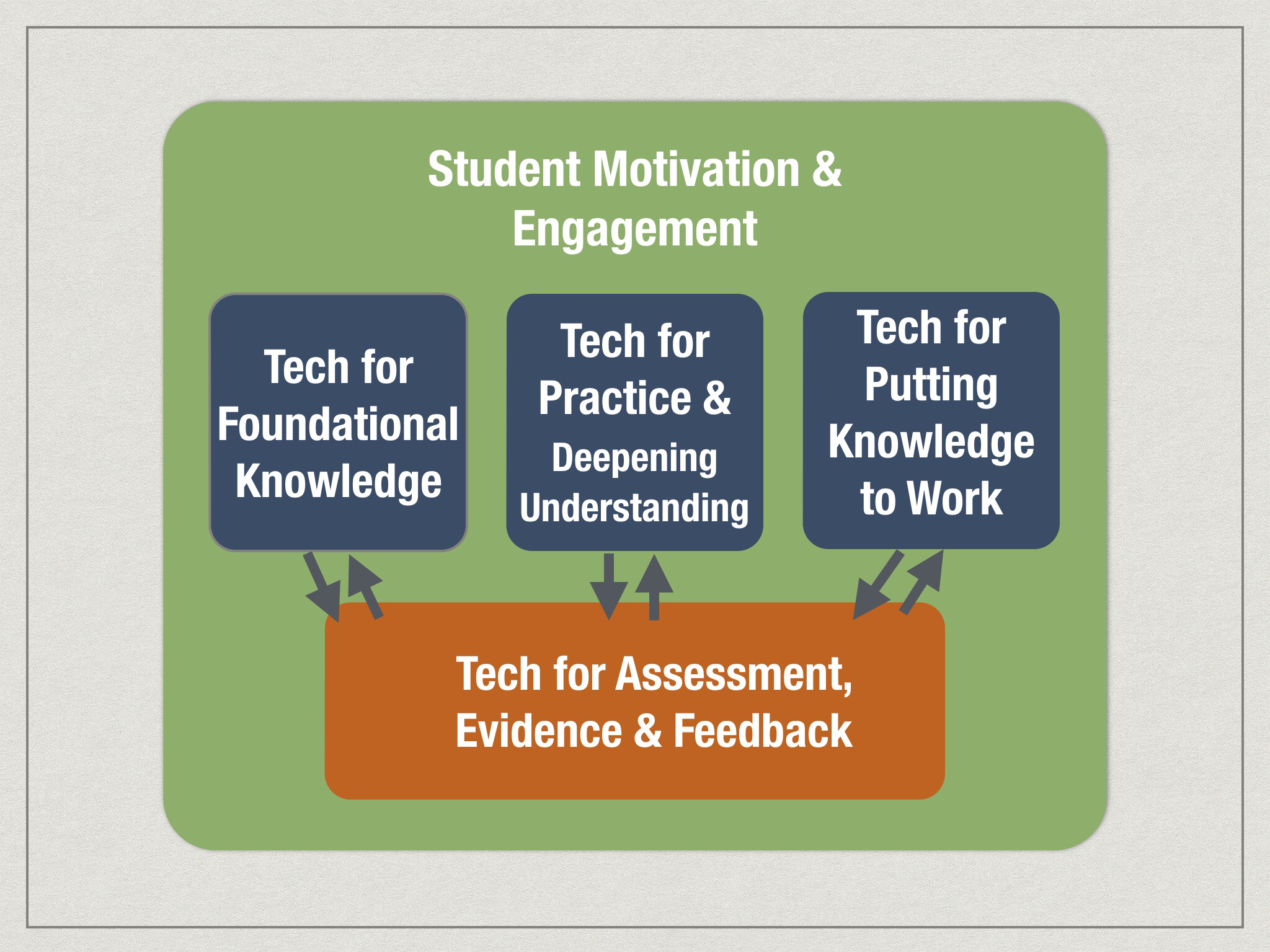
One way we’re trying to further that conversation is by introducing what we call a plain English instructional model. That model includes the following components:

  • Tech for Foundational Knowledge: How can we help students learn the basics?
  • Tech for Practice and Deepening Understanding: What tools and resources help students develop some fluency with those basics?
  • Tech for Using Knowledge: How can we contextualize learning and make learning engaging and meaningful? How can students use their knowledge? What is the role for creating and creativity, and for project-based learning.
  • Tech for Assessment, Evidence of Learning & Feedback: How can technology help us capture what students know and can do, and provide feedback to help drive continuous improvement?
  • Student Motivation & Engagement: How do teachers ensure that students are mentally and physically engaged? How can teachers create the conditions for student self-motivation?

This instructional model is not intended to replace any general or content specific instructional model that a school has already adopted. In fact, it is quick work to do a crosswalk between those models and this one.

The goal of this Plain English Instructional Model it to provide a framework around which educators and school leaders can have a conversation (a plain English conversation!) about teaching and learning and the role of technology in pedagogy and instruction.


In the next post, we describe the advantages of a Plain English Instructional Model.


Not All at Once – Phases of Implementing Technology for Learning

Technology is new to many teachers, and leveraging technology for learning is new to even more. Supporting teachers in things they haven’t experienced as learners themselves is complex, paradigm shifting work involving many components. Breaking your initiative into phases makes the change manageable.

When working to implement complex initiatives (like technology integration, or Customized Learning), we want to support our educators by not dropping it  on them all at once.  Toward that end, we try to define a productive sequence or set of phases of implementation.

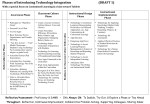
As part of the Distributed PD Project, a Auburn-and-friends work group developed a wpid-Photo-Jan-24-2014-601-PM.jpgdraft Phases of Tech integration document. It is a draft, but we want to live with it and use it for a while before working to revise and update it. (Practice provides better feedback for revision than theory!)

We wanted to think about developing teachers’ skills at leveraging iPads for teaching and learning beyond just googling topics and word processing. Beyond just projecting material. Beyond just thinking about getting good at various tools. Beyond just using apps connected to the curriculum.

We wanted to think about technology as a tool to help us customize learning. We wanted to focus more on pedagogical goals than technological goals. And we wanted to think about where technology could take us that we couldn’t easily go without technology.

So we set up our professional learning continuum, our phases of implementing technology integration, to be similar to our Phases of Implementing Customized Learning, and how such a structure helps support plementation and teachers. (Driver 1)

And we based it on our current thinking about powerful uses of technology for learning.(Driver 2)

And we tried to think about how the SAMR Model might inform our work. (Driver 3)