Another Adventure; Same Mission

Learn about my new job with GEAR UP Maine and how we’re helping schools not only create a culture for post-secondary education, but support their work with Proficiency-based Education.

I have a new job. Well, I have a new employer.

I recently joined GEAR UP Maine. GEAR UP (Gaining Early Awareness and Readiness for Undergraduate Programs) is that federal grant program  that increases the number of low-income students who are prepared to enter and succeed in postsecondary education.

The traditional approach to GEAR UP programs provide academic supports so students are both academically ready for college and can graduate on time. It provides opportunities to parents and students, such as tutoring, campus visits, and financial aid workshops, to help them view college and post-secondary education as a real possibility.

Maine is going further by leveraging several Multiple Pathway pilot programs of school-design, shared leadership training, and supports for proficiency-based education.

My position is Proficiency-based Education Specialist. I’m working to support our over-tasked, under-resourced schools with frameworks, tools, and supports right-sized for their context. In addition, we’ve identified a couple promising practices we’re helping some of our schools implementing: experiential math, and student micro-credentials to certify learning outside the classroom.

I have joked for a while now that for the last 20 years I’ve really only had one job: helping schools figure out how to reach disengaged learners, students in poverty, and youth from rural, isolated areas. I just keep changing who pays me!

Well, this change to GEAR UP Maine certainly fits the bill!

What Makes for Good Learning Experiences?

Trying to reach more of your students? Consider finding out what makes for a good learning experience by asking the real experts: students, parents, educators, community members. Here’s how

The more we try to to help build the talents of every student and help every learner succeed in school, the more we have to be deliberate about creating good learning experiences in our classrooms. I have certainly added to the conversation about what I believe gives students good learning experiences.

The roots of those ideas are not just my own experiences as a learner and a teacher, and not just conducting research and reviewing research, but from actually asking people about their own good learning experiences. The Good Learning Experiences Activity is one of the ways I have explored different people’s perspectives on how they think they learn well.

The Process

learn-939239_960_720Gather a group of stakeholders: student, teachers, administrators, parents, community members. 

“Think of a good learning experience,” the script for the activity begins. “It can be in school, or out of school. It can be when your grandfather taught you how to cast a fly rod, or when your teacher worked with you to write that really good essay. But think of a time when you had an ‘aha!’ or something finally made sense, or you could finally do something. Think of a good learning experience.”

I give small groups of participants a few minutes to share their stories. Next, I ask them to jot down on scratch paper what it was that made it a good learning experience. What were the characteristics of the experience? After a few more minutes to share their lists with their neighbors, we compile a class list on chart paper, an overhead, or on a projected computer.


Before reading on, just take a second to think about a good learning experience of your own, and what it was that made that a good learning experience.


I have conducted the activity with people of nearly every age group: upper elementary students, middle school students, high school students, college students, teachers, parents, and community members. Only a few participants have ever stated that they can’t think of any good learning experience. Many of the learners state that their best learning experiences have taken place outside of school. No one has ever said that their best learning experience came from a terrific lecture, or an interesting textbook, or an engaging worksheet (although I believe each of these can be a useful teaching tool when applied wisely).

Having conducted this activity with so many groups, I am intrigued by the results. I was surprised to find that, regardless of the group involved, there were common elements with other groups’ lists. Since 1992, I informally tracked the results and found that certain characteristics of good learning experiences come up in nearly every list:

  • The work was well connected to other ideas and to the real world
  • The content of the learning experience was personally relevant, interesting, useful, or meaningful to the learner
  • The learner had choices, shared authority, control, and responsibility
  • The learning was hands-on and experiential
  • The learner learned from and taught others
  • The learner had the support of a patient, supportive, and nurturing mentor
  • The learning was individualized and although there were standards for the work, the learner could meet them in his or her own way
  • There was a positive aesthetic component to the experience: it was fun or left the learner feeling good
  • The experience helped the learner understand him or herself
  • The learner had success and accomplishment with challenging work

Now, these are my words synthesizing the lists I have collected over the two and a half decades I’ve been doing this activity. Certainly elementary students aren’t going to use these word exactly. But doesn’t this list reflect what has made your own good learning experiences good?

Much can be learned by investigating how students believe they learn well. What better source for finding out what motivates students to learn than themselves?

But with knowledge comes responsibility. If you know what makes for good learning experiences, don’t you now have an obligation to ensure that you model these in our own teaching? – Or at least start learning how to do these in the classroom?


(Note: I have been with educators who have used the prompt “think of a good experience” or “think of a good school experience”, and it never gets to the right information about when people learn well. If you are considering doing this activity with your own students, teachers, or parents, I highly recommend that you stick with the prompt “think of a good learning experience.”)

Are We Talking Technology or Are We Talking Learning

We will never be successful having our technology help improve student learning if we continue to primarily discuss the technology. Our technology conversations must focus on the kinds of learning we want for students.

More and more, educators are recognizing that the true value of technology isn’t learning how to use the tools and devices, but rather using the tools and devices to learn (see here, here, and here).

Even a recent meta analysis of the research on 1to1 learning environments shows that when the studies focused simply on the presence of technology, there was no real improvement in learning. Yet, when a study focused on how the devices were used, certain types of use (those focused on effective instructional practices), there was a real improvement in learning.

We will never be successful having our technology help improve student learning if we continue to primarily discuss the technology.  Our technology conversations must focus on the kinds of learning we want for students. After all, if the goal of our technology initiative is simply to make sure that students have technology, when we are successful, all we have are students with devices (and perhaps distracted students at that!).

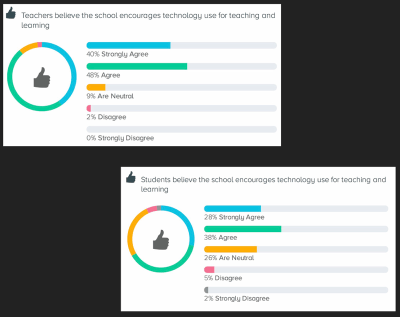
The good news is that Maine’s statewide BrightBytes data on technology and learning show that students and teachers feel they are encouraged to use their technology for learning:

Teachers and students encouraged to use tech for learning

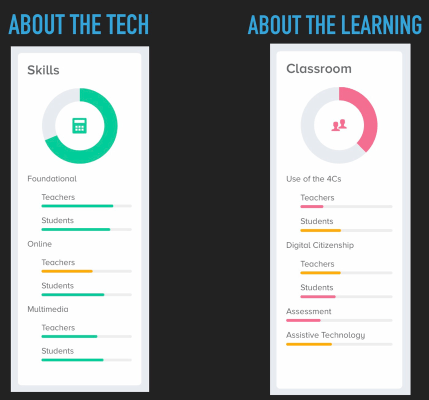
But those data also show that, although we’ve done a pretty good job of teaching teachers and students how to use the devices and tools, we have a ways to go for implementing those tools and devices for learning:

Knowing skills and using for learning

So, our state data reinforce the need for our push for “More Verbs, Fewer Nouns” – our need to talk less about the devices and tools and more about the way we want to use them.

How can you tell if you are talking about Tech or talking about Learning?

You are talking about tech when you talk about the following:

  • Cost of devices
  • How easy it is (or isn’t) to manage
  • Wanting same device/platform K-12
  • Teaching skills or about the tools (out of context)
  • Tips and Tricks PD
  • Latest Gimmick/Gadget PD

And you are talking about learning when you talk about the following:

  • Specific academic content focus
  • Used meaningfully for learning task
  • Beyond facts to deeper understanding, to creativity and complex reasoning
  • Student engagement
  • Teaching tech skills as foundation to completing learning activity
  • PD on good instruction (with tech)

There is no doubt that we need “noun people” as part of ensuring technology is used purposefully for learning. We still need a technology infrastructure to support the learning activities for which we want to use technology. In the Maine Learning Technology Framework, they refer to that as Learning-Focused Access.

In Taking Classroom Tech Use to the Next Level: Specific Traits to Look For, the author points out that Alan November recommends six questions to determine if technology adds any value to the learning:

  1. Did the assignment create capacity for critical thinking on the Web?
  2. Did the assignment reach new areas of teaching students to develop new lines of inquiry?
  3. Are there opportunities to broaden the perspective of the conversation with authentic audiences from around the world?
  4. Is there an opportunity for students to publish (across various media) with an opportunity for continuous feedback?
  5. Is there an option for students to create a contribution (purposeful work)?
  6. Were students introduced to the best example in the world of the content or skill?

OoAnd the author points out, “Three of the most important traits they look at when evaluating a lesson are whether it is discipline specific, promotes critical thinking and whether technology is used in transformative ways.”

One approach to making sure that your education technology conversations are well grounded in learning is to create a shared vision for learning with a diverse group of stakeholders (at least including educators, students, parents, and community members). That shared vision isn’t a vision for the school or a vision for education technology, but rather a vision for the kids of learning experiences the school community want for its students.

Here are two easy-to-implement strategies for creating a shared vision for learning. Neither takes a lot of time to implement. One asks participants to think about a preferred future for children they care about and then the kinds of learning that they would need to be doing now to achieve that perfected future. The other asks participants to think about a good learning experience and then about the characteristics of that experience.


Ed Tech Research is Clear: Owning a Device Does Not Improve Learning

It’s easy to find stories and reports in the media frustrated with technology in schools, promoting caution, or even advocating for banning tech. But to what extent to these look at how the technology was being used, consider desired learning experiences for students, or the support offered teachers?

Scanning the media on education technology could easily lead one to believe we are wasting our money when putting devices into the hands of students.

Whether it is districts that have had disturbing problems trying to implement technology for learning (such as here, or here), or folks who tell us why we shouldn’t have devices in school, or schools that have decided that technology is too disruptive and have banned it, or authors who caution about the over-promising with technology (such as here, or here), it is not surprising that we are dubious of investing in education technology, and wonder “why bother?”

Digital LearningOn the other hand, educators in Washington County, PA, find that their devices benefit students, and in Auburn, ME, educators found that when they carefully selected apps aligned to their curriculum or participated in professional learning focused on using apps to build conceptual understanding of mathematics, student learning improved.

So what’s different between these two groups?

From my perspective, each of these instances are really just reflections of either the problems we experience when we focus on the device more than we do the learning, or the benefits of doing the reverse (the notion of “more verbs, fewer nouns”). It is ludicrous to look inside a classroom and decide if technology is a waste of investment or a distraction without also investigating how we are using them for learning. Simply having technology does not improve learning.

And there are plenty of authors and organizations out there who are anxious to help us be successful with education technology:

Here is our advice to your school when considering the value of your education technology:

  • If the goal of your technology initiative is to provide students with technology, then all you will end up with is students with devices (and probably distracted, off-task students at that).
  • Your technology initiative should consider the kinds of learning experiences you want for your students and the supports you put in place to help teachers create those experiences.
  • Keep in mind that student distraction is almost never a device problem. It is almost always a boredom problem. We must stop blaming technology and get better at engaging students with our teaching.
  • Make classroom management in technology rich classrooms a part of your school’s professional learning plan. Support teachers in developing strategies beyond sending kids to the principal and requesting that devices be locked and blocked.
  • When reviewing research on technology in schools, ask yourself if the study simply looks at the presence of technology, or if it looks at how the technology was used. Further, did the study measure student engagement? Don’t put too much value in the incomplete studies – we already know that owning devices doesn’t improve learning.

In short, start with the pedagogy, then think about the devices.


Let’s Focus on the Learning

As you move through the state and talk with educators about their technology initiatives, too often the conversations have focused on laptops and tablets and folks wondering if we could find devices that were less expensive.

Is it possible that in their thinking, all laptops and devices were created equal, in such a way that the only variable is cost?

Possibly it is the wrong conversation completely. The conversation shouldn’t be about price; it should be about value.

We may have missed the boat on the value conversation when we started spending too much time talking about the technology and the tools, or about providing technology and procurement.

We need to spend most of our time talking about what kinds of learning we would like to make happen with the technology. You can only get to the value conversation when you can discuss what you want to do with the devices and compare different devices and tools around how well suited they are to those purposes.

A really wonderful professor of elementary educational technology, Ralph Granger, used to say, “When you go to the hardware store to buy a new drill bit, you don’t really want a drill bit. You want a hole.” When it comes to educational technology, we need to talk less about our “drill bits” and more about the “holes” we want.

Or as Marc Prensky says, we need more verbs and fewer nouns.

And, as TPACK reminds us, when we align our educational arrows, we are talking about content, pedagogy, and technology (What instructional strategies might we use to teach this learning target, and what role could our devices play?).

How are you prepared to help make our educational technology conversations focus more on learning?

Organizing Early to Avoid Device Breakage and Misuse

We had an interesting experience last year, at Auburn Middle School, related to iPad breakage and misuse.

AMS has six teams (3 7th & 3 8th). Last June, when we collected the iPads, we found that some teams had quite high breakage and misuse rates, and some had quite low breakage and misuse rates.

And what we saw right away was that the low-rate teams had done some things that the high-rate teams had not:

  • Worked on classroom culture (code of collaboration, rules, procedures, mutual respect, etc. – in general, not  iPad specific) before distributing iPads
  • Had a shared vision for learning
  • Had clear expectations for students for iPad use (actively taught them and re-taught them when needed)
  • Had clear expectations of teachers to use the iPads in class regularly for meaningful (to the students) learning activities 
  • Were thoughtful about including motivation and engagement strategies when designing learning activities (including those that include the iPad)
  • Responded to misuse in measured ways that were geared more toward getting students on track for appropriate use than on punishment

This was a great reminder of the success strategies from the beginning of MLTI (the original page seems to be gone, but Deer Isle has reposted it). The state MLTI team uncovered these strategies from visiting schools across the state and finding patterns among successful and more challenged schools. AMS’s trend data was almost the same as the original MLTI discovery: do these things, have low breakage/misuse; don’t do these things and have high breakage/misuse.

It confirms the conclusion from more than a decade ago that breakage/misuse is primarily a function of leadership and teacher practice. 

I’m not dumping on or blaming folks who have that higher rate. I’m much more interested in all of us learning from these kinds of experiences, so we can help all schools implement the more productive strategies and be more successful.


On Transitioning – Not Jumping Straight from the Traditional to the New

In my experience, the biggest mistake we make with large scale school change, like with Customized Learning, is thinking that we should, or need to, make the change all at once.  One day we’re living in the old; the next we’re living in the new. Part of that mistake is thinking that the initiative is one monolithic thing (that can just be turned on or off!), rather than something made up of many interconnected parts; also, it is thinking we should do it all at once, rather than phasing in the work.

But another piece is misunderstanding the nature of transitioning from the traditional to the new.

Let me show you what I mean.

Put your hands on the table about 18 inches apart, edge of your hand touching the table and palms facing each other (like you are measuring some fish you caught!).

We're here now, and want to end up here.Your left hand is where we are today. A group of students are taught the content at the same time (regardless of the pace they are learning it). They all learn it the same way. They all take the assessment at the same time. Grades are F to A, based on that assessment. Learning and assessment are based more on activities than they are learning targets; based more on building foundational knowledge (recall) than they are about both foundational knowledge and putting that knowledge to use (both recall and complex reasoning).

Your right hand is where we want to end up.  Learning is the constant and time is the variable (pace is based on how fast the student learns the material – with lots of teacher nudging and coaching, of course). Everyone learns the same content, but they learn it in a way that works well for them. Assessments are taken when the student is ready. Scoring (grades) is 1 to 4 based on the learner’s level of proficiency with the learning target. The student doesn’t move on until they are proficient with the content and there are multiple ways a student might demonstrate that proficiency. Proficiency requires being able to put the knowledge to use, not simply recall the related foundation knowledge.

But notice, your hands aren’t touching.  They’re 18 inches apart. We think it will take us about 5 years to transition from where we are now (left hand) to where we want to be (right hand).

And here is where we misunderstand transitioning. 

We get frustrated with teachers, or think they are doing it wrong if they are still doing parts from the traditional system. 

Instead, we should be expecting a mix of the old and the new that is (more or less) proportionate to how far along with the transition we are.

Now tap your right hand about a third of the way from your left hand. This is where we would be about a third into the transition. The problem is that some will expect that change to look just like where we want to end up. But it’s only a third of the way there. In reality, we should expect it to look mostly like the transitional system and only a little like the new system. If we were two-thirds along the transition, we’d expect it to still look some like the traditional system, but more like the new system.
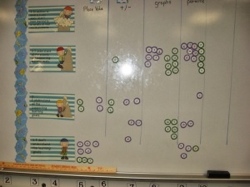
Student progress trackingFor example, let’s say we are talking about learning progress management, and we are about a third of the way along our transition from what we used to do to the new system we want (keeping in mind that “a third” is metaphorical, simply to make a point). We would expect that a teacher might be keeping track of which unit or chapter each student is in the text (maybe with charts on the wall), students take the chapter test when they are ready, and grades are recorded in the electronic grade book (e.g. PowerSchool). The traditional pieces are that “the curriculum” is the textbook, that the text (and teacher mini lessons, we presume) are the primary approach to learning, and students are earning traditional grades. The new parts include keeping track of where students are in their learning, and students have some flexibility of pace.  

But if we were 2/3rds along, we might expect that the teacher would be using an online learning progress management system (e.g. Educate/Empower) to make sure that both she and her students know the full curriculum and which learning targets they are currently working on, is keeping track of which learning targets each student has demonstrated proficiency on, and the teacher then translates that information into an A through F for the report card each quarter. The traditional pieces include the A to F grades, and report cards each grading period. The new pieces include the transparent curriculum, keeping track of proficiency of learning targets,  and “grades” based on proficiency, rather than performance on assignments and activities.

Notice, more traditional and a little new early in the transition and a little traditional and more new later in the transition.

The big idea here is that we shouldn’t expect what teachers are doing to look entirely like the new system until the new system is fully implemented.

Additionally, if we’re just starting a transition, it needs to be ok that most of what we are doing looks like the traditional system. And even when we’re pretty far along with the change, we need to remember that there will still be elements of the traditional mixed in with the new.

From a leadership perspective, our biggest job is supporting teachers through the initiative toward a high level of implementation. And a major component of that is having realistic expectations of those teachers, based on how far along with the transition they currently are.
 

Benefits of Attending Auburn’s Leveraging Learning iPad Institute

Auburn Schools (ME), an early adopter of 1to1 iPads in primary grades, hosts the annual Leveraging Learning Institute on the topic. Registration for the Nov 12-14 Institute opens at noon (ET) on August 21.

Dr. David Murphy, RSU 44 Superintendent (Bethel, ME), has sent a team to the Institute every year. In this video, he discusses both what his district has gotten from attending the Institute, and the benefits of sending a team of teachers, administrators, tech integrators, and technicians.


Registration is limited to 135, so be sure to register early. Districts are encouraged to send teams, and the Institute is structured to support teamwork (but individuals are welcome, too!).

This year, we are expecting the Institute to be internationally rich! More than a third of our participants are likely to be educators from outside the United States. What a great opportunity to share your experiences and learn from educators from across the country and around the world!

Learn more by visiting the Leveraging Learning Hold the Date Page.  We hope to see you at the Institute!


The (New) Evolving Face of Professional Development

We’ve been thinking a lot lately about professional development. 

We’re working on a comprehensive project to define a professional learning curriculum related to our strategic initiatives (Customized Learning, Tech for Learning, etc), build modules and professional learning playlists around those learning targets, and provide a system for certifying teachers for their accomplishments and for what they know and can do. And I have written before about how our thinking about professional development has evolved over time.

This post captures our current (Summer 2014) thinking on the topic.

Not only are we recognizing that we just don’t have enough resources and opportunities to do traditional “everyone in the same room” professional development, but we have started thinking differently about the purpose of those workshops and other whole-group PD.

Until recently, I used to think of whole-group PD as the end. Teachers attend the PD session and they would leave being proficient at the skill taught in the session, ready and able to implement it well in their classroom.

Now, I think of whole-group PD as just the beginning, an opportunity to introduce a group to a new idea and get them all “on the same page” before they begin working in their own classrooms at learning how to implement the skill well. This is especially important given that the work we’ve been doing lately around Customized Learning, including teaching with iPads, is new to teachers (they haven’t experienced this themselves as learners) and have to invent many of the pieces. 

And that idea, the idea that these new skills are complex, and need inventing and development, and later need practice, and that teachers need to be supported throughout their work to get good at them, has us thinking about workshops as just one small piece of professional development.

For us, professional development for our teachers needs to include some fluid combination of these components:

  • “Same Page” Trainings – These are introductory workshops, getting teachers on the same page about a new set of concepts, skills, or strategies they will be working to implement.
  • Lesson Invention & Tryouts – There is much to this new system that needs to be designed or invented (or at least adapted for our schools). The work teachers do to design, invent, prototype, refine, perfect, and share these systems and strategies is valuable professional learning for all of us. Embedded in this idea is the notion of continuous improvement, and the chance to try a skill in the classroom, reflect on how it went and how it could be done better, and then try it out again with the improvements (play-debrief-replay).
  • Coaching & Feedback – Keeping with the idea of continuous improvement, this includes any Technology Integrator, Instructional Coach, administrator, or peer who models lessons or strategies, co-designs or plans with the teacher, observes, and/or provides formative feedback to support the teacher’s professional growth.
  • Teacher Face-to-Face Time – Teachers need time to sit with other teachers to share experiences, ideas, and resources, as well as to ask questions and seek support. They need a chance to share things that they have tried that worked, and to seek assistance with those things they are still challenged by. And the notion of “face-to-face” can extend well beyond her school or district via the blogs and social networks the teacher builds and follows.
  • On-Demand Modules & Play Lists – Instead of having to wait for a workshop, or for the Tech Integrator or Instructional Coach to visit her classroom, these how-to articles, lessons, short courses, videos, and other digital resources are available to a teacher as she needs them.
  • Answering “But What Does It Look Like?” – Simply stated, this is models & examples: a curated collection of possible classroom visits, videos, photos, and articles, etc., to help teachers develop a sense of what an aspect of the initiative would look like in action. Teachers often have an intellectual understanding of what they are being asked to do, but not a practical understanding.  These models and examples play a critical role in helping them move to the point of being able to try this new idea in their own classroom.
 
Of course, now we have to figure out how to do all of these well…. 
  

Does Technology Improve Learning – No! A Keynote

I recently had the honor of keynoting at the Illinois Computing Educators (ICE) conference.

My message was that technology alone will not improve learning; only teachers improve learning. But technology can be wonderful tool for teachers and for students under the guidance of teachers.

Watch the keynote here. And related resources are down below.


If we want to leverage technology well for learning, then these are the components we should attention to:

  • Focus on Learning
  • Deliberate, Shared Leadership
  • Community Engagement
  • How You REALLY Protect Stuff
  • Support the Heck Out of Folks

Resources

Technology:

Learning:

Leadership:

Community Engagement:

Supporting Educators (Professional Development):


Valentines Day: Showing Love and Care of Others via Technology

The bad things kids (and adults, too) do with technology seem to get a ton of press. Kids “hacking” their school devices, playing games instead of doing learning activities, going to inappropriate sites, intentionally damaging equipment…

Platform for Good blog

So it was quite refreshing to find a post called “14 Ways People Showed Love Online This Year” (but, then again, what would you expect from a blog called A Platform For Good?!).

Besides, it's Valentines Day, and it's nice to remember that love isn't reserved for our partners and our families, but is also represented by how we show care for others.

So take a few minutes to explore this article.

And maybe think about:

  • How might we shift focus in the public from kids being bad (especially with technology), to how they can also be very, very good?
  • How do these examples give us ideas for our own classrooms?
  • How can we engage students in academic content, while they get to contribute to something they find to be of social significance?
  • How else might we leverage technology to show love and care for others?

Happy Valentines Day!


“How Is Technology Changing Schools?” is The Wrong Question

I keep hearing people ask the question “How is technology changing schools?”

But I think that's the wrong question.

I think the right question is “How is technology changing learning?”

I see technology (outside of school) playing a critical and ubiquitous role in how students learn what they want to know. (And, for that matter, how adults and organizations learn and grow.)

Maybe the real question is “Will schools respond to those changes?”

(And I worry the subtext will become, “or if we don't, will we (schools) become less and less relevant to students?”)

How will we respond?


The Real Power of Technology in Schools – Focusing on the Right Thing

I worry when I hear schools talking about their (often new) technology, and simply describe the tools (word processors, blogs, social networks, apps, etc.) that they are teaching their students to use.

And I fear that they have wasted their money, because they have totally missed the point about technology's role (and potential!) in school.

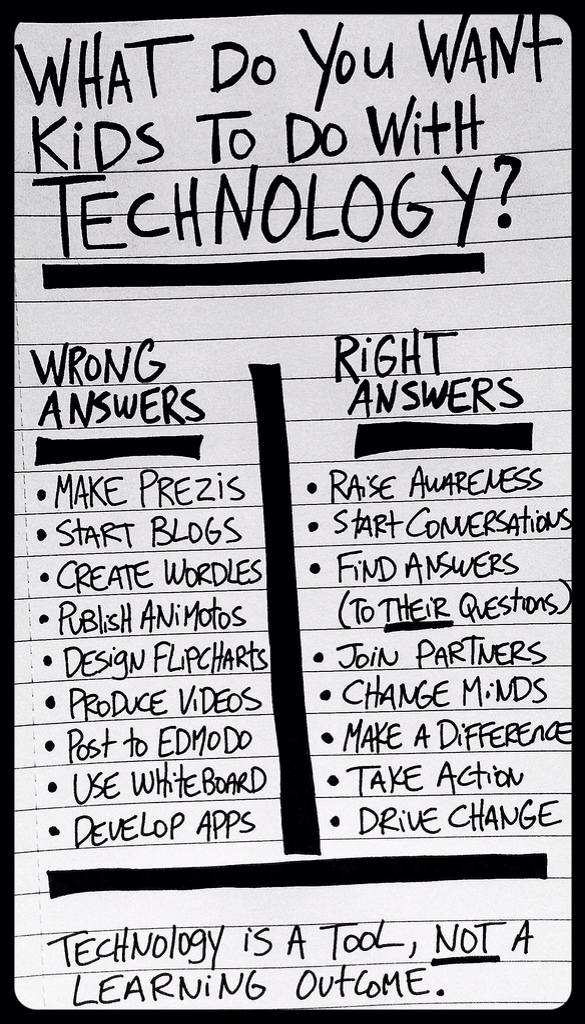
The true value of technology lies not in learning to use the technology, but in using the technology to learn.

Early on in MLTI, Maine's 13 year old statewide, middle grades 1to1 initiative, there was a discussion about the focus of our PD. Should we have workshops on spreadsheets, for example. But we decided, instead, that we would do a data collection and analysis session, and participants would leave also knowing how to use spreadsheets.

After all, why bother creating spreadsheets? Certainly not just for the sake of creating spreadsheets. They are a tool in service to some other purpose.

As an aside, I have heard some make the “prerequisite argument,” that is, the need to learn spreadsheet creation in order to be able to analyze data. But that's using logic when we should be applying psychology. Because the irony is that people learn better, understand better, can apply better, and remember longer skills they learn in the context of some immediate, authentic need, rather than in the absence of any context other than the abstract (and uncertain) “you'll need it in the future.” I have had to reteach too many lessons when the students now had an actual need to know, that I had already taught once “in case” they needed to know in the future… How'd that work for me? “Need” first, “tool” second, not the other way around.

So I am thankful to kindred spirits, such as the author of Technology Is a Tool, Not a Learning Outcome, (and is credited with the image in this post) who also work to insure that we focus on the right thing when we bring technology into our schools.

So I wonder, when districts struggle with their technology, like LA Unified has recently, if they are focusing on the right thing…


Learning to Use the Common Core

A friend recently asked what teachers are doing to align with the new Common Core curriculum.

She wrote:

As I am working with teachers on the ELA CCSS, some are asking about examples of how the other content areas are using the standards in their curriculum. They are meeting with some resistance re: looking at their curriculums in light of the standards and are “waiting for their content associations” to publish new standards.

Educators being reluctant to put too much energy into the “New Best Thing” isn't surprising, given the speed with which innovations come and go in schools. But the notion of being clearer about what we are teaching and increasing the consistency of what is taught across classrooms, schools, and districts is not new, and is enduring enough that having a “new” curriculum is a good opportunity to be deliberate about getting better at that. (Now, if we could only get as strong and enduring a focus on quality instruction!)

We are working on transparency of teaching and integrating the Common Core in my district, and I shared with my friend what we are doing:

Introducing and Starting to Use the Common Core

In keeping with approaching implementing Customized Learning in phases, we are looking at using the curriculum differently as a phased implementation. I think I would label those phases as something like: Awareness, Models, Practice, Implementation.

Awareness: Have teachers do what they're doing now, but make sure that students know what the learning targets are for their activities that day (regardless of which set of standards teachers are using). At the same time, see if the teacher can identify which Common Core standards the activities they are doing that day are most closely related to. Some of this phase should be devoted to doing a 10,000 ft crosswalk between the curriculum they are used to using and the Common Core, to help identify how they are the same and how they are different.

Models: Have teachers visit (in person, on line, or in print) some examples of folks teaching from the Common Core in ways we might label “high level of implementation.” The goal, of course, is to help teachers find exemplars so they can experience what it looks like, feels like, tastes like, smells like, etc. Part of this phase is reflecting on how they might organize their teaching, lessons, or units differently to bring them more in line with the Common Core.

Practice: Teachers use the Common Core to design their teaching, lessons, and units, and try them out. Both feedback from knowledgeable, trusted others, and self reflection guide the revision and improved implementation of that teaching. The goal is to know you won't start out perfect, but that you are working to get better. Teachers here, in Cohort districts, would also be using the curriculum more and more to have students monitor their own progress.

Implementation: Teachers have gotten pretty comfortable with the transition and pretty good at teaching with the Common Core (these teachers don't have to be perfect or outstanding, just competent). Teachers in this phase become both places to visit and coaches (knowledgable, trusted others) for teachers in more novice phases.

Teachers in a builidng don't have to be all at the same phase at the same time. In fact, it's really helpful to have those teachers who are a phase or two ahead and can work with the more novice teachers.

We need to help teachers move from a Fixed Mindset to a Growth Mindset (the ability to learn and adapt as things change and evolve around you), possibly by having them all read the book Mindset. You need to build a common language around Growth Mindset, and talk about it often to keep that idea in the forefront of their minds while struggling through change. Parallel to this is helping teachers know that the new constant is change, and we must learn how to constantly adapt to productively respond to new challenges and requirements.

And lastly, I suspect part of what is giving teachers a hard time is not the Content Knowledge piece, but the focus on higher order thinking and the application of knowledge (changes away from sacred cow units of study aside). I think getting them involved with the Cohort's Complex Reasoning curriculum (essentially Marzano and Pickering' Dimensions of Learning) would give them a concrete way to apply and leverage higher order thinking to their content…


Keeping Track of Student Learning in Customized Learning – Part 2

In the previous post, I discussed how keeping track of student mastery of learning targets is both a critical and a non-trivial component of personalized, standards-based, competency-based education, such as within Customized Learning schools.

Online systems can make the task much easier to implement. Already, there are a growing number of options for schools, including PowerSchool, Jump Rope, Project Foundry, and Educate (I have used the last two).

But not all of the available options do the same thing, nor do it the same way. Some simply make it easier to connect standards to courses, some are standards-based grading systems, and some are true learning progress management systems, a frequently updated individual student data system that tracks student progress and attainment of learning standards (not courses), help students select or propose learning activities as they progress through a learning pathway, and help communicate individual student progress to teachers, students, and parents.

So, what do you look for in a learning progress management system?

At it's most basic, a good learning progress management system would do several things:

  • It would maintain a database of the curriculum (standards-based measurement topics and the progression of learning targets).
  • It would contain assessment information for each level of mastery of each measurement topic and learning target (think rubrics).
  • It would maintain a database of each student's level of mastery for each measurement topic and learning target.
  • The learning progress management system would be used to set goals, and create and monitor each student's Individualized Learning Plan, or Pathways (a personalized sequence of instructional content and skill development designed to enable the student to achieve his or her individual learning goals), and Individualized Graduation Plan (to ensure he or she can “graduate on time”).
  • It would facilitate the creation of individualized, data-driven transcripts and progress reports.
  • Teachers, students, and parents could access the learning progress management system readily to monitor where the student is in his or her learning progression 24/7.

A well-designed learning progress management system would also utilize a database of educational resources (including links to digital content and references to common resources, such as texts) and learning activities correlating to each learning target. These resources and activities allow students multiple pathways to demonstrating mastery of the learning target and would facilitate teachers and students selecting activities that appeal to their learning styles and interests, thus motivating students and deepening individual student learning. Further, the system would allow for the uploading of artifacts and evidence of learning correlated to specific learning targets or steps on a learning progression. (These would be the “proof” of mastery for each student.)

A superior learning progress management system would “intelligently” provide students suggestions on what activities he or she might try next, matching both the next learning target in their progression and their learning preferences. Imagine, as a student completes a measurement topic, getting a recommendation from the system of an activity for the next learning target, which is an approach the system thinks the student will like. (Think Amazon book recommendations, but for learning activities.)

Maine Cohort for Customized Learning districts are partnering with Scott Bacon of 3Shapes to create and develop such a learning progress management system: Educate. Through that partnership (including piloting the system in some Cohort districts), Educate already has many of the features described above. Further, Scott Bacon solicits feedback from our schools to keep Educate under continuous development, both to better implement existing features, as well as to add new features we would find helpful. Many of the Maine schools using it report that Educate seems especially well suited for Customized Learning, our version of personalized, performance-based learning.


Life-Long Habits of Mind: Curriculum for Customized Learning

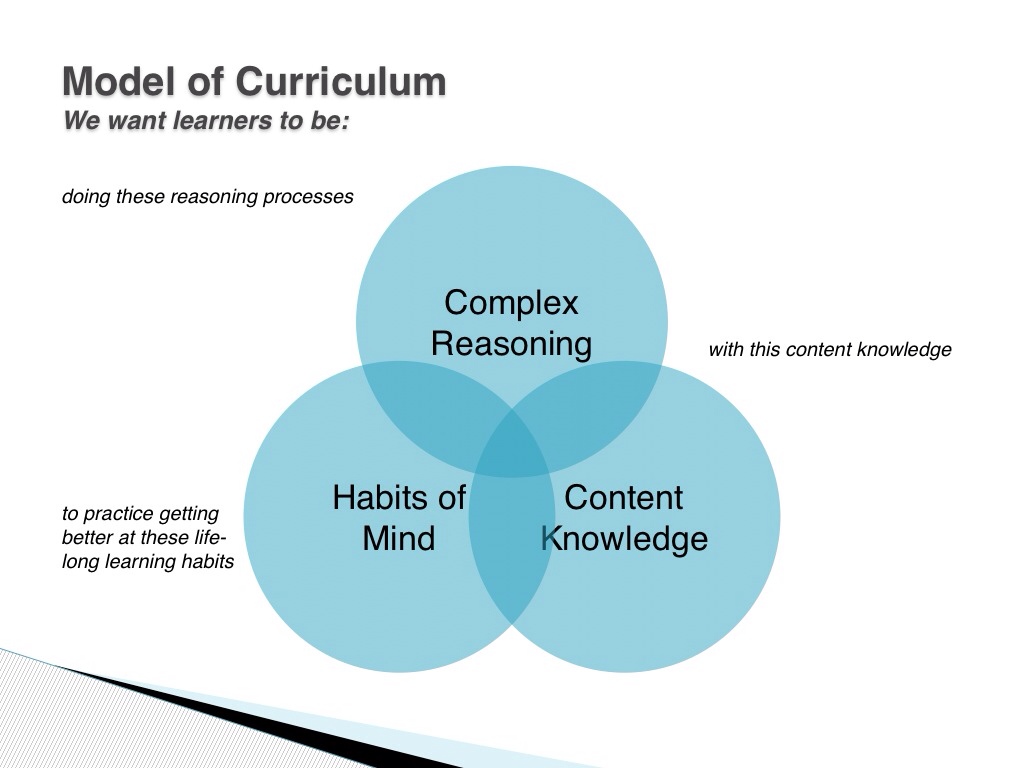
Districts in the Customized Learning Consortium have expanded their curriculum model beyond simply content knowledge. Lesson planning and unit development happens at the intersection of Content Knowledge, Complex Reasoning, and Life-Long Habits of Mind. Life-Long Habits of Mind is the third domain of our curriculum model.

The Life-Long Habits of Mind curriculum is where Customized Learning schools will be addressing the social, emotional, and behavioral needs of students, built around foundational work, such as the Search Institute's 40 Developmental Assets. All students must be guided in developing the “soft skills” that are so often left dormant in our populations (e.g. resilience, self-confidence, mental toughness).

Districts in the Maine Cohort for Customized Learning are working with Bea McGarvey to create a Life-Long Habits of Mind curriculum.

Educators collaborating on this writing effort, will create teacher materials for Life-Long Habits of Mind in a similar format to the Dimensions of Learning: Teacher's Manual, used for the Complex Reasoning curriculum. Also as with the Complex Reasoning curriculum, instruction in the Habits will progress from helping students develop an understanding of the “habit” through examples, to providing students with written guidelines and graphic organizers, and then to lots of modeling. Once the teacher materials are developed, the curriculum may be organized into the Marzano curriculum framework, to facilitate the tracking of students' development of thes skills.

The current draft outline of the Life-Long Habits of Mind curriculum includes the following:


Reflective Learner (Understanding Oneself)

  • Understanding One’s Learning Style
  • Cultivating Creativity & Imagination
  • Maintaining a Growth Mindset
  • Responding Appropriately to Feedback


Self-Directed Learner (Improving Oneself)

  • Meeting Quality Standards
  • Persevering
  • Setting and Monitoring Goals
  • Managing Impulsivity


Collaborative Worker (Working with Others)

  • Working Toward Team Goals
  • Listening With Understanding/Empathy
  • Seeking To Be Understood
  • Seeking to Resolve Conflicts

This approach of looking at the intersection of Content Knowledge, Complex Reasoning, and Life-Long Habits of Mind allows student to not only master critical academic content but to also develop skills and traits important to career and life readiness, such as goal-setting, teamwork, perseverance, critical thinking, communication, creativity, and problem-solving.


Complex Reasoning: Curriculum for Customized Learning

The second domain of curriculum for Customized Learning is complex reasoning.

Lesson planning and unit development happens at the intersection of content knowledge, complex reasoning, and life-long habits of mind. We want learners to be – doing these reasoning processes – with this content knowledge – to practice getting better at these life-long learning habits.

Not only is the focus on complex reasoning a key component of Customized Learning, but represents the higher order thinking that is one of the Focus 5 strategies for motivating students.

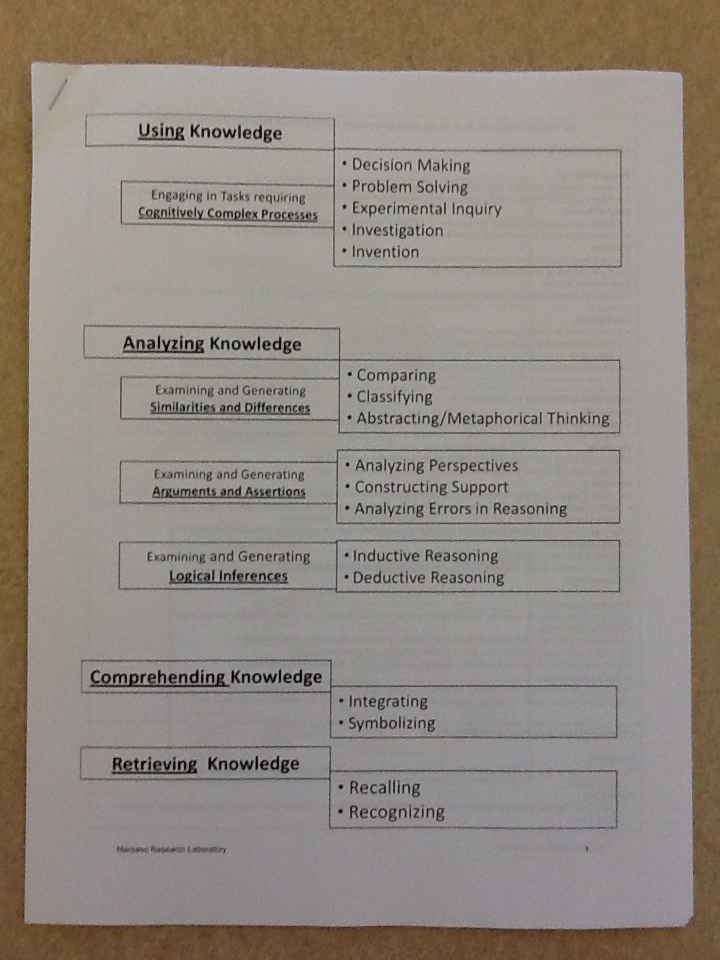
We are using Marzano's framework for higher order thinking. The Complex reasoning curriculum includes the following:

Complex Reasoning Curriculum

Comprehending Knowledge

  • Symbolizing
  • Integrating

Analyzing Knowledge

  • Comparison
  • Classification
  • Error Analysis
  • Deduction & Induction
  • Perspective Analysis
  • Constructing Support

Using Knowledge

  • Decision Making
  • Problem Solving
  • Experimental Inquiry
  • Investigation
  • Invention

The Maine Cohort for Customized Learning has partnered with Debra Pickering and Bea McGarvey of Marzano Associates and are using the curriculum outlined in the Dimensions of Learning: Teacher's Manual as the foundation for our Complex Reasoning curriculum.

The plan is to organize it into the Marzano curriculum framework of measurement topics, learning targets, scopes, and scales, just as the content knowledge curriculum has been. Teachers will be trained to explicitly teach students the strategies. The instruction in each strategy would happen when students might logically apply the strategy (not in an out-of-context separate class), and includes helping students develop an understanding of the process through examples, providing students with written guidelines and graphic organizers, and modeling, modeling, and modeling.


Content Knowledge & Curriculum Organization for Customized Learning

The first of the three domains of our Customized Learning curriculum model isn't very sexy, nor interesting, and is what most folks already think of when you say “curriculum”: Content Knowledge. (But there is some interesting stuff a little further down this post!)

Like most states, Maine's education standards are determined by law (we call ours the Maine Learning Results). These standards, as recently updated, identify the knowledge and skills, as the DOE likes to say,essential for college, career, and citizenship in the 21st century.” As you'd expect, Maine has specific sets of standards for each of eight subject areas:

  • Career and Education Development
  • English Language Arts
  • Health Education and Physical Education
  • Mathematics
  • Science and Technology
  • Social Studies
  • Visual and Performing Arts
  • World Languages

Maine has incorporated the Common Core State Standards for math and English language arts into the Learning Results, and Maine is one of 26 states participating in the development of Next Generation Science Standards.

So, where curriculum gets interesting is in how we organize it to support Customized Learning.

The curriculum from these standards needs to be articulated and organized in a way to facilitate proficiency-based learning. What are the measurement topics within each subject area? What are the learning targets and learning progressions within each measurement topic? What are the scoring guides for each learning target that allow a student to assess their progress and teachers to provide formative feedback?

Educators from districts in the Maine Cohort for Customized Learning have collaborated to organize the curriculum into Marzano's curriculum framework. The framework breaks each content area into a group of Measurement Topics. Each Measurement Topic has a scope, that is a progression of learning targets, and represents the learning required for mastery of that topic. Each level in the scope has a scoring guide, called a scale, that clearly identifies the proficiency target for that level.

In the process of revising how the content knowledge standards are organized and written, some changes have been made. In some cases, what has long been thought of as Content Knowledge, such as scientific reasoning and the experimental process, was moved over to the Complex Reasoning domain because of the nature of the knowledge or skill.

We have also pulled all assessment language from the standards (e.g. ”write a report to demonstrate…”) and left just the pieces that were the actual content knowledge in the standard. Part of Customized Learning is the premise that students should be able to demonstrate mastery in what ever way they choose and deem best (multiple pathways to learning and mastery).

Currently all 8 content areas exist in this framework and are being piloted in classrooms across Maine. Feedback from the pilot classrooms will allow the curriculum teams to revise and update the Content Knowledge curriculum framework. These frameworks will be reviewed and revised annually by the educators who are actually using them.

And all of curriculum frameworks are stored in a learning progress monitoring/management system (Educate) that make it infinitely easier for both students and teachers to know where students are in their learning, what they need to learn next, and to identify a diversity of resources and activities to learn it.


Curriculum and Customized Learning

We are one of the 29 districts who make up the Maine Cohort for Customized Learning. Together, we are on a journey to implement Customized Learning. Further, Maine statute now requires that, by 2017, students in Maine will graduate based on demonstrated mastery of the State's rigorous content knowledge standards, rather than by course credits (seat time).

When you start changing how you organize school for performance-based learning and recognizing that people learn in different ways and in different time frames, you quickly realize that the center of school shifts from courses to the curriculum and where students are within the curriculum.

How you organize the curriculum becomes critically important.

You need an explicit model of curriculum.

Curriculum Model

The model we have adopted views the curriculum as 3 overlapping domains – Complex Reasoning, Content Knowledge, and Life-Long Habits of Mind (“Use these reasoning strategies to learn this content knowledge to develop these habits of mind.”).

So this is the first in a series of posts that hopefully will shed light on how Customized Learning districts are using and organizing the curriculum. Future posts will include not just how we're organizing content knowledge, but the Complex Reasoning curriculum, the Life-Long Habits of Mind curriculum, and learning progress management.


What The Union Did Say (And I Was Glad They Did)

A while back, I wrote about what I wish the Union had said. I was responding to the announcement of Maine’s new education strategic plan (which I’m excited about) and the press coverage of the Union, which seemed like mostly they were poo-pooing the plan. Unions can and do a ton of good, but I’m frustrated with that public image that seems to say “Don’t ask us to change. Don’t ask us to be held accountable. And don’t you dare remove that teacher, even though she can’t do her job.” Some of that is the press and what they choose to focus on, and some of it is political expediency (let’s blame teachers and the union for all our economic and educational woes). But some of it is how the Union crafts it’s own public messages and how they respond publicly to real challenges in in our schools.

So I was really pleased, then, when I saw them post this. A great message about how they “don’t just say ‘no,'” and the various ways they work to develop and support teachers and the profession.

I still wish that the public saw and heard more of this kind of message. I believe that this was a newsletter that just went to members (I don’t think I could even find a direct link to it on their website).

They do support developing quality teachers through things like the Professional Issues Conference on March 24th. (I’ll be presenting there on Motivating Students and on Auburn’s Literacy and Math iPad Initiative.) You’ve got to register by March 9, if you’d like to attend.

Supporting teachers working toward National Board Certification. Taking the lead on quality teacher evaluation and accountability systems through their Instruction and Professional Development Committee work. Their Professional Issues Conference. These are the kinds of things that the Union needs press on also.