Does Technology Improve Learning – No! A Keynote

I recently had the honor of keynoting at the Illinois Computing Educators (ICE) conference.

My message was that technology alone will not improve learning; only teachers improve learning. But technology can be wonderful tool for teachers and for students under the guidance of teachers.

Watch the keynote here. And related resources are down below.


If we want to leverage technology well for learning, then these are the components we should attention to:

  • Focus on Learning
  • Deliberate, Shared Leadership
  • Community Engagement
  • How You REALLY Protect Stuff
  • Support the Heck Out of Folks

Resources

Technology:

Learning:

Leadership:

Community Engagement:

Supporting Educators (Professional Development):


A Child Struggles in School: Where Does the Problem Lie?

In a conversation recently with a caring, conscientious teacher, she commented that she had success working with struggling learners and helping to make them feel smart.

But when they got to the next grade and perhaps had a teacher that wasn't as effective at reaching those children, or perhaps thought there was a pace for learning and students should stick to it, or perhaps simply saw the onus for learning as being on the student, the students really struggled again.

She worried that perhaps she had led those students to have an unrealistic view of themselves by not being more up front with them about being struggling learners. She wondered, despite her success helping those students to learn, to feel successful, and to feel smart, if she shouldn't be more direct with them about being struggling learners, to prepare them for possible pain and disappointment later.

And I caught myself wondering, is the problem that each child isn't where the school is in the curriculum?

Or is the problem that the school isn't where the child is in the curriculum?


Is “What’s the iMovie Curriculum?” the Wrong Question?

A while back, I was part of an online conversation when a tech director asked for ideas for an iMovie curriculum. His district was working to establish a course in digital video production at their high school.

Right away, I had to wonder if asking for ideas for an iMovie curriculum wasn't the wrong question. iMovie, after all, is just a tool. And you already know that I believe the real power of technology isn't having a “learning technology” focus, but rather a “technology for learning” focus.

I don't object to learning iMovie. I object to learning iMovie out of the context of a compelling purpose to use the tool.

In fact, my experience is that the lessons about the tool (iMovie) are much easier to learn (students remember the skills better) when they are taught in the larger context of being used for something. In fact, I have seen well intentioned teachers teach all the skills for a tool in advance of using it for some purpose meaningful to students, and having to reteach all those skills again when the task was at hand.The brain just really isn't wired for “just in case” learning. It's wired for “just in time” learning.

So I wondered, “Knowing their interest in students learning iMovie, what is it that they might really want students to learn?” What might be the authentic reason to learn how to use iMovie?

For example, a school could offer a course in digital storytelling. In addition to iMovie skills, the students would likely also learn interviewing; scripting and story boarding; pre-production, production, and post-production; visual communication styles, etc. (I have included some links to resources below.) But it would all start with students learning about and doing storytelling.

Or why not take it a step further and have students tell stories that they feel compelled to tell? Perhaps a documentary making class. Students could take on an issue of social significance to themselves, research it, and create a documentary that may even ask it's watchers to take action (and what action would they recommend!?).

Think of how powerful those courses could be for students!

Digital Storytelling Resources:

Documentary Making Resources


We Thought We Were Pretty Good Tech Integrators, Until We Met Jennie

Our team of technology integrators is very experienced and does great work. At least we thought so, until we met Jennie Magiera. 😉

Jennie works with teachers in Chicago Public Schools on leveraging technology to engage and motivate students, as well as strengthen their learning. We were fortunate enough to have her join us for last year's Leveraging Learning Institute: iPads in Primary Grades. She not only keynoted, but led several sessions, collaborated with participants, and worked closely with our middle grades twitter reporters. She even convinced us all (in the middle of the Institute!) that a panel of our student reporters should do one of the evening keynotes! (We took her advice, and the kids were great!)

Her energy and positive attitude are contagious (although there is a chance that the Energizer Bunny is exhausted by having her around!), and her great ideas about teaching with technology are so numerous, you just can't try them all at once.

But that's ok. Take your time. It's worth the investment of practice and the effort to make them part of your repertoire.

This is her keynote from last year. Her slides are here. I hope you get as much out of it as we did.


The Leveraging Learning Institute highlights Auburn's experience and “lessons learned” from the country's first district-wide 1to1 iPads in primary grades initiative, and helps participants learn how to successfully design and implement an iPad initiative to customize learning for students. This year's Institute is Wednesday Nov. 13 through Friday November 15, and registration is currently open.


Getting Better at Engaging Tasks Through Revision.

A great way to get better at Engaging Tasks is to use the criteria for great Engaging Tasks to critique and revise other Tasks. (I’m not sure that I would say that all Tasks are Engaging Tasks! – or, at least, they don’t all start out that way.)

For example, look at this Task:

Imagine that you are living during the Great Depression and that your classmates have decided to put together a time capsule for students of the future to use to learn and understand what life was like during the Great Depression.

Lets start by looking at this critically with an eye to the criteria for Engaging Tasks.

  • Standards-based: Yes.
  • All 3 pieces – Scenario, Role, & Task: Task, yes: put together a time capsule. Role: sort of: you are someone living during the Great Depression. Compelling scenario, not really: the Task doesn’t really provide much more of a context for doing this than you and your classmates have decided to do it…
  • In the form of a “story”- no “teacher talk”: Not written like a little story. Reads like a teacher’s assignment. “Imagine that you are…” “your classmates” are teacher talk, and clues that the Task needs to be revised.
  • HOTS – Apply, Analyze, Evaluate, Create: Could be, depending on how it is framed.
  • Students: authentic or believable: Yes, people do leave time capsules for others to open in the future.
  • Students: interesting or of significance: Mostly: some would clearly enjoy working on this, but there are others who would not. This could be because the Task doesn’t have all three pieces. Often the compelling scenario helps with this.

So if we were to revise this task, we would likely work on the following:

  • Make sure the Task has a compelling scenario and a stronger role
  • Rewrite it as a story, and remove the teacher talk
  • Make sure the Higher Order Thinking focus is more clearly articulated in the activity the students need to complete
  • Double check that the new version would seem significant and interesting to students (or at least more so than the current version)

A new version of the Task might look like this:

It is 1936 and as part of the New Deal, your town is building a new Town Hall. The mayor has issued a challenge to all the school children to help create a time capsule that will be put in the corner stone of the Town Hall then opened far in the future. Your teacher has broken your class into teams of 4 and 5 students and each team needs to help identify the best items to include in the time capsule. The best ideas will be included in the actual time capsule.

How does this version of the Task fare against the criteria? I’ll let you decide, but here are a couple of my thoughts. I’m hesitant to write tasks where the student is a student (I tend to find more engaging the ones where students can imagine themselves in a different role), but this Task already had them as students; whereas I didn’t mind revising this Task, I didn’t want to totally rewrite it. There is now a compelling scenario (new Town Hall and the Mayor’s challenge). The whole thing is written as a story (ok, there is a little teacher talk here, but not the author telling the reader, rather the teacher is a character in this story – see my comments above about students in the role of students…). And “Which is best?” is a short-cut question for getting to higher order thinking (analysis and evaluation).

How might you now get practice getting better with Engaging Tasks through revision?

Maybe you and a group of colleagues are working to write your own Engaging Tasks. You could swap drafts and critique each other’s, offering suggestions for revisions.

This Engaging Tasks Feedback Form might be helpful.

Or you could look for WebQuests with Tasks in need of critiquing and revising, and practice your skills on them.

Or you could use these sample elementary Engaging Tasks or these sample high school and middle school Engaging Tasks to practice critique and revision.

Resources:

It’s Not About Blaming Teachers, It’s About Locus of Control

I keep writing about, and presenting about, how teachers need to teach differently… Pretty soon you'll start thinking that I'm blaming teachers for the challenges in our schools…

Most of what I write about in this blog is educational change, usually focused on instruction and/or technology integration (which, of course, is just a subset of “instruction”). But when you talk a lot about changing expectations for teaching and learning, and how teachers teach, and paradigms, and getting them to focus on the right thing instead of the wrong thing, and supervising for those changes, it's easy to start to think that I believe that teachers are the reason that schools aren't changing or that more students aren't learning.

Nothing could be farther from the truth.

First off, I write about the changes that need to happen and how to help teachers make those changes because they are things that most teachers have not experienced before themselves.

I believe that the rules for education have changed. The world of work has changed and we now need every child to learn in school what we used to only need the college prep kids to learn (well, actually what has changed is that we now need every kid to be college prep!). Second, new tools (laptops, tablets, cell phones, iPods, information access, personal broadcasting, the read/write web, multimedia, etc.) have changed how kids work, necessitating changing how schools have students learn (or risk becoming irrelevant to students).

As I described when Bea McGarvey came to Auburn, she points out that schools still do industrial age education, when we need an educational system for the information age:

During the industrial age, schools’ goal was to sort out talent and make the rest compliant. We got really good at that. But for this economy, the goal needs to be to develop talent in every child. That’s why we’re so frustrated: we’re trying to meet one goal with a tool that was designed for another…

It doesn’t matter how much we agree with the burning platform that our schools need to work for all our children, or how well we understand that the root problem is how our goals have changed and it isn’t “the teachers’ fault” (Bea says, according to Deming: 95% of the problems are not with the people; they are with the structure), the fact is, at some point teachers understand that they are good at a system designed for an old goal, and that they might not know how to do the system for the new goal…

So teachers are now working in an environment they didn't really experience as students themselves, and probably weren't trained for professionally. Even if teachers need to be the ones making most of the changes, the reason is that the rules have changed, not because they weren't doing a good job.

But even more importantly, we focus on teachers making the changes because teachers are the ones who can solve our challenges. They have the power, the locus of control. When we look at all the factors that impact our students being successful, the one we (schools, educators) have the most control over is teacher practice: what happens in the classroom.

And if teachers have to make changes for a new environment they haven't experienced or been trained for, and if they are the ones who have the power to make the changes, then we have to be very, very clear that we don't blame teachers. Nothing could be more inappropriate, nor unproductive for achieving our new goals.

Instead, what we need to do is support the heck out of teachers.

We need to provide teachers support to a level like we never have before. Side by side with an expectation to teach in ways so all students can learn a high status curriculum, and that makes use of the modern tools for intellectual work, we have to be making a promise to support teachers in this work, making clear we believe in our teachers, and that we know that they can do this hard work. We have to provide training, resources, and time. We have to let teachers try, and allow them to make mistakes, and also to get better – and hold them harmless in this important work. That includes sticking up for them and their efforts, even when (maybe especially when!) it doesn't go well the first time.

If we don't, we guarantee failure: for our schools, for our teachers, and for our students.


Not All Motivators Are Created Equal

I continue to get questions from educators about motivating seemingly unmotivated students. The teachers are often frustrated because they are “trying hard” and “working hard,” but with little to no payoff.

When I talk more with those teachers, I find two common misperceptions that stand in the way of the teacher being more successful (they are hard to teach students, after all. We can't expect complete success motivating them!): (a) motivation resides entirely within the student (the teacher has no role in student motivation); or (b) all teacher efforts to motivate are created equal and should have the same impact on students.

The teachers who believe (a) have larger issues… (The research is pretty clear – as is common sense: teachers who don't believe they can influence student learning, don't.)

But we can work with teachers who believe (b)!

Most of these teachers who are struggling to motivate students, are simply trying to leverage the wrong motivators, often undermining their own efforts.

Many of the struggling teachers I have observed have the right instincts and do try to motivate students, but most of the motivators teachers say they use, or were observed using, tend to be “low payoff” motivators such as showing enthusiasm, being nice to students, or using manipulatives.

They also used “no payoff” motivators such as grades, or statements like “you’re going to need this in high school (or college, or work, etc),” or “it’s going to be on the state test.” These may be motivators for easy to teach students, or important to teachers, but they tend not to be motivators for hard to teach students. In many cases, this approach only succeeded in agitating the hard to teach students or exasperating undesirable behavior. It’s no wonder that if teachers are putting a lot of energy into these kinds of motivators that they are frustrated with the results, and the students.

But, trying to teach hard to teach students qualifies as extraordinary circumstances requiring extraordinary efforts.

Teachers need to not just “try” or “work hard”; they need to try the right things and work hard at effective practices.

Teachers who were more successful motivating the students used strategies such as making the material interesting, using real world examples, or leveraging their positive relationship with the students.

Teachers need to be using “high payoff” motivators, such as these:

  • Project-based learning
  • Connecting with students
  • Connecting learning to the community and the students’ lives
  • Focusing on higher order thinking activities
  • Learning by doing
  • Making learning interesting
  • Involving students in designing their learning

(It's not hard to see how these map onto the Meaningful Engaged Learning Focus 5)

Dewey reminds us just how important using effective motivators is:

Our whole policy of compulsory education rises or falls with our ability to make school life an interesting and absorbing experience to the child. In one sense there is no such thing as compulsory education. We can have compulsory physical attendance at school; but education comes only through willing attention to and participation in school activities. It follows that the teacher must select these activities with reference to the child’s interests, powers, and capacities. In no other way can she guarantee that the child will be present. (1913, p. ix)


Sometimes Humor is the Best Way to Correct Behavior

So, one of your hard to teach student has just acted up in class again. Or maybe he isn't acting out, but just won't do the assignment or get into the lesson.

What do you do?

You've got to do something fast, before that student's behavior starts affecting the rest of the class…

Just as helping students save face can be a powerful tool in reaching hard to teach students, so is the use of humor. Several of the students in the underachievers study said they preferred teachers who used humor. Humor builds and preserves relationships. In fact, I often find that humor works better than many other strategies, especially when trying to correct student behavior.

I had a student named James, who was the kind of student who was always inappropriate, but in funny ways, and I was always trying to get the class back on task after his antics while trying not to laugh uproariously! I really enjoyed him and I wished I didn’t have to teach the whole class while he was there! I just wished I could have him one on one and help him learn whatever I could, and then deal with the rest of the class separately.

I prayed for those days James was absent. But, of course, he never was.

One day James was driving me crazy and I finally had to send him out in the hall. I followed him out, wondering what I could possibly say to James that he had not heard a thousand times before. He got dressed down in the hall regularly: I’d be walking in the hall, and there would be James with another teacher, and I would say to myself, “Oops! He did it again!” Clearly the traditional scolding wasn’t changing James’ behavior.

I had to think about what my goal was. Was it to punish and chastise James for being a pain (which clearly had a track record of not working)? Or was it to get him to settle down so I could teach the class?

Out in the hall, I closed the door and maneuvered so that James’s back was to the door, so I could see the class through the narrow window. I wasn’t sure how to get what I needed, but, on a whim, decided to try humor. My intuitive response to James was, “Do you want to play a trick on the rest of the class?”

This was not what he was expecting, and, although he wasn't really sure where this was going, said he would, albeit a bit hesitantly.

I whispered, “I’m going to start yelling and screaming at you about your behavior and I want you to throw yourself up against the door.” Given his facial expression, he was now a willing coconspirator, without reservation!

As I yelled, “James, I’ve had enough of you!!!” he’d throw himself against the door. Boom!!! Boom!!

Then I'd yell, “I’m trying to teach the whole class and I can’t do that while you’re in there fooling around!!!” Boom!!! Boom!! Boom!

And this continued for a couple more rounds.

Well, he was the consummate actor and kept up the show as we returned to the room, staggering, like he’d taken an awful beating! Hamming it up all the way. I just went in with a straight face and went right back to teaching as if nothing had ever happened. The whole class was on its best behavior, playing along, seeing the whole event as the hoax it was, but now playing the properly cowed students!

This approach was a bit of a risk, and it only worked because I knew James and my other students well (and they knew me). I knew what was likely to work with James and what wasn't; there were certainly other students that I would never dream of doing something like this with.

But it did seem to be exactly the right move with James. The change in him was great, at least for a couple weeks (Only a couple of weeks!?, you say… What was the last intervention you did with a hard to teach student that lasted more than 5 minutes, let alone a couple of weeks!?!). I had to hardly speak to James about his behavior at all. We’d just see each other and laugh. But I got want I wanted: James to be settled enough that I could teach the class. As his old ways started to creep back into class, I would look at him sternly and ask, “Do you want more of the same!?” and he'd laugh and playfully protest, “No! No!” and he'd settle down for a couple more days.

Since then, I've figured it works out better for me (and the whole class) if I do whatever I need to to get the behavior I want (from any student, not just James), even if it doesn’t include punishment. There’s no doubt James knew what was right and what was wrong. There is no doubt that James' behavior warranted punishment or a scolding. There’s no doubt that James knew that he was disrupting the class. But it turned out I didn’t need to yell, or scold, or punish him. Besides! None of those worked when other teachers did them!

What I got was something much more useful: we ended up being allies.

By using humor, I could work much better with James (and much more importantly, James would work with me!). Over time, I got much more of the behavior I wanted from James! And this lesson helped me get much more of the behavior I wanted from my other hard to teach students, too.

 

We Must Do More Than Fill Students’ Vessels

I was especially dissatisfied with my own teaching when I started.

Early in my teaching career, I was presented with a paradox that continues to shape my interests in education. When I was teaching high school computer application courses, my students would learn to use a word processor (in the day when stuents were likely to only have access to computers at school). I was very thorough and made sure they learned how to use nearly every feature (although word processors then had many fewer features than they do today!). We spent a lot of time on it, and together we worked hard so that nearly everyone would be successful on the challenging word processing test.

What surprised me, however, was that a few weeks later, students would return to me, announce that they had a paper to write, and ask me to show them how to use “that word processor thing” again!

I couldn't understand why these students didn't remember how to use the program. These were bright students who had had no problems during class, and who had done well on the test. Very little time had gone by since we had last used the word processor. There was no reason that they should not know how to use it.

There was obviously something I didn't understand about learning. It was the first time I started to question how learning took place, and prompted my inquiry into how people learn.

I fear that during my first few years of my teaching, all I had really taught most of my students was that I was knowledgeable within my field. I tried to convey my knowledge to my students but I was simply trying to “fill their vessels.”

The way I organized the curriculum wasn't even oriented toward learning; it was organized for teaching. I was mostly concerned with questions like when were the standardized tests and what would be on them, when would other teachers be teaching related ideas, what would kids need to know for the next course? All my content was organized the way an expert might look at it. It was neatly categorized and sequenced like it might be done by someone who was already familiar with the information.

I never asked myself how people might learn the same information. I never asked how experts had acquired their vast knowledge; was it through a logical sequence or some other order?

Some of my kids seemed to do okay, but not enough of my students to make me feel like I had done a satisfactory job. I knew I was teaching the way all my teachers had taught me, so I knew I was teaching correctly. But somehow contradictions, like with the word processor, kept happening, and I started to doubt if it really were the right way to teach…

Those contradictions and doubts led me to question my assumptions about teaching and learning. Eventually, I found tidbits that helped shape my work, such as the quote from the classical Greek philosopher, Plutarch, “A mind is a fire to kindled, not a vessel to be filled.

My job wasn't to give students information but to inspire and nurture them. And like Ian Jukes says, “Teachers don't need to be fire kindlers, they need to become arsonists!”


Making Lessons Interesting 2

It may not be possible to always tie curriculum into the students’ interests, even when teachers know their students well. I do believe, however, that we can make things interesting.

Take, for example, adjectives.

This is typically a topic that many students are less than enthusiastic to study (was that an understatement?). Even so, one of the university practicum students I was supervising (teacher candidates doing their sophomore student teaching) had planned a different kind of lesson designed to make adjectives interesting to students.

When the students came into the room, each pair of students had a little brown paper lunch bag. On the brown paper lunch bag was written one of the five senses. The practicum student began, “There is a mystery object in your brown paper lunch bag and what you are going to do is try and help us figure our what your mystery object is. What you and your partner are going to do is write down as many descriptive words as you can about your mystery object. Don’t take your mystery object out of the bag, because you don’t want anybody to see it, but write down as many descriptive words as you can. Each descriptive word should only relate to the sense written on your bag.”

For example, if the bag was labeled “sight,” the students could only write about what it looked like. If it said “taste” the students could only write about what it tasted like. If it said “hearing,” the students could only write about what it sounded like, etc.

So students generated their words and then the class regrouped and each pair read off their lists. When the other students could figure out what the mystery object was, just from the list of descriptive words, the whole class applauded! When the students could not figure out what the object was, my student teacher would say, “Wow, those were great descriptive words, but we didn’t figure out what it is yet. Why don’t you show us what it is and the rest of you now think of descriptive words for that sense that would have helped you figure it out!” And the students could often think of a couple words that would have helped the class.

When they were all done deducing the objects in the bags, the practicum student asked, “Do you know what we’ve been working with all day today? We’ve been working with adjectives. Adjectives are just descriptive words.” Then she would instruct the students to open their grammar books and do a series of exercises related to identifying and applying adjectives.

And the students did the assignment!

Have you ever seen kids willingly do assignments in the grammar book?!

It was because they were hooked; because she made it interesting to them first.


How do you try to hook students on a topic you are teaching?

Making Lessons Interesting 1

Intrinsic motivation (things that we're interested in) is probably our most powerful motivator. Interest as a motivator is not just building on what students are already interested in. It is also about making things interesting.

  • Can you use novelty?
  • Can you make it a mystery?
  • Can you make it fun?
  • Can you make it interesting?

My doctorate focused on what motivates underachieving middle school students (article; dissertation). In the Underachievers Study, even though students thought that much of their work did not tie in with their interests, they did find some of the work interesting. This varied by the individual. Doris liked teachers sharing stories from their past. Cathy liked lessons related to government and books such as The Outsiders and Huck Finn, which related to the South, where she had lived as a young child. Ben thought his fourth grade teacher, who dressed up as story characters, was interesting.

There is a special category that motivates middle school students: “blood and guts.” Why do you think those “Grossology” books that we all love to hate sell so well? Because middle school kids love belching and farting, body parts and bodily fluids. They love anything disgusting! So anything, we can tie productively into belching and farting will capture their imaginations! Mrs. Edwards, a teacher in the study, reported that Ben also liked blood and guts and anything gory, “Ben loves books that have gory stuff things in them. He loved Edgar Allan Poe.”

When I was a university Practicum Supervisor (supervising sophomore student teachers during their first field experience), I was in a sixth grade science teacher’s classroom and they were introducing students to the microscope. A common introductory activity for working with microscopes is to look at the difference between plant cells and animal cells. Often the activity uses onions because they have large cells. The activity also often calls for using cells from inside their mouths. The students have to take a cotton swab, dab the inside of their cheeks, and put it on a slide.

What do all the sixth grade girls say at this point in the activity? “Ewwwww, gross!” But they almost always follow that immediately with, “Let me do it!”


What do you do to make your lessons interesting?

What’s to Blame for Kids Not Learning?

If you’ve been following this blog for a while, you know I believe all students can learn. You know I think there are “easy to teach” students and “hard to teach” students, but I think they all can learn. So what is it that gets in the way of students learning?

When I ask teachers that question, they often generate a list like this one:

    • Attitude
    • Lack of home support
    • Learning disability
    • Learning styles
    • Substance abuse
    • Apathy
    • Defiance
    • Low aspirations
    • Lack of sleep
    • Lazy
    • Peer pressure
    • How the teacher teaches
    • Lack of preparation
    • Normal distractions

There is no doubt that home and social factors have an enormous impact on achievement. Many students come to school facing problems that cannot be fixed by anything that teachers might do. We could point to a long list of factors such as psychological problems, emotional problems, poor study habits, low self-esteem, withdrawal, aggression, social isolation, conflicts at home, over-expectations of parents, under-expectations of parents, physical or medical causes, social/class differences and expectations, conflicts with teachers, lack of academic readiness and preparation, learning disabilities, poor home life, unsupportive parents, previous traumatic experience, poverty, and low self-confidence.

When you look at lists like these, it is easy to understand why educators might fall into the trap of blaming others for why some students aren’t learning.

But we need to be careful of blame as this poem (author unknown) points out:

Different Levels of Blaming Each Other for What has Happened…

The college professor who said such wrong in the student is a shame,
Lack of preparation in high school is to blame.
Said the high school teacher good heavens that boy is a fool,
The fault of course is with the middle school.
The middle school teachers said from such stupidity may I be spared,
They sent him up to me so unprepared.
The primary teacher said the kindergarten blockheads all,
They call it preparation, why it’s worse than none at all.
The kindergarten teacher said, such lack of training never did I see,
What kind of mother must that woman be.
The mother said poor helpless child–he’s not to blame,
His father’s folks are all the same.
Said the father at the end of the line,
I doubt the rascal is even mine!

Blaming, however, does not help us address the issue of helping every child learn. I am reminded of the old saying, “Do you want to fix blame, or do you want to fix problems?” Perhaps another familiar saying is appropriate here:

Grant me the serenity to accept the things I cannot change.
The strength to change the things I can, and
The wisdom to know the difference.

While it is easy to identify all those factors that contribute to a child not succeeding in school, it is much more important that we identify the ones we do and do not have significant control over. For example, we can’t control if students are sleepy unless we let them sleep in class, and we can’t control anything that happens away of school unless we adopt them (and supervise them closely!). And there is no way to control what has happened to them in the past.

So what can we control? What factors can we change? Where is the opportunity for us to impact learning, especially with students facing lots of challenges?

And the only answer is: What we do in the classroom. Instruction.

Classroom practice, how we teach and how we interact with students, is one of the few factors impacting achievement over which teachers have direct control. A few premises of this blog are that school practice does play a role in both underachievement and achievement, and that changing instruction to better meet the needs of hard to teach students can both help reverse negative achievement patterns and counter-act the negative conditions over which we have no control.

And maybe that’s the best reason for a teacher to focus on engaging students in meaningful learning: to gain a little more control…


What Makes for Good Learning Experiences?

The more we try to to help build the talents of every student and help every learner succeed in school, the more we have to be deliberate about creating good learning experiences in our classrooms. I have certainly added to the conversation about what I believe gives students good learning experiences.

The roots of those ideas are not just my own experiences as a learner and a teacher, and not just conducting research and reviewing research, but from actually asking people about their own good learning experiences. The Good Learning Experiences Activity is one of the ways I have explored different people’s perspectives on how they think they learn well.

“Think of a good learning experience,” the script for the activity begins. “It can be in school, or out of school. It can be when your grandfather taught you how to cast a fly rod, or when your teacher worked with you to write that really good essay. But think of a time when you had an ‘aha!’ or something finally made sense, or you could finally do something. Think of a good learning experience.”

I give small groups of participants a few minutes to share their stories. Next, I ask them to jot down on scratch paper what it was that made it a good learning experience. What were the characteristics of the experience? After a few more minutes to share their lists with their neighbors, we compile a class list on chart paper, an overhead, or on a projected computer.


Before reading on, just take a second to think about a good learning experience of your own, and what it was that made that a good learning experience.


I have conducted the activity with people of nearly every age group: upper elementary students, middle school students, high school students, college students, teachers, and parents. Only a few learners state that they can’t think of any good learning experience. Many of the learners state that their best learning experiences have taken place outside of school. No one has ever said that their best learning experience came from a terrific lecture, or an interesting textbook, or an engaging worksheet (although I believe each of these can be a useful teaching tool when applied wisely).

Having conducted this activity with so many groups, I am intrigued by the results. I was surprised to find that, regardless of the group involved, there were common elements with other groups’ lists. Since 1992, I informally tracked the results and found that certain characteristics of good learning experiences come up in nearly every list:

  • The work was well connected to other ideas and to the real world
  • The content of the learning experience was personally relevant, interesting, useful, or meaningful to the learner
  • The learner had choices, shared authority, control, and responsibility
  • The learning was hands-on and experiential
  • The learner learned from and taught others
  • The learner had the support of a patient, supportive, and nurturing mentor
  • The learning was individualized and although there were standards for the work, the learner could meet them in his or her own way
  • There was a positive aesthetic component to the experience: it was fun or left the learner feeling good
  • The experience helped the learner understand him or herself
  • The learner had success and accomplishment with challenging work

Now, these are my words synthesizing the lists I have collected over the two decades I’ve been doing this activity. Certainly elementary students aren’t going to use these word exactly. But doesn’t this list reflect what made your own good learning experience good?

Much can be learned by investigating how students believe they learn well. What better source for finding out what motivates students to learn than themselves?

But with knowledge comes responsibility. If you know what makes for good learning experiences, don’t you now have an obligation to insure that you model these in our own teaching? – Or at least start learning how to do these in the classroom?


(Note: I have been with educators who have used the prompt “think of a good experience” or “think of a good school experience”, and it never gets to the right information about when people learn well. If you are considering doing this activity with your own students or teachers or parents, I highly recommend that you stick with the prompt “think of a good learning experience.”)


Thinking of Instruction as Two Types

When our pilot teachers were visiting a school that is a little further along than we are at implementing Customized Learning, a colleague and I got talking about how we (us and our colleagues) had a lot of work to do on instruction if we were going to be successful with our implementation.

Then it hit us that a lot of teachers would say they already do a pretty good job with instruction and would object to being told that we had a lot of work to do on it.

And then I realized that both perspectives were right. We just weren’t talking about the same kind of instruction in each instance.

There are two kinds of instruction.

There is Instruction for Lower Order Thinking and Instruction for Higher Order Thinking.

So, it doesn’t matter if you use Bloom’s Taxonomy, New Bloom’s, Marzano’s Taxonomy, or Webb’s Depth of Knowledge, Instruction for Lower Level Thinking is focused on recall and simple application, and Instruction for Higher Order Thinking is focused on nontrivial application, complex reasoning, and creating.

Our teachers are really pretty good at Instruction for Lower Order Thinking. But we have a lot of work to do on Instruction for Higher Order Thinking.

The distinction, thinking of instruction as two types, doesn’t just help clarify our thinking.

This distinction would actually help us in a couple different ways.

We now could say, “You guys are really good at Instruction for Lower Level Thinking. But now, to do Customized Learning well, we need to help you get better at Instruction for Higher Level Thinking.” The message about getting better at instruction would have always been about support, but could have been taken as criticism of their abilities. Now, we can differentiate between validating their abilities, and identifying a need, and offering support to address that need.

And it helps us think about when should teachers apply each type of instruction.

And it will help teachers think about how the two kinds of instruction are different and which strategies support which type.

And it helps us think about leveraging what kinds of interventions to support teachers.

What would thinking of instruction as two types mean to you and the work you are doing in your school?

School is Boring

School is boring.

We all know it.

Kids know it.

Parents know it, but don’t want to think about it.

We teachers know it, too, but defend it. In some small way, I think we don’t want to think that the subject(s) we love could possibly be boring! But we do go on to say things like: It’s preparation for life after school. We all have to do things in life that we don’t want to do. Or, I wish students would start taking responsibility for their own learning. Or, it is the students’ job to learn.

My problem with putting the onus on students is that we are all quick to forget that kids are not in school by choice. They are in school by law. Ironically, it is we, the educators, who are in school by choice. In fact, we are getting paid to help kids learn. In fact, we are the only ones getting paid – if learning were the children’s job, wouldn’t they get paid, too? To me this all shifts the moral responsibility.

And we are quick to forget that kids are kids. And that being a kid when you are a kid is appropriate. It is what you are supposed to be!

And we are the adults.

And we spend WAY too much time trying every possible crazy thing so solve the problem, EXCEPT trying to engage students. It’s enough to make you tired!

I think teachers defend school being boring because we fear we will be blamed.

But I don’t blame teachers.

(Well, if you lecture through an 80 minute block, perhaps you should be blamed…)

Edwards Demming, the father of Total Quality Management, says that 95% of our problems come from structures, not people. And Roger Schank actually makes the argument that it is school being boring that is to blame for kids not learning more, not teachers! In response to Tom Friedman’s blaming teachers, Schank writes:

So one more time for Tom: the problem is that school is boring and irrelevant and all the kids know it. They know they will never need algebra, or trigonometry. They know they will never need to balance chemical equations and they know they won’t need random historical myths promoted by the school system. When all this stuff was mandated in 1892 it was for a different time and a different kind of student.

I’m not denying that it’s hard, or that teachers get frustrated when we are trying what we think we can and not getting any further than we do. Why wouldn’t we feel like we were treading water as fast as we can?! And maybe that even makes it (a little) understandable when we blame kids for not learning.

But, the the solution to ALL this is teachers doing more to engage students.

Not be because it is our fault.

Because it is what we have control over.

And if we want teachers to engage students, then we sure better support the heck out of teachers!

And even though its true, we can’t simply say to teachers, you just have to focus on these five things: inviting schools, higher order thinking, learning by doing, real world connections, and student voice and choice.

We need to get teachers training. And into classrooms with teachers who do a good job engaging students. And we all better remove the barriers that are keeping us from creating the conditions that students find engaging (even if it means changing our curriculum, or how we schedule students, or how we group and regroup students, or how we connect with the community and the potential classrooms outside the building).

And the good news is that when kids aren’t bored, they don’t only learn more (making teachers/us look good), they behave better (making teachers/us happier!).

We need to get beyond the (irrelevant) question of who is to blame, or the (senseless) debate of whether we should or not, and just do it! Just work to engage students!

Engaging students is a win-win! It’s good for kids and it’s good for teachers. Just do it!


How will you help make school less boring?


What If Sitting In Class Were As Much Fun As Days Off!

I participate in conversations on the Association for Middle Level Education’s MiddleTalk listserve. Recently, we’ve had a series of interesting conversations around each of the 9 points in the Forbes article, “Nine Dangerous Things You Were Taught In School.”

Number 8 is “Days off are more fun than sitting in class.”

I caught myself thinking this one might be true…

Most of you reading this know, my own professional work has focused, for a long time, on motivating students. I constantly wonder how many of our problems would we solved if we just put more energy into how to engage students and how to make learning meaningful to them: attendance; behavior; being on task; distractions like technology and social media; achievement; and on and on.

Now in all fairness, I don’t blame teachers for this lack of focus on engagement and student motivation. I think few of us grew up in schools focused on motivation and engagement, and few of us went through teacher preparation programs that emphasized (let alone modeled!) a focus on engagement and motivation. And you can’t do what you don’t know.

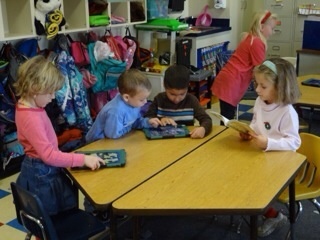
Young children engaged with an iPad

That said, I do think now is the time to start building that focus. It seems clear, when I think about the the challenges schools face, like the day-to-day issues listed above. And it seems clear as competition for students is increasing (public schools, private schools, charter schools, online schools, political pressure for school choice, etc.). And it seems clear as I think about the shift from Industrial Age education, with its focus on developing the talents of the few and the compliance of the many, to Information Age education, with its need to develop the talents in all.

But, if we’re going to ask teachers to do what they have not experienced, then we need to support the heck out of them. And not with information. Information doesn’t change practice, teachers need experiences! Send them to schools and classrooms that are doing a great job of motivating students. And share stories and videos of such classrooms. Structure workshops and courses and committee meetings (any school function focused on the adults needing to learn) so that they model the conditions that motivate learners.

And then, maybe, if we do focus on engagement and motivation, being in class would be more fun than a day off…


It’s a Matter of Using the Right Prompt: The Words of Gary Stager

This week, both Gary Stager and I were featured speakers at the Association for Independent Maryland and DC Schools’ (AIMS) technology conference.

Gary is an old friend and colleague, who has a long history of working with 1to1 learning with laptop schools (including the very first, in Australia) and with other schools interested in leveraging technology for learning and in constructivist learning. He clearly loves children and everything he advocates for schools is based on creating better experiences (especially learning experiences) for children. He is provocative and takes on a lot of populist education ideas with a very common sense approach. He always leaves his audience thinking.

What follows are some of the ideas and quotes Gary shared in his sessions at the AIMS conference.

  • The secret to engaging students is using the right prompts. A good prompt is worth a 1000 words – a good prompt, challenge, problem, or motivation; appropriate materials; sufficient time; supportive culture (including expertise) – kids can do works that is beyond them. Good prompts require a really different educational environment, one that values the kinds of things that Reggio Amelia values.
  • Gary has several articles on effective PBL on his “virtual handout.” (among other great resources)
  • We have to think less about teaching how to do computers, or about working at someone else’s pace. We need to stop teaching secretarial skills. We need good prompts. We need to teach students to use the computer to create what they want to create.
  • Alan Kay – the computer is simply an instrument whose music is ideas.
  • Gary’s only rule when he is working with students – you have to be doing something.
  • Teacher as “Ringmaster”
  • “Students will do it for themselves, when it matters to them, but not when it is arbitrary or coercive” – Gary Stager
  • Less us, more them
  • Gary likes it when schools/classrooms focus their work with children by asking the question, “What are the 5 big ideas of your grade level or course?”
  • Some of Gary’s recipe for being successful with students: Being sensitive to the passions, talents, and styles of kids. Being receptive to the learning differences of kids. If you are doing active learning activities, then you can get to know kids.
  • The best decisions about education are made closest to the child.
  • What if we simply reduced it all to waking up every morning and asking, “How do we make this the best 7 hours possible for these children?”
  • The biggest problem we have in school is we don’t get to know the kids and everything is taught disconnected from everything else. That’s followed by not trying to make things interesting for students, not finding out what is of interest or a passion to the students, not having resources, not letting students do things.
  • Gary on why teachers need lots of PD that puts them in different learning environments as learners: People can’t choose from what they haven’t experienced

Correct Answers vs. Building Understanding: What Do Learners Need?

My step-son, Sam, is one of those otherwise bright students who struggles with math. Back when he was in high school, his mom asked me to help him. He had gotten a question wrong on a Geometry quiz and didn’t understand the correct answer. My wife hoped that since I was a former high school math teacher that I could help him out.

The question was, “What is the intersection of two planes?”

He told me that he had answered that the intersection was a point, since only lines intersect. Sam went on, “I went in to ask my teacher about the question, but she just kept giving me the right answer. I really don’t understand it at all.”

“So, you’ve only talked about lines intersecting?”

Sam nodded.

“And you haven’t really talked at all about planes and how they intersect?”

Sam shook his head.

“Then I could see why you thought it was a point,” I told him. “But look at this.” His notebook was on the kitchen counter where we were talking and I said, “Let’s say this is one of the planes,” while tapping his notebook. I grabbed a magazine, saying it was the other plane. I held the spine of the magazine at an angle against the face of Sam’s notebook.

“How do these two planes come together? What kind of geometric shape?” I asked.

Sam got one of those “Oh, my gosh! Is it that simple?!” looks on his face and said it was a line.

Now, there was nothing wrong with the teacher asking the plane intersection question without first modeling it for students. It is a great way to have students apply the concept of intersection of geometric shapes and see if they really understand it. And the teacher was a kind and knowledgeable math teacher.

But students who struggle with a subject need more than just someone who is sensitive and kind and knowledgeable. Sam needed more than the correct answer. I think teachers who are intuitive mathematicians (or social scientists, or literacy specialists, or scientists) know their subjects in an intuitive way that makes it hard for them to explain ideas to students who do not understand their subject intuitively.

When students get an incorrect answer, it is too easy for teachers who understands their content intuitively to assume that the student simply made a mistake (perhaps in calculating), or didn’t study hard enough, or is simply a slow student in their subject.

What they don’t understand is that more often than not, a student’s wrong answer is actually a correct answer within the student’s current (but incorrect) schema for the topic – the student’s internal model that tells him how things work.

If the teacher’s goal is to have the student understand the material correctly, then simply offering the correct answer is less productive than trying to understand the student’s misconception and then think of an example or a way to model the material that will create a bridge between the student’s misunderstanding and the correct understanding.

Sam’s schema said only lines intersect and he knew that lines intersect in a point. We could either stop with proving that Sam was wrong by giving him the correct answer, or we could work to understand his thinking so we could lead him in the right direction.

I don’t blame the teacher. She simply did what I did when I was a math teacher. It wasn’t until long after I stopped teaching math and became of student of learning that I grew to understand this principle.

How much more effective would our teaching be if we approached our students’ incorrect answers as misconceptions rather than missing information?


Keeping the Main Thing the Main Thing in Middle Level

I recently posted “Let’s Put the “Middle” Back in Middle Level” over on the Bright Futures Blog.

In it, I argued that we middle level educators are being pulled away from our core values by a lot of competing priorities and goals. I wrote:

Middle level shouldn’t be about test taking, or getting kids to put aside their cell phones or Facebook pages, or high school readiness, or work readiness. It’s not even about “hormones with feet…” First and foremost, middle level needs to be about young adolescents: what are their characteristics and what practices are harmonious with those characteristics.

And later:

And the more we get away from that being our center (no pun intended), the harder it is to teach middle level students. That includes (and is perhaps especially true for) that list of important (but supporting) goals for middle level education…

I also shared some really great resources! available for free on the AMLE website, that we can use with our teachers, school boards, and parents and communities to remind everyone about the main thing in middle level education.


It’s Your Turn:

How are you keeping the main thing the main thing in middle level education?


Harassment & Engagement – Social Media Study Group

Note: This is one in a series of blog posts to be used by Auburn’s Social Media Design Team to conduct a study group before making recommendations for social media policy. If unfamiliar with this series, you might find reading this post helpful.

Core Issues Study Questions (Bullying & Boredom)

  • What are Auburn schools current doing related to bullying and school climate?
  • What are Auburn schools current doing related to fostering student engagement in academics?
  • What is considered best practice around bullying?
  • What is considered best practice around engaging students?

Although intended as a tool for Auburn’s Social Media Design Team, everyone is invited to use these posts as a resource. And if you are not a member of Auburn’s Social Media Design Team, you are welcome to post comments, too. But please limit/be thoughtful of the sharing of opinion and stay focused on the focus questions – we a trying to use these posts for fact-finding, identifying resources, identifying best practice, etc. Thanks!