
Driving Your Initiative: Positive Pressure & Support (Part 1: Expectations)

So you’re working on your school initiative, and you really believe in it, and you really want it to make a difference.

And you are trying to pay attention to leadership for school change, and have certainly provided training to your staff and have made resources available.

Unfortunately, simply participating in training and having the resources available does not mean that students will do better or that your initiative will have it’s desired impact. The degree to which teachers implement your initiative and related strategies matters. Level of implementation matters.

So, how do you get your level of implemention up?

Providing Positive Pressure and Support is how school leaders affect the level of implementation. Positive Pressure and Support is made up of three easy pieces:

  • Expect
  • Supervise
  • Support

This is the first in a series of three posts on Positive Pressure and Support, each on one of the three pieces, and this first focusing on setting expectations.

Expect – Start Simple
When MLTI, the country’s first statewide learning with laptop initiative, first got started in 2001, there were still an awful lot of teachers who had not used technology much themselves, let alone used it in the classroom with students. The goal, of course, was to impact learning, but more than a few teachers were a little intimidated by either having to teach differently (especially with a device they weren’t that familiar with), or by having every middle schooler sitting in front of them having a laptop (that the student was probably a lot more comfortable with it than they were!).

But we started seeing good progress in schools where the principal made a simple expectation: Do one unit, between now and Christmas, that involves students using the laptops.

That seemed to take the pressure off of teachers who may have assumed that since laptops were everywhere, they needed to be used all the time. In fact, many of those teachers then did their single unit (perhaps to get it out of the way) and discovered that it wasn’t so bad and started using the laptops pretty regularly.

But without the expectation, reluctant teachers may have continued to put off using all the technology in their classrooms.

Similarly, setting initial expectations for Meaningful Engaged Learning can be as simple as letting teachers know you expect to see greater implementation of the Focus Five strategies. Setting expectations for an iPad initiative can be as simple as letting staff know you’d like to see the iPads used in centers. Expectations for getting started in another initiative might be the following: participate in the offered training; increase the use of higher order thinking strategies in daily lessons and activities; do at least one engaging task with students each week; and do one project in a unit in one class before the end of the next grading period.

But setting expectations (even starting with simple ones) can help overcome the (often understandable) inertia that some teachers may feel at the start of a new initiative.

Expect – Participate Yourself
Another way to set expectations is to participate yourself. Busy leaders sometimes find it hard to take the time to attend trainings. But doing so sends the vital message that you value the training and think it’s important. Participating in the training also means that you know what you can expect your staff to be able to do in their classrooms and can better supervise and support the implementation of those strategies.

I once worked with a school where the principal would announce the professional development then leave. We had a hard time getting staff to an adequate level of implementation, I’m sure in no small part because many staff felt that if the initiative wasn’t important enough for the prinicpal’s time, why should it be important enough for theirs…
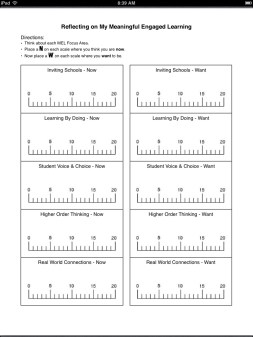
Meaningful Engaged Learning goal setting form

Expect – Have Teachers Set Goals
Teachers seem to do better with expectations when they have a voice in setting them. One way to do that is to have teachers set goals. When I have worked with schools using Meaningful Engaged Learning as their School Improvement Program, I have had teachers think about the five components of Meaningful Engaged Learning, and asked them to rate themselves on where they think they are in implementing each component (I have used this form).

I then ask them to think about where they would like to be on implementing each component at the end of some timeframe (the end of the semester, for example). When that time frame is up, we can reflect again on what progress has been made.

This approach sets the expectation that we will get better at each component, while both validating that the teacher may already be good at some of those components (is already meeting that expectation), and giving the teacher a voice in deciding how much energy to put into each component, and which they will focus on the most.
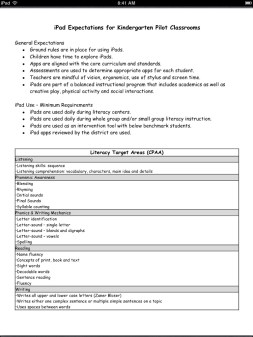
iPad expectations

Expect – Collaboratively Set Expectations
Another way to give teachers voice is to collaborate with them on setting those expectations. That’s what we did in Auburn, as we started Advantage 2014, our math and literacy initiative that includes iPads in Kindergarten. We simply had a conversation. What should our expectations be? In what kinds of activities should we expect to see the iPads used? How often?

The consensus that grew from those discussions became our expectations for the program. This included general guidelines, like apps should correlate to our curriculum, and that iPads are part of of balanced educational program that includes traditional approaches, and included minimum expectations for use, such as using iPads daily in literacy stations, or using iPads for interventions with students.

When collaboratively planning expectations related to implementing new initiatives and strategies, it should be a goal to set specific expectations on those strategies:

  • How many?
  • How often?
  • By when?
  • By whom?


These four strategies for setting expecations should help you get started with Positive Pressure and Support. How will you set expectations with your staff? What will those expectations focus on?
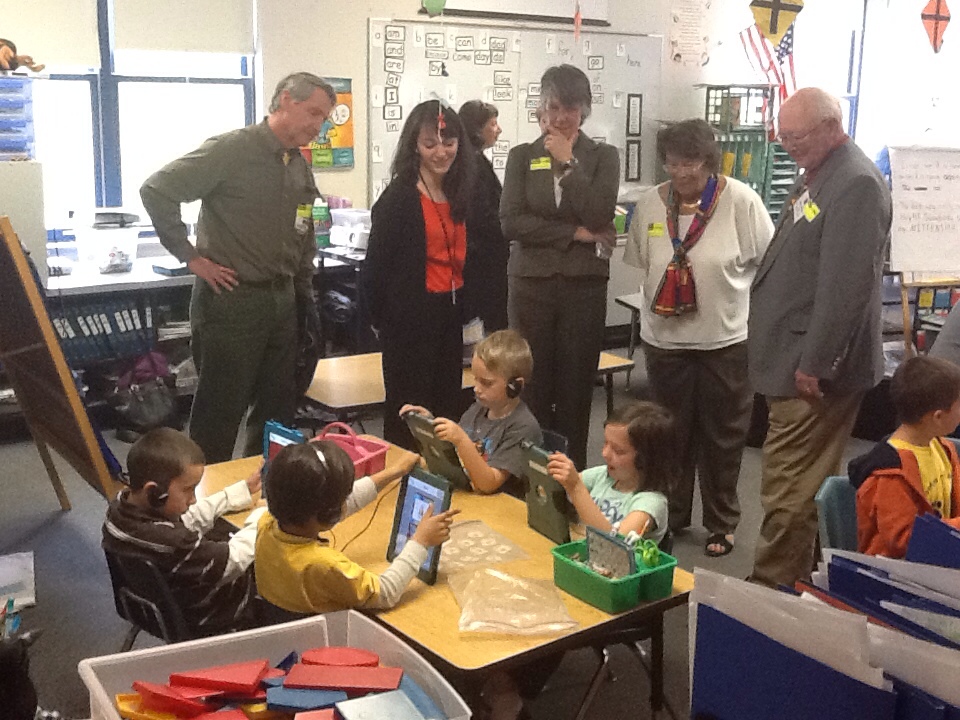
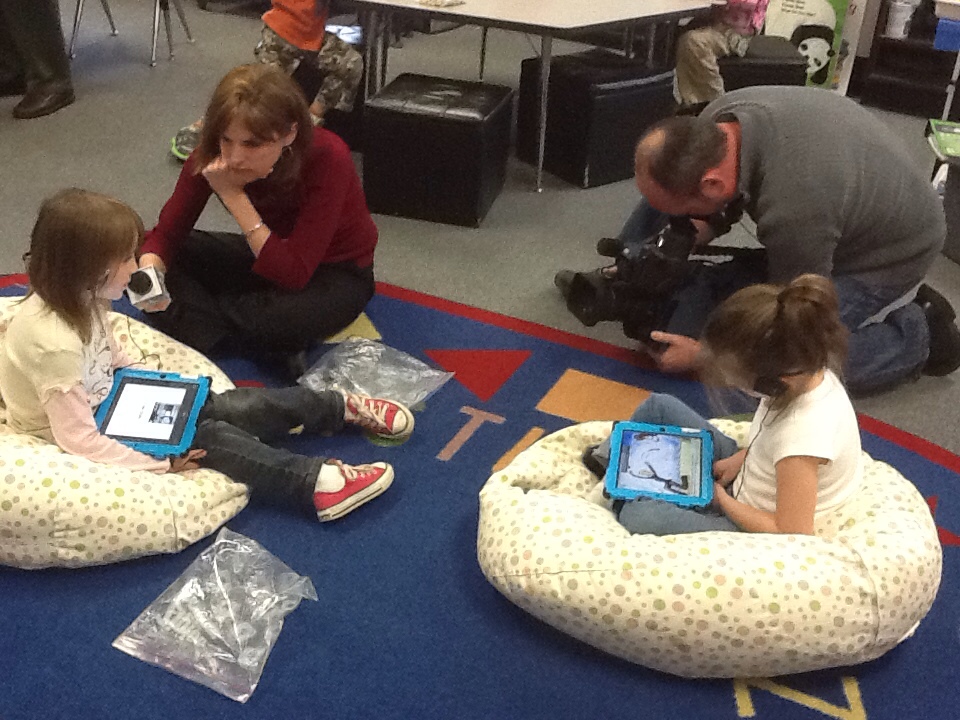
 

MLTI, Kindergarten iPads, & Customized Learning: a Keynote with Gov. King & Commissioner Bowen

Imagine!

Governor Angus King, who started the country’s first statewide 1to1 learning with laptop initiative, on stage with Commissioner Steve Bowen, whose strategic plan for education moves Maine away from Carnegie Units and toward Customized Learning, answering questions posed by kindergarten students who are participating in the country’s first 1to1 learning with iPads in kindergarten program.

What would they say about meeting the needs of all students?

What would they say about the role technology could play?

What would they say their favorite color was?

That was the opening keynote, “Learning – Past, Present, and Future,” at the 2011 Leveraging Learning – iPads in Primary Grades Institute in Auburn, ME.

If you missed the institute, you can still watch the keynote (link to YouTube).

Hope folks can join us for the 2012 Leveraging Learning Institute next November. Registration opens in mid-August.


Our 8 Messages to the State Board of Education

State Board of Ed visits an Auburn Classroom

On May 9th, the State Board of Education had their meeting in Auburn (press coverage in the SunJournal and at WCSH6). The Board often has their regular meeting at a school, spending the morning in a workshop and the afternoon in their business meeting. They came to Auburn School Department because they wanted to learn more about teaching and learning with technology.

We used the morning workshop to have them visit technology-using classrooms at our middle school, high school, and one of our elementary schools, then return to Auburn Middle School for a debrief and lunch with some of our students.

What did we want the Board to learn about teaching and learning with technology? Here are our 8 messages to the Board:

1) Technology is About Learning
Technology isn’t “cool gadgets” or a content area. Technology is a teaching and learning tool, and decisions need to be based on questions such as, “How does this impact the quality of learning opportunities in the classroom?” and “How can we leverage technology to help students learn in ways that they couldn’t without?”

2) Technology For Learning Takes Deliberate Leadership
Good teaching and learning with technology doesn’t happen on its own. It doesn’t happen just by giving teachers laptops or tablets. It takes deliberate leadership, leadership that is a team focus on positive pressure and support, teacher practice, funding, partnerships, resource management, branding and buzz, and PD for paradigm shift.

3) Technology is No Luxury; It Is The Modern Learning Tool
Some view technology as a luxury schools can’t afford. And yet technology is prevalent in nearly every sector and part of life outside of school. If we want students to think school is relevant to their lives, then we need to use tools for learning that they see in use outside of school.

4) Effective Technology Use in Schools is All About Having Great Teachers
Technology is just a tool. It doesn’t replace teachers. In fact, using technology well takes a good teacher. We won’t ever improve learning by simply handing technology to students. But when a good teacher hands technology to students with a good activity, then learning can soar.

5) Teachers Need Support
Very few of our teachers grew up as students in classrooms where technology was a teaching and learning tool. It is unfair to expect teachers to implement technology well if they have not experienced it’s use as a learning tool themselves. We need to provide lots of support to teachers so they can get good at teaching and learning with technology. That support needs to include identifying models of effective use, classroom visits, trainings that model effective use, access to resources, a safe environment to try new things (and maybe fail), and a little professional hand holding.

6) Teachers Need to Focus on Student Engagement
Whether we have technology available in the classroom or not, teachers need to compete for student attention more than ever before. Students have access to much more information outside of school than when we were students. If teachers are to remain effective and schools are to remain relevant to students, then we need to focus on engaging students, keeping things interesting, and making learning meaningful.

7) Even Young Students Learn With Technology
Young children are adept at using technology, and there are many great technology-based apps and resources available for a quality early learning or primary grades program.

8) It’s About Blalance
Schools known for effective technology rich environments are good at identifying the right learning tool for the learning target. And even though they use technology widely, they would never use technology exclusively. Students still have teachers, read books, create art, play outside, write with pencil and paper, toss a ball, etc.


3 Tools to Assess and Guide Your Deliberate Leadership

So, you’re working on your school’s big change. Maybe it’s getting instruction shaped up for the introduction of the Common Core. Or maybe all your students and teachers are getting laptops or tablets. Or maybe you’re making the move to customized learning, or project-based learning, or…

And if you’re reading this blog, then you’ve probably found this model for school change to use when it’s a biggie, such as when it requires a paradigm shift for educators (and perhaps the community) because it’s different than when they were a student and maybe they have never taught this way or been trained to teach this way.

And maybe, like a lot of schools, you had a good start and you paid attention to all the Key and Supporting components of the model, but as the year went on, and the initiative went on, and the day to day running of the school/district loomed big, you have begun to wonder, how do I know we’re still paying attention to all the moving parts of our initiative? How can you get a little check to make sure you’re still on track?

The three tools described below are designed to do exactly that. The three work in concert to help you or your team identify what you’re doing in the initiative, where there may be gaps in providing leadership for the initiative, and what can be done to make the initiative more complete.

This process can be done individually by an initiative leader, or with a leadership team, or with a larger group of stakeholders. I’m partial to using a team effort. Over and over and over again, I’m surprised about the things that are captured and dealt with because team members have perspectives and strengths different than my own. These were always things that would have fallen through the cracks, if it hadn’t been for the diverse perspectives of team members. When working with a group, decide if it is most appropriate to work through each component as a whole group or to divide up into smaller groups, each working on a different component.

A group can work through all three of these tools in 2-3 hours.

The Lead4Change Check-In Tool
The Lead4Change Check-In tool has one sheet for each of the 7 components of the Lead4Change Model. The intent is to reflect on what work is currently underway in each category. It’s a way to gather your list of efforts toward your initiative. The intent is to determine what is going on right now, in preparation of asking the question, are we dealing with all the parts we should be dealing with?

As each effort is listed on the form, the note taker can check which piece(s) of the Component the effort relates to. Some efforts will not only relate to more than one piece of a Component, but to more than one Component. There is no problem with listing an effort on more than one sheet. In fact, you want to make sure that all your efforts toward each Component are recorded.

I’ve done this work with a leadership team through a modified Carousel Activity. I broke the large team into smaller groups. Each small group worked on a different Component for a certain amount of time, then passed the individual Component sheet to the next group. The next group would add to the sheet, passing it to the next group when time was up. Each Component sheet would eventually visit each group. One advantage is that this kind of small group work is more likely to engage every member of the large group than when the same work is done in a “whole group” approach.

The Where Are The Holes? Tool
The Where Are The Holes? tool let’s the same group of reflective practitioners to then look back over the Check-In documents and think about each piece of each Component. They would decide if that piece is “covered” or a “hole.”

Why not skip the Check-In and jump right to here? I think that sometimes, when presented with a checklist, it is too easy just to look at an item and say “Yup! Doing that!” without really stopping to think about “how are you doing that?” Using the the Check-In tool forces you to provide the evidence of if you have covered it or not.

Is it always a problem when there is a hole? No. Large-scale school change initiatives take time and have lots of pieces to pay attention to. There are times when you will look at a hole and say something like, “It is okay that that is a hole right now, because it isn’t time yet to do that. We will be addressing that next semester/year/etc.” But finding the holes insures that any current hole is a hole on purpose, for a good reason, and not just because the team has overlooked it.

The What Could We Do? Tool
So now you know what is going on, and where you have holes and need to pay attention. Now is the time to capture some ideas of what the initiative could do, especially to fill those “overlooked” holes in implementation.

The What Could We Do? Tool helps with this. Groups fill in their ideas of what could be done, recording whose idea it was, who could be a contact person, as well as, what Component and piece it relates to. Special attention should be paid, of course, to those pieces that you identified as holes.

The ideas listed on the sheet are brief and sometimes the sheet sits for a while before the leadership team gets back to it. Capturing whose idea it was allows the leadership team to go back later and find out more about the idea if they have clarifying questions.

Listing a contact person allows the group to get in touch either with who would be responsible for getting the suggested idea going, or with an outside contact person who has implemented similar work.


Having your leadership team work through these three tools, could be a useful approach to revisiting the Lead4Change Model as a piece of your continuous improvement plan.

Put the Middle Back in Middle Level: Vote Mike for AMLE President Elect #WhyMikeAMLE12

The Association for Middle Level Education (formerly the National Middle School Association – NMSA) is a wonderful organization striving to be the go-to people for all things related to educating young adolescents.

They are currently having their annual elections for the Board of Trustees (elections opened April 5 and continue through early May).

I’m running for President Elect and hope you’ll consider voting for me.

Middle Level has been the driving force in making me the educator I am today. When I was first a teacher in the mid and late 80s, mostly I just knew that school didn’t seem to work for too many kids. Middle Level Education was my first introduction to an approach to education that really started with the learner and a hard look at the developmental characteristics of the age group.

Since then, I’ve considered my work to be being in the service of students. How could I make learning more interesting and engaging to them? How could I make school meaningful? How could I make it work for more students.

Along that journey, I’ve been a middle grades technology integrator, and part of the design team of the country’s largest middle level initiative, MLTI (the Maine Learning Technology Initaitive) which is still the only statewide learning with laptop initiative and started with every 7th and 8th Grade student and teacher in the state. I’ve been a teacher educator at the University of Maine at Farmington, and helped create their middle level education program and established the Maine Center for Meaningful Engaged Learning. My doctoral program emphasized middle level education, and my doctoral research focused on what motivates underachieving middle school students, producing a model that is now a state-approved School Improvement Model in Louisiana. I’ve been an educational developer, creating programs designed to motivate students. And I’ve served my state and national middle level associations, being a Board member and President of the Maine Association for Middle Level Education (MAMLE), and a Research Advisory Board member and an East Region Trustee for NMSA/AMLE. (Learn more about my contributions to middle level)

I’m ready now to leverage my experience to help put the Middle firmly back into NMSA/AMLE.

Please vote Mike for AMLE ’12!

Tell why you’d vote for Mike at Facebook.com/MikeMuirForAMLE12

Or Post it to Twitter with the hash tag #WhyMikeAMLE12


Introduction to Twitter for Educators: 12 Resources & Strategies

The irony is that at the same time my district has banned Facebook and has a team working on a social media policy, our administrators are learning how to use Twitter for both Branding and Buzz and their own professional development.

(Well, maybe it isn’t irony. I think maybe it is exactly the Yin and Yang of social media that has schools confused about what to do with it. On one hand social media seems to lead to distraction and bullying. On the other hand, it is a powerful marketing tool and tool for building a professional learning community.)

Auburn’s administrative team will soon get a brief Introduction to Twitter inservice. These are the resources I will be sharing with them.

What other resources would you share? (please add your suggestions in the comments)


Getting Started with Twitter:


Leveraging Twitter as Your Professional Learning Community:


Leveraging Twitter for Building Branding and Buzz Around Your School:


Leveraging Twitter for Teaching and Learning


Supervision – Social Media Study Group

Note: This is one in a series of blog posts to be used by Auburn’s Social Media Design Team to conduct a study group before making recommendations for social media policy. If unfamiliar with this series, you might find reading this post helpful.

Supervision Study Questions

  • What are Auburn schools current doing related to supervision when students are using technology?
  • What are manual and technical approaches to supervision and setting limits?
  • What is considered best practice around supervision of technology use?


Although intended as a tool for Auburn’s Social Media Design Team, everyone is invited to use these posts as a resource. And if you are not a member of Auburn’s Social Media Design Team, you are welcome to post comments, too. But please limit/be thoughtful of the sharing of opinion and stay focused on the focus questions – we a trying to use these posts for fact-finding, identifying resources, identifying best practice, etc. Thanks!


Educating for Appropriate Use – Social Media Study Group

Note: This is one in a series of blog posts to be used by Auburn’s Social Media Design Team to conduct a study group before making recommendations for social media policy. If unfamiliar with this series, you might find reading this post helpful.

Education for Digital Citizenship Study Questions

  • What are Auburn schools current doing related to Digital Citizenship (both for students and adults)?
  • What is considered best practice around teaching digital citizenship?

Although intended as a tool for Auburn’s Social Media Design Team, everyone is invited to use these posts as a resource. And if you are not a member of Auburn’s Social Media Design Team, you are welcome to post comments, too. But please limit/be thoughtful of the sharing of opinion and stay focused on the focus questions – we a trying to use these posts for fact-finding, identifying resources, identifying best practice, etc. Thanks!


18 Reasons We Need More Psychology (And Less Logic) In Our Education Thinking

Few systems are as complex as education.

I’ve been thinking a lot about education lately, I’m in the school change business, especially as it relates to creating schools that work for all children. Over the last years, my work has focused on designing schools that work for all students, programs for hard to teach students, and on technology-rich learning environments, especially 1to1 learning with laptop and ipad initiatives (these all usually overlap considerably when each is done well). And I especially wonder how it is that competent educators (good people) make decisions and policies that seem to not work very well.

From my perspective, a decision or policy works if it supports the working of the system. You can tell if it doesn’t work if the system is still upset or in some level of tourmoil.

I’m not sure I can explain this like I want to, but I guess I should say here that when I say “system,” I don’t mean the “education system” or “school system” (the policies that govern a district, school, classroom or other jurisdiction), but rather the system of learning. By my definition, if kids generally do their work, follow the rules, learn, and are engaged, then the system “works.” If kids are breaking rules, not learning, refusing to do their work, then the system doesn’t work. If a school has a high breakage rate on devices or they go missing, the the system isn’t working. When breakage and missing rates are negligible, then the system works.

So why do seemingly good policies not work?

I’ve come to the conclusion that problem lies with logic.

Good people use logic to make decisions. But education is a complex system based on people, not things. Therefore, we need to use psychology, not logic. By definition, logic makes sense in systems that focus on things or stuff. But it is psychology that makes sense in people systems.

So, from two decades of working with schools, including my own, around customized learning, or student motivation, or technology-rich learning environments, or leadership for school change (or, more often, all of these combined!), I’ve started to discern some of the “Logic vs. Psychology” problems schools have. In each case, the “logical” solution is certainly logical, but seems to have perpetuated (or even exasperated) the kinds of disruption or disequilibrium that the solution was trying to solve (it “didn’t work”), whereas the “psychological” solution seems to have had the desired effect.

So here are 18 reasons we should use more psychology and less logic:

  1. Logic says 1to1 is a technology initiative. Psychology says it is a learning initiative.
  2. Logic says students should learn (it is for their own good). Psychology says we must ask ourselves why students would want to learn.
  3. Logic says do workshops on how to use the various software on the laptops. Psychology says do workshops on how the software can be used to help students learn academic content.
  4. Logic says that a teacher must cover content. Psychology says that a teacher must connect with students personally.
  5. Logic says schools should ban disruptive technology (cell phones, mp3 players, blogs, chat, social networks, etc.). Psychology says if a tool is part of the child’s culture, then we should find academic uses for it.
  6. Logic says filter the Internet heavily. Psychology says filter some, but mostly educate students.
  7. Logic says use technology to do what teachers have always done, but more effectively. Psychology says use technology in new ways to engage students and help them learn.
  8. Logic says supplying the tools is enough. Psychology says apply some positive pressure and support to get teachers to use the technology effectively for academic purposes.
  9. Logic says breakage and theft is about the technology and the kids. Psychology says breakage and theft is about how the technology is being used for academics and the leadership around the technology initiative.
  10. Logic says tech folks need to protect the stuff. Psychology says tech folks need to enable engagement and the learning.
  11. Logic says a school is doing well if the easy to teach students are doing well. Psychology says that a school is doing well if the hard to teach students are doing well.
  12. Logic says give students information. Psychology says help students make meaning of information.
  13. Logic asks, did the teacher cover the material? Psychology asks, did the students learn it?
  14. Logic says that technology is a separate line item. Psychology says that all the expenses related to technology are integrated throughout the budget (infrastructure, instruction, staff, etc.).
  15. Logic asks, how smart are you? Psychology asks, how are you smart?
  16. Logic says teachers should speak to students with authority. Psychology says teachers should speak to students as people.
  17. Logic says a teacher can select which teaching styles they choose to employ. Psychology says that there are high-impact and low-impact pedagogies, and teachers should choose wisely.
  18. Logic says pass out laptops to teachers as soon as the school gets them. Psychology says pass out the laptops at an inservice where school leaders can set the tone on how they will be used in the classroom.

Let’s try to use a little less logic and a little more psychology.


7 Social Media Articles to Help Your School’s Communication Impact

Schools and educational organizations are starting to realize that even though they are doing great work, they need to get that message out to their parents, communities, members, and constituents. “Branding and Buzz” is one of the “Supporting but Necessary” components of the Lead4Change Model, and encourages schools and organizations to state their case for the work they are doing, communicate with their community and beyond, tell their story, and present their evidence.

So begins my recent Bright Futures blog post on schools using social media to get their message out.

The post points readers toward the Social Media Examiner, a wonderful resource for helping organizations leverage social media. In particular, I highlighted 7 articles focused on getting the most from Facebook, Twitter, and blogging.

A lot of schools already have a Facebook page. Some are even using twitter. Others have administrators or teachers who blog. But are they using these avenues to connect with parents, communities, and colleagues as effectively or with as much impact as they could?

I think these 7 articles can help insure that schools do. The articles share wonderful tips from folks who are getting the most from their social media. Where can a school start?

Use the post as a jumping off point. Do a deep dive into one or the articles, or have your staff or leadership team jigsaw a couple of them. Your school could take what they learn and decide on a couple things that they want to try out.

The Bright Futures Partnership did just that. We read the article 26 Tips For Writing Great Blog Posts, and decided on 5 or 6 things we were going to try (look for changes coming to the Bright Futures blog and see if you can spot which tips we put into action!). By the way, reading the article also allowed us to pat ourselves on the back for 5 or 6 things we were already doing!


It’s Your Turn:

What are your best strategies for getting your school’s or educational organization’s message out via social media?


Professional Development for Auburn’s iPad Kindergarten Teachers

Auburn is excited that our initial research results strongly suggest that our initiative is extending the impact our teachers are having on their students. It has prompted lots of requests to know more about what we’re doing for professional development with our teachers. Professional development is, clearly, one critical component to any school change initiative, and designing and providing the right kind of PD and support is a critical leadership role.

What professional development did we conduct with our kindergarten teachers?

Content of Professional Development – All of our PD and training has focused on a couple of topics. We wanted to expand our teachers’ skill at applying literacy best practice, and to insure that our teachers and specialists working with kindergarten students had the capacity to select and apply appropriate apps directly toward student academic needs, as well as how to manage the iPads and work within the unique demands of this initiative. We have summed this up at the beginning of each of our PD session agendas with the following goals:

  1. Link iPads to learning.
  2. Problem-solve technology-related issues.
  3. Discuss best practices.
  4. Discuss and review apps.

How did we manage professional development and support that achieved these goals?

PD for Paradigm Shfit – Although teachers can often, sometimes with coaching, apply best practice they are familiar with to unfamliliar contexts, the integration of technology at this level is often a paradigm shift for teachers. Rarely have teachers experienced learning with technology themselves, and many have received very little training with computers, let alone iPads. “PD for Paradigm Shift” recognizes that changing paradigms requires more than sharing information. Schema theory sheds the best light on how to structure professional development for large change: provide models and experiences. See it in action. Live it in action. That’s what we’ve tried to do for our teachers.

Getting Technology into the Hands of Teachers – A terrific first step for professional development is to get the technology into the hands of teachers, so they can become used to it through their own use. We made sure that every teacher had an iPad to use over the summer for this purpose. But it is important to keep in mind that this will develop a teacher’s personal use skill, not their integration for learning skill. That’s not a problem. The problem comes from thinking that if teachers know how to use their iPad that they also know how to leverage it for their students’ learning…

Modeling: Visiting Classrooms – When teachers don’t have a lot of experience with an innovation, one way to get them that experience is by having them visit other teachers who are successfully doing similar work. This can be done in person, or vicariously through videos or stories (not descriptive articles, so much as those that tell the story and paint a picture for the reader – remember, this is not about information, it’s about experience). Unfortunately, there weren’t a lot of classrooms for us to visit when we got started. We have tried to make it easy for our teachers to visit each other’s rooms, and we have had teachers video (on their iPads!) and share examples of what they are doing. Now we’re working to make sure that other teachers can come to visit our classrooms so they can begin to expand their experience (although we’re trying to be careful how we schedule and manage such visits as not to distract too much from the learning that is supposed to be our first order of business!).

Modeling Effective Practices – Did we see a teacher do a great lesson? We had her model that lesson to the other teachers in a PD session. Did we learn a better way to sync or manage apps? We modeled that approach in a PD session. Did we think the press might start contacting teachers? We’d review procedures for dealing with press requests, as well as share talking points and provide them language they could choose to use if interviewed. (Our teachers’ favorite talking point: “That’s a great question! You should ask the superintendent.” I think they might be a little press shy!) 🙂

Connecting with other Educators – A different approach to helping teachers and program leaders build models is to provide them opportunities to communicate with educators who are doing similar work. Networking is a powerful way for teachers to develop their own practice while helping colleagues (often in different states or countries!) to develop their own. Although few teachers have taken us up on these options to date, we encourage them to consider tweeting or blogging about their experiences, since it can help build a diverse professional learning network for the teachers who do. Our teachers are more eager to connect with teachers in more traditional ways: on the phone or via email. One avenue which has really opened possibilities for these connections was the national iPads in primary grades education conference we hosted last November. About half our participants were from Maine, and the other half from across the country (we even had one from India!). We’re already planning next year’s conference.

Constructivist Approach – As we thought about designing PD for our teachers, we didn’t want to just hand teachers information or resources; for example, we didn’t just want to hand them “approved” apps. We wanted teachers to have an intimate understanding of various components of the initiative they were on the front lines of implementing, including app (educational resource) selection. We decided to take a constructivist approach. For example, we had our teachers start by simply exploring apps. They had a limited budget for apps, but could also download as many free apps as they wanted. Then teachers made recommendations for apps that they thought would be the “core collection” of apps, those apps the district would purchase for every classroom. We would give teachers two similar apps and ask, “which one’s better?” to get them thinking about criteria for app selection; this eventually was developed into a rubric. Finally, we correlated apps to our kindergarten curriculum. The constructivist approach insures a deeper understanding based on their own experience.

Collaboratively Designed – I think one of our best secrets to successful professional development and support is realizing that none of us is as smart as a group of us together. We have tried to have a team approach to all design work for this initiative. Our Advantage 2014 Design Team includes central office administrators, our grant writer, a couple School Committee members, a couple parents and community members, as well as our some of our teach folk, and one of our elementary principals (and, of course, me, the Multiple Pathways Leader). We have smaller groups working on specific aspects of the program: funding, research, the Institute, and professional development. Our professional development planning group includes our Tech Director, our elementary Technology Coach, an elementary principal, one of our Special Education administrators, and myself. And even though no teacher is officially on the PD design team, in reality, they all are. We solicit their input in a variety of ways and work hard to be responsive to their needs (see the next section). Teachers helped us craft our policies and procedures, our expectations for teachers, our core collection of apps and our app selection rubric, and other significant components of our initiative.

I can’t over state this: this work MUST be a team effort. I can’t tell you how many times in the last few weeks I’ve said, “See! That’s exactly why we have a team planning this!” And not just for PD, but for lots of different aspects of this work. I don’t care how good some individuals in your district are; he or she doesn’t have the capacity represented by a collection of your staff, with various experience bases, perspectives, and areas of expertise.

Continuous Improvement Focus – We’ve tried to be highly responsive to the needs of our teachers. In additional to listening to our teachers, asking them directly, and being tuned in to situations as they develop, we use two tools. On a regular basis, we have our teachers complete one of two surveys we created in Google Docs. One asks questions about how often they used the iPad that week for various types of tasks (these correspond to our expectations for teachers that we collaborately created with the teachers, and essentially gets to fidelity of implementation). The other survey simply asks about their recent successes and challenges within the program. Although quite simple, both provide us with amazing data on what the teachers need right now. Although we plan our PD sessions in advance, we’ve been known to completely redesign a session hours before it starts based on what we’ve learned the teachers need.

Imbedded Support – Our district has three technology integrators: one for the high school, one for the middle school and one serving our elementary schools. As you can imagine, we’ve had our elementary technology coach spend much of her time working in our kindergarten classrooms. A good technology coach is really a good pedagogical coach. She can collaboratively design lessons with teachers, co-teach lessons, model lessons, sit back and observe and provide feedback, make recommendations to resources and otherwise support teachers. Although the technology coach becomes eyes and ears for program leaders, it is not an evaluative position. The teacher needs to feel safe with the coach working in her room, and we only use information from the coach to help direct resources and support.

Built On A Strong Literacy Foundation – Our teachers had been working on literacy instruction for several years prior to Advantage 2014 and the introduction of iPads to their classrooms. Auburn had been part of the Maine Literacy Project out of the Univerrsity of Maine and our teachers had done graduate level work with the Project. Adding the iPads and its apps was a logical extension of this work, and training we conducted specficially about the iPads was intended to extend this earlier work, not replace it.

Where Did We Find the Time? – We used the usual approaches: taking advantage of workshop days, after-school opportunities, and scheduling a couple days in the summer prior to school starting. But we also had the advantage of the district already having “Early Release Wednesdays” available for our elementary schools. We have used nearly every other Wednesday to provide several hours of training. Some days we met just with the “September Teachers” (the first round of teachers to get the iPads). Other times we met with all the kindergarten teachers, or just the specialists, or everyone all at once.

It’s Your Turn:

What are your best strategies for delivering professional development and support to your staff?

Learn More about Projects4ME and Auburn’s iPad Program

The other night, I had the pleasure of joining Cheryl Oaks, Alice Barr, and Bob Sprankle on their Seedlings podcast.

We had a chance to talk about Auburn’s literacy and math initiative at includes 1to1 iPads in kindergarten and Projects4ME, Maine’s statewide virtual project-based program for at-risk youth.

Check out the links and podcast here.

Getting a School Back on Track

A friend from out of state recently wrote me asking for some suggestions for helping a school she’s involved with.

She wrote (edited to add some anonymity):

I have been appointed recently to serve on a Commission for a high school that was reconfigured and provided with $54 million for building and equipment in 2000.  It was the investment child of a foundation with matching funds from several local corporate donors for the intention and purpose of establishing a state-of-the art trade and tech school. It has a 99-year intergovernmental agreement among the local university, tech college, and school district that allows the school to be directed by a Commission.  The IGA allows more flexibility and autonomy than I have seen in most charter contracts.

Unfortunately, the Commission has not really held anyone accountable, and never implemented the very cool (albeit unrealistic) curriculum and programs.  Twelve years later, the school is a pack of trouble.  Donors are squealing about wasted investments, and the neighborhood (Latino) kids won’t go to the school since it is now mostly African American.

She wanted suggestions on model programs they could look at (and I suggested one), but mostly she wanted some ideas on how to get the school back on track.

I’m wondering if there aren’t other schools and districts out there that also feel like they have gotten off track and are wondering what to do next.  So I’ll share here a version of my respone to my friend.

I think the answer is working on your school’s “Burning Platform” and on your Shared Vision.

In school change circles, the Burning Platform is that big reason you have that screams “WE NEED TO CHANGE OUR SCHOOLS!” to all the stake holders.  For us (Auburn School Departement), it’s that 70% of our kids are doing well – which really means that our schools don’t work for 30% of our kids.

So, the first step is to work with your leadership team to involve stakeholders in identifying the Burning Platform.  But the Burning Platform can’t be something like “we got away from our plan” (teachers & students are just as likely to say, “so what!” to this as anything).  It’s got to be that one big reason that will pull everyone together to say, “Let’s do it!”

Then you need a shared vision.  There are lots of approaches to creating a shared vision (I promise to blog about a visioning process I like very much in the near future). But which ever way you do it, make sure you are involving TONS of stakeholders – students, teachers, admin, parents, community members, local employers, school committee/commission folk, donors/investors…  Literally having hundreds of people involved with creating your shared vision is not a bad thing.  The more the merrier – but much more importantly, the harder it will be for anyone to criticize your vision after it is created.  But you need a good facilitator and a good process, especially if you are going to involve lots of diverse stakeholders. 

I guess the other piece is leadership.  I suggested to my firend that either their Commission needed to lead hard or they needed to hire a good principal for the school (or both).  Maine’s major lesson from MLTI (our statewide learning with laptop initiative): Leadership is everything. (Judy Enright, another friend who works with schools on large scale change, likes our Lead4Change model to help insure that school change leaders are being systematic and paying attention to all the moving parts.)

Anyway, it seems to me that the only way you start getting back on track is to first bring everyone together – through the Burning Platform and the Shared Vision.

It’s Your Turn:

What are your suggestions for getting a school back on track?

What I Wish The Union Had Said

Maine has had two sets of educational announcements in the last month.  One was for the Commisisoner’s plan, focused on customized learning and a performance-based diploma.  The more recent came jointly from the Governor and the Commisioner, and focused on four proposed pieces of legislation: allowing public funding be used toward (certified) private religious schools, school choice, teacher evaluation and accountability, and greater focus on career and technical education.

Chris Galgay (president), and Rob Walker (executive director) from the Maine Education Association were at both announcements.  News stories focused, not just on the announcements, but on how the teacher union was critical of the announcements.

Nationally, teacher unions have developed quite the reputation of blocking any kind of educational advancement and have become the villain in tales of attempts to improve education for all students.

I have mixed feelings about teacher unions.  I think unions should be the defenders of the profession, negotiating contracts favorable to their membership, insuring good working conditions, monitoring evaluation procedures so they are fair and reasonable.

But the reputation teacher unions have is not for defending the profession, but for defending the least professional teachers, protecting mediocre performance, and preserving the right of teachers to do as they wish, not that that is needed to be done.

I suspect that this reputation is somewhat undeserved, but I also know I have experienced myself actions that reinforce this reputation.  At a special purpose, project-based learning school I was part of creating, several teachers in the union told us they wouldn’t implement the educational program because the union told them they didn’t have to. When we had a workshop day, had bought all the teachers lunch (which we did as a nice gesture), and told them what time lunch would be served, several teachers came to us and told us that we couldn’t require them to come to lunch because it violated union rules (who had required anyone to do anything?  We had just done something nice…)

And I worry that dour expressions of the MEA leadership and the news reports of their critical and negative message are reinforcing that image, as well.  And yet, my wife is involved in some very progressive projects of the MEA that demonstrate a very different kind of defending and preserving the profession…

Here is what I wish I had heard from the union:

The MEA and our membership are working hard to insure that every zip code has a great school, so families indeed choose their local school. – I heard the union say they didn’t like school choice because it would take resources away from local schools.  A long time ago, in the early 90’s when charter schools were first proposed in Maine, a teacher told me he was against charters because the public schools would just be left with the least desirable students.  Yet, these issues would only come to fruition if the local schools were schools people wouldn’t choose.  Is the MEA defending undesirable teaching, educational programs, and schools rather than promoting their own vision for creating “Great Public Schools for Every Maine Student“?

The MEA and our membership are working to propose a teacher accountability and evaluation system that is fair to teachers, uses multiple measures, and is based on best practice. – In the past, I have heard the union say that they are against teachers being evaluated based on the performance of their students. This sounds too much to me that the union doesn’t believe that workers (including professionals) should be expected to be effective in their jobs.  I fail to see how this helps defend and protect the profession. This also seems rather counter to their own efforts.  The Instruction and Professional Development Committee has been working for a while on adapting an evaluation system based on the MTA Teacher Evaluation program, endorsed by Charlotte Danielson and Linda Darling Hamond, and connected to the inTASC Model Core Teaching Standards. The MEA’s own position statement on teacher evaluation reads, “MEA wants a meaningful, high quality evaluation process that is based upon sound pedagogical criteria and multiple evaluation tools. It is in the best interests of students, programs, and career educators.”

Teachers ought to be given the training, support, and resources needed in order to do the job they are being asked to do. – With these new announcements, I heard Chris Galgay say that the MEA is against ineffective teachers being placed back on probation. Again, is the union really claiming that if you aren’t good at your job there should be no consequences? How does this give the message that teachers are professionals? On the other hand, it is a travesty when a teacher who needs help to get good or better at their job is not offered that assistance.  Every teachers deserves professional development, coaching, and support, especially is this day of educational change.  And it is right and proper for the MEA to be the organization that champions this on behalf of teachers.

In all fairness, I’m responding to what was reported on the news.  MEA leadership might have said these exact things and the reporters chose not to include them in their reports.

But I still believe that an organization would earn more power and cred by taking on the issues of the day and being the ones proposing quality solutions, rather that appearing to defend the least common denominator and waiting around for others to propose solutions and publicly denounce them. The MEA is doing some very progressive work, insuring that teaching be a quality profession contributing to the changing educational landscape.  But at the same time, they are getting the most press for when they simply criticize other’s work to improve education.

Or is perhaps the MEA simply caught between the days of the old unions that defended their workers no matter what, and the new unions that are trying to create a quality profession…

Why We Need To Change Our Schools – Bea McGarvey

I don’t know about you, but on the one hand I see our schools working and on the other I don’t.  

I see a ton of kids who show up every day, do their work, get good grades, graduate, go on to college.  But I also see the kids who show up half the time, do little work, might graduate (but barely) or just choose to drop out. Anyone who knows my work knows that I’m trying to create educational programs that work for this second group of kids.  But it’s also no wonder that so many folks look at the first group and decide that schools are working and wonder why the second group can’t “get it together”…

So the question seems to be are schools working or not?

I know Auburn (and other districts) have decided that our schools aren’t working.  Where others see our schools working for 70% of the kids, we see our schools not working for 30%. We want our schools to work for all our children (or at least a whole heck of a lot more than they are now).

We’re looking for help from several areas, including: customized learning and Maine’s new Cohort for Customized Learning, Reinventing Schools Coalition training, and ideas from a variety of books, including Inevitable.

On Monday, January 23rd, Inevitable‘s co-author, Bea McGarvey spend the day in Auburn.  It was our workshop day, and she conducted two workshops with our teachers: the morning with the middle and high school staffs, and the afternoon with the elementary school staffs.  That evening she also led a community event focused on why we need to change our schools (you can watch a streaming video of the evening event – sorry, requires Flash).

One of the big aha’s for me was finally having a clear understanding of why things both seem to work and not work…

Bea shared that throughout her work with schools on how to change, she would have some teachers come up and ask, why do we need to fix schools if they seem to be working?

After really chewing over the question, Bea finally seemed to know the reason: schools aren’t broken.  They work great.  They do very well at what they were designed for.  The problem is that that goal has chanced.

During the industrial age, schools’ goal was to sort out talent and make the rest compliant.  We got really good at that.  But for this economy, the goal needs to be to develop talent in every child. That’s why we’re so frustrated: we’re trying to meet one goal with a tool that was designed for another.  (Bea says about this change of goals and the mismatch between the system and the goal: you can be cranky about this, but if this makes you really cranky, then you just have to leave education and do something else.)

This mismatch between our goal and our system made me think about how different the strategies are for each.  No wonder we’re “insane” – doing the same thing over and over again and expecting different results…

But I think even once we understand the need to change our schools, it makes us educators crazy in another way. 

It doesn’t matter how much we agree with the burning platform that our schools need to work for all our children, or how well we understand that the root problem is how our goals have changed and it isn’t “the teachers’ fault” (Bea says, according to Deming: 95% of the problems are not with the people; they are with the structure), the fact is, at some point teachers understand that they are good at a system designed for an old goal, and that they might not know how to do the system for the new goal…

And why wouldn’t this scare teachers whitless?

But being difficult isn’t a reason not to do the right thing.

And this is why Bea McGarvey says teachers need to get good at problem solving thinking and invention thinking. And it’s why “PD for Paradigm Shift” is one of the components of the Lead4Change model.  Teachers deserve to be supported, trained, and involved in the problem solving and invention needed to help our schools get good at our new goal.


It’s Your Turn:

How are you and your school working to develop the talent of all students?

Technology to Improve Learning: Strategies for Middle Level Leaders

What should middle level school leaders know about technology? What should middle level leaders do to provide the leadership necessary for effective learning with technology in their school?

When you look out among all your students, you certainly see that tech is an everyday part of their lives. It’s probably an everyday part of your life, too. But figuring out where tech fits in school may be a little more allusive:

  • It seems to be a distraction. Should we ban it?
  • Kids seem to like it. Can we use it as a motivator?
  • If we invest in technology, how do we make sure we get the most our of our investment?
  • We’ve bought technology, but we’ve got a lot of damage. Now what?

Actually, effective leadership is everything when it comes to technology in schools. It is no surprise that technology in schools is neither good nor bad, although there are approaches and strategies to integrating technology into the school that prove productive and those that are counter-productive. The school leader’s effectiveness will depend on how well she understands technology’s role and potential impact on learning, and how to lead and support working toward that potential.

Tomorrow, you’ll have the opportunity to learn more, if you’re attending the Association for Middle Level Education’s conference.

You can attend the featured Technology session (Thursday, 200p-315p in the Cascade Ballroom A (Convention Center)). At this session, I will describe specific strategies needed to lead for large scale school change such as integrating technology, including leading with a focus on teaching and learning and how to support learning with technology through infrastructure considerations, professional development, and much more.

Learn more about the Lead4Change Model here. Some of the early work that led to this model was published in the AMLE book Technology to Improve Learning: Strategies for Middle Level Leaders.

IT’S YOUR TURN:
What do you see as critical strategies for school leaders if you want to successfully integrate technology for learning?

Having a Plan and Knowing Your Outcome Isn’t Enough

During a training I recently attended, we had a maze activity.

Using a marker intriguingly suspended by several ropes, the team had to draw a path (while only holding the ropes) from the opening to the exit of the large maze on the table. It took us a while to get used to the device itself, but then we headed off on our plan to work through the maze. But we quickly ran into dead end after dead end.

Then we got smart and traced with our a finger a path back from the exit to where our marker was in the maze. At that point we had no difficulty using our marker to trace a path out of the maze.

Afterward, we were asked to think about how we had communicated with each other during the exercise. We had communicated well throughout, but for me, communication wasn’t the lesson from the activity.

For me, the activity became a metaphor for leadership.

Interestingly, we all knew the goal (we could plainly see the exit from the maze), and we had a plan (we had discussed how we might proceed, work together, and communicate). Even so we kept hitting dead ends and back tracking. (Admittedly, we were all probably assuming that some “trial and error” would be part of our approach.) But it was only when we went to the exit (our desired outcome) and literally worked backwards that we were really successful.

So, it was interesting to see firsthand the efficiency that backwards planning brings, and noting that knowing the outcome and having a plan on how to get there can be so dramatically insuffient.

Leadership for Change – Part 2 – A Model for Large-Scale School Change

In Leadership for Change – Part 1, I introduced the idea that large scale school change, change that really redefines the way things are done in school, requires careful attention to implementing the right components in a thoughtful way.

In this post, I’d like to introduce a model for large scale school change: the Lead4Change Model. It tries to make clear the desired outcome, the critical components, and the supporting but necessary componenets.

The overarching goal within the Lead4Change model is Learning. Although this may seem obvious, it is surprising how many times the goal of an initiative becomes (either officially or in practice) about some other aspect: about the technology involved, about a program, about an organizational structure, or about a new curricular resource. There is no doubt that these might be important pieces or contributors to the initiative, but in and of themselves, they are not sufficient reason to do any initiative. Why bother implementing anything within schools if it does not help to move the mission forward, to further the learning of young people? Keeping this key desired outcome in the forefront of their minds will help change leaders make the right decisions while working on each of the other components.

Probably the best evidence of Learning are the future accomplishments of students. Unfortuately, schools don’t have the decade or more it takes gather this evidence. We can fall back on more conventional measures, such as assessments, grades, or student work. Other secondary indicators can be equally as useful: attendance, behavior, engagement, and attitude.

There are two Critical Components to the Lead4Change model: Leadership and Teacher Practice. These are the most important components of the school change model and need the most careful attention. All other components of the model are there to help these two be effectively implemented.

As pointed out in the Part 1 post, leadership is everything when it comes to school change. This critical role doesn’t necessarily need to be played by the superintendent or the principal, but the pieces of the Leadership component need to be evident within the initiative. These include building a common vision, expectancy, supervision for level of implementation, policies and procedures, a safe environment, and that change is someone’s job.

Where Leadership creates the necessary conditions at the school or district level for implementing the change, the classroom is where the rubber meets the road. Teacher Practice is the second Critical Component of the Lead4Change model. It’s pieces include engaging teaching, classroom management and planning, and level of implementation.

There are five Supporting But Necessary Components within the Lead4Change model: Funding, Partnerships, Resource Management, Branding and Buzz, and PD for Paradigm Shift. Each of these is important to a well implemented initiative, one that successfully changes how schools work and therefore the amount of learning that takes place there. But it is important to remember that each of these five is in service to the Critical Components.

Making large-scale school change requires schools o think differently about funding. As a component of this model, Funding includes these pieces: seed money, “we’ll find a way” attitude, savings from avoided costs, and sustainable and integrated funding.

Partnerships are key to successfully implementing change initiatives. There are three types of partners that assist with this work: cheerleading partners, pedagogical partners, and implementation partners.

Resource Management is all about providing teachers and leaders with what they need to successfully implement the change. This component includes having what folks need when they need it, “we’ll find a way” support, and that “stuff just works.”

Public schools aren’t good at marketing. They have rarely had to do it in the past; the really prestigious private schools are much better at it. But in this era of competing for shrinking resources, and needing to make some fairly substantial changes, schools need to focus on Branding and Buzz. Branding and Buzz includes naming the initiative, stating your case, communicating with your community and beyond, telling your stories, presenting your evidence, and dealing with controversy.

Large-scale school change often includes having educators do things that are outside their experienced base and that they have never done themselves. That’s why large-scale school change involves paradigm shifting and why professional development needs to be different than the kinds of training schools are used to conducting. PD for Paradigm Shifting includes models, play-debrief-replay, coaching, just-in-time support, and building a human network.

So there it is, the Lead4Change model. Learning is the key desired outcome. Leadership and Teacher Practice are the critical components. And the Supporting But Necessary Components include Funding, Partnerships, Resource Management, Branding and Buzz, and PD for Paradigm Shift.

In the future, I’ll blog about these components and some of their pieces. But in the meantime, does this model make sense? Have I missed someone important? What are your thoughts?

Leadership for Change – Part 1

I was just starting my education career when the Nation at Risk report came out (Wikipedia provides a good overview – including a link to the full report). (Wow! Have I really been an educator that long!?) It was the report (or at least the first “modern” report) that warned that America’s schools weren’t doing the job they needed to to adequately prepare students, and seems to be the impetous for so many of the changes that schools have gone through in the last couple decades.

Since then, there has certainly been a variety of reasons named as to why we need schools to change. These include improving achievement, better preparing students for a future (or present!) that is significantly different from our past, increasing engagement and decreasing the number of dropouts, and being able to better compete in a global economy. And there have been quite a few approaches targeted at addressing these needs, such as increased accountability (testing and state and national standards), NCLB’s Highly Qualified Teachers, the introduction of computers and other new learning tools, and various pedagogies, such as curriculum integration, project-based learning, online learning, and massively customized learning.

Despite there being seemingly limited agreement on the why or how of school change (although there seem to be plenty of pundits for each – and that probably includes yours truly), there does at least seem to be consensus that schools need to change.

Over the years, I have come to believe several truths about educational change (and especially large scale school change).

Clearly, we only talk school change because we want something to be better than it has been. School Change Truth 1 is that successfully attaining those improvements hinges on making the right change, implemented consistently and with fidelity.

School Change Truth 2 is that human nature seems to abhor change. I don’t believe this one is about “bad teachers” trying to get out of something. I think we’re preprogramed to like a certain amount of routine and that making change goes against the grain. I’ve known really great people, including great teachers, who put twice as much energy into avoiding the change than it would have taken to simply make the change (ok, maybe not so simply…).

My third School Change Truth is that when people do accept change, it seems to be human nature that, if you arent careful, people will try to implement it in the way that is most like the ways they have always done things. For example, have you ever wondered why, with all the exciting capabilities and educational possibilities of technology, that interactive smart boards seem to be a favorite in schools? I can’t help but be reminded of the slightly tongue-in-cheek definition of “insanity”: doing the same thing over and over, but expecting different results.

School Change Truth #4 is that, large scale school change is significantly different than the kinds of changes that schools are used to. Schools are used to changing staff or administrators. Schools are used to changing which textbook series or curricular materials they use. And schools are used to changing the grade configuration of a building, or the configuration of the building itself and how teachers themselves are grouped and distributed throughout.

But these are really only just tweaks to a system that essentially allow the system to continue to work as it always has. Large scale school change requires really doing things differently. Because schools aren’t really that different than they were 150 years ago, “really doing things differently” means that most of the school’s educators haven’t experienced for themselves anything similar to the innovation. That means at the root of large scale school change is paradigm shifting, something that requires techniques quite different from the usual “how to” and informational trainings teachers are used to.

School Change Truth 5: For school change, leadership is everything. This was an initial lesson in the early days of MLTI (the Maine Learning Technology Initiative – the first statewide learning with laptops initiative). While working for a group that designed and implemented engaging school programs to motivate students, I learned the hard way that when the leadership was not in place (or was no longer in place), even the best programs couldn’t continue or move forward.

And my last School Change Truth is that leadership is what you do, not what job or position you have. So, as a corollary to School Change Truth #1, not only does the school have to implement the the right change with consistency and fidelity, but the school leader(s) needs to put the right components into place, thoughtfully and skillfully.

For quite some time, I’ve been thinging about a model for effective large scale school change, something that would help define what those key components were. It started back in the early days of MLTI, with a model I called “Doing 1to1 Right.” Since then, I’ve had the opportunity to evaluate 1to1 learning with laptop initiatives, and to collaborate in creating a career academy, a magnet school program, a non-traditional middle and high school, and a statewide virtual project-based program for at risk kids, and have realized that the model generalizes nicely (with some updates, modifications, and additions) to other kinds of large scale school change.

So, if you might be a school leader, and you really want to see the kinds of improvements that can only come about, not by tweaking the system, but through large scale school change, then you might want to subscribe to the RSS feed for this blog. In addition to writing about the projects I’m currently involved in, I want to think more and write more about leadership for school change. And I can’t wait to learn more about your views, and to have the kinds of conversations around leadership that can happen with social media.

In Part 2 of this post, I’ll outline the model.