
Apple, Textbooks, and Carbon Fibre Buggy Whips…

The other day, Apple held a big education event in New York, focused on textbooks on the iPad. (Info here or watch the event here). Apple released several products and tools, hoping to further impact the education market.

Apple released iBooks 2.0 (supports multimedia in the books, interactive elements, highlighting, note taking, pinch for TOC etc.) and a new category in the store: textbooks. Pearson, DK, and McGraw Hill already have a couple textbooks available. They’re cheaper than a regular text, too: around $15, but I think the goal is to sell one per student, instead of using one with 5-8 students over a period of 5-8 years. (Cool Cat Teacher blogs here about what it was like to work with/test out an interactive text.)

There is a new Mac app (Lion only) called iBooks Author for making your own “textbooks” (think Pages combined with iWeb combined with Keynote). Completed books can be sold in the iBookstore.

Finally, there is a new iTunes U app for iPad which lets teachers harness “courses” based on content from iTunes U, and the addition of tools so you can add your own syllabi, message with your students, make assignments, etc. Looks kind of like if iTunes U, Noteshare, and Newstand combined. Apple also announced that although iTunes U has traditionally been for University use, K-12 can now sign upfor accounts.

I can’t blame Apple for wanting a piece of the textbook market. According to Wired, in 2010, Pearson had over $8 billion in revenues and McGraw-Hill over $2 billion. (Yes. Billion. With a “B”! As in 9 zeros!) And the traditional print publishing industry is struggling. Newspapers, magazines, trade books are are struggling to redefine themselves in a digital world.

What print textbooks share with those other genre’s is that they are not interactive in an age when our students are accustomed to accessing interactive media (as illustrated by Joe’s frustration at his non-notebook computer). At least Apple’s new textbooks and textbook creation tools address this issue and allow publishers to create textbooks with videos, interactive models and other elements. So, if you’re going to use a textbook, I guess I’d rather you use one with interactive elements than a static one…

But in general, I’m not a huge fan of textbooks. I think for me, the problem is that too many places use textbooks AS the curriculum. I’m perfectly happy with good teachers who see textbooks as one educational resource to use as they design (or as students design) learning experiences. But too often it seems the textbook is the only resource. Textbooks are insufficent for the curriclum because they only provide background knowledge. They don’t provide context, or experiences, or allow students to synthesize or apply information. In other words, by themselves, textbooks essentially only provide facts, they don’t help students create meaning.

Textbooks seem out of place in a day when schools are trying to reinvent themselves from a system that was designed to work for only some students. In this economy, we need systems that work for every student. And those systems need to engage students not just in aquiring knowledge, but in creating meaning from it. Textbooks are so “last century”! Given today’s interactive, digital world, educator and blogger Fraser Speirs refers to the new textbooks as “the equivalent of carbon fibre buggy whips.”

In my opinion (and other’s, and other’s, and other’s, and other’s) often the best learning (and teaching) happens when teachers don’t use textbooks. This is especially true, living in a state where every middle school student, and about half the high school students, have a school provided laptop (and all of my district’s kindergarten students have iPads!). You’d think teachers would work with students not only on how to find information, but then also how to leverage their technology to apply, evaluate, and create with that knowledge.


For example, imagine an introductory lesson focused on building a student’s background knowledge on a topic. Instead of having students read a chapter on the causes of the Civil War and then discussing what they read (which, by the way, every single child not only read the exact same description of the causes, but they all have been exposed to only one take on those causes – the textbook’s), have students open their laptops and ask them, “what were the causes of the Civil War?” Students could search and share what they found out. You could ask, “Did anyone find anything different?” You could even compare sources or discuss approaches to surfing and searching. You could have them find perspectives that would reflect substantially different points of view. You could explore and discuss different kinds of sources and the apparent relative value.


Well, maybe not the first time you do this with students, but certainly the more times you do, the more you model for them, and the more they reflect on the process, the more your “introductory” lessons could look like this. And think about the “learning” skills and digital citizenship skills your students would develop!

That all said, these announcements are ripe with possiblities and potential! There is certainly some incremental improvement having texts with interactive elements (still no real model of an interactive text). But I think the understated power of Apple’s announcement last Thursday are iBooks Author and the iTunes U app. I agree with Fraser Speirs’ assessment:

iTunes U is the game changer. Put iBooks Author and iTunes U into the hands of great teachers, put iPads in their students hands, put them all in a room together then step back and see what happens. That’s the ballgame.

Over the next week or so, I’m going to publish a series of posts that explore some of that potential:

  • Product Creation Tools for Students
  • A Platform for Creating On-Demand PD for Teachers
  • Curriculum Creation Tools for Customized Learning

It’s Your Turn:

What was your reaction to Apple’s textbooks announcement? How do you think it will impact schools, education, and educational reform?
Advantage 2014: The iPads are rolling out!

We’ve started!

The iPads have been rolling out!

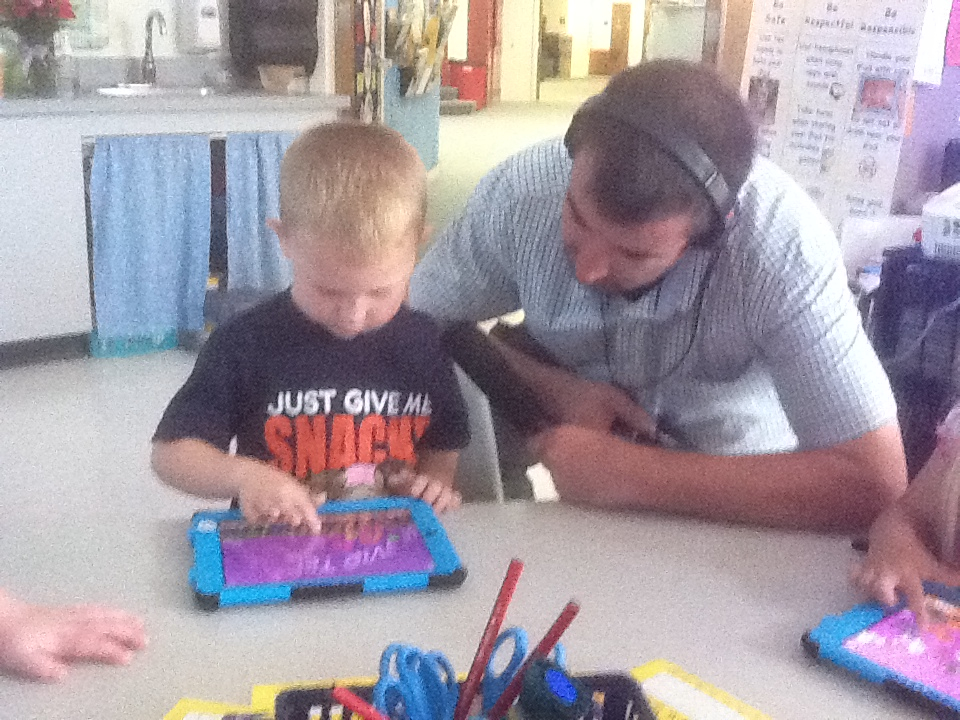
Half our kindergarten classrooms now have iPads for each of our kindergarten students, as part of Advantage 2014, our initiative to improve the literacy and math learning of our primary students. (Don’t worry, the other half of classrooms will get theirs after we’ve had a chance to collect some data and see if we we a making a difference or not.)

Kindergarten student being interviewed for the radio

And it’s not surprising that the press wasn’t far behind our roll out!

Want a glimpse (or two) into the program?

The Lewiston Sun Journal created this video.

CNN produced this segment.

And MPBN has broadcast this radio story. (Sorry iOS users. This one is in Flash)

And if you really want to learn more about what’s going on in Auburn with the iPads, consider sending a team to our conference this November: Leveraging Learning: the iPad in Primary Grades

Leadership for Change – Part 2 – A Model for Large-Scale School Change

In Leadership for Change – Part 1, I introduced the idea that large scale school change, change that really redefines the way things are done in school, requires careful attention to implementing the right components in a thoughtful way.

In this post, I’d like to introduce a model for large scale school change: the Lead4Change Model. It tries to make clear the desired outcome, the critical components, and the supporting but necessary componenets.

The overarching goal within the Lead4Change model is Learning. Although this may seem obvious, it is surprising how many times the goal of an initiative becomes (either officially or in practice) about some other aspect: about the technology involved, about a program, about an organizational structure, or about a new curricular resource. There is no doubt that these might be important pieces or contributors to the initiative, but in and of themselves, they are not sufficient reason to do any initiative. Why bother implementing anything within schools if it does not help to move the mission forward, to further the learning of young people? Keeping this key desired outcome in the forefront of their minds will help change leaders make the right decisions while working on each of the other components.

Probably the best evidence of Learning are the future accomplishments of students. Unfortuately, schools don’t have the decade or more it takes gather this evidence. We can fall back on more conventional measures, such as assessments, grades, or student work. Other secondary indicators can be equally as useful: attendance, behavior, engagement, and attitude.

There are two Critical Components to the Lead4Change model: Leadership and Teacher Practice. These are the most important components of the school change model and need the most careful attention. All other components of the model are there to help these two be effectively implemented.

As pointed out in the Part 1 post, leadership is everything when it comes to school change. This critical role doesn’t necessarily need to be played by the superintendent or the principal, but the pieces of the Leadership component need to be evident within the initiative. These include building a common vision, expectancy, supervision for level of implementation, policies and procedures, a safe environment, and that change is someone’s job.

Where Leadership creates the necessary conditions at the school or district level for implementing the change, the classroom is where the rubber meets the road. Teacher Practice is the second Critical Component of the Lead4Change model. It’s pieces include engaging teaching, classroom management and planning, and level of implementation.

There are five Supporting But Necessary Components within the Lead4Change model: Funding, Partnerships, Resource Management, Branding and Buzz, and PD for Paradigm Shift. Each of these is important to a well implemented initiative, one that successfully changes how schools work and therefore the amount of learning that takes place there. But it is important to remember that each of these five is in service to the Critical Components.

Making large-scale school change requires schools o think differently about funding. As a component of this model, Funding includes these pieces: seed money, “we’ll find a way” attitude, savings from avoided costs, and sustainable and integrated funding.

Partnerships are key to successfully implementing change initiatives. There are three types of partners that assist with this work: cheerleading partners, pedagogical partners, and implementation partners.

Resource Management is all about providing teachers and leaders with what they need to successfully implement the change. This component includes having what folks need when they need it, “we’ll find a way” support, and that “stuff just works.”

Public schools aren’t good at marketing. They have rarely had to do it in the past; the really prestigious private schools are much better at it. But in this era of competing for shrinking resources, and needing to make some fairly substantial changes, schools need to focus on Branding and Buzz. Branding and Buzz includes naming the initiative, stating your case, communicating with your community and beyond, telling your stories, presenting your evidence, and dealing with controversy.

Large-scale school change often includes having educators do things that are outside their experienced base and that they have never done themselves. That’s why large-scale school change involves paradigm shifting and why professional development needs to be different than the kinds of training schools are used to conducting. PD for Paradigm Shifting includes models, play-debrief-replay, coaching, just-in-time support, and building a human network.

So there it is, the Lead4Change model. Learning is the key desired outcome. Leadership and Teacher Practice are the critical components. And the Supporting But Necessary Components include Funding, Partnerships, Resource Management, Branding and Buzz, and PD for Paradigm Shift.

In the future, I’ll blog about these components and some of their pieces. But in the meantime, does this model make sense? Have I missed someone important? What are your thoughts?

Leadership for Change – Part 1

I was just starting my education career when the Nation at Risk report came out (Wikipedia provides a good overview – including a link to the full report). (Wow! Have I really been an educator that long!?) It was the report (or at least the first “modern” report) that warned that America’s schools weren’t doing the job they needed to to adequately prepare students, and seems to be the impetous for so many of the changes that schools have gone through in the last couple decades.

Since then, there has certainly been a variety of reasons named as to why we need schools to change. These include improving achievement, better preparing students for a future (or present!) that is significantly different from our past, increasing engagement and decreasing the number of dropouts, and being able to better compete in a global economy. And there have been quite a few approaches targeted at addressing these needs, such as increased accountability (testing and state and national standards), NCLB’s Highly Qualified Teachers, the introduction of computers and other new learning tools, and various pedagogies, such as curriculum integration, project-based learning, online learning, and massively customized learning.

Despite there being seemingly limited agreement on the why or how of school change (although there seem to be plenty of pundits for each – and that probably includes yours truly), there does at least seem to be consensus that schools need to change.

Over the years, I have come to believe several truths about educational change (and especially large scale school change).

Clearly, we only talk school change because we want something to be better than it has been. School Change Truth 1 is that successfully attaining those improvements hinges on making the right change, implemented consistently and with fidelity.

School Change Truth 2 is that human nature seems to abhor change. I don’t believe this one is about “bad teachers” trying to get out of something. I think we’re preprogramed to like a certain amount of routine and that making change goes against the grain. I’ve known really great people, including great teachers, who put twice as much energy into avoiding the change than it would have taken to simply make the change (ok, maybe not so simply…).

My third School Change Truth is that when people do accept change, it seems to be human nature that, if you arent careful, people will try to implement it in the way that is most like the ways they have always done things. For example, have you ever wondered why, with all the exciting capabilities and educational possibilities of technology, that interactive smart boards seem to be a favorite in schools? I can’t help but be reminded of the slightly tongue-in-cheek definition of “insanity”: doing the same thing over and over, but expecting different results.

School Change Truth #4 is that, large scale school change is significantly different than the kinds of changes that schools are used to. Schools are used to changing staff or administrators. Schools are used to changing which textbook series or curricular materials they use. And schools are used to changing the grade configuration of a building, or the configuration of the building itself and how teachers themselves are grouped and distributed throughout.

But these are really only just tweaks to a system that essentially allow the system to continue to work as it always has. Large scale school change requires really doing things differently. Because schools aren’t really that different than they were 150 years ago, “really doing things differently” means that most of the school’s educators haven’t experienced for themselves anything similar to the innovation. That means at the root of large scale school change is paradigm shifting, something that requires techniques quite different from the usual “how to” and informational trainings teachers are used to.

School Change Truth 5: For school change, leadership is everything. This was an initial lesson in the early days of MLTI (the Maine Learning Technology Initiative – the first statewide learning with laptops initiative). While working for a group that designed and implemented engaging school programs to motivate students, I learned the hard way that when the leadership was not in place (or was no longer in place), even the best programs couldn’t continue or move forward.

And my last School Change Truth is that leadership is what you do, not what job or position you have. So, as a corollary to School Change Truth #1, not only does the school have to implement the the right change with consistency and fidelity, but the school leader(s) needs to put the right components into place, thoughtfully and skillfully.

For quite some time, I’ve been thinging about a model for effective large scale school change, something that would help define what those key components were. It started back in the early days of MLTI, with a model I called “Doing 1to1 Right.” Since then, I’ve had the opportunity to evaluate 1to1 learning with laptop initiatives, and to collaborate in creating a career academy, a magnet school program, a non-traditional middle and high school, and a statewide virtual project-based program for at risk kids, and have realized that the model generalizes nicely (with some updates, modifications, and additions) to other kinds of large scale school change.

So, if you might be a school leader, and you really want to see the kinds of improvements that can only come about, not by tweaking the system, but through large scale school change, then you might want to subscribe to the RSS feed for this blog. In addition to writing about the projects I’m currently involved in, I want to think more and write more about leadership for school change. And I can’t wait to learn more about your views, and to have the kinds of conversations around leadership that can happen with social media.

In Part 2 of this post, I’ll outline the model.